Vertebral Column Anatomy & Bone Structure w/ Matching & Labeling (RAD 1101)
 Call Kai
 Learn
Learn Practice Test
 Spaced Repetition
 Match
Match Flashcards
 Knowt Play
1/257

There's no tags or description
Looks like no tags are added yet.
Name | Mastery | Learn | Test | Matching | Spaced | Call with Kai | Chat |
|---|
No analytics yet
Send a link to your students to track their progress
258 Terms
The vertebral column has 2 functions:
(1.) support (at the head) and (2.) protection (serves as attachment for ribs, heart, and lungs)
The vertebral column occupies the
midportion of the ___________ _____, the posterior portion of the _______, ________ and _______.
posterior neck, thorax, and abdomen & pelvis

How many bones and what type of bones compose the vertebral column?
33 irregular shaped bones
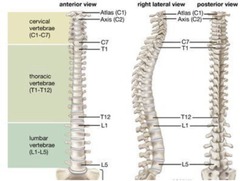
The 33 vertebrae are separated into _____ true vertebrae meaning they are not fused together
24

The 33 vertebrae are separated into _____ false vertebrae meaning they are fused together
9

The ______ and ______ are a part of the false vertebrae
sacrum and coccyx

The cervical vertebrae has ____ vertebra
7
The cervical vertebrae is located in the _______
neck

The thoracic vertebrae has ____ vertebrae
12
The thoracic vertebrae is located in the _______
posterior chest

The lumbar vertebrae has ____ vertebrae
5
The lumbar vertebrae is located in the _________
lower posterior back

The sacrum vertebrae has ____ vertebrae
5 fused
The sacrum vertebrae is located in the ________
pelvis
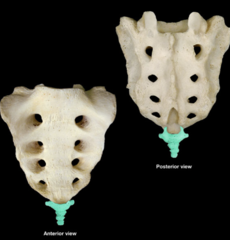
The coccyx vertebrae has ____ vertebrae
4 fused
The coccyx vertebrae is located in the _________
pelvis
kyphotic curve
posterior curve (concave)

lordotic curve
anterior curve (convex)

At birth, the vertebral column has only 2 curves. What type of curve is it and where are they located at?
both kyphotic curves; at the thoracic and pelvic
The __________ lordotic curve begins to form when a child lifts its head
cervical
The __________ lordotic curve begins to form when a child learns to walk
lumbar

An adult has 4 curves when viewed from the lateral aspect. The lordotic curve is at the _______ and ________.
cervical and lumbar
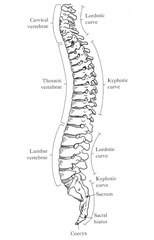
An adult has 4 curves when viewed from the lateral aspect. The kyphotic curve is at the _______ and ________.
thoracic and sacrum-coccyx
Structures Of A Typical Vertebrae

Lateral View of A Typical Vertebrae

body (anterior portion)
block shape of the anterior aspect that increases in size as you go down the vertebral column and supports the weight of the vertebrae above it

pedicle
part of the vertebral arch that is posterior to body of the vertebrae on the lateral aspect

lamina
part of the vertebral arch that is posterior to the pedicle and unites in midline to complete the arch/foramen
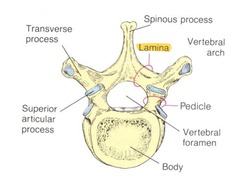
vertebral notches
curved areas on superior and inferior surface of the pedicle helps to form the interverbal foramen

spinous processes
sharp pointed process that projects posteriorly and extends from junction of lamina in midline and is the only process that is palpable

transverse processes (2)
extending laterally at junction of pedicle and lamina (goes across)

superior articular processes (2)
extend upward at the junction of pedicle and lamina

inferior articular processes (2)
extend downward at the junction of pedicle and lamina

vertebral foramen
opening is posterior to the body and formed by pedicle, lamina, and the body and is used to transmit and protect the spinal cord

intervertebral foramen
formed by vertebral notches of pedicles between vertebrae and transmits spinal nerves

zygapophyseal joint (apophyseal or interarticular joints)
formed by the articulation between the superior and inferior articulating processes

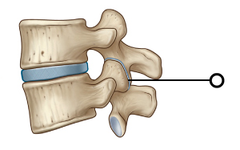
What type of joint is the zygapophyseal joints (apophyseal or interarticular joints)?
diarthrodial joint (gliding)
intervertebral joint
located between the bodies of the vertebrae acting as cushions between each one

articular cartilage
part of the intervertebral joint as a layer of cartilage that covers the surface of the upper and lower vertebral body
intervertebral disk
part of the intervertebral joint consisting of the annulus fibrosis and nucleus pulposus

annulus fibrosis
part of the intervertebral disk as a layer of fibrous tissue and cartilage that forms a pad between the vertebral bodies

nucleus pulposus
center of the annulus fibrosis that is soft pulpy, highly elastic substance

Motion in the spine is somewhat limited between the vertebrae known as an _____________ joint
ampiarthrodial
What motion is the complete spine capable of?
rotation, flexion, and extension

The complete spine is a _________ joint
diarthrodial
Cervical Vertebrae
lordotic or anterior curve and greatest flexion
The cervical vertebra has ____ vertebrae
7
C-2 through C-6
bifid spinous process
bifid spinous process
the split in the back of the process of C-2 through C-6
C-1 through C-7
transverse foramina
transverse foramina
transmit the vertebral artery to the brain of C-1 through C-7
C-1
very first bone in the vertebral column is the circle of bone
C-1 is also known as the _________
atlas
C-1 contains/composed of:
- lateral mass (2)
- arch (2)
- transverse processes (2)
- articulating processes (4)
- tubercle (2)
- transverse foramina (2)
- no body or spinous process
lateral mass of C-1 (2)
on each side (right and left) of the arch under the superior articulating process
arch of C-1 (2)
anterior and posterior
anterior arch of C-1
narrow arch for placement of the odoentoid process
posterior arch of C-1
large arch for spinal cord to go through
transverse processes of C-1 (2)
on each side
articulating processes of C-1 (4)
2 inferior and 2 superior
tubercle of C-1 (2)
posterior and anterior
There is NO __________ or ___________ of the C-1 (atlas)
body or spinous process
TRUE/FALSE: The atlas has a body and spinous process in its bone structure
false
What acts as the body for C-1?
C-2 (axis)
C-1 joints include:
- atlantoocipital joint
- atlantaoaxial or atlantoepistropheal joint
atlantoocipital joint
helps flexion and extension (bending head back and forth)
atlantaoaxial or atlantoepistropheal joint
helps side to side rotation of the head
C-2
forms body of C-1
Another name for C-2 is ________ ( __________ or ____________)
axis or epistropheus or axial
odontoid process (dens)
apart of C-2 that are the "tooth"-like projects superiorly and fits into the anterior arch of C-1
Another name for odontoid process is ________
dens
C-7
prominent to spinous process and can be palpated
Another name for C-7 is _____
vertebral prominens
cervical rib
apart of C-7 that is the transverse process that continues to grow anteriorly and sometimes attaches to the sternum
Thoracic Vertebrae
kyphotic or posterior curve (concave)
The thoracic vertebra has ____ vertebrae
12
The thoracic vertebra contains/is composed of:
- facets on body of vertebrae
- facets on transverse processes
- spinous processes
facets on body of vertebrae
on each side of the body that articulates with the head of the rib
facets on transverse processes
on each side that articulates with tubercles of ribs (only T1-T10)
spinous processes of the thoracic vertebrae
point/project inferiorly and are long
Thoracic vertebrae joints include:
- costalvertebral joint
- costaltransverse joint
costalvertebral joint
towards front
costaltransverse joint
towards back
Lumbar Vertebrae
lordotic or anterior curve that is the weightbearing bone of the spine
The lumbar vertebrae are __________ bones
weightbearing
The lumbar vertebra has ____ vertebrae
5
The lumbar vertebrae is the _________ of the true vertebrae
largest
There is NO ________ or __________ of the lumbar vertebrae
facets or transverse foramina
Sacrum
located in the pelvic region
The sacrum has ____ ______ vertebrae which is one solid bone
5 fused
The 24 other vertebrae _________ on the sacrum
rest
The sacrum is _________ shaped
triangular
base of sacrum
broader part at the top
apex of sacrum
peak part at the bottom
The sacrum consists/is composed of:
- sacral promontory
- superior articular process
- body
- lateral masses
- ala
- 16 sacral foramina
- sacral canal
- sacral crest
- cornu
sacral promontory
prominent anterior edge of the body of the SI
superior articular process of sacrum
articulates with L5
body of sacrum
main portion of 5 fused bodies in midline
lateral masses of sacrum
fused transverse processes lateral to the foramina
ala of sacrum
upper wing-like portion of lateral masses