Chem- Structure and fucntional groups
 Call Kai
 Learn
 Practice Test
 Spaced Repetition
 Match
 Flashcards
 Knowt Play
1/42

There's no tags or description
Looks like no tags are added yet.
43 Terms
what is the lewis dot and lewis structure
Forms of atom representation aimed at displaying the position of electron around molecules and in bonds that are better for smaller molecules
Dot: shows every electron as dots and the atom symbol
Lewis structure: doesn’t show electrons that aren’t in bonds and display bonds as lines in between 2 symbols
What is a the partially condensed and condensed structure
Partially condensed: show only some bonds between atoms that aren’t hydrogen and often utilises the VSEPR theory of bind angles
Condensed: No bonds are shown and instead symbol are written in the order they appear in the molecules
if in brackets then they appear as a chain attached to previous carbon
what are skeletal structures and their rules
Displays only the bonds between molecules, apart from hydrogen bonds in zigzag formation to comply with VSPR theory
end of the point where two line connect is a carbon
the lines are bonds
we imagine where the hydrogen are based on how many binds a carbon has
any other molecule apart from C and H need to be specified
what is an ionic bond
A polar bond between and metal and a non-metal with different electronegativity at which an electron is completely transferred from one molecule to a more electronegative molecule
Water-soluble due to the charge of the molecule attracting the charges in water
groups 1-2 with groups 14-17
what is a covalent bond
A non-polar bond between 2 non-metals with little to no electronegativity difference that involves the sharing of electrons through a bond
Strong covalent bonds are called sigma bonds
Group 4-7 atoms
when polar due to electronegativity difference, creating a dipole in which the more electronegative molecule attracts the eletrons closer to itself in the bond
what is an alkane and how do you name it
Aka a saturated hydrocarbon, which is an organic molecule consisting of covalently bound chains of carbon and hydrogen
named using numbered-based names + any functional groups ( make sure to find longest chain to use as base name)
non-polar when no functional groups, making it not water-soluble and less dense than water
held by only dispersion forces, so has very low b.p. that increases as mass increases
What are the intermolecular forces
Intermolecular forces are the forces between atoms that hold them together and will effect their bp/m.p
dispersion/london forces are the weakest and are found between non-polar molecules
Dipole-dipole forces are found in molecules with dipoles due to electronegativity differences
Hydrogen bonds: stronger bonds between H and O, N, S
Ion-dipole bonds are the strongest
what are functional groups
The parts of a molecule that are not the alkane and are responsible for the molecule’s chemical properties and ability to bind to receptors/enzymes in the body
site of reactions
all of them are polar but some more than others depedning onf electronegativity differences
Polarity and solubility/ b.p
the more polar something is the higher the boiling poitn are the more water soluble it is
how can polarity of a molecule be determined
The more polar functional groups, the more polar the molecule ( polar = contains N or O)
The more polar the are the more H-bond opportunities the molecules have
the shorter the alkly group the more polar the molecule as the non-polarity of the alkly portion overide the polarity of the functional groups
salts are the most polar molecules due to ionic bonds and their charge
what are the types of h-bonds
H-bond donors: functional groups that can donate H+ to electron donors and take the form of O-H or N-H
H-bond acceptors: functional groups with lone electrons that can bind to the H of H-bond donors due to its negative charge
Carboxylic acids have 2 of each type and can bind together to create a dimer that doubles its b.p
what are the rules for wheter or not a molecule in water soluble
Hydrogen bonds must be available to form between molecules
Molecules with 4 or more carbons are generally not water-soluble,
Salts with ionic bonds are able to solubilise very large molecules due to the attraction between the ionic charges and polar water
non-polar molecules are never water soluble
How can you determine the presence of functional groups
Functional groups give drugs their specific properties, meaning we can use them to determine which drug is which by:
colour testing: reacting drugs with different reagents, which will produce colours depending on the presence of functional groups
thin layer chromatography: seperating compounds based on their polarity, which can be used to compare and identify or determine purity
what is the process of thin layer chromatography
Draw a pencil line 1cm from the bottom of the plate stationary phase plate, and dot the line with solution
Place it into a developing chamber of a less/non-polar substance, aka the mobile phase, that will absorb into the plate and travel up it
Put a lid on the chamber and remove it only when the solvent is about 1cm from the top
Take it out and quickly draw line where the solvent stopped
How to interpret resulst of thin layer chromatography
The furthest molecule is the least polar and has interacted less with the polar stationary phase and more with the less polar mobile phase
The molecule that moved the least is the most polar, as it has interacted more with the polar stationary phase
a more polar solvent causes thing to move faster/ further and have high rf
to quantify movement and compared calculate the retention factor by dividing the distance travelled by the spot by the distance travelled by the solvent
what is an unstaurated Hydrocarbon and how to name them
Hydrocarbons are no longer saturated when the 4 possible bonds of a carbon are replaced by something other than hydrogen
One way this can happen is through double bonds (alkene) or triple bonds (alkyne)
Count the number of carbons in the longest chain starting from the side closest to the unsaturated hydrocarbon and add ene or yne to with the number of the closest carbon in front
How to determine hybridisation of a molecule
sp3- molecule with all single bonds (in hydrocarbons, the molecule will be tetrahedral)
sp2- molecules with double bonds ( in hydrocarbons, the molecule will be trigonal planar) -
sp - molecules with triple bonds or two double binds (linear hydrocarbons)
how are some bonds flexible
Single bonds between carbon are flexible, allowing two tetrahedral molecules to change conformations depending on what is most stable
allows molecules to change conformation to bind
double bonds are not flexible
how to draw sawhorse projection
The sawhorse molecule displays tetrahedral molecules bound together in a 3D space and can show how they rotate along their connecting bond

what are the 3 forms of newman projection
The less stable molecules require lots of energy to remain in shape, making them less likely to form
Staggered: maximum distance between all molecules, creating the least steric hindrance via electron repulsion, making it the most stable
Eclipsed: minimum distance between all molecules, at which each carbon’s substituents are eclipsed over one another, creating lots of steric strain
Gauche: middle of the line where some electron-dense groups are placed near one another in a staggered formation, making the molecule slightly unstable but not as much at eclispsed
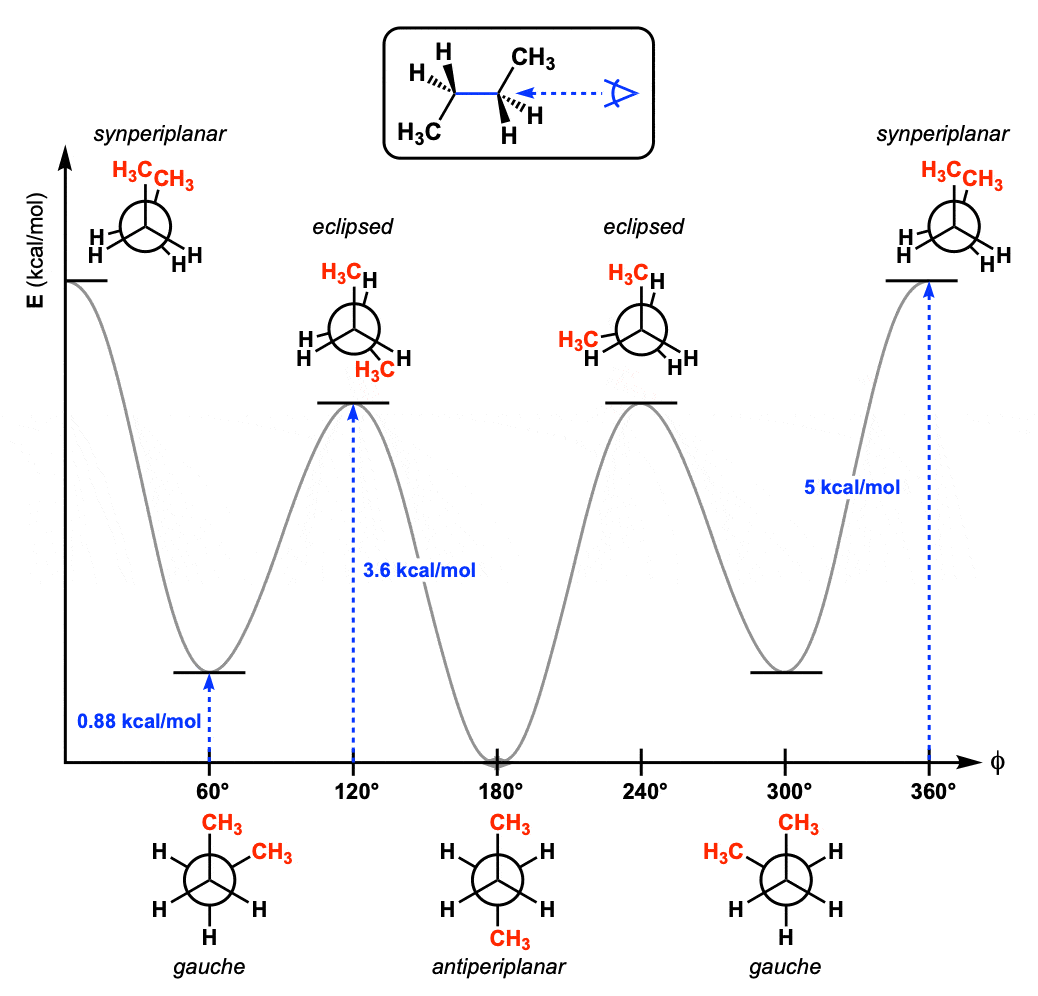
hoe does steric strain effect molecule structure
Due to steric strain, the molecule will prefer a linear structure, as it places the molecule's atoms as far away as possible, unlike in a cyclic molecule
are why the hydrophobic tail on the membrane stays straight and doesn’t interact with water, as doing so would ruin their most stable structure
how to draw newman projection
When counting the carbon with the lowest number in your given bond, the front molecule is the one with the lowest number, and the highest number is the back
First, draw the front molecule as trigonal planar, replacing the C in the middle with a dot
Draw a circle within the molecule so that the bond line of the front molecule sticks out
draw like stick out of the circle in space between the front molecules line ( when doing eclipse lines must by to the left of the front molecule)
put all the molecules attached to the back carbon on those lines in whatever formation is needed

how does bond twisting effect pepetides
The rotation along the single bond allows the peptide to twsit and form different protein structures
they also twist and are controlled by the effects of steric strain
what is the order of priority for counting carbons
Functional groups
alkene/ynes
substituents (alkyl groups and halides)
what is a haloalkane
aka an alkyl halide is a halogen attached to a hydrocarbon
are readily converted to other molecules through substitution reactions
name them by adding a particular name to the starting in alphabetical order in alkyl groups ( bromo, chloro, fluro, iodo)
what is a hydroxyl group
aka an alchol in a OH molecule on a hydrcarbon that increase the m.p/b.p of that molecule and can make something water soluble
name by adding -ol to the end of the name plus the number of the carbon it is attached to
what is an alkyl gorup
A hydrocarbon branch off of the longer hydrocarbon
when counting the longest chain, this in the CH branch that is left over
can’t have alkene/yne or functional groups
named by counting the carbons in the branch, adding -yl to the base name and maybe di or tri if multiple
if more than 1 kind, add alphabetically
how to name hydrocarbons with functional groups
Count the number of carbons in the longest chain starting at the end according to the prioroity list
determine if any functional groups, branches, halogen or alkene/yne
add names onto the base with the given rules making sure to at the number of the carbon they are attached to
what are the different form of substituents isomers
when the carbon attaches the branch to the main chain in attached to
1 carbon = normal naming
1 carbon attached to 2 others = add iso in front or -yl name
2 carbons = add sec in front of -yl name
3 carbons = add tert in front of -yl name
what are the differnt sustitutions of Carbons
methyl carbon (1°) 1 carbon with only hydrogen
primary carbon (1°) C attached to 1 C and 3 H
secoundary Carbon (2°) 2 C and 2 H
tertiary Crabon (3°) 3 C and 1 H
quatenary Carbon (4°) 4 C and 0 H
how does subsitution work for akly halides and alcohols
works the same as with the number of carbon except it doesn’t go past tertiary as the alcohol / halogen takes up 1 bond
what is an ether
an O between two alkane chains using in glycosidic linkage to make disaccharides
count number of carbon on each cahin and add their -yl name in front of ether ( if same number add di)
only dipole-dipole, so b.p/m.p is low
what is a carbonyl group
A group in functional groups that is a carbon double-bonded to an O
in a ketone, aldehyde, Carboxylic acid and ester
what is an aldehyde
a C double-bonded to an O at the end of a chain
add -al to the end of name plus number if other functional gorup otherwise always assumed to be at the start
what is a ketone
a C double-bonded to an O in the middle of a chain
and -one to the end, plus number of C attachments
what is a carboxylic acid
A C double-bonded to an O and single-bonded to an OH at the end of a chain
have higher b.p when hydrogen-bonded together as they form dimers
add a carboxylic acid to the end plus a number if other functional groups
what is an ester
A C double-bonded to an O and single-bonded to another O that is attached to another carbon chain
chain with double bond is base name, and the extra is an -yl group
add- oate to the base name plus the number of attachments
what is an amide
a C double-bonded to an O and single-bonded to an NH2 using to link together proteins
add amide to the end of the base name
if NH is attached to another chain, add as an -yl group, but use N- instead of a number to show it's attached to a nitrogen
how does resonanace effect amides
The double bond of O can move to the nitrogen as well through resonance, allowing for the creation of beta sheets in proteins
A carbon bonded between two amides can then rotate to create helices
what are amines
an amide without the carbonyl group found in a lot of foods or used to break down proteins
add amnie to the end if only functional group
add amino if multiple + number
id substituented add di —— yl if symmetrical and use the ester rules if not
amine substitution
Carbon is slowly added to the nitrogen molecule and replace the H
primary to quaternary, with quaternary having a positive charge N
what are the sulfur containing functional groups
Thiol: SH bound to C used in cysteine and to form disulphide bonds
Sulfide: a S betwen two carbon chains and the product of a disulphide bond
what are the phosphurus containing functional groups
the energy carriers AMP, ADP and ATP