Forgetting: retrieval failure
 Call Kai
 Learn
Learn Practice Test
 Spaced Repetition
 Match
Match Flashcards
 Knowt Play
1/26

There's no tags or description
Looks like no tags are added yet.
Name | Mastery | Learn | Test | Matching | Spaced | Call with Kai | Chat |
|---|
No analytics yet
Send a link to your students to track their progress
27 Terms
What is retrieval failure?
a form of forgetting - when we don’t have the necessary cues to access a memory. The memory is available but not accessible unless a suitable cue is provided
What is a cue?
a ‘trigger’ of information that allows us to access a memory. Cues may be meaningful or may be indirectly linked by being coded at the time of learning
Who proposed the Encoding Specificity Principle?
Tulving
What does the Encoding Specificity Principle state?
Memory is best when the cue used at retrieval was present at encoding
Memory is best when the cue used at retrieval was present at encoding
When cues available at retrieval do not match the cues present when the memory was formed
What is context-dependent forgetting?
external cues regarding the environment i.e weather, location
What is state-dependent forgetting?
internal cues regarding the physiology of the body i.e alcohol, mood
Example of context-dependent forgetting
Forgetting something learned in a classroom when tested in a different room
Example of state-dependent forgetting
Forgetting something learned when calm if later anxious
Who conducted the diver study on context-dependent forgetting?
Godden & Baddeley (1975)
What was the aim of Godden and Baddeley’s study?
to investigate whether training delivered on land influenced the work of scuba-divers when working underwater
What was the method of Godden and Baddeley’s study?
divers were asked to learn a list of words either on land or underwater and then asked to recall the words either on land or underwater. This created four conditions:
Learn on land – recall on land
Learn on land – recall underwater
Learn underwater – recall underwater
Learn underwater – recall on land
What were the results of Godden and Baddeley’s study?
recall was much higher when the external cues matched (land and land and beach and beach)
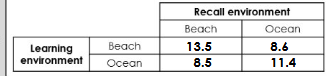
What was concluded from Godden and Baddeley’s study?
external cues are important in recall and should be present at both learning and recall of information
Who conducted the antihistamine study on state-dependent forgetting?
Carter & Cassaday (1998)
What was the aim of Carter & Cassaday’s study?
to investigate whether the state at learning and the state at recall influences recall
What was the method used in Carter & Cassaday’s study?
24 ppts (aged 18-21, undergraduates) were asked to learn a listof words either under the influence of an antihistamine (mild sedative) or not then recall the words under the influence of the drug or not. Any ppts in the ‘no drug’ conditions were given a placebo (vitamin c). The 4 groups were:
Learn on AH – recall on AH
Learn on AH – recall on Vit c
Learn on Vit c – recall on AH
Learn on Vit c – recall on Vit c
What were the results of Carter & Cassaday’s study?
in the mismatch conditions, recall was far worse than ppts in the matched conditions
What was concluded from Carter & Cassaday’s study?
internal cues are important in recall and should be present at both learning and recall of information
How is the fact that retrieval failure can be used in real life situations, and so has real-life application a strength? (+counter/development)
as this RLA can help to ensure that people are brought to justice and it will benefit society overall
C: however, a weakness is that context reinstatement doesn’t always work
Give an example of this strength
for example, context reinstatement is a psychological technique used to enhance memory retrieval. Context reinstatement can be used in crime to jog the memory of a witness and ensure mostly accurate recall as the cues at the encoding of the memory match the cues at recall.
How is the fact that that research that was conducted to support retrieval failure consisted of a sample size that was unrepresentative of the target population a weakness?
as both of the research lacks population validity. Due to the small and specific samples used, the results can’t be generalised to the target population as the ppts are unrepresentative
Give an example of this weakness
for instance, Godden and Baddeley’s sample size consisted of only 16 ppts who ere all divers and Carter and Cassaday’s sample size was small as many ppts were excluded from medical screening
How is the fact that there are issues with both of the pieces of research that support retrieval failure a disadvantage of it? (+counter/development)
a weakness of Baddeley and Godden’s experiment is that they had limited control over confounding and extraneous variables, whilst a weakness of Carter and Cassaday’s experiment is that it has a low ecological validity, and so presents the issue of demand characteristics. This is a weakness of retrieval failure overall as it means that it is invalid, seeing as the research it relies on has flaws
C: on the other hand, it could be argued that the types of experiments used are good as Godden and Baddeley’s field experiment has high mundane realism and Carter and Cassaday’s lab experiment is standardised and has more control
Give an example of this disadvantage
for example, Godden and Baddeley conducted their research as a field experiment and Carter and Cassaday used lab experiments
A limitation of retrieval failure is that context-dependent forgetting depends on the type of memory being tested. How is this a limitation?
this suggests that retrieval failure is a limited explanation for forgetting because it only applies when a person has to recall information rather than recognise it
Give an example of this limitation
for instance, Godden and Baddeley replicated their underwater experiment but used a recognition test instead of recall - ppts has to say whether they recognised a word read to them from a list instead of retrieving it. When recognition was tested, the divers performed the same across all conditions