Block 1: Lecture 12: Scale up chemistry - API from mg to kg
 Call Kai
 Learn
Learn Practice Test
 Spaced Repetition
 Match
Match Flashcards
 Knowt Play
1/18

There's no tags or description
Looks like no tags are added yet.
Name | Mastery | Learn | Test | Matching | Spaced | Call with Kai | Chat |
|---|
No analytics yet
Send a link to your students to track their progress
19 Terms
What are the characteristics of the scale-up and process development of an API?
Differences from small scale synthesis
Synthesis planning
Working with outsourcing partner
GMP
Safety
What are the process (R&D) requirments?
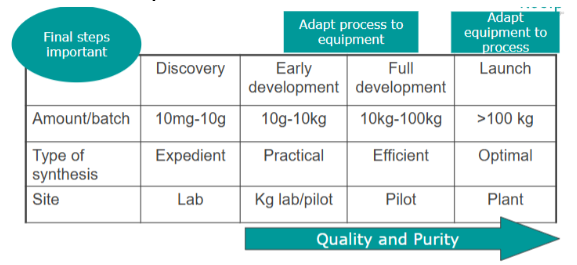
What do we need to know about the process of an API?
Reproducible process on scale
Available starting materials at an acceptable cost
Patent or other regulations
Identification of critical reaction parameters
Understanding their effect on yield and quality
Process safety
Is a change of synthetic route required for safety reasons?
Unit operations suitable for pilot plant
What are 7 differences between lab and pilot plant?
Working on scale takes time
1 hour in the lab = several hours in the pilot plant
Some unit operations are more difficult on scale and/or are not commonly used.
Rotary evaporation/ distillation to dryness
Purification by chromatography
Rapid transfers
Keeping temperature very low
Drying with Na2SO4
Filtration
Mud takes time to filtrate
Alternative solutions to ordinary suction filtration: pressure filter, filter dryer, centrifuge
Keep dilution low
You can’t see what is in the reactor
How do the crystals grow?
If you can’t see the phase separation in a separating funnel, it’s even harder through a sight glass.
Safety
A small exotherm on lab-scale can be magnified to a large exotherm in the plant.
It is dangerous to make additions in one, quick shot.
Flammable solvents
Static electricity
Impact on environment
How do you select a synthetic route?
Few steps
Minimize protecting groups
Order of synthetic steps
Convergent synthesis
Telescoping
Available starting materials
Suitable solvents (avoid diethyl ether, hexane, chlorinated solvents)
Keep waste streams low

Which critical process parameters should be identified in optimisation?
Temperature, pH, stoichiometric ratio, addition rate, mixing efficiency, reaction time, concentration, crystallisation conditions…
What happens when optimisation is done at a too early stage?
It will just lead to waste
What are the differences between an initial sythetic route and a pilot plant route?

What are common scale-up challenges?
Poor mixing
Heat transfer limitations
Difficult filtration
Different crystal morphology
Unexpected impurity formation
Equipment limitations
Longer cycle times
What are the 4 steps in selecting an outsourcing partner?
Should be appropriate for the phase of development
Early development: innovative and strong technical capability
Later development: optimization, routine manufacturing
Specific processing and equipment capabilities?
One- stop-shop: minimise the number of technical transfers in the future?
Location
How do you work with an outsourcing partner?
Frequent meetings (face to face, Teams)
Written updates
Reports
Go and visit!
Start in time!
What is an API?
An “API Starting Material” is a raw material or intermediate that is used in the production of an API and that is incorporated as a significant structural fragment into the structure of the API.
What should be applied after API?
From this point on, appropriate GMP should be applied:
Number of synthetic steps
Good control strategy (specifications, IPC)
Good manufacturinbg practice (GMP)
Suitable manufacturing facilities
Written instructions (SOP standard operation procedures)
Written batch protocol
Records are made during manufacture: demonstrate that all steps have been performed
Trained staff
Controlled raw materials
Traceability
Cross contamination should be prevented
GMP is not only documentation. It is a system that ensures product quality, patient safety and process consistency.
Who is responsible for the API/GMP?
You as a sponsor is responsible for the quality
Contract manufacturers (including laboratories) should be evaluated by the contract giver to ensure GMP compliance of the specific operations occurring at the contract sites.
Audits, questionnaire
Regardless of where the active pharmaceutical ingredient is made, companies must adhere to strict safety and quality standards set by the country where it will be used.
What are 3 characteristics of cleaning an API?
In pilot plant production cleaning and control of cleanliness is time consuming.
Cleaning may sometimes need as much documentation as the chemical process.
Extremely important that the cleaning is done and verified properly as cross contamination between different API’s is a disaster.
How is safety monitored in a pilot plant?
Reagents
Stability and toxicity
Process
Stability and toxicity of intermediates
Control of exotherms
Control of gas formation
Concern and control of static discharge
Flammable materials (If exotherms are in a gaseous environment they can be under pressure.)
DSC
Differential Scanning Calorimeter
What are 4 possible safety evaluations?
Lab scale observations
Literature and calculations
DSC (Differential Scanning Calorimeter): when you start to raise the temperature, there is no going back.
Peak = mountain energy that is removed in order to keep the temperature constant
Reaction calorimeter