ACCT 1130 Exam 3 Study Guide
 Call Kai
 Learn
 Practice Test
 Spaced Repetition
 Match
 Flashcards
 Knowt Play
1/105

Earn XP
Description and Tags
Contains Chapters 6, 7, and 8
106 Terms
Internal control system
Managers use an ___________ to monitor and control business activities. An __________ is policies and procedures used to
o Protect assets.
o Ensure reliable accounting.
o Promote efficient operations.
o Uphold company policies.
Sarbanes-Oxley Act (SOX)
___________ requires managers and auditors of companies whose stock is traded on an exchange (called public companies) to document and verify internal controls. Following are some of the requirements.
o The company must have effective internal controls.
o Auditors must evaluate internal controls.
o Violators receive harsh penalties—up to 25 years in prison with fines.
o Auditors’ work is overseen by the Public Company Accounting Oversight Board (PCAOB).
Committee of Sponsoring Organizations (COSO)
____________ lists five ingredients of internal control that add to the quality of accounting information.
o Control environment—company structure, ethics, and integrity for internal control.
o Risk assessment—identify, analyze, and manage risk factors.
o Control activities—policies and procedures to reduce risk of loss.
o Information & communication—reports to internal and external parties.
o Monitoring—regular review of internal control effectiveness.
Principles of internal control
Internal control varies from company to company, but internal control principles apply to all companies. We discuss seven __________.
o Establish Responsibilities
o Maintain Adequate Records
o Insure Assets and Bond Key Employees
o Separate Recordkeeping from Custody of Assets
o Divide Responsibility for Related Transactions
o Apply Technological Controls
o Perform Regular and Independent Reviews
Robotic process automation (RPA)
Technologies such as _________ are used by accountants to automate a wide range of repetitive tasks.
Liquidity
_________ refers to a company’s ability to pay for its current liabilities.
Liquid assets
Cash and similar assets are called __________ because they can be readily used to pay for liabilities.
Cash
__________ includes currency, coins, and deposits in bank accounts. _________ also includes items that can be deposited in these accounts such as customer checks, cashier’s checks, certified checks, and money orders.
Cash equivalents
___________ are short-term, highly liquid investment assets meeting two criteria: (1) readily convertible to a known cash amount and (2) close enough to their due date so that their market value will not greatly change.
Cash Over and Short
This difference is reported in the __________ account, also called Cash Short and Over, which is an income statement account recording the income effects of cash overages and cash shortages.
Accounts | Debit | Credit |
Cash | 555 | |
——??? | 5 | |
——Sales | 550 |
Accounts | Debit | Credit |
Cash | 550 | |
??? | 5 | |
——Sales | 555 |
Voucher system
A(n) __________ is a set of procedures and approvals designed to control cash payments and the acceptance of liabilities that consist of
o Verifying, approving, and recording liabilities for cash payment.
o Issuing checks for payment of verified, approved, and recorded liabilities.
Voucher
A(n) ________, which is an internal document (or file) used to collect information to control cash payments and to ensure that a transaction is properly recorded.

Enterprise resource planning (ERP)
Many companies use a(n) __________ system to streamline electronic cash receipts and payments. A(n) __________ system helps automate and manage accounting and other processes within an organization.
Petty cash
To avoid writing checks for small amounts, a company sets up a(n) __________ system. _________ payments are small payments for items such as shipping fees, minor repairs, and low-cost supplies.
Setting up petty fund
This entry represents:
Accounts | Debit | Credit |
Petty Cash | 25 | |
——Cash | 25 |
Establish a petty cash fund.
Reimburse petty fund
This entry represents:
Accounts | Debit | Credit |
Parking Expense | 15 | |
Printing Expense | 4 | |
Posting Expense | 5 | |
Janitorial Expense | 47 | |
——Cash | 71 |
Reimburse petty cash
Increase petty fund
This entry represents:
Accounts | Debit | Credit |
Petty Cash | 25 | |
——Cash | 25 |
Increase petty fund from $75 to $100
Decrease petty fund
This entry represents:
Accounts | Debit | Credit |
Cash | 25 | |
——Petty Cash | 25 |
Decrease petty fund from $75 to $50
Signature card
Persons authorized to write checks on the account must sign a(n) ___________, which the bank uses to verify signatures.
Deposit ticket
Each bank deposit has a(n) __________, which lists items such as currency, coins, and checks deposited along with amounts. The bank gives the customer a receipt as proof of the deposit.
Check
To withdraw money, the depositor can use a(n) ________, which is a document telling the bank to pay a specified amount to a designated recipient. A(n) _________ involves three parties: a maker who signs the ________, a payee who is the recipient, and a bank (or payer) on which the ________is drawn.
Electronic funds transfer (EFT)
___________ is the electronic transfer of cash from one party to another. Companies are increasingly using _________ because of its convenience and low cost.
Bank statement
The bank prepares a(n) __________ showing the account activity. Different banks use different formats for their __________, but all of them include the following.
o Beginning-of-period account balance.
o Withdrawals and other decreases to the account during the period.
o Deposits and other increases to the account during the period.
o End-of-period account balance.
Canceled checks
__________ are checks the bank has paid and deducted from the customer’s account. We say such checks have cleared the bank.
Bank reconciliation
To do this, we prepare a(n) __________ to explain differences between the checking account balance in the depositor’s records and the balance on the bank statement.
Deposits in transit
__________ are deposits made and recorded in the depositor’s books but not yet listed on the bank statement. For example, companies can make deposits (in the night depository) after the bank is closed.
Outstanding checks
___________ are checks written by the depositor, subtracted from the depositor’s books, and sent to the payees but not yet turned into the bank for payment by the bank statement date.
Bank Reconciliation
What is this picture showing?

Collection of Note
This entry represents:
Accounts | Debit | Credit |
Cash | 500 | |
——Notes Receivable | 500 |
Record note collected by bank
Interest Earned
This entry represents:
Accounts | Debit | Credit |
Cash | 10 | |
——Interest Revenue | 10 |
Record interest earned in checking account
Check printing
This entry represents:
Accounts | Debit | Credit |
Miscellaneous Expenses | 20 | |
——Cash | 20 |
Check printing charge
NSF Check
This entry represents:
Accounts | Debit | Credit |
Account Receivable - Tommy | 30 | |
——Cash | 30 |
Charge Tommy’s account for $30 NSF check
Days’ sales uncollected
One measure of how quickly a company can convert its accounts receivable into cash is the __________, also called days’ sales in receivables. We use ___________ to estimate how much time is likely to pass before the current amount of accounts receivable is received in cash. It is used to determine if cash is being collected quickly enough to pay upcoming obligations.
Days’ sales uncollected
This formula is for:
??? = NetSalesAccountsReceivable⋅365
Purchase requisition
Instead, a department manager must inform the purchasing department of its needs by preparing and signing a(n) ____________, which lists the merchandise requested to be purchased.

Purchase order
A(n) __________ is a document the purchasing department uses to place an order with a vendor (seller or supplier). A(n) _________ authorizes a vendor to ship merchandise at the stated price and terms.

Invoice
A(n) _________ is an itemized statement of goods prepared by the vendor listing the customer’s name, items sold, sales prices, and terms of sale. A(n) _________ is also a bill sent to the buyer from the supplier. From the vendor’s point of view, it is a sales invoice. The buyer, or vendee, treats it as a purchase invoice.
Receiving Report
It then prepares four or more copies of a(n) __________, which is used within the company to notify that ordered goods have been received and to describe the quantities and condition of the goods.
Invoice approval
To verify this information and to ensure that no step is missing, it often uses a(n) __________, also called check authorization. A(n) ___________ is a checklist of steps necessary for approving an invoice for recording and payment.
o Requisition check: Items on invoice are requested per purchase requisition.
o Purchase order check: Items on invoice are ordered per purchase order.
o Receiving report check: Items on invoice are received per receiving report.
o Invoice check: Price: Invoice prices are as agreed with the vendor.
§ Calculations: Invoice has no mathematical errors.
§ Terms: Terms are as agreed with the vendor.

Voucher register
After a voucher is approved and recorded (in a journal called a(n) __________), it is filed by its due date.
Check register
A check is then sent on the payment date from the cashier, the voucher is marked “paid,” and the voucher is sent to the accounting department and recorded (in a journal called the __________).
Receivable
A(n) ________ is an amount due from another party. The two most common __________s are accounts _______ and notes _________.
Accounts receivable
___________ are amounts due from customers for credit sales.
Account Receivable Transactions
These entries represent:
July 1:
Accounts | Debit | Credit |
Account Receivable - Company A | 1000 | |
——Sales | 1000 |
Record credit sales
July 1:
Accounts | Debit | Credit |
Cash | 600 | |
——Account Receivable - Company B | 600 |
Record collection of credit sales
Sales on Bank Credit Cards and Mobile Payments
This entry represents:
Accounts | Debit | Credit |
Cash | 96 | |
Credit Card Expense | 4 | |
——Sales | 100 |
Record credit card sales less 4% credit card expense
Bad debts
When a company directly grants credit to customers, it expects some customers will not pay what they promised. The accounts of these customers are uncollectible accounts, or ________.
Direct write-off method
The __________ records the loss from an uncollectible account receivable when it is determined to be uncollectible. No attempt is made to predict bad debts expense.
Recording bad debt using the Direct write-off method
This entry represents:
Accounts | Debit | Credit |
Bad Debt Expense | 500 | |
——Accounts Receivable - Company A | 500 |
Write off an uncollectable account
Recovering an account using the Direct write-off method
These entries represent:
Accounts | Debit | Credit |
Accounts Receivable - Company A | 500 | |
——Bad Debt Expense | 500 |
Reinstate account previously written off
Accounts | Debit | Credit |
Cash | 500 | |
——Accounts Receivable - Company A | 500 |
Record full payment of account
Allowance method
The __________ for bad debts matches the estimated loss from uncollectible accounts receivable against the sales they helped produce. We use estimated losses because when sales occur, sellers do not know which customers will not pay.
Recording bad debt using the Allowance method
This entry represents:
Accounts | Debit | Credit |
Bad Debt Expense | 2000 | |
——Allowance for Doubtful Accounts | 2000 |
Record estimated bad debts.
Allowance for Doubtful Accounts
The __________ is a contra asset account with a normal credit balance.
Write off an account using the Allowance Method
This entry represents:
Accounts | Debit | Credit |
Allowance for Doubtful Accounts | 500 | |
——Accounts Receivable - Company A | 500 |
Write off an uncollectable account
Recovering an account using the Allowance method
These entries represent:
Accounts | Debit | Credit |
Accounts Receivable - Company A | 500 | |
——Allowance for Doubtful Accounts | 500 |
Reinstate account previously written off
Accounts | Debit | Credit |
Cash | 500 | |
——Accounts Receivable - Company A | 500 |
Record full payment of account
True
(True or False) Bad debts expense is estimated under the allowance method.
Percent of sales method
The ___________ , or income statement method, assumes that a percent of credit sales for the period is uncollectible. For example, Musicland has credit sales of $400,000 in 2027. Musicland estimates 0.6% of credit sales to be uncollectible. This means Musicland expects $2,400 of bad debts expense from its sales ($400,000×0.006)
Percent of accounts receivable method
The ___________, a balance sheet method, assumes that a percent of a company’s receivables is uncollectible. This percent is based on experience and economic trends. Total receivables is multiplied by this percent to get the estimated uncollectible amount as reported in the balance sheet as Allowance for Doubtful Accounts.
Aging of accounts receivable method
The ____________, another balance sheet method, is applied like the percent of receivables method except that several percentages are used (versus one) to estimate the allowance.
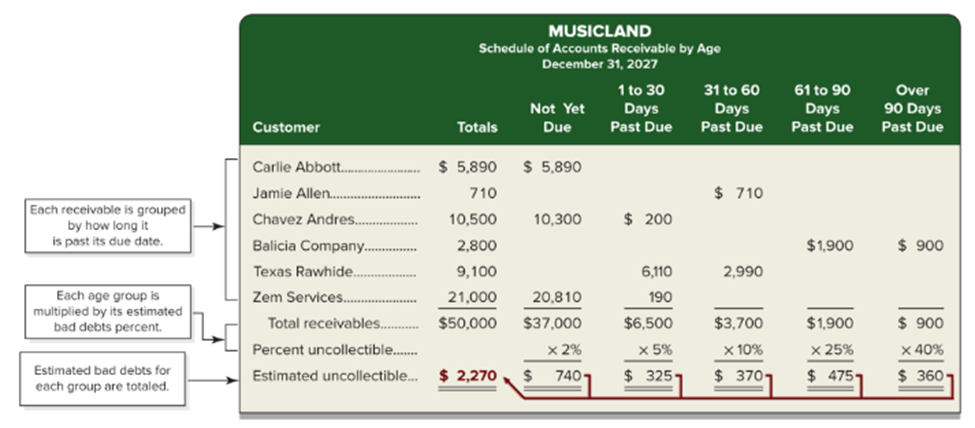
$2,500 credit
Using the Accounts Receivable method, what should the required adjustment for Allowance for Doubtful Accounts be if I have an unadjusted balance of $ 250 Credit and a estimated balance of $2,750 credit
$3,000 credit
Using the Accounts Receivable method, what should the required adjustment for Allowance for Doubtful Accounts be if I have an unadjusted balance of $ 250 debit and a estimated balance of $2,750 credit
$2,750 credit
Using the Sales method, what should the required adjustment for Allowance for Doubtful Accounts be if I have an unadjusted balance of $ 250 debit and a estimated balance of $2,750 credit
Promissory note
A(n) _________ is a written promise to pay a specified amount, usually with interest, either on demand or at a stated future date. ____________ are used in many transactions, including paying for products and services and lending and borrowing money.

Maturity date of a note
The _________ is the day the note (principal and interest) must be repaid. The period of a note is the time from the note’s (contract) date to its maturity date.
Maturity date
What is being computed in this picture?

September 8th
What is the maturity date of a 90 day note that was received on June 10th
Interest
This equation is for
??? = Principal of the note * Annual interest rate * Time expressed in fraction of the year
$100
What is the interest of a 90 day, 8%, $5,000 note that was received on June 10th. (Round to the nearest dollar)
Recording a note receivable
This entry represents:
Accounts | Debit | Credit |
Note Receivable | 500 | |
——Sales | 500 |
Good sold on a 90 day, 12 % note
Honored Note
This entry represents:
Accounts | Debit | Credit |
Cash | 515 | |
——Notes Receivable | 500 | |
——Interest Revenue | 15 |
Collected note with interest of $500 × 12% * 60/360
Dishonored Note
This entry represents:
Accounts | Debit | Credit |
Accounts Receivable - Company A | 515 | |
——Notes Receivable | 500 | |
——Interest Revenue | 15 |
Charged account of Company A for a ________ with interest of $500 × 12% * 60/360
$150
$10,000, 180 day, 9% note that was accepted on November 1st
Finish the adjusting entry:
Accounts | Debit | Credit |
Interest Receivable | ??? | |
——Interest Revenue | ??? |
Selling Receivables
This entry represents:
Accounts | Debit | Credit |
Cash | 47,500 | |
Factoring Fee Expense | 2,500 | |
——Accounts Receivable | 50,000 |
Sold accounts receivable for cash less 5 % fee
Pledging Receivables
This entry represents:
Accounts | Debit | Credit |
Cash | 50,000 | |
——Notes Payable | 50,000 |
Borrow with a note secured by pledging receivables
Accounts receivable turnover
___________ helps assess the quality and liquidity of receivables. Quality of receivables is the likelihood of collection without loss. Liquidity of receivables is the speed of collection. ___________ measures how often, on average, receivables are collected during the period.
Accounts receivable turnover
This equation is for
??? = AverageAccountsReceivable,NetNetSales
Plant assets
__________ are tangible assets used in a company’s operations that have a useful life of more than one accounting period.
Cost
_______ includes all expenditures necessary to get an asset in place and ready for use. The _______ of a machine, for example, includes its invoice _______ minus any discount, plus necessary shipping, assembling, installing, and testing ________. Examples are the ________ of building a base for a machine, installing electrical hookups, and testing the asset before using it in operations.
Land improvements
__________ are additions to land and have limited useful lives. Examples are parking lots, driveways, walkways, fences, and lighting systems. __________ include costs necessary to make those improvements ready for their intended use.
Lump-sum purchase
Plant assets sometimes are purchased as a group in a single transaction for a lump-sum price. This transaction is called a(n) _________, or group, bulk, or basket purchase. When this occurs, we allocate the cost to the assets acquired based on their relative market (or appraised) values.
Lump-sum purchase
What is this picture showing?

Depreciation
_________ is the process of allocating the cost of a plant asset to expense while it is in use. __________ does not measure the decline in the asset’s market value or its physical deterioration.
Salvage value
___________, also called residual value or scrap value, is an estimate of the asset’s value at the end of its useful life. This is the amount the owner expects to receive from disposing of the asset at the end of its useful life. If the asset is expected to be traded in on a new asset, its _________ is the expected trade-in value.
Useful life
_________ of a plant asset is the length of time it is used in a company’s operations. _________, or service life, might not be as long as the asset’s total productive life.
Inadequacy
___________ is the inability of a plant asset to meet its demands.
Obsolescence
___________ is the process of becoming outdated and no longer used.
Straight-line depreciation
_________ charges the same amount to each period of the asset’s useful life. A two-step process is used. We first compute the depreciable cost of the asset, also called cost to be depreciated. It is computed as asset total cost minus salvage value. Second, depreciable cost is divided by the number of accounting periods in the asset’s useful life.
Straight-line depreciation
What is the equation in the picture?

Straight-line depreciation
What depreciation method is being used?

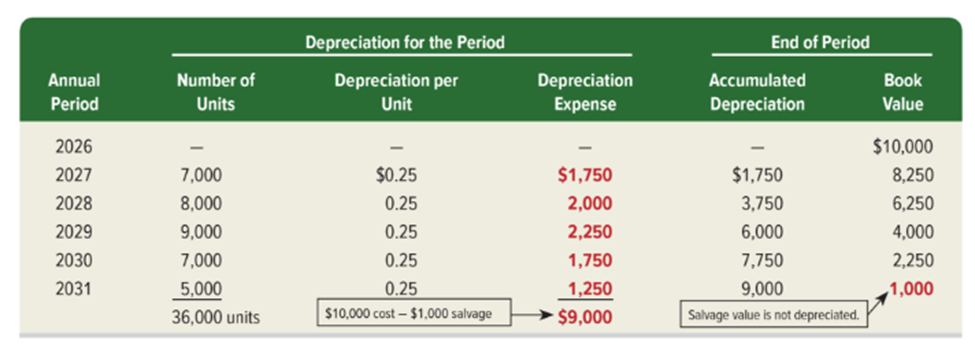
Units-of-production depreciation
When equipment use varies from period to period, the ___________ method can better match expenses with revenues. __________ charges a varying amount for each period depending on an asset’s usage.
Units-of-production depreciation
What is the equation in the picture?

Units-of-production depreciation
What depreciation method is being used?
Double-declining-balance (DDB)
An accelerated depreciation method has more depreciation in the early years and less depreciation in later years. The most common accelerated method is the declining-balance method, which uses a depreciation rate that is a multiple of the straight-line rate. A common depreciation rate is double the straight-line rate. This is called ___________.
Double-declining-balance (DDB)
What is the equation in the picture?

Double-declining-balance (DDB)
What depreciation method is being used?

Asset book value
The net balance sheet amount is the __________, or book value, and is the asset’s total cost minus accumulated depreciation.
Modified Accelerated Cost Recovery System (MACRS)
· These rules include the ___________, which allows straight-line depreciation for some assets but requires accelerated depreciation for most kinds of assets. __________ is not acceptable for financial reporting because it does not consider an asset’s useful life or salvage value.
Change in an accounting estimate
Revising an estimate of the useful life or salvage value of a plant asset is called a ___________ and only affects current and future financial statements. We do not go back and restate (change) prior years’ statements. This applies to all depreciation methods.


Revenue expenditures
__________, also called income statement expenditures, are costs that do not materially increase the plant asset’s life or capabilities. They are recorded as expenses on the current-period income statement.
Capital expenditures
__________, also called balance sheet expenditures, are costs of plant assets that provide benefits for longer than the current period. They increase the asset on the balance sheet.