NEUR30080 L11 JoC smooth muscle: mechanical properties
 Call Kai
 Learn
 Practice Test
 Spaced Repetition
 Match
 Flashcards
 Knowt Play
1/23

There's no tags or description
Looks like no tags are added yet.
24 Terms
smooth muscle
involuntary muscle
innervated by Autonomic NS (ANS) (visceral efferent fibres)
found primarily in the walls of hollow organs and tubes
spindle-shaped cells typically arranged in sheets
cells do not have T-tubules, and have very little SR
smooth muscle cells
do NOT contain sarcomeres, not striated
but made of thick and thin filaments
thin filaments in smooth muscle do NOT contain troponin
Ca binds to CaM instead of troponin
Ca-CaM complex activates myosin which then binds to actin and contraction begins
contraction
the swivelling of cross-bridges
2 types of smooth muscle
visceral (single-unit)
multi-unit
visceral smooth muscle
single-unit/unitary
found in walls of hollow organs
e.g. small blood vessels, digestive tracts, urinary & reprod systems
multiple fibres contract as a unit (impulse travels easily across gap junctions from cell to cell)
self-excitable in some cases (gen spontaneous APs & contractions)
multi-unit smooth muscle
consists of MUs that are activated by nervous stimulation
found in walls of large blood vessels
e.g. in the eye (adjusting the shape of the lens to permit accommodation & size of pupil)
e.g. at base of hair follicle (‘goose-bump’ muscles)
which is responsible for ‘goose bumps’?
multi-unit smooth muscle
single- vs multi-unit smooth muscle image

contractile activity of different smooth muscle
red: bladder, normally relaxed, then contracts
green: the opposite, anal sphynctus

time course events in smooth muscle contraction
A: force follows phasic contraction
B: continuous stimulation

relationship between Em and force generation (F) in diff smooth muscle cells

relationship between Em and force generation (F) in diff smooth muscle cells RHYTHMIC
rhythmical activity depolarising then firing Ca APs
depending on the amount of depol from Ca levels corresponds to force being gen
more depol = more force

relationship between Em and force generation (F) in diff smooth muscle cells TONIC
might be from some hyperpol
force gen directly correlated to amount of RMP

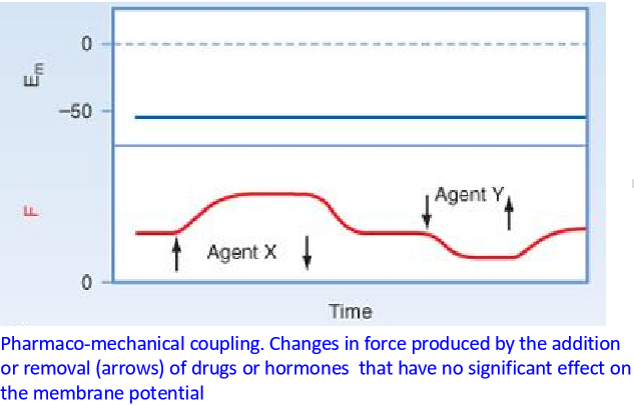
relationship between Em and force generation (F) in diff smooth muscle cells PHARMACO-MECHANICAL COUPLING
bypassing Ca, so NOT via myosin-actin kinase
may cause contraction of muscle, and memb potential does NOT change
length-tension relationships
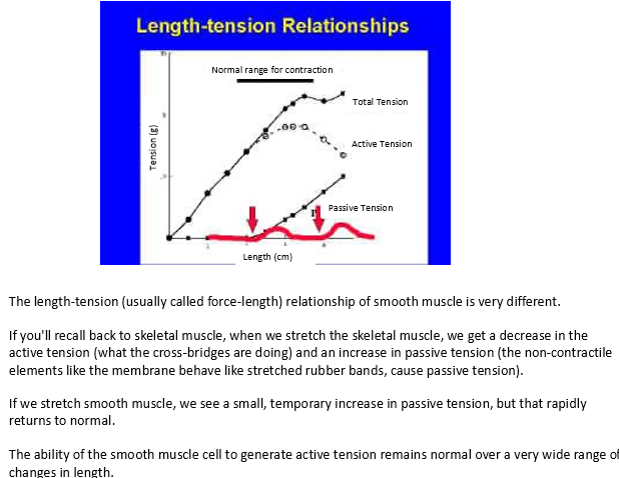
if you stretch a muscle making it bigger, adding passive tension to active tension = total tension
e.g. stretch stomach but still able to contract when it is stretched
diff for skeletal - NOT able to contract while stretched (L0 different from skeletal)

length-tension continued
usually called force-length relationship
v different in smooth vs skeletal
skeletal: decrease in active tension and increase in passive tension
smooth: a small, temporary increase in passive tension, but that rapidly returns to normal
the ability of smooth muscle cell to gen active tension remains normal over a v wide range of changes in length
length-tension relationships continued image
length-tension: smooth muscle histology
NO striations
the thick and thin filaments are not lined up in the way that they are in skeletal
this lack of rigid structure means that i can stretch the muscle fibre and there will still be some myosin head able to bind to the active site
may not be the same myosin head, but doesnt matter
Z line to Z line actin, sarcomere in skeletal (possible MQ)
length adaptation of smooth muscle
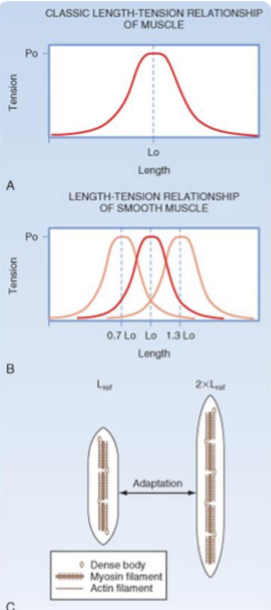
both skeletal (A) and smooth (B) muscle exhibit a bell-shaped length-tension relationship, although the length-tension relationship of smooth muscle can vary
within a short period after stretching smooth muscle, there is a rightward shift in the length-tension relationship such that maximal force gen occurs at longer muscle length (B)
likewise, within a brief time after shortening of smooth muscle, there is a leftward shift in the length-tension relationship (B)
the mechanism(s) underlying this adaptation are hypothesised to reflect a change in the no. of contractile units in series (C)
force-velocity curves
Velocity of shortening would get less and you pull and pull
More stress on muscle = slower velocity
Highest stress = lowest
If draw straight line would get away w it (instead of exponential)
Skeletal = all or none, a twitch - Smooth not like that

modelling of smooth muscle length-adaptation

skeletal vs. smooth muscle curves

summary

key take-aways
not just Ca2+ APs
to do with receptors
skeletal muscle not good at dealing w/ hypoxia but smooth is
be aware of pharmacology of smooth muscle contraction too