5 - Central Dogma
 Call Kai
 Learn
 Practice Test
 Spaced Repetition
 Match
 Flashcards
 Knowt Play
1/139

Earn XP
Description and Tags
Proverbs 16:3
140 Terms

Summary Only of Central Dogma:
c. DNA replication
[Summary Only of Central Dogma]
DNA synthesis
a. Transcription
b. Translation
c. DNA replication
d. Mutation
a. Transcription
[Summary Only of Central Dogma]
RNA synthesis
a. Transcription
b. Translation
c. DNA replication
d. Mutation
b. Translation
[Summary Only of Central Dogma]
Protein synthesis
a. Transcription
b. Translation
c. DNA replication
d. Mutation
c. Replication
[Summary Only of Central Dogma]
DNA-directed DNA synthesis
a. Translation
b. Transcription
c. Replication
d. Reverse transcription
d. Nucleus
Replication happens inside this part of the cell
a. Cytoplasm
b. Ribosome
c. Mitochondria
d. Nucleus
c. Replication
Involves synthesis of two daughter strands from a parent strand
a. Transcription
b. Translation
c. Replication
d. Splicing
c. Replication
High fidelity , wherein proofreading is present
a. Transcription
b. Translation
c. Replication
d. Splicing
Bidirectional
Semi-discontinuous
Semi-conservatives
Replication is described as ______ [3]
Initiation
Elongation
Trends for DNA Replication [2]
b. Origin of replication

[DNA Replication - Initiation]
The point on the DNA strand where replication begins
a. Replication fork
b. Origin of replication
c. Telomere
d. Centromere
c. Helicase

[DNA Replication - Initiation]
Performs unwinding of the DNA strand during initiation
a. Topoisomerase
b. DNA ligase
c. Helicase
d. Primase
c. Replication bubble/fork

[DNA Replication - Initiation]
The area where the DNA strand is unwound and opened up to form two single strands
a. Origin
b. Telomere
c. Replication bubble/fork
d. Centromere
d. Topoisomerase
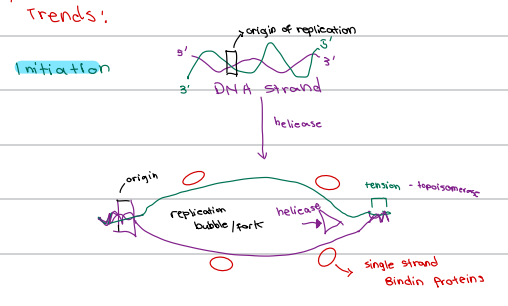
[DNA Replication - Initiation]
Tension that occurs during replication is relieved by this enzyme
a. Helicase
b. DNA ligase
c. Primase
d. Topoisomerase
c. Single strand binding proteins (SSBP)
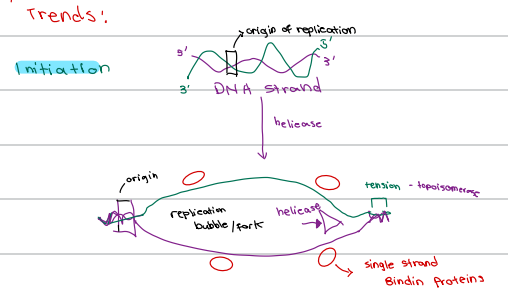
[DNA Replication - Initiation]
Proteins that keep the single strands of DNA separated during replication
a. Helicase
b. Topoisomerase
c. Single strand binding proteins (SSBP)
d. DNA ligase
c. Leading strand

[DNA Replication - Elongation]
DNA strand synthesized continuously in the 5' to 3' direction
a. Lagging strand
b. Okazaki fragment
c. Leading strand
d. Primer
c. Lagging strand
Term

[DNA Replication - Elongation]
DNA strand synthesized discontinuously, in the 3' to 5' overall direction
a. Leading strand
b. Okazaki fragment
c. Lagging strand
d. Primer
b. Primer
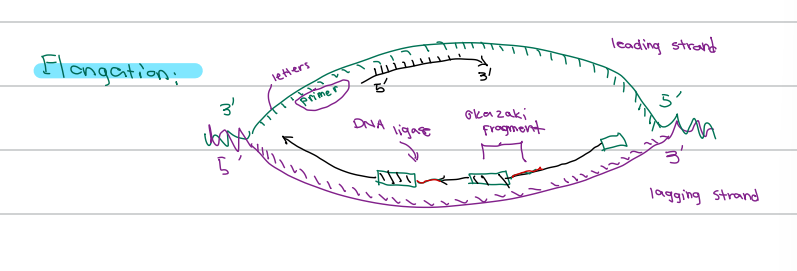
[DNA Replication - Elongation]
Short RNA sequence (letters) needed before DNA polymerase can begin synthesis
a. Okazaki fragment
b. Primer
c. Leading strand
d. DNA ligase
d. DNA ligase

[DNA Replication - Elongation]
Enzyme that joins together the Okazaki fragments on the lagging strand
a. DNA polymerase
b. Primase
c. Helicase
d. DNA ligase
c. Okazaki fragments

Short newly synthesized DNA segments formed on the lagging strand
a. Primers
b. Leading strand
c. Okazaki fragments
d. Replication fork
Primase adds an RNA primer
DNA Polymerase elongates the primer in 5' to 3' direction
The primer are eventually replaces
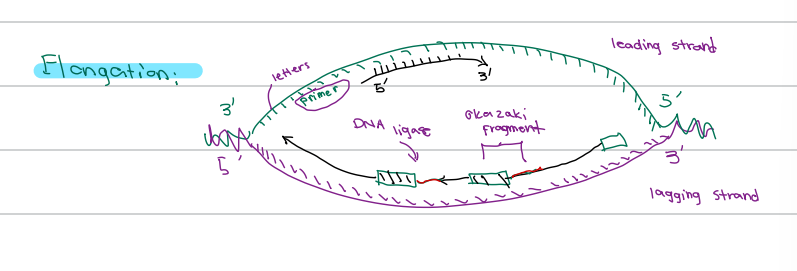
[DNA Replication - Elongation]
Steps in Elongation [3]
c. Okazaki fragments

[DNA Replication - Elongation]
Short newly synthesized sequences of DNA that are formed discontinuously
a. Primers
b. Leading strand
c. Okazaki fragments
d. Replication fork
b. Primase

[DNA Replication - Elongation]
This enzyme adds an RNA primer
a. DNA polymerase
b. Primase
c. Helicase
d. DNA ligase
a. DNA polymerase

[DNA Replication - Elongation]
This enzyme elongates the primer in 5' to 3' direction
a. DNA polymerase
b. Primase
c. Helicase
d. DNA ligase
c. Transcription
DNA-directed RNA synthesis
a. Translation
b. Replication
c. Transcription
d. Reverse transcription
d. Nucleus
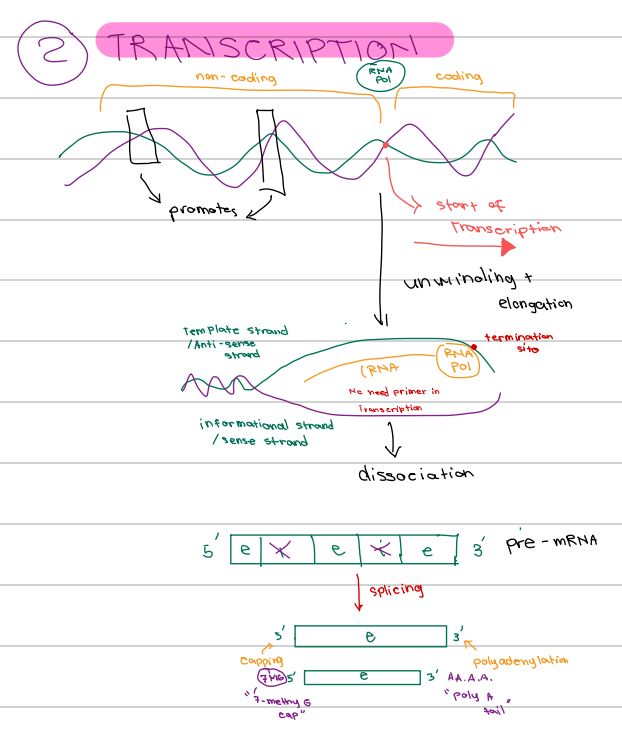
[Transcription]
Transcription happens inside this part of the cell
a. Cytoplasm
b. Ribosome
c. Mitochondria
d. Nucleus
b. Transcription
[Transcription]
Synthesis of hnRNA (aka pre-mRNA) from DNA
a. Replication
b. Transcription
c. Translation
d. Splicing
c. Unidirectional
[Transcription]
Transcription is described as this (one-direction)
a. Bidirectional
b. Semi-conservative
c. Unidirectional
d. Discontinuous
c. RNA polymerase
[Transcription]
Enzyme primarily involved in transcription
a. DNA polymerase
b. DNA ligase
c. RNA polymerase
d. Helicase
b. Transcription
[Transcription]
Lower fidelity (no proofreading)
a. Replication
b. Transcription
c. Translation
d. Splicing
a. True
[Transcription]
Unlike replication, transcription has no need for primers before elongation
a. True
b. False
c. Promoters
[Transcription]
Transcription depends on _____ to initiate
a. Primers
b. Origins of replication
c. Promoters
d. Okazaki fragments
c. Post-transcriptional modifications
[Transcription]
Conversion of pre-mRNA to mRNA
a. Translation
b. Replication
c. Post-transcriptional modifications
d. Splicing only
Splicing out of introns, leaving the exons together
Capping at 5’ end
Polyadenylation at 3’ end
[Transcription]
Steps for Post-transcriptional modifications [3]
b. Promoters

[Transcription - Diagram]
Tells other enzymes where to start transcription
a. RNA polymerase
b. Promoters
c. Termination site
d. Pribnow box
Pribnow box
Hogness box

[Transcription - Diagram]
Examples of promoters
a. Exon and intron
b. Sense and antisense strand
c. Pribnow box and Hogness box
d. Template and informational strand
c. RNA polymerase

[Transcription - Diagram]
_____will stop once it reaches termination site
a. Promoters
b. DNA polymerase
c. RNA polymerase
d. Helicase
a. True

[Transcription - Diagram]
Replication is more accurate than transcription process
a. True
b. False
c. Template strand

[Transcription - Diagram]
Anti-sense strand
a. Informational strand
b. Sense strand
c. Template strand
d. Coding strand
c. Informational strand

[Transcription - Diagram]
Sense strand
a. Template strand
b. Anti-sense strand
c. Informational strand
d. Non-coding strand
c. Primer

[Transcription - Diagram]
Unlike replication, transcription has no need for ______
a. RNA polymerase
b. Promoters
c. Primer
d. Termination site
c. Dissociation

[Transcription - Diagram]
Process where RNA polymerase falls off the DNA strand after reaching the termination site
a. Splicing
b. Capping
c. Dissociation
d. Polyadenylation
b. Splicing

[Transcription - Diagram]
Process of removing introns from pre-mRNA, joining exons together
a. Capping
b. Splicing
c. Polyadenylation
d. Dissociation
c. 7-methyl G cap (7-MG)

[Transcription - Diagram]
5' modification added to mRNA after splicing
a. Poly A tail
b. Polyadenylation
c. 7-methyl G cap (7-MG)
d. Okazaki fragment
b. Poly A tail

[Transcription - Diagram]
3' modification added to mRNA after splicing
a. 7-methyl G cap
b. Poly A tail
c. Capping
d. Promoter
b. Exon

[Transcription - Diagram]
Coding part of DNA
a. Intron
b. Exon
c. Promoter
d. Template strand
d. Intron
[Transcription - Diagram]
Noncoding part of DNA
a. Exon
b. Promoter
c. Template strand
d. Intron
b. 5' and 3’

[Transcription - Diagram]
Target for hydrolysis
Prone to degradation
a. 3' end
b. 5' and 3’
c. Coding region
d. Promoter region
c. 5' end

[Transcription - Diagram]
Protected by "7-methyl G" capping
a. 3' end
b. Coding region
c. 5' end
d. Promoter region
c. 3' end

[Transcription - Diagram]
Protected by "poly A tail"
a. 5' end
b. Promoter region
c. 3' end
d. Coding region
b. Translation
RNA to Protein
a. Transcription
b. Translation
c. Replication
d. Reverse transcription
d. Ribosome
[Translation]
Protein synthesis occurs in this organelle
a. Nucleus
b. Mitochondria
c. Endoplasmic reticulum
d. Ribosome
b. Codon
[Translation]
The genetic code unit found in mRNA used for amino acid-nucleotide pairing
a. Anticodon
b. Codon
c. Promoter
d. Primer
d. tRNA (transfer)
[Translation]
This RNA delivers amino acids upon matching its anticodon with the corresponding codon
a. mRNA (messenger)
b. rRNA (ribosomal)
c. hnRNA
d. tRNA (transfer)
c. 70S
[Translation]
Svedberg unit of prokaryotic ribosome
a. 80S
b. 60S
c. 70S
d. 40S
d. 80S
[Translation]
Svedberg unit of eukaryotic ribosome
a. 70S
b. 50S
c. 30S
d. 80S
d. 50S
[Translation]
Svedberg unit of prokaryotic large ribosomal subunit
a. 30S
b. 40S
c. 60S
d. 50S
b. 30S
[Translation]
Svedberg unit of prokaryotic small ribosomal subunit
a. 50S
b. 30S
c. 40S
d. 60S
c. 60S
[Translation]
Svedberg unit of eukaryotic large ribosomal subunit
a. 30S
b. 50S
c. 60S
d. 40S
d. 40S
[Translation]
Svedberg unit of eukaryotic small ribosomal subunit
a. 30S
b. 50S
c. 60S
d. 40S
Universal
Non-ambiguous (1 codon = 1 amino acid)
Degenerate / Redundant (1 amino acid = many codons)
Non - overlapping
No punctuation / Commaless
[Translation]
Rules of the Genetic Code [5]
c. Initiation

[Translation- Diagram]
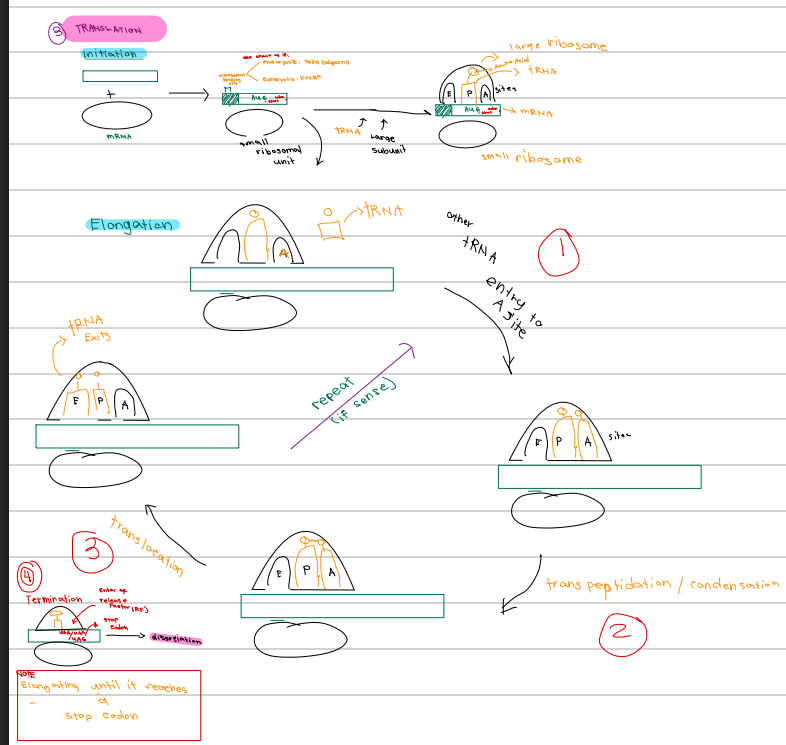
First step of translation wherein the small ribosomal unit binds to mRNA
a. Elongation
b. Termination
c. Initiation
d. Translocation
b. Shine-Dalgarno sequence

[Translation- Diagram]
Helps the small ribosomal subunit find the start codon in prokaryotes
a. Kozak sequence
b. Shine-Dalgarno sequence
c. Promoter
d. Pribnow box
c. Kozak sequence

[Translation- Diagram]
Helps the small ribosomal subunit find the start codon in eukaryotes
a. Shine-Dalgarno sequence
b. Pribnow box
c. Kozak sequence
d. Hogness box
b. E, P, A sites

[Translation- Diagram]
Sites of the large ribosome involved during elongation
a. Promoter sites
b. E, P, A sites
c. Origin sites
d. Termination sites
b. Entry to A site
[Translation- Diagram]
Step in elongation wherein the next tRNA enters the A site
a. Translocation
b. Entry to A site
c. Transpeptidation
d. tRNA exit
d. Transpeptidation/condensation

[Translation- Diagram]
Step in elongation wherein peptide bond formation occurs
a. Translocation
b. Entry to A site
c. tRNA exit
d. Transpeptidation/condensation
c. Translocation

[Translation- Diagram]
Step in elongation wherein the ribosome moves forward and the tRNA exits
a. Transpeptidation
b. Entry to A site
c. Translocation
d. Initiation
d. Termination

[Translation- Diagram]
Final step of translation triggered by a stop codon
a. Initiation
b. Elongation
c. Translocation
d. Termination
b. Release factor (RF)

[Translation- Diagram]
Protein factor that enters the A site upon reaching a stop codon during termination
a. tRNA
b. Release factor (RF)
c. RNA polymerase
d. DNA polymerase
c. A stop codon

[Translation- Diagram]
Elongation continues until it reaches this
a. A termination site
b. A promoter
c. A stop codon
d. An origin of replication

Genetic Code (for discussion purposes only; PLEASE do not memorize except for the start and stop codons)
UGA
UAG
UAA
[Genetic Code]
Stop Codons [3]
c. AUG
[Genetic Code]
Start Codon
a. UAA
b. UAG
c. AUG
d. UGA
c. 64
[Genetic Code]
Total number of codons
a. 20
b. 61
c. 64
d. 3
b. 61
[Genetic Code]
Number of codons called coding/sense
a. 64
b. 61
c. 3
d. 20
d. 3
[Genetic Code]
Number of codons called noncoding/stop codon
a. 61
b. 64
c. 20
d. 3
c. mRNA
[Genetic Code]
Codon is found in _______
a. tRNA
b. rRNA
c. mRNA
d. DNA
d. tRNA
[Genetic Code]
Anticodon is found in ________
a. mRNA
b. rRNA
c. DNA
d. tRNA
d. tRNA
[Genetic Code]
Holds the amino acid
a. mRNA
b. rRNA
c. DNA
d. tRNA
Folding toward the native forms
Modification by trimming away or residue modification
Degradation for wrong sequence or wrongly folded proteins (which are usually nonfunctional)
Targeting to the appropriate site with the help of endoplasmic reticula or Golgi apparatuses
Post - translational Modifications [4]
c. Nascent proteins
[Post-Translational Modifications]
Newly synthesized proteins that are not yet native (meaning not functional)
a. Mature proteins
b. Holoenzymes
c. Nascent proteins
d. Apoenzymes
c. Chaperones (ex. hsp)
[Post-Translational Modifications]
Group of proteins that assist other proteins in folding
a. Prions
b. Histones
c. Chaperones (ex. hsp)
d. Ribosomes
b. hsp
[Post-Translational Modifications]
Example of Chaperone, which is a group of protein that assist other proteins in folding
a. Collagen
b. hsp
c. Prion
d. Albumin
Prion diseases
Alzheimer’s disease
[Post-Translational Modifications]
Misfolding can lead to some popular conditions like ______ [2]
Bovine Spongiform Encephalopathy (BSE) / Mad cow disease
Creutzfeldt-Jakob Disease (CJD)
[Post-Translational Modifications]
Example of Prion diseases [2]
c. Collagen
📌Rationale: Collagen is the most abundant protein in the human body, making up a major portion of connective tissue, skin, bones, and tendons.
Hemoglobin — abundant in blood
Albumin — most abundant plasma protein
Insulin — a hormone,
[Post-Translational Modifications]
Most abundant protein
a. Hemoglobin
b. Albumin
c. Collagen
d. Insulin
c. Collagen
[Post-Translational Modifications]
Example of a protein that is abundant in proline and lysine
a. Hemoglobin
b. Albumin
c. Collagen
d. Insulin
c. Scurvy
[Post-Translational Modifications]
Condition associated with humans with deficient hydroxylation of proline and lysine in collagen
a. Pellagra
b. Beriberi
c. Scurvy
d. Rickets
d. Vitamin C

[Post-Translational Modifications]
Vitamin needed for the hydroxylation of proline and lysine (+OH)
a. Vitamin D
b. Vitamin A
c. Vitamin E
d. Vitamin C
b. Hydroxyproline

[Post-Translational Modifications]
Product of hydroxylation of proline
a. Hydroxylysine
b. Hydroxyproline
c. Proline
d. Lysine
d. Hydroxylysine

[Post-Translational Modifications]
Product of hydroxylation of lysine
a. Lysine
b. Hydroxyproline
c. Proline
d. Hydroxylysine
d. Scorbutic
[Post-Translational Modifications]
Term for a human with scurvy
a. Pellagric
b. Beriberic
c. Rachitic
d. Scorbutic
c. Mutations
Changes in the base sequence of DNA and are often responsible for causing disease
a. Polymorphisms
b. Mutagens
c. Mutations
d. Epigenetic modifications
a. True
Mutations can be classified in multiple ways. In most cases, they can be classified by how much of the DNA it affects (large or small) followed by the mechanism (ex. replacement, insertion, or deletion)
a. True
b. False
Large - scale mutations
Small - scale mutations
Type of Mutations Based on How Much DNA it Affects [2]
c. Large-scale mutation
Affects major chunks of the chromosome, involving as far as millions of bases
a. Point mutation
b. Frameshift mutation
c. Large-scale mutation
d. Silent mutation
d. Pairs
[Large-scale Mutation]
Humans have ___ of chromosomes by default
a. Triplets
b. Single copies
c. Quartets
d. Pairs
c. 46
[Large-scale Mutation]
Total number of chromosomes in humans
a. 23
b. 44
c. 46
d. 48
b. 23
[Large-scale Mutation]
Number of chromosome pairs in humans
a. 22
b. 23
c. 24
d. 46