diving physiology I
 Call Kai
 Learn
 Practice Test
 Spaced Repetition
 Match
 Flashcards
 Knowt Play
1/28

There's no tags or description
Looks like no tags are added yet.
29 Terms
physiological response to diving (immediate responses)
Vasoconstriction
Bradycardia → abnormally slow resting heart rate
afferent vs efferent activation of diving reflex
Afferent activation is through cold receptors on the skin + chemoreceptors + baroreceptors
Efferent activation includes both sympathetic and parasympathetic nervous activation
Ambient or atmospheric pressure arises due to air molecules which is greatest at sea level and is reduced with increasing (?)
altitude → reduction in air molecules
pressure calculation for within a body of water
density (p) x gravity (g) x depth (d)
what is 1 atm in pascals?
101.325 × 10³ pascals
density of sea water vs fresh water
1025 kg/m3 vs 1000kg/m3
calculate the pressure underwater (at 40.3m depth, given that the density of sea water is 1025kg/m3) → then calculate atmospheres

atmospheres absolute
atm (water) + atm (surface)
surface atmospheric pressure plus the additional pressure exerted by water is equal to atmospheres absolute pressure
change in blood pressure (upright on land vs upright in water)
Upright on land
High peripheral blood pressure
Pressure in our feet is high due to weight of blood
Pressure in our capillaries is high and exceeds the oncotic pressure that allows for reabsorption of fluid -> lose plasma volume
Pressure causes veins to expand -> more blood stored in peripheral veins
Decrease blood in central veins -> decrease in venous return
Reduces cardiac output
Reduces blood pressure
Upright in water
Low peripheral blood pressure
Pressure inside blood vessels increasing at same rate as pressure outside our blood vessels due to the aqueous environment
Low pressure -> veins do not expand
Increased venous return
Increase in cardiac output
Increases blood pressure

why urination increases in the pool
Blood pressure increases (due to decreased peripheral blood pressure → reduces expansion of veins and reduces loss of fluid from capillaries)
Glomerular capillary blood pressure increases → increases glomerular filtration
Atrial stretch increases from increased blood pressure → increases atrial natriuretic peptide (ANP)
ANP increases water and salt excretion into our urine → water follows via osmosis
Full bladder → urination
a maximal breath to total lung capacity and subsequent free dive with no equipment will cause (?) of the air in your lungs
compression
boyle’s law (explain and calculation)
At a constant temperature, the volume of gas is inversely proportional to pressure
P1 x V1 = P2 x V2
if the lung contains 5L after maximal inspiration, what will be the volume after a dive to 40.3m in sea water? (given 4 atm at 40.3m depth)
previously calculated → pressure at 40.3m depth is 5 ATA
P1 = 1 ATA (sea level)
V1 = 5L (maximal inspiration)
P2 = 5 ATA
V2 = P1 X V1 / P2 = 1L
the lung is compressed to 1/5th its volume

residual volume
total amount of air remaining in your lungs after maximal expiration
lung squeeze
When lung volume compression falls below residual volume
Crushing pressure causes blood vessels to leak fluid and blood into the lungs
Causes haemoptysis (coughing up blood) and pulmonary oedema (fluid in lungs)

calculate the depth at which a female diver’s lung would compress from TLC (at the surface) to RV in sea water?
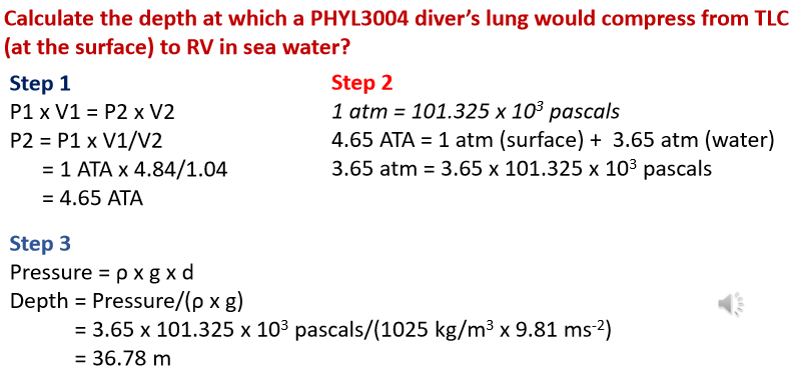
mechanisms preventing lung squeeze
Lungs contain collagen and elastin fibres
Provides rigidity to the lung (elastic matrix) and resists compression
Redistribution of blood from the periphery to the thorax
Increases the volume of an incompressible material into the lung
Both reduce the magnitude of lung squeeze
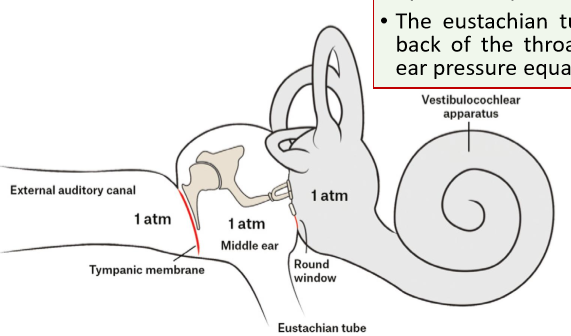
ear barotrauma
External auditory canal is exposed to depth-induced hydrostatic pressure
Liquid filled vestibulocochlear apparatus under same hydrostatic pressure
Eustachian tube is connected to the back of the throat and allows for ear pressure equalisation
However if the eustachian tube is closed
Pressure in the middle ear is not equalised
Air is not compressible in the ear like in the lung
Tympanic membrane (ear drum) is displaced inwards and ruptures
Can cause permanent hearing loss

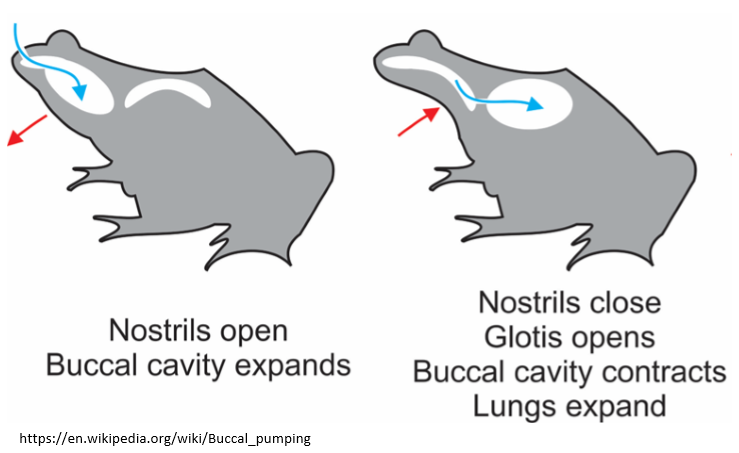
frog breathing (glossopharyngeal insufflation)
Humans draw air into the lung by creating negative pressure
Frogs push positive pressure into the lungs
Nostrils open and buccal cavity expands
Nostrils close and glottis opens
Buccal cavity contracts pushing air into lungs
Lungs expand as result of positive pressure
total lung capacity is the sum of residual volume and:
vital capacity
glossopharyngeal insufflation can increase:
total lung capacity → allows for greater diving depth
shallow water blackout
Loss of consciousness caused by cerebral hypoxia towards the end of a breath-hold dive in shallow water
Diver has reached targeted depth -> shallow water blackout can occur on the way back up
dalton’s law
sum of the partial pressure of each gas is equal to the total pressure exerted by the mixture
what is the partial pressure of atmospheric O2
760 x 0.21 = 160mmHg
760mmHg → atmospheric pressure
0.21 -> 21% -> fraction of oxygen in the air
central vs peripheral chemoreceptors
Central
Responds to changes in H+ (caused by increase in CO2 diffusion across BBB-> bicarbonate) in the CSF
Contributes to 80% of the response to an increase in arterial CO2
Peripheral
Responds to CO2 and H+
Contributes to 20% of the response to an increase in arterial CO2
Activated when arterial O2 falls below 60mmHg -> coma
which chemoreceptor is responsible for our inability to hold our breath
central chemoreceptor
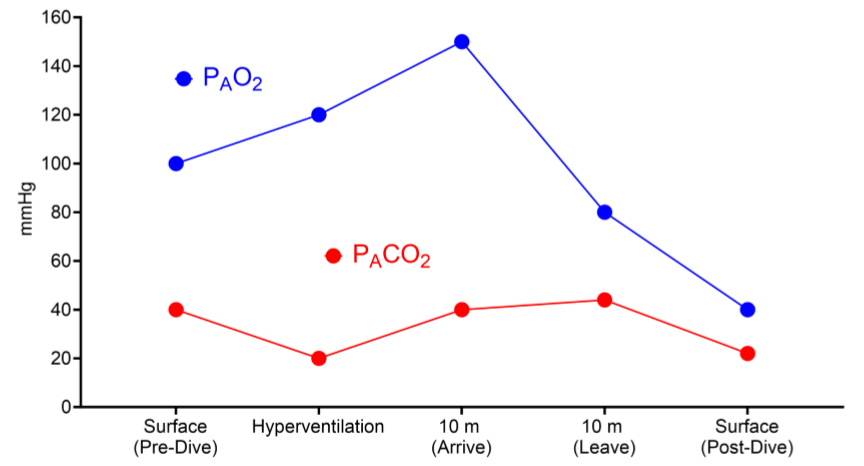
explain what occurs at each depth
Surface
Alveolar oxygen -> 100mmHg
Alveolar carbon dioxide --> 40mmHg
Hyperventilation
Alveolar oxygen -> increaase
Alveolar carbon dioxide -> 20mmHg -> decrease
Hyperventilation removes carbon dioxide at the same rate as it is being produced
Thus CO2 levels in blood/alveoli will decrease
10m after diving
Alveolar oxygen -> 150mmHg -> increase
Alveolar carbon dioxide -> increase
Increase in alveolar oxygen and carbon dioxide due to hydrostatic pressure compressing lung
10m before resurfacing
Alveolar oxygen -> 80mmHg
Alveolar carbon dioxide -> more than 40mmHg -> activate chemoreceptors
Drop in alveolar oxygen as it is used up by cells
Diver is alerted to return to surface
Surface
Pressure acting on the body is drastically reduced upon return to surface
Partial pressure of oxygen also reduced
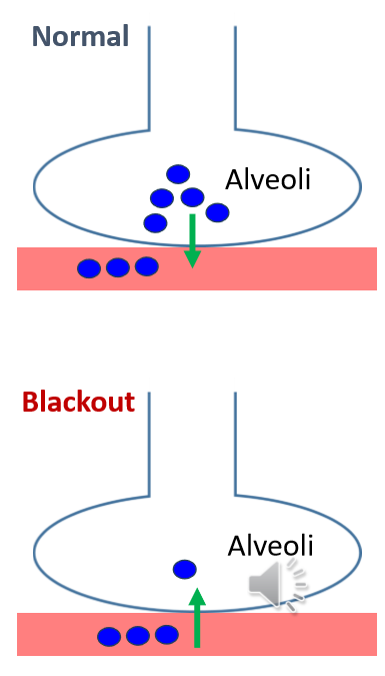
shallow water blackout explained
Levels of alveolar O2 and CO2 normal at surface
Diver hyperventilates which expels CO2 and resists urge to breathe
At 10m hydrostatic pressure increases which increases partial pressure of O2
O2 is used up by working muscles → CO2 production
Eventually, CO2 levels will increase beyond threshold -> chemoreceptors
As diver returns to surface the hydrostatic pressure decreases -> decreases partial pressure of alveolar O2
Partial pressure gradient now favours the movement of O2 from the blood into the alveoli -> leads to cerebral hypoxia if severe
summary
