Lecture 5 - Infancy and toddlerhood
 Call Kai
 Learn
 Practice Test
 Spaced Repetition
 Match
 Flashcards
 Knowt Play
1/67

There's no tags or description
Looks like no tags are added yet.
68 Terms
Define synaptic blooming
period of rapid neural growth through synaptogenesis and dendrite abundance
Define synaptogenesis
Formation of connections between neurons
To what can we attribute much of the brain’s increased volume during infancy and toodlerhood
myelination
define synaptic pruning
neural connections are reduced to strengthen the ones that remain, making brain activity more efficient
At what ages do blooming and pruning occur
blooming - first few years of life
pruning - continues through childhood and adolescence
What is myelin and what are its uses?
coating of fatty tissue around the axon which helps insulate the nerve cell and speed the rate of transmission of impulses
When is myelin development the most pronounced
during the first several years of life
Identify the lobes and cortices of the human brain
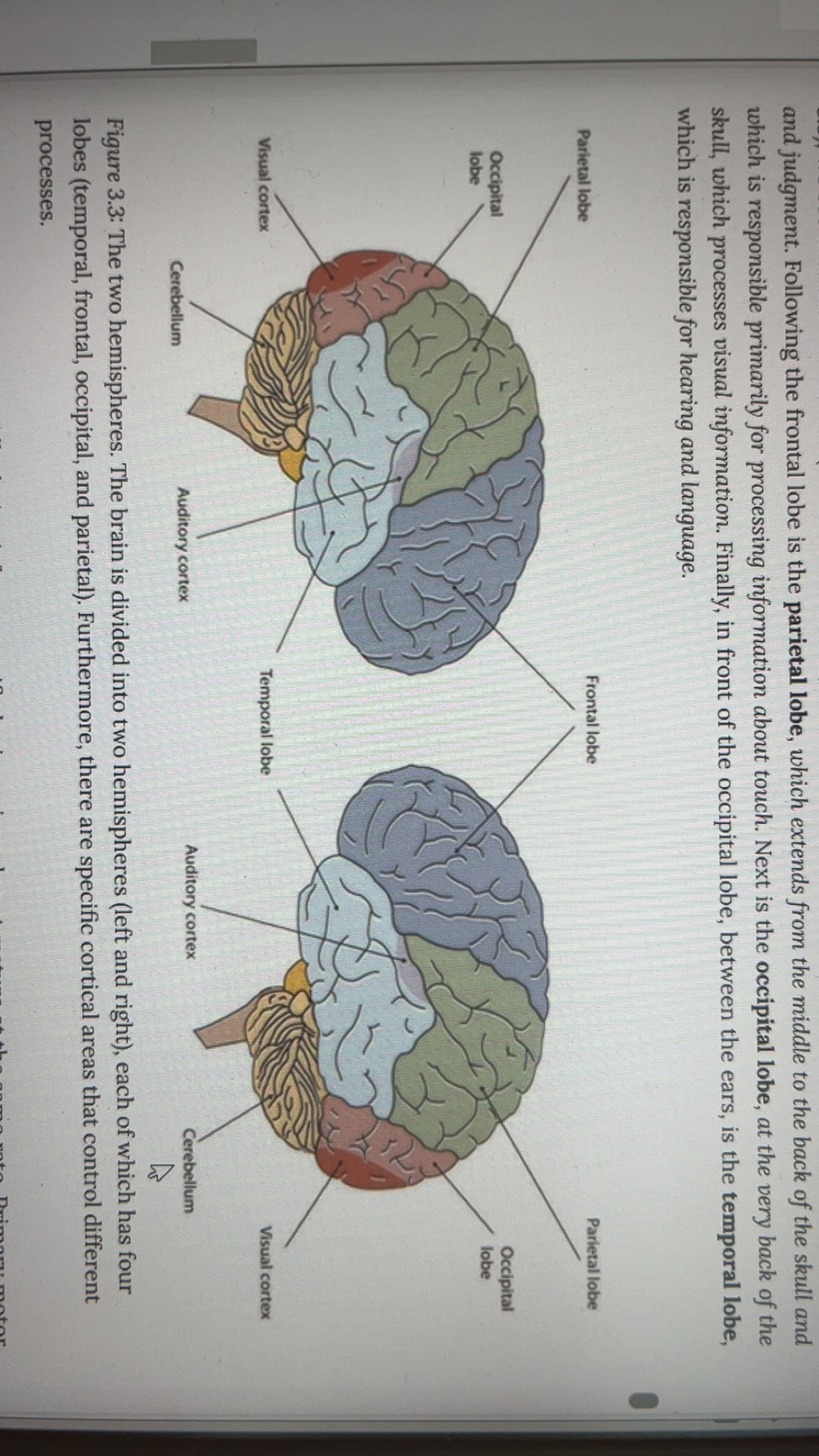
Identify the functions of each part of the brain
IN CEREBRUM
frontal lobe: thinking, planning, memory, judgement
parietal lobe: processing touch-related information
occipital lobe: visual information
temporal lobe: hearing and language
OUT OF CEREBRUM
cerebellum: balance , motor behavior, eye-body function movement coordination
Primary _______ areas develop earlier than primary ________ areas, and the prefrontal cortex is the ________ developed.
motor
sensory
least
define lateralization
process in which different functions become localized primarily on one side of the brain
Use language and sight to explain lateralization
In most adults, language uses the left hemisphere of the brain whilst the right hemisphere is more active when using visuospatial abilities
define neuroplasticity
brain’s capacity to change both physically and chemically to enhance adaptability to environmental change and compensate for injury
What parts of the cerebrum develop during the first year of life? what about infancy through preschool?
first year: auditory, visual, body movement
infancy through preschool: language areas
In what age span does the frontal love develop? When does efficient functioning begin?
functions more effectively starting at 2 months
develops until 20s
define gross motor development
refers to control over actions that help infants get around in the environment
How does motor development impact social relationships
imposes limits on behavior, encourages babies to initiate social interaction
Identify the 10 steps of typical gross motor development
fetal posture (newborn)
holds up chin (1m)
holds up chest (2m)
sit when supported (4m)
sit alone (7m)
stand holding furniture (9m)
crawl (10m)
walk if led (11m)
stand alone (11m)
walk alone (12m)
How do reaching and grasping impact cognitive development? What steps characterize the behavior?
cognitive development allows babies to explore and learn about objects
babies start with pre-reaching as newborns and rarely make contact
they then achieve purposeful reaching at 3-4months
they become coordinated in both hands at 4-5 months
they use thumb and fingers opposable at 9 months
\
Define the Ulnar grasp and the age period where it appears
when the whole hand is able to close around an object around 3-5 months
Define the pincer grasp and the age period where it appears
The thumb and finger are used opposably at 9+ months
Compare assimilation and accommodation
Assimilation refers to fitting new information in existing schemes
Accommodation refers to expanding the framework of knowledge to fit new situations
Define Piaget’s substages of the sensorimotor stage
reflexes (0-1 months)
primary circular reactions (1-4 months)
secondary circular reactions (4-8 months)
coordination of secondary circular reactions (8-12 months)
tertiary circular reaction (12-18 months)
beginning of representational thought (18-24 months)
Briefly describe Piaget’s theory on children’s intelligence and growth
Children acquire knowledge and build mental models of their world. They learn by doing. They undergo 6 substages of sensorimotor development until age 2)
Define primary, secondary, and tertiary circular reactions
primary: repeated behaviors directed towards the baby’s own body. May firstly occur b y chance but persists due to occurring pleasure.
secondary: repeated behavior directed towards the baby’s environment
tertiary: baby experiments with the world surrounding him through repeated “experiments” and discovery
In _______ circular reactions, the baby begins to discover they can affect the world surrounding them.
secondary
Define object permanence
understanding that objects continue to exist when out of sight
When do toddlers develop object permanence
Around 13 months
Define the A not B error
Children often fail to locate objects that are placed in location B after they left it in location A, even if they see the object being displaced to location B
Define and explain infantile amnesia
Inability of older children/ adults to recall memories from childhood. May be due to lack of brain maturation such as immature hippocampus, limited language skills and limited understanding of self.
Define deferred imitation and the time period in which it appears
Imitation of actions after a delay of time, appears after 4 weeks and by 12 months of age
Way of communication common with babies involving repeated consonants
Babbling
Way of communication common with babies involving repeated vowels
Cooing
Define and compare receptive and expressive vocabulary
Receptive vocabulary refers to the number of words a person can understand whereas expressive vocabulary refers to the number of words a person can use in the production of language
When do babies use their first words
11-13 months
Define holophrasic speech
use of single words to convey an idea
Define the important milestones of a baby’s speech
11-13 months: holophrasic speech
18-22 months: word explosion
During the word explosion, how does a baby’s vocabulary increase
from 50 to more than 300 words
Define overextension in language
use of a word to refer to a term outside of its intended meaning
Define underextension in language
use of a word to refer exclusively to terms in its intended meaning, but not all
Between 18 and 24 months, the child observes a steady increase in word production, thus, ______ new words per day.
1-2
Define telegraphic speech, and the age period where it appears
two word utterances
observes 8-12 months after they say their first word
Define infant directed speech (IDS)
consists of short sentences, clear pronunciation, clear gestures, exaggerated sounds and expressions, etc.
Explain how IDS relates to Lev Vygotsky’s psychosocial theory on development
child conversation creates a zone of proximal development for the MKO to guide the child
Identify the time line of the following emotional stepping stones:
basic emotion
pleasure (laughter)
displeasure (fear, sadness, anger)
2 months
3-5 months
6-8 months
Define social referencing
Seeking emotional information from a trusted individual
Define temperament
Innate characteristics of the infant, including mood, activity level, emotional reactivity
characteristics emerge and change as we age
Define personality
individual’s consistent pattern of feeling, thinking and behavior
strongly influenced by environment
Define goodness-of-fit
bidirectional (parents affect children, children affect parents)
easier for children to thrive in environments where their temperament is compatible
Define attachment
close bond with a caregiver from which the infant derives a sense of security
What is an internal working model
expectations about attachment figures
Define contact comfort
Infant need for closeness and touching
Who paved the way for attachment theory
Bowlby
Define Bowlby’s attachment theory
affectionate tie or bond that an infant forms with their mother
Define the secure base
Caregiver’s presence which gives the child a sense of safety as the child explores surroundings
What is Erikson’s first stage of psychosocial development
trust versus mistrust
According to Erikson, how do caregivers instill trust in a child
caregivers who consistently meet needs for comfort, survival, etc instill sense of trust
Name the different types of attachment and their prevalence
secure attachment 65%
insecure attachment - avoidant attachment 20%
insecure attachment - anxious/ambivalent pattern 5-10%
insecure attachment - disorganized pattern of attachment 5%
Define secure attachment
Child is confident that AF will match their needs, soothe them.
Explores the world independently but returns periodically
Define the insecure attachment - avoidant pattern. What can cause it?
child does not seek proximity to AF while exploring and avoids them when they return
develops when AF is unavailable in times of need/distress and rejects needs
Define the insecure attachment - anxious/ambivalent pattern. What can cause it?
child does not feel security from AF, not comforted by AF
ambivalent of AF in interaction but distressed when distanced from AF
develops when response to child’s needs is inconsistent
Identify the attachment pattern: the child distrusts the caregiver but clings to them out of need for affection
Insecure attachment - anxious/ambivalent pattern
Define the insecure attachment - disorganized pattern. What can cause it?
child does not seem to know how to react
source of care is also source of fear
change from extreme emotions to others quickly
results from inconsistent/inappropriate caregiving
What attachment pattern is characterized by an inconsistent AF and unpredictable behavior, resulting in a confused and unadaptable child
insecure attachment - disorganized pattern
Define the attachment pattern: the child is consistently rejected by their caregiver so sees themselves as unworthy
avoidant pattern
What is sensitive caregiving?
responding promptly, consistently, and appropriately to infant cues to show them that the world is reliable
Infants who are ______ are more likely to develop later insecure attachment
emotionally reactive