Biology Chapter 5
 Call Kai
 Learn
 Practice Test
 Spaced Repetition
 Match
 Flashcards
 Knowt Play
1/51

There's no tags or description
Looks like no tags are added yet.
52 Terms
Equation that Summarizes Photosynthesis and its Reactants, Products, and Number of Molecules

Reactants: water and carbon dioxide (6 water, 6 carbon dioxide)
Products: Oxygen and glucose (6 oxygen, 1 glucose)
Where is chlorophyll located in the chloroplast and its function
Location: Embedded in the membrane of the thylakoids.
Function: Chlorophyll a is the primary photosynthetic pigment in plants. It absorbs mostly blue and red light. Chlorophyll b is an accessory pigment (absorbs blue and red light). Allows plants, algae, and cyanobacteria to harness energy from sunlight.
Light-dependent reactions
Occurs in the thylakoid membrane. Needs direct energy from sunlight. Light energy is transferred to ATP and NADPH (energized electron carrier). Water molecules are split, releasing O2

Light-independent Reactions (carbon reactions/calvin cycle)
Occurs in the stroma (fluid inside chloroplast). Does not need direct energy from sunlight. Carbon dioxide from atmosphere and energy electrons from light-dependent reactions (energy from ATP and electrons from NADPH) drives synthesis of glucose and other carbohydrates.
Reactants, Products, and Location for Light-dependent Reactions
Location: thylakoid membrane
Reactants: Solar energy, water (H2O), ADP, and NADP+
Products: ATP, NADPH, and oxygen (O2)
Reactants, Products, and Location for Light-independent Reactions
Location: stroma
Reactants: carbon dioxide (CO2), ATP, and NADPH
Products: glucose (sugar), ADP, and NADP+
C4 Plants
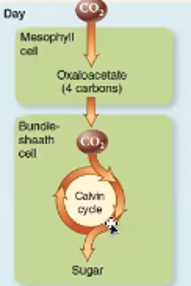
Plants that have an additional set of reactions for sugar production on dry days when stomata are closed. These plants fix carbon twice, in different cells. A preliminary carbon fixation reaction occurs in the mesophyll where CO2 combines with a three-carbon “ferry” molecule to form a four-carbon compound, oxaloacetate. Oxaloacetate is usually reduced to malate, which moves via plasmodesmata into adjacent bundle sheath cells, which are isolated from the leaf’s air spaces. It releases CO2 in these Rubisco-containing cells without the concern of photorespiration because the Rubisco is not exposed to any O2. The Calvin cycle then fixes the carbon a second time. Then, at the cost of ATP, the three-carbon “ferry” returns to the mesophyll to pick up another CO2.
CAM Plants (Crassulacean Acid Metabolism)
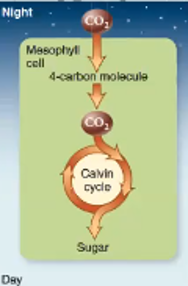
Plants with an alternative carbon-fixing pathway that allows them to conserve water. In the CAM pathway, desert plants open their stomata and take in CO2 at night, storing the fixed carbon, oxaloacetate, which is later reduced to malate, in vacuoles. During the day, they split off CO2 and fix it in chloroplasts in the same cells for sugar production. Their stomata are closed during the day to conserve water in hot climates. Occurs in mesophyll cells.
C3 Plants
takes place in mesophyll cells. Carbon fixation pathway in which CO2 is incorporated into a three-carbon carbohydrate; the Calvin cycle. When stomata are open, CO2 can enter leaves and O2 can exit. The Calvin Cycle can occur because the CO2 concentration is higher. When stomata are closed, O2 builds up in leaves, promoting photorespiration. However, in hot, dry weather, plants lose carbon to photorespiration. All plants use this pathway, but C3 plants only use this pathway.

Chemiosmotic Phosphorylation
the coupling of the release of energy from a proton gradient and ATP formation. It is called this because it is the addition of a phosphate to ADP (phosphorylation) using energy from the movement of protons across a membrane (chemiosmosis).
Photorespiration
at high O2 levels, Rubisco attaches to oxygen instead of carbon. CO2 is produced rather than fixed. A metabolic pathway in which Rubisco reacts with O2 instead of CO2, counteracting photosynthesis. Wastes carbon and energy.
Autotrophs
organism that produces organic molecules by acquiring carbon from inorganic sources; a primary producer.
Heterotrophs
organism that obtains carbon and energy by eating another organism; a consumer
Photons
the electromagnetic energy of light is organized in packets called photons. Photon energy is inversely proportional to wavelength. A packet of light or other electromagnetic radiation.
Wavelength
the distance between the crests of two successive waves of light, and is measured in nanometers (nm). The distance a photon moves during a complete vibration

Shorter Wavelength
higher energy (UV, gamma, x-rays). Less than 380 nm. Dangerous to organisms as they can destruct DNA.
Longer Wavelength
lower energy (infrared, microwaves, radiowaves). More than 750 nm. Not dangerous to organisms
Pigments
An organic molecule that selectively absorbs light of specific wavelengths. Wavelengths of light that are not absorbed are reflected, and that reflected light gives each pigment its characteristic colors—the molecular bridges between sunlight and photosynthesis.
Photosystem
Consists of proteins, antenna pigments, and a reaction center. Embedded in a chloroplast’s thylakoid membrane. Part of an ETC that converts light energy into ATP and NADPH.

Reaction center
a special pair of chlorophyll a molecules (and associated proteins) that participates in the light reactions of photosynthesis. At center of the photosystem.
Chlorophyll a
the primary photosynthetic pigment in plants. It absorbs mostly violet, blue, and red light. Reflects green light; that is why we see most plants as green because this is the dominant pigment. It is what is used by many organisms to harness the energy in sunlight. It is a green pigment.
Accessory/antenna pigments
Photosynthetic pigment other than chlorophyll a that extends the range of light wavelengths useful in photosynthesis. Main ones are chlorophyll b (absorbs blue and red light) and carotenoids (absorb blue-green and violet light). Absorb slightly different wavelengths than chlorophyll a.
Thylakoid
third membrane system of the chloroplast that is folded into flattened sacs. Contains photosynthetic pigments like chlorophyll. Pancake-shaped structure that makes up the inner membrane of a chloroplast
Stroma
enzyme-rich fluid inside the chloroplast.
Upper epidermis
Part of a leaf cell. Contains thick layer of wax called a cuticle. Wax is a cutil. Prevents excess loss of water (evaporation of water in plants).
Lower Epidermis
Part of leaf cell. Contains stomata. Has thinner layer of cuticle.
Stomata
leaf pores in the lower epidermis where gas exchange occurs. Pore between the guard cells. Help balance the competing needs of gas exchange and water conservation due to guard cells. Open into air spaces of the spongy mesophyll.

Mesophyll Cells
Part of leaf cell. Between the upper and lower epidermis of leaf cell. Each mesophyll cell contains several chloroplasts. It is a photosynthetic tissues in a leaf’s interior. Consists of Palisade and spongy mesophyll cells.
Palisade Mesophyll Cells
Closer to the upper epidermis; the upper one or two layers of cylindrical-shaped and elongated, compactly arranged cells in fairly uniform rows. Contains more chloroplasts than spongy mesophyll.
Spongy mesophyll cells
closer to the lower epidermis; region of loosely packed irregular-shaped cells surrounded by many air spaces. They are spongy because they have air spaces that maximize gas exchange within the leaf.
Vascular Bundles
Part of leaf cells. Have xylem and phloem cells, which help transport water, minerals, and other substances in plants. Veins provide structural support for leaf. Represent the veins in a leaf. (red bundle in picture)

Bundle Sheath cells
cells that surround vascular bundles. Thick-walled plant cell surrounding veins; site of Calvin cycle in C4 plants
Guard cells
bean shaped cells that guard stomata. When they're full of water, they pull the opening apart and open the stomata. When they lose water, they collapse against each other and close the stomata
Photosynthesis
a metabolic process where organisms (plants, algae, some microorganisms) harness the energy of light to build organic molecules from inorganic raw materials. Is a redox reaction. The process of converting light (kinetic) energy into chemical (stored) energy.
Visible Light
the part of the electromagnetic spectrum of energy radiating from the sun that reaches the Earth’s surface and powers photosynthesis. Such radiating energy travels in waves. Its spectrum is 380-750 nm. This is the energy that is utilized by plants for photosynthesis.
Why do plants have so many pigments?
So they can maximize the amount of energy they absorb from the sunlight, as each pigment absorbs energy of a particular wavelength.
How pigments work
the pigment absorbs energy, the energy level moves up. Then, they return quickly to a lower energy level by emitting the extra energy. That energy goes from one pigment to another, eventually to the reaction center.
Rubisco
an enzyme that is formed in all photosynthetic cells. Slow and inefficient because it can only catalyze three reactions per active site per second. It is the enzyme that adds CO2 to ribulose bisphosphate in the carbon reactions of photosynthesis.
ATP
a molecule whose high-energy phosphate bonds power many biological processes
Electromagnetic Spectrum
range of naturally occurring radiation
Chloroplast
organelle housing the reactions of photosynthesis in eukaryotes
Grana
a stack of flattened thylakoid disks in a chloroplast
Thylakoid Space
the inner compartment of the thylakoid
Antenna pigments
photosynthetic pigment that passes photon energy to the reaction center of a photosystem
NADPH
coenzyme that carries electrons in photosynthesis
Carbon Fixation
the incorporation of carbon from CO2 into an organic compound
Ribulose Biphosphate (RuBP)
the five-carbon molecule that reacts with CO2 in the Calvin cycle
Light-independent Reactions (detailed)
carbon reactions use energy from ATP and electrons from NADPH in carbon fixation reactions that add CO2 to organic compounds. Rubisco catalyzes the reaction of CO2 with ribulose biphosphate (RuBP) to yield two molecules of PGA. These are converted to PGAL, the immediate product of photosynthesis. PGAL later becomes glucose and other carbohydrates. Some PGAL are rearranged to form additional RuBP, perpetuating the cycle.
ATP Synthesis in Light-dependent Reactions
Proteins in an electron transport chain use energy from electrons to create a proton (H+) gradient by active transport. The protons diffuse out through channels in ATP synthase. This movement powers the production of ATP.
Photosystem II
first photosystem in the ETC. Captures light energy and sends electrons from reactive chlorophyll a along the ETC. Electrons from chlorophyll are replaced with electrons from water. O2 is a waste product.
Photosystem I
second photosystem in ETC. Photon energy strikes energy-absorbing pigment molecules, which pass the energy to the reaction center chlorophyll a. The reactive chlorophyll sends electrons along the ETC, which pass to an enzyme that uses them to reduce NADP+. The product of this reaction is NADPH. The electrons from Photosystem I are replaced by electrons passing down from Photosystem II.
Cuticle
the waxy layer of cutin that coats both the upper and lower epidermis. Thicker on upper epidermis. Minimizes water loss.