WOP
 Call Kai
 Learn
 Practice Test
 Spaced Repetition
 Match
 Flashcards
 Knowt Play
1/71

There's no tags or description
Looks like no tags are added yet.
72 Terms
Brief History of I-O Psychology
1876–1930
Munsterburg and Cattell
World War 1: Army Alpha and Army Beta Tests
1917 — First Ph.D. in Industrial Psychology awarded to Lillian Gilbreth
Research in time and motion study → Human Engineering
1930–1964
Hawthorne Studies, Human Relations
Human relations movement
Theories of motivation
Emotional world of the worker
Studies of job satisfaction
WWII
Hawthorne Effect
A type of behavioural reactivity in which individuals modify an aspect of their behaviour in response to their awareness of being observed
Hofstede’s Theory of Cultural Influence: Five Dimensions
Individualism-Collectivism
Power Distance
Uncertainty Avoidance
Masculinity/Femininity
Long-term versus short-term orientation
Common Research Designs in I-O Psychology
Experimental
Random assignment of participants to conditions
Conducted in a laboratory or the workplace
Nonexperimental
Does not include manipulation or assignment to different conditions
Two common designs:
Observational design: Observes and records behavior
Survey/Questionnaire design (most common)
Quasi-experimental
Nonrandom assignment of participants to conditions
Methods of Data Collection: Qualitative and Quantitative Research
Qualitative methods
Include procedures like observation, interview, case study, and analysis of written documents
Quantitative methods
Rely on tests, rating scales, and physiological measures
Multiple Correlation
Multiple correlation coefficient
Overall linear association between several variables and a single outcome variable
Meta-Analysis
Statistical method for combining results from many studies to draw a general conclusion
Reliability
Consistency or stability of a measure
Test-retest reliability
Calculated by correlating measurements taken at Time 1 with measurements taken at Time 2
Internal consistency
Assesses how consistently items of a test measure a single construct
Validity
Whether measurements taken accurately and completely represent what is to be measured
Predictor
Test chosen or developed to assess identified abilities or other characteristics (KSAOs)
Criterion
Outcome variable describing important performance domain
Generalisability in Research
Generalisability — application of results from one study or sample to other participants or situations
The more areas a study includes, the greater its generalisability
Every time a compromise is made, the generalisability of results is reduced
Mediation
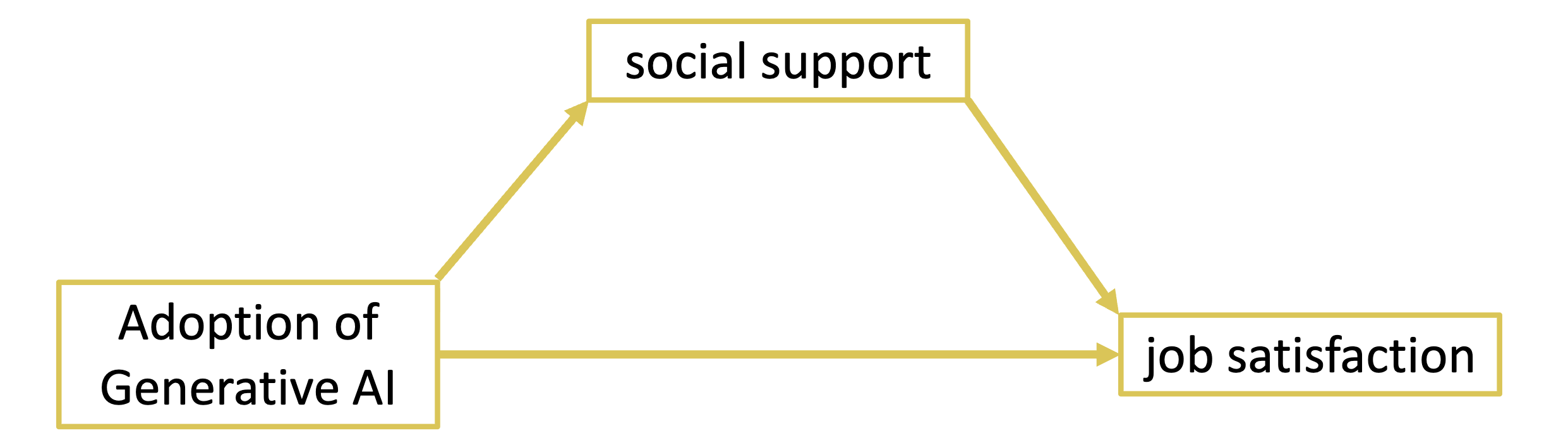
Moderation

Research design
Experimental
Assigns participants to conditions randomly
Example: the impact of a new policy (e.g., optional remote work) on employee performance; a sample of new employees gets randomly divided into 2 groups: with policy, and without; IV is manipulated to measure DV, and assignment to conditions is random
Quasi-experimental
Design assigns participants to conditions in a non-random way
Example: evaluating the efficiency of a new policy, with one department getting the new policy, and the other working as usual. The IV (policy/no policy) is manipulated, but the groups are not random
Non-experimental
Does not involve manipulation or assignment to different conditions
Example: evaluating the efficiency of the new policy by sending out a survey after its implementation
Individual Differences
Dissimilarities between or among two or more people
Background
1890 — Cattell and concept of “mental test”
Differential psychology
Psychometrics
World War I and intelligence tests
“g” or general mental ability
Varieties of Individual Differences
Cognitive ability and the g-ocentric model
Physical ability
Personality
Interests
Knowledge
Emotion
Assumptions for individual differences relevant for work performance
5 main assumptions:
1. Adults possess different attributes (e.g. intelligence, personality, interests), which remain relatively stable over several years.
2. People differ in these attributes and these differences are related to job success
3. Individual differences remain relatively consistent even with experience
4. Different jobs require different combinations of individual attributes
5. These attributes can be measured through appropriate assessment methods (i.e. psychological tests)
Definitional Issues in Intelligence
IQ is a historical term that stands for “intelligence quotient”; term is popular with laypersons but is generally not used by scientists.
Mental ability and cognitive ability are current terms that scientists often use interchangeably
Cognitive ability and mental ability often refer to specific abilities such as memory or reasoning; intelligence refers to general intellectual capacity (often called “g” for GMA).
The Five Factor Model (FFM)

Foundations of Assessment
Past and present of testing
1890—Cattell and “mental test”
WWI: Over million soldiers tested
First trial of large-scale group testing
During WWII: full employment
After WWII: little control over testing
1960s—constraints on testing
Criticism by social observers
Civil Rights Act of 1964
Cognitive Ability Tests (cont'd)
Cognitive test batteries
General Aptitude Test Battery (GATB)
Personality
Screen-out tests → Identify psychopathology
Generally used for positions of public trust
May only be administered after offer of employment
Best known example is the MMPI
Screen-in tests → Identify normal personality
May be administered as pre-employment tests
Examples include HPI, NEO-PI, PCI
Emotional Intelligence
Controversial construct with continued research investigating its links with Big Five, cognitive ability, and work outcomes
Ability-based EI measures have lower overlap with Big Five personality measures, whereas self-report EI measures overlap strongly with Big Five
Integrity Testing
Overt Integrity Test
Asks questions directly about past honesty behavior (stealing, etc.) as well as attitudes toward various behaviors (employee theft, etc.)
Personality Based Integrity Test
Test that infers honesty and integrity from questions dealing with broad personality constructs (conscientiousness, reliability, and social responsibility)
Interviews
Structured interview
Situational interview
Unstructured interview
Assessment Centers
Collection of procedures used for evaluation, often for possible promotion
Grades and Letters of Recommendation
May be able to predict job offers, but not job success
Controversial Assessment Practices
Graphology
Assumes traits can be assessed from various characteristics of a person’s handwriting
Polygraph
Machine that measures person’s physiological reactions and signals deception
Incremental validity
Value in terms of increased validity of adding a particular predictor to an existing selection system
Linear regression utility (or prediction) formula
ΔU stands for change in utility
It represents the expected gain in performance or economic value (often measured in dollars or output) per person hired

Feelings of Unfairness Regarding Staffing Strategies can Lead to…
Initiation of lawsuits
Filing of formal grievances with company representatives
Counterproductive behaviour
Practical Issues in Staffing
Staffing Model
Comprehensiveness
Enough high quality information about candidates to predict likelihood of their success
Compensatory
Candidates can compensate for relative weakness in one attribute through strength in another one, providing both are required by job
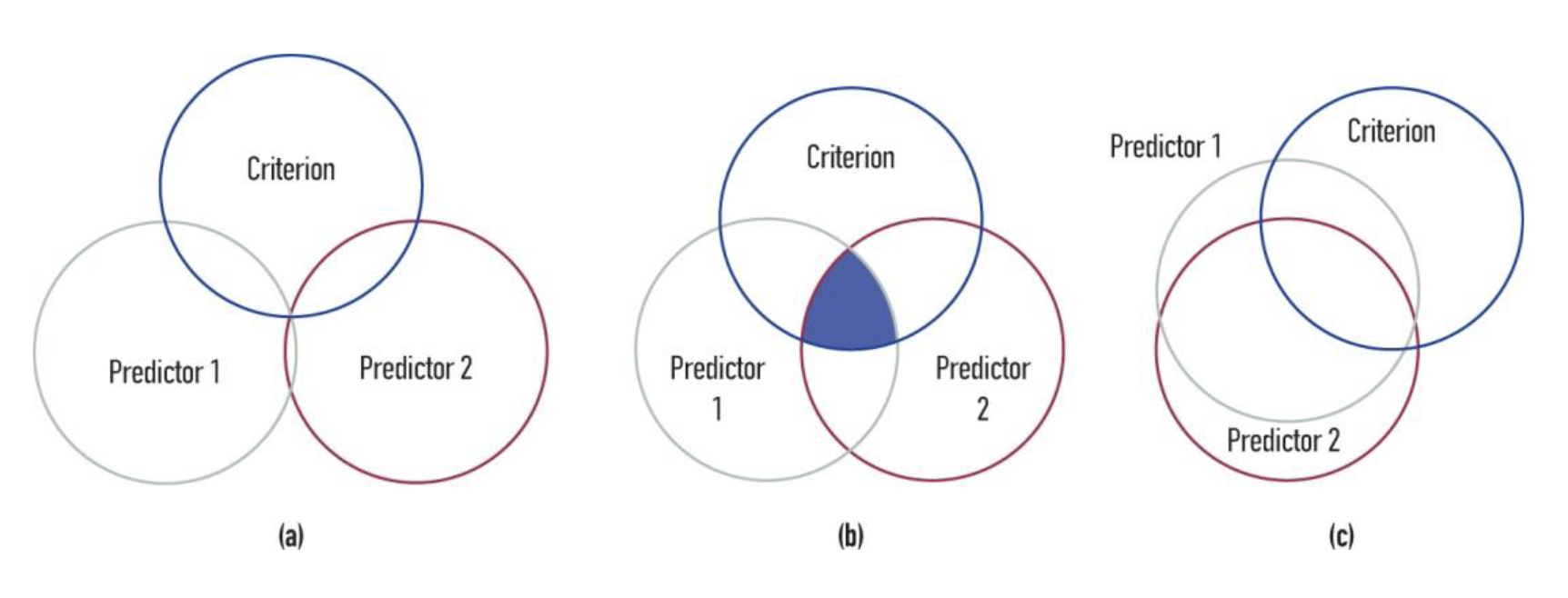
Relationship between Predictor Overlap and Criterion Prediction
A Basic Model of Performance
Basic definitions
Performance: Actions or behaviors
Effectiveness: Evaluation of results of performance
Productivity: Ratio of effectiveness (output) to cost of achieving that level of effectiveness (input)
Campbell’s Model of Job Performance
3 direct determinants of job performance
Declarative knowledge (DK)
Procedural knowledge and skill (PKS)
Motivation (M)

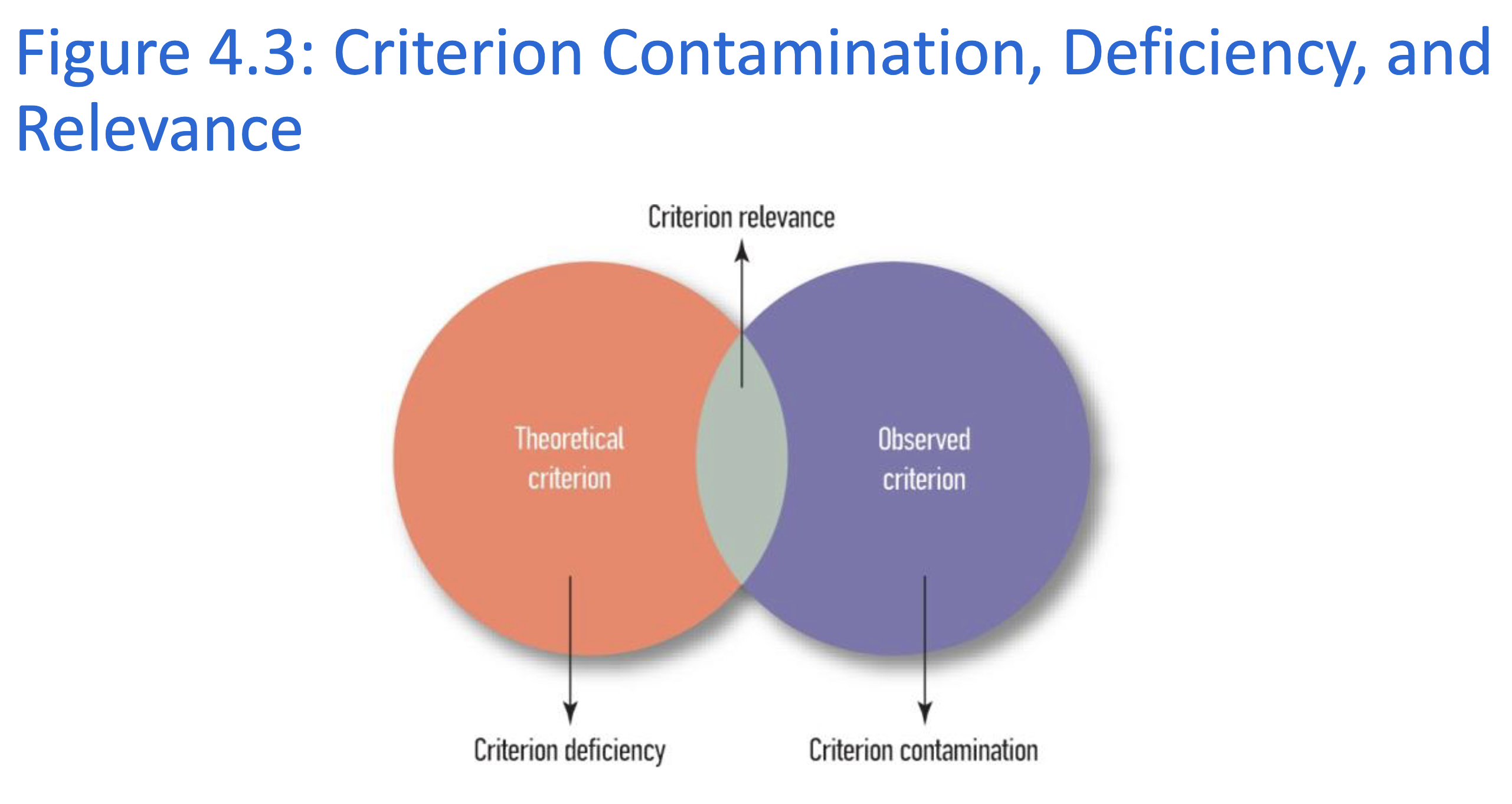
Criterion Deficiency and Contamination
Ultimate (theoretical) criterion
Ideal measure of all relevant aspects of job performance
Actual criterion
Actual measure of job performance obtained
Differences between ultimate criterion and actual criterion represent imperfections in measurement— deficiency and contamination
Measuring performance: Criterion Deficiency and Contamination (cont'd)
Criterion deficiency
When actual criterion is missing information that is part of behavior one is trying to measure
Criterion contamination
When actual criterion includes information unrelated to the behavior one is trying to measure
Extensions of the Basic Performance Model
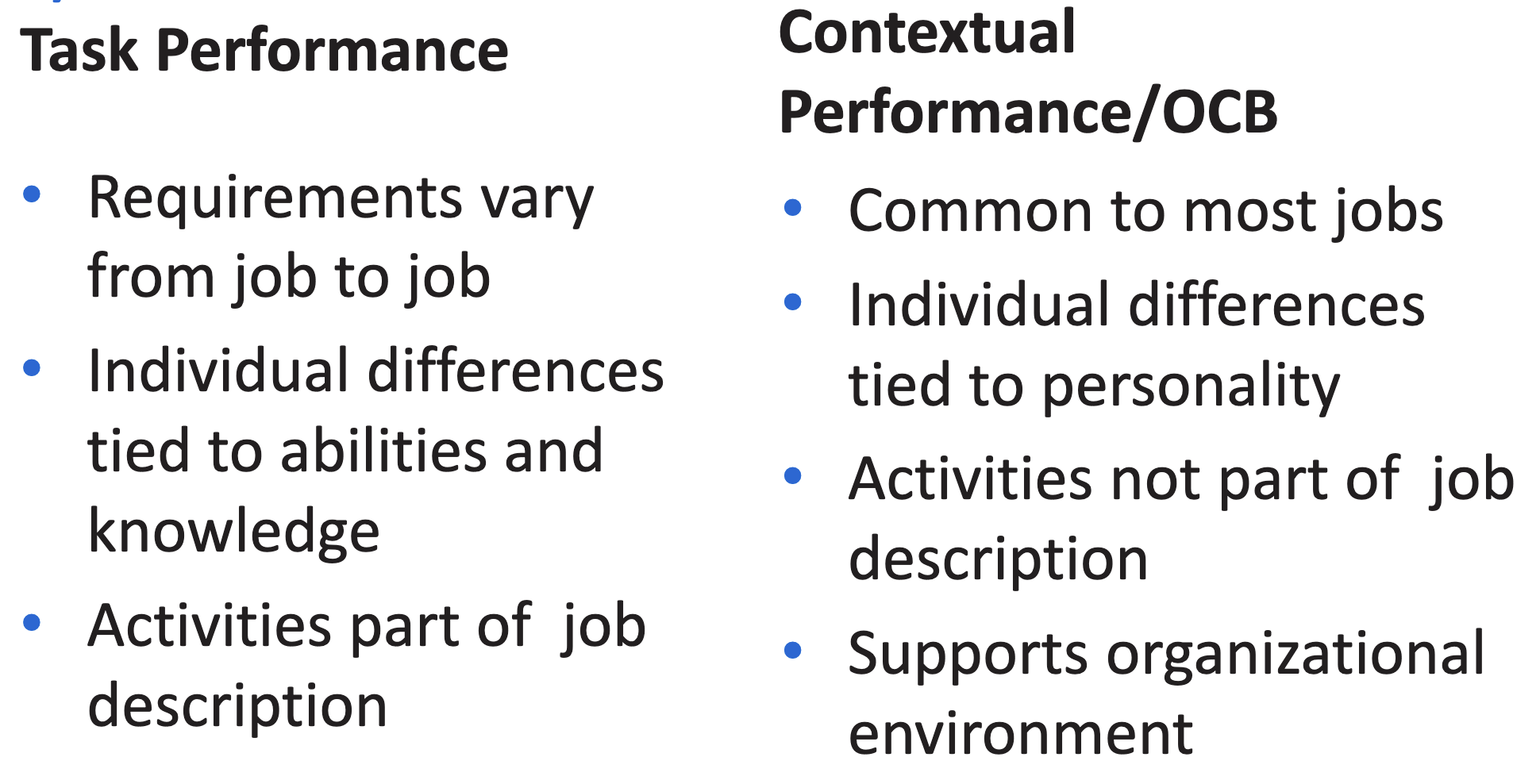
Task performance (Doing just what is expected)
versus
Organizational Citizenship Behavior (Going beyond what is expected)
Expert Performance
Performance exhibited by those who have practiced for at least 10 years and have spent average of 4 hours/day in deliberate practice
Deliberate practice
Individualised training on tasks selected by a qualified teacher
Common Counterproductive Behaviors (CWBs)
Dishonesty
Employee theft or dishonest communications
Absenteeism
Failure to report for or remain at work as scheduled
Sabotage
Acts that damage, disrupt, or subvert the organization’s operations
KSAOs
Knowledge
Collection of discrete, related facts and information about a particular domain
Skill (e.g., computer or interpersonal skills)
Practiced act
Ability (e.g., cognitive or physical ability)
Stable capacity to engage in a specific behavior
Other characteristics: interests, personality, etc.
Job Evaluation, Comparable Worth, and the Law
Job evaluation
Method for making internal pay decisions by comparing job titles to one another and determining their relative merit
Compensable factors
Skills, responsibility, effort, and working conditions
Equal Pay Act of 1963: requires “equal pay for equal work”
Three problems with Performance
Defining performance
Predicting performance
Measuring performance
A Basic Model of Performance
Basic definitions
Performance: Actions or behaviors
Effectiveness (Results): Evaluation of results of performance
Productivity: Ratio of effectiveness (output) to cost of achieving that level of effectiveness (input)
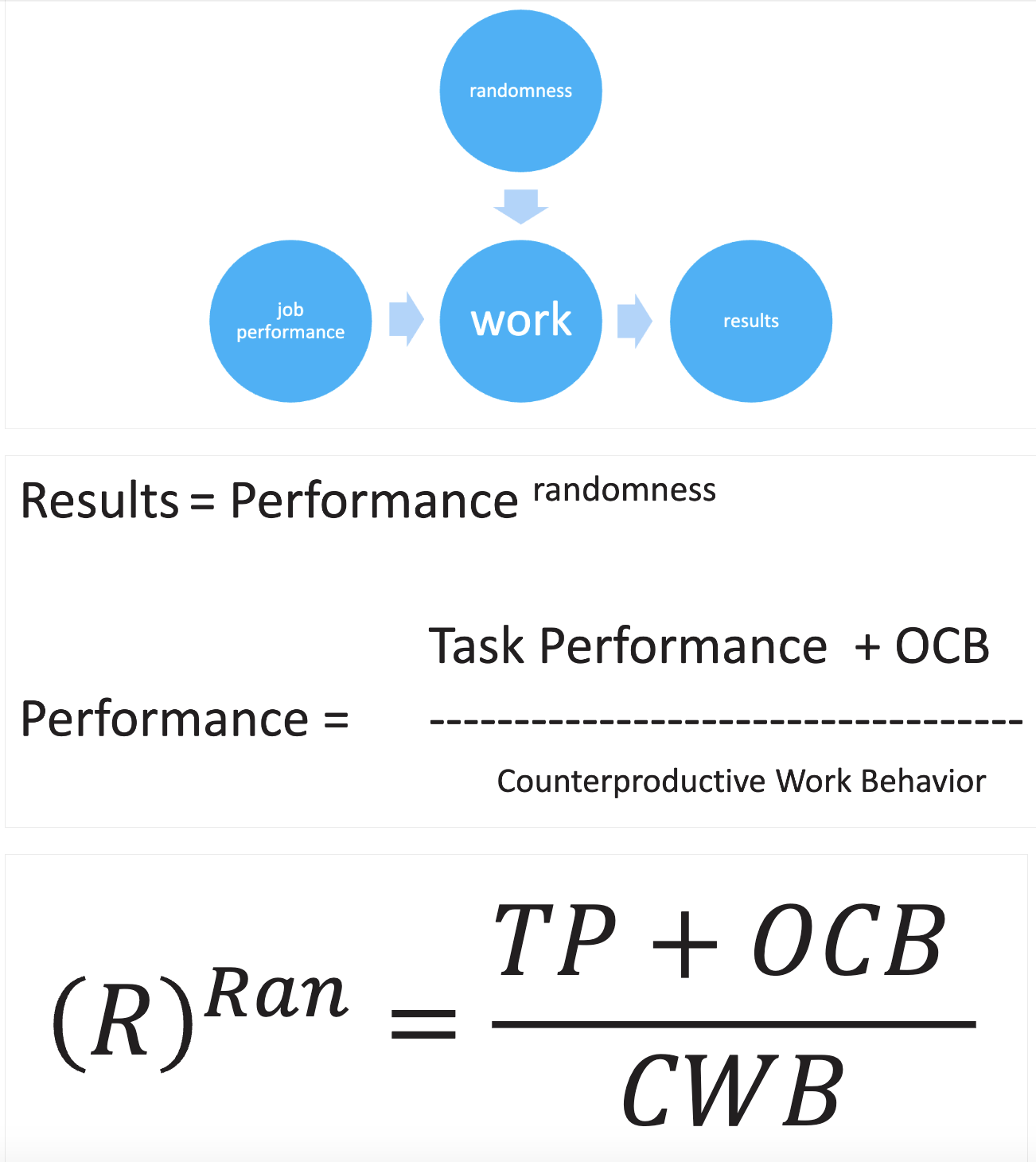
Results
Results
The outcome of employee behaviors that contribute to organizational effectiveness
Randomness
The lack of pattern or predictability in events
A black swan
An event that:
Is unexpected
Has high impact
Is understandable in hindsight
Basic Concepts in Performance Measurement
Uses for performance information
Criterion data
Employee development
Motivation/satisfaction
Rewards
Promotion
Layoff
Types of Performance Data
Objective: numerical results (e.g. sales volume, number of products made, attendance)
Personnel
Judgmental / Subjective: a person evaluates an employee’s effectiveness
Hands-on measures: employees perform job-related tasks / simulations while a trained observer assesses their performance
Walk-through testing: employees explain how they would complete a work task.
Comparison methods: employees are compared with one another (e.g. ranking)
Electronic performance monitoring: technology is used to collect information about employees’ performance
Perceptions of Fairness in Performance Measurement
Factors associated with fairness measurement
Appraisal frequency “+” related to fairness perceptions
Joint planning with supervisor to eliminate weaknesses enhances fairness perception
Supervisor’s knowledge of duties of person being measured
Supervisor’s knowledge of actual performance of person being rated
Perceptions of Fairness in Performance Measurement (cont'd)
Distributive justice
Fairness of outcomes related to decisions
Procedural justice
Fairness of process by which ratings are assigned and a decision is made
Interpersonal justice
Respectfulness and personal tone of communications surrounding evaluation
Focus on Performance Ratings
Overall performance ratings
Influenced by 3 factors
Task performance
Contextual performance
Counter-productive performance
Employee Comparison Methods
Involve direct comparison of one person w/another
Simple ranking
Employees ranked from top to bottom according to assessed proficiency
Paired comparison
Each employee in a group is compared with each other individual in the group
Employee Comparison Methods (cont’d)
Useful in making layoff or downsizing decisions
Feedback is difficult because there is no clear standard of performance
Difficulty in comparing individuals in different groups
360-degree feedback
A performance evaluation method that collects feedback from several sources (e.g. supervisors, peers, subordinates, and sometimes clients, suppliers, employee self-assesments), rather than relying only on the employee’s supervisor
Important guidelines:
Ensure anonymity
Choose evaluators together with both supervisors and employees
Train participants who give / deliver feedback
Focus on common themes across the reports
Potential Sources for 360 Degree Feedback

Rating Distortions
Central tendency error
Raters choose mid-point on scale to describe performance when more extreme point is more appropriate
Leniency-severity error
Raters are unusually easy or harsh in their ratings
Rating Distortions (cont'd)
Halo error
Same rating is assigned to an individual on a series of dimensions, causing the ratings all to be similar; lack of identification of strengths and weaknesses
A “halo” surrounds the ratings
Rater Training
Some distortions (errors) may be corrected through training
Administrative training
Important for uncommon rating systems (e.g., BARS) or if one or more structural characteristics are deficient
“Destructive” Criticism
Feedback that is cruel, sarcastic, and offensive
Usually general rather than specific
Often directed toward personal characteristics of employee
Leads to anger, tension, and resentment on part of employee
Apology best to repair damage of such criticism
Implementing 360 Degree Feedback
Ensure anonymity of sources
Rater and ratee should jointly identify the evaluator
Use for developmental and growth purposes
Train information sources and those giving feedback
Follow up feedback session with regular opportunities for progress assessment
Performance Evaluation and Culture
Hofstede’s five dimensions of culture might affect performance evaluations
Modesty bias
When raters give themselves lower ratings than warranted
Prevalent in cultures with high power distance
Foundations of Training and Learning
Training
Systematic acquisition of skills, concepts, or attitudes resulting in improved performance in another environment
Basic foundation for training programs is learning
Learning
Relatively permanent change in behavior and human capabilities produced by experience and practice
Three broad categories of learning outcomes
Cognitive outcomes
Skill-based outcomes
Affective outcomes
Performance
Actions or behaviors relevant to organization’s goals; can be measured in terms of each individual proficiency
Can often be directly observed
We assume learning takes place from observing performance
Training, Learning, and Performance
Training increases probability of learning, and learning increases probability of better job performance
Training Needs Analysis
Three-step process
Organizational analysis
Task analysis
Person analysis
Required to develop systematic understanding of where training is needed (organizational), what needs to be trained (task), and who will be trained (person)
Organizational analysis
Examines:
organizational goals
available resources
organizational environment
…To determine where training should be directed.
Task analysis
Examines what employees must do to perform the job properly
Identifies and describes:
Tasks performed by employees
KSAOs needed for successful job performance
Person analysis
Identifies which individuals in an organization should receive training and what kind of instruction they need.
Employee needs can be assessed using a variety of methods that identify weaknesses that training and development can address
Learning and Motivational Theories Applied to Training
Reinforcement theory
Learning results from association between behaviors and rewards
Positive reinforcement - desired behavior followed by reward
Behavior modification - simple recognition and feedback can be effective in increasing performance
Cognitive learning theory
People learn by processing, understanding, organising, and remembering information
Social learning theory
People learn by observing others, practicing what they see, and receiving feedback
Social learning theory proposes that there are many ways to learn including:
Behavioural modelling
1. Observe actual job incumbents demonstrate positive modelling behaviours
2. Rehearse before using role-playing
3. Receive feedback on rehearsal
4. Try behaviour on the job
Broad approach:
Self-efficacy - belief in one’s capability to perform
Goal setting - specific, difficult goals direct attention and improve performance
Feedback - knowledge of results of one’s actions
enhances motivation, learning, and performance
Fidelity
Extent to which task trained is similar to task required by job
Physical fidelity
Extent to which training task mirrors physical features of task performed on job
Psychological fidelity
Extent to which training task helps trainees develop KSAOs necessary to perform job
Evaluating Training Programs
Training evaluation
Systematic collection of descriptive and judgmental information that can be used to make effective training decisions
Several purposes of training evaluations

Saks and Burke (2012)
Hypothesis 1: The frequency of training evaluation at all four levels will be positively related to the transfer of training
Hypothesis 2: The frequency of training evaluation of behavior and results criteria (levels 3 and 4) will be more strongly related to the transfer of training than reactions and learning criteria (levels 1 and 2).
Results
Training evaluation-transfer of training paradox:
Organizations are most likely to evaluate trainee reactions and learning
BUT only behavior and results criteria are significantly related to higher rates of training transfer
Dunlosky et al. (2016)
Performance = Motivation x Ability x Environment