AUTHORSHIP & FIRST OWNERSHIP ECONOMIC AND MORAL RIGHTS
 Call Kai
 Learn
 Practice Test
 Spaced Repetition
 Match
 Flashcards
 Knowt Play
1/19

There's no tags or description
Looks like no tags are added yet.
20 Terms
Authorship and First Ownership
Who is the author of a copyright work?
Section 9(1) CDPA 1988
The author is the person who creates the work (traditional author’s works)
Section 9(2)
Sound recording — producer.
Film — producer and principal director.
Broadcast — person making the broadcast.
Typographical arrangement — publisher.
Section 9(3)
Computer-generated literary, dramatic, musical or artistic work — person undertaking the arrangements necessary for creation.
The author is the first owner of copyright — Section 11(1) CDPA.
◦ Employment exception: The employer is ordinarily the first owner of qualifying works created by employees in the course of employment — section 11(2) CDPA (literary, dramatic, musical, artistic, film). The employment rule is subject to agreement to the contrary.
Stevenson, Jordan & Harrison v MacDonald & Evans [1952] 69 RPC 10
Copyright ownership depends on whether the work was created in the course of employment, rather than merely during employment)
◦ Copyright may subsequently be assigned under section 90 CDPA, but it must be in writing and signed by or on behalf of the assignor
Bentley Book pg 143– while to describe the creator of a painting or a sculpture as an ‘author’ may jar few problems arise in ascertaining who is the author of most literary, dramatic, musical and artistic work – question of an amanuensis is an author see Donoghue v. allied newspapers[1938] 1 ch 106. This is because in relation to traditional categories of literary dramatic musical and artistic works, there is a general consensus aas to which of the various people involved in the production of a work is to be treated as the creator or author of it . Moreover it is no impediment to the recognition of authorship that an author utilises technology; whether that be a journalist making an audio recording , a writer typing on a laptop; a photographer adjusting an image with computer software or in principle a composer prompting artificial intelligence.
More problems in relation to entrepreneurial works and computer generated work. Concept of authorship does not sit comfortably with the way in which we tend to think about such works – we do not normally think of a sound recording, a typographical arrangement or a broadcast as having an author, even in the broad sense in which it is used in copyright law
‘author’ is an artificial construct, a legal fiction, which is used to allocate rights.
Computer generated – by definition has no author of the work – the author is the person whom the arrangement necessary for the creation of the work are undertaken
Cummins v bond – spirutlaist who produced ‘automatic writing; dictated to her from beyond the grave at a séance was the author of the resulting work
S 178 cdpa computer-generated by whom the arrangements necessary for creation of the work is undertaken
Martin v kogan
coa emphasised the concept of the person who pushes the pen – authorship
Non distinctness - IDDQD V codeberry
judge hacon suggested that the contribution of one author’s is not distinct in nature, in classifiable form , from that of the authors.
ommissioned – r Griggs group v evans
doc martins commissioned advertising agency Jordon to produce logo . evan did the freelance work for Jordon produced the work and paid his standard £15 an hour
Key Facts
The Logo: In 1988, R. Griggs Group (manufacturer of Dr. Martens footwear) commissioned an advertising agency to combine its "Dr Martens" and "AirWair" trademarks into a single unified logo. [1, 2]
The Creator: The advertising agency hired an independent freelance designer, Ross Evans, to draw the design. [1]
The Dispute: Evans retained legal ownership of the copyright as an independent contractor (not an employee). He later assigned the copyright to an Australian rival company, Raben Footwear Pty Ltd. Griggs argued that they were the rightful equitable (beneficial) owners of the copyright worldwide. [1, 2, 3]
Core Legal Issue
Who owns the copyright to a commissioned work when an independent contractor creates it and the contract does not explicitly assign the copyright to the client? [1, 2]
Court Findings & Decision
Implied Term: The High Court and the Court of Appeal ruled in favor of Griggs, holding that an agreement transferring the beneficial ownership of the copyright to the commissioning client must be implied into the contract based on business efficacy and the "officious bystander" test. [1, 2, 3]
The Rationale: A reasonable person would not expect a designer to create a brand logo for a client and then retain the power to stop that client from using it globally or to sell the copyright to a competitor. [1, 2]
Outcome: The appeal by Evans and Raben was dismissed, and Griggs was confirmed to have full beneficial ownership. [1, 2]
ch their contributions are not distinct. Section 10(1) CDPA 1988
Relevant considerations:
◦ Collaboration in producing the work.
◦ Authorial contributions.
◦ A common design.
◦ Contributions that are not distinct.
◦ Kogan v Martin [2019] EWCA Civ 1645: Joint authorship does not require equal contributions. Focuses on whether an author made an authorial contribution to the work as a whole.
Work of co-authorship: Work produced by the collaboration of the author of a musical work and author of literary work where the two works are created in order to be used together. Section 10A CDPA
ECONOMIC RIGHTS

• The restricted acts apply differently to different categories of copyright works.
• Infringement may involve the whole work or a substantial part (Section 16 (3)).
• The rights are subject to statutory exceptions and other limitations.
Reproduction right u/17. Communication to the public will be examined in the next lecture
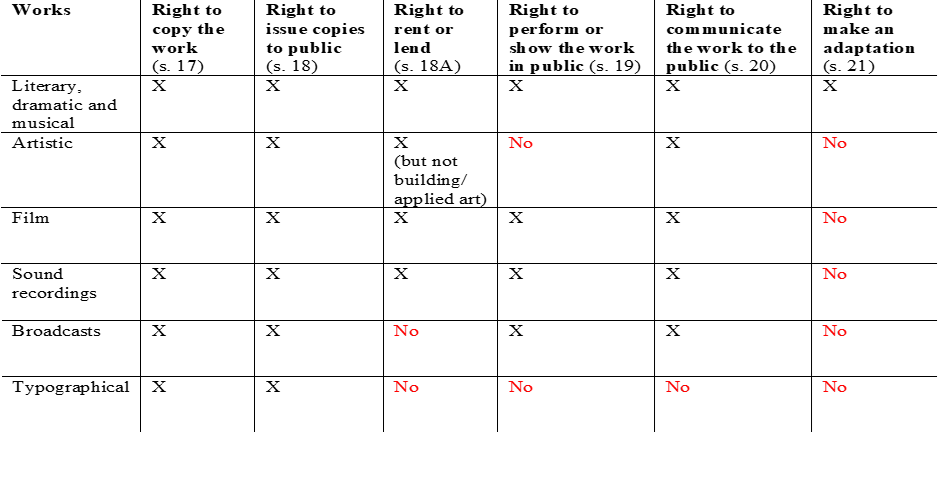
reproduction right – Right to copy the work
Reproduction right
• The copying of the work is an act restricted by the copyright. This right extends to ALL categories of “works” Section 17(1) CDPA.
◦ Literary, dramatic, musical and artistic works (Section 17(2)): Reproducing the work in any material form, including storing it electronically.
◦ Artistic works (Section 17(3)): Copying includes making a three-dimensional copy of a two-dimensional work, and vice versa.
◦ Films, broadcasts and sound recordings (Section 17(4)–(5)): Specific rules govern copying or recording the protected subject matter.
◦ Typographical arrangements (Section 17(6)): Copying means making a facsimile copy of the arrangement.
Two important principles
◦ Copying may concern the whole work or a substantial part (Section 16(3)).
◦ Temporary electronic copies can engage the reproduction right, although some are exempt from infringement where the conditions of Section 28A are satisfied..
Copying a Substantial Part – Quality, Not Just Quantity
◦ Copyright infringement may arise from copying the whole or a substantial part of a protected work.
◦ Substantiality is primarily qualitative, not merely quantitative.
◦ The court examines the significance of the material taken in relation to the original copyright work.
◦ The copied material must reflect protected expression, rather than merely unprotected ideas.
Designers Guild Ltd v Russell Williams (Textiles) Ltd [2000] UKHL 58 – Assess substantiality by examining what has been taken from the claimant's work; a combination of elements may be significant.
Infopaq International A/S v Danske Dagblades Forening (C-5/08) – Even an extract of 11 words may reproduce a protected part if it contains elements expressing the author's own intellectual creation.
Note: A small extract can be substantial; a large extract is not automatically infringing.
Reproduction Beyond Exact Copies – What Counts as Copying?
◦ Direct copying: Reproducing protected material from the original work.
◦ Indirect copying: Reproducing protected material through an intermediate source. E.g. tattoos
◦ Similarity alone is insufficient: The claimant must establish copying of protected expression.
◦ Changes do not necessarily avoid infringement: A copy may differ in appearance or form yet retain a substantial part of the original work.
King Features Syndicate Inc v O & M Kleeman Ltd [1941] AC 417 (HL) – Popeye Toys
◦ The defendants imported and sold unauthorised Popeye dolls and brooches reproducing protected features of the original cartoon drawings. Copying through intermediate representations did not prevent copyright infringement, even though the products were three-dimensional.
◦ Key principle: Indirect copying and reproduction from 2D to 3D may infringe copyright where the whole or a substantial part of protected artistic expression is reproduced. – indirect copy infringement
◦ CDPA 1988, ss 16(3) and 17(3).
2d à 3d and vice v3rsa = infrigenement UNLESS IT IS TECHINICAL STUFF
Can Following Instructions Amount to Copyright Reproduction?
Copying a drawing into a physical object
Copyright can protect artistic drawings, including technical drawings. 2D to 3D copying: Making a three-dimensional object from a two-dimensional drawing may infringe copyright.
But not always: Section 51 provides an important exception. If you have a design drawing or model for an ordinary, functional product, someone does NOT infringe your copyright by making the physical product shown in that drawing.
Following instructions is not necessarily copying
Copyright protects the words and illustrations in an instruction manual. It does not generally protect the underlying ideas, methods or procedures. Example: Copying a cake recipe's written instructions may infringe copyright; baking the cake by following them does not, by itself.
Brigid Foley Ltd v Ellott [1982]: Following written knitting instructions to produce a physical garment is not copying literary expression.
Autospin (Oil Seals) Ltd v Beehive Spinning [1995]: Manufacturing a functional article from ideas or dimensions does not circumvent design law into copyright.
Sandman v Panasonic [1998]: There is a distinction between using information and copying protected expression Using the technical information disclosed in circuit diagrams is not the same as copying their artistic expression.
Reproduction of Sound Recordings and Films
Sound recordings
Copyright protects the recording itself, not the underlying musical composition. Copying a substantial part of the recorded sounds may infringe. Section 5A and Section 17 CDPA 1988
Films
◦ Copyright protects the recorded moving images. Copying footage or photographing a substantial part of a film image may infringe. Similar filming techniques or visual styles do not necessarily amount to copying.
◦ Section 17(4) CDPA 1988
Note: Copyright in a sound recording or film is separate from copyright in the underlying music, script or other protected works.
Compared to authorial works that protects the content in the work – the definition of “reproduction” in entrepreneurial works are narrow
Sound recording copyright protects the recording of sound, rather than content per se and the content may include the song, storyline, plot or language – or the music or lyrics (which may be protected by literary work). Sound recording of speech is not infringed when speech is transcribed
Film copyright protects the recording of the image, rather than the image itself.
◦ Film copyright not infringed when a description of film is written or play replicating film is staged.
◦ Copyright not infringed if someone records contents of a similar nature of style of film or sound recording (Norowzian v. Arks [1998] – Independently reshooting a similar scene without copying the original film frames may avoid infringement of film copyright. However, copying protected dialogue or dramatic expression may infringe separate copyright.
◦ Recording WILL be treated as reproduction EVEN IF the recording medium has changed.
Reproduction of broadcasts and typographical arrangements Broadcasts:
B
◦ Broadcast copyright protects the transmitted broadcast, rather than the underlying information, sounds or images as independent content.
◦ No infringement if someone summarises or describes the contents of the broadcast
◦ Independently broadcasting the same material in the same order does not, by itself, infringe copyright in the original broadcast but may infringe copyright in underlying works.
Typographical arrangements:
◦ Copying of typographical arrangement of a published edition means making a facsimile copy of the arrangement
◦ Facsimile includes enlargements and reductions but within the framework of copies made through the use of reprography, photocopiers, digital scanners, fax copiers.
◦ Retyping the text without reproducing the published layout does not normally infringe copyright in the typographical arrangement, although copyright in the underlying text may still be infringed.