Ecology Exam2 (updated 10/19)
 Call Kai
 Learn
 Practice Test
 Spaced Repetition
 Match
 Flashcards
 Knowt Play
1/180

There's no tags or description
Looks like no tags are added yet.
181 Terms

Based on the data in the graph, what is the carrying capacity in this environment?
28
Which principle is illustrated by Lande’s theoretical work with spotted owls?
If the availability of suitable habitat for a species goes below a critical threshold, the entire metapopulation will collapse.
Which pattern of population dynamics best describes that exhibited by sheep introduced to the island of Tasmania?
logistic growth
Which statement about population fluctuations is true?
All of the above
Sequential hermaphrodism and paedomorphic development are both adaptations that allow individuals to take advantage of
conditions that are most favorable for reproduction
T/F? Ecological interactions among organisms and between organisms and their environment can cause evolutionary changes, ranging from allele frequency changes in populaitons to the formation of new species
True
Which of the following cannot be an example of evolution?
After repeated exposure to high temperatures, an individual turtle can tolerate heat more successfully.
Which process is least likely to be the direct cause of appreciable change in allele frequencies over short periods of time?
Mutation
If a population of monkeyflowers has 500 members with 135 of genotype DD, 280 of genotype Dd, and 85 of genotype dd,
what is the frequency of the D allele?
0.55
Which statement about genetic drift is false?
It tends to decrease genetic differences among different populations.
The term “r-selection” refers to selection
for high population growth rates.
There are advantages and disadvantages to sexual reproduction. The low levels of genetic variation resulting from sexual reproduction may be beneficial in challenging environments.
False
Genetic divergence between populations over time can lead to speciation, the process by which one species splits into two or more species. Speciation requires the evolution of reproductive barriers between populations.
True
Which statement about the r–K continuum is true?
It involves an ecological trade-off.
Which organisms would be most likely to be K-selected?
Lions
Which of the following has resulted from commercial fishing for cod?
A reduction in the age and size at which fish become sexually mature
Which of the following cannot be an example of evolution?
After repeated exposure to high temperatures, an individual turtle can tolerate heat more successfully.
Tall people generally have tall parents, and short people tend to have short parents. Based on this observation, we can infer that height is
a heritable trait.
In cod fishing, older and larger fish are more likely to be retained in nets than younger and smaller fish. Despite the removal of these large breeders, the population is still reproducing. How do you think cod characteristics have changed due to the selection pressure from over-fishing?
Selection has led to decreases in the size of fish at the age of maturity.
Evergreen foliage would most likely be found in which of Grime’s categories of plants?
Stress-tolerant

Based on the graph, the largest mass extinction occurred about _______ million years ago.
250
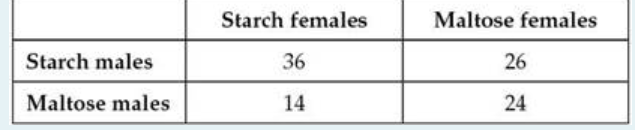
Suppose that, following the experiments by Dodd, Drosophila pseudoobscura are fed one of two diets (starch or maltose) for many generations. Once they have adapted to the new food sources, individual females from the starch treatment are given a choice between a male adapted to starch (a starch male), or a male adapted to maltose (a maltose male). When 50 females have chosen a mate, the experiment is repeated with females adapted to maltose. According to the results, what percentage of starch females chose maltose males?
28%
Although natural selection acts on individuals, an individual does not evolve – either it has a favored trait or it does not. Only populations evolve.
True
Suppose a population of shorthorn cattle has only two alleles (R and r) at a locus. If the frequency of R is 0.37, what is the frequency of r?
0.63
All plants and some algae have a complicated life cycle with both a multicellular diploid _______ stage and a multicellular haploid _______ stage. This type of life cycle is called _______.
sporophyte; gametophyte; alternation of generations
Which pair of evolutionary processes can introduce new alleles into a population?
Gene flow and mutation
Grasshoppers and crickets share many similar characteristics such as general body form, elongated hind wings (which they use for jumping), and particular wing structures. The simplest hypothesis that would explain the similarities between these insects is that they resulted from
shared ancestry.
Fitness
The genetic contribution of an organism’s descendants to future generations
Dispersal
The movement of organisms or propagules from their birthplace
Iteroparous
Having the capacity to reproduce multiple times in a lifetime
Isogamy
The production of equal-sized gametes
Direct development
A simple life cycle that goes directly from fertilized egg to juvenile without passing through a free-living larval stage
Allocation
The relative amounts of energy or resources that an organism devotes to different functions
Anisogamy
Production of two types of gametes of different sizes
Semelparous
Reproducing only once in a lifetimes
Which classification scheme or metric is generally most helpful for comparing life histories across broad ranges of size or taxonomy?
Charnov’s dimensionless ratio (c)
Which statement about the impacts of climate change on the snowshoe hare is true?
The number of days of camouflage mismatch has increased.
Which statement about Lack’s experiments on clutch size is true?
They demonstrated ecological trade-offs.
They showed that the life histories of birds vary depending on their geography.
(Both a and c)
Trophy hunting in bighorn sheep has had an inadvertent evolutionary consequence: the sheep have become _______ and their horns have become _______.
smaller; smaller
There is a trade-off between offspring size and number, such that organisms tend to produce large numbers of relatively small offspring or small numbers of relatively large offspring.
True
Which process can produce new combinations of alleles in a population?
Recombination
Which statement about the r–K continuum is true?
Most species are intermediate between the two extremes.
Adaptive radiations can be promoted by factors such as the removal of competitor groups by a mass extinction or the evolution of a major new adaptation.
True
Natural selection modifies populations by favoring individuals with some heritable traits over other individuals.
True
Four clownfish individuals of the species Premnas biaculeatus live in a single anemone. Albert measures 15 cm, Barry is 12 cm, Cindy is 8 cm, and Diane is 6 cm. Based on what you know about clownfish biology, which statement is most likely true?
Barry is the only breeding male.

Refer to the diagram, showing four cases of selection on egg number in a population of flour beetles. The solid blue line represents the frequency of the original population, and the dashed red line represents the frequency distribution after eight generations. Which graph most likely represents a case of disruptive selection?
Graph C
K-selection
In the r-K continuum used for classifying life history strategies, the selection pressure for slower rates of increase faced by organisms that live in environments where population densities are high (at or near the carrying capacity, K).
Morphs
Discrete phenotypes with few or no intermediate forms.
r-selection
In the r-K continuum used for classifying life history strategies, the selection pressure for high population growth rates faced by organisms that live in environments where population densities are usually low.
Paedomorphic
Resulting from a delay of a developmental event relative to sexual maturation.
Sequential
hermaphroditism
Resulting from a delay of a developmental event relative to sexual maturation.
Metamorphism
An abrupt transition from a larval to a juvenile life cycle stage that is sometimes accompanied by a change in habitat.
Life history strategy
An abrupt transition from a larval to a juvenile life cycle stage that is sometimes accompanied by a change in habitat.
Life history
The major events relating to an organism's growth, development, reproduction, and survival; these events include the age and size of first reproduction, the amount and timing of reproduction, and longevity.
Phenotypic plasticity
The ability of a single genotype to produce different phenotypes under different environmental conditions.

According to the graphs, in 2005 the sheep, on average, weighed approximately _______ than sheep weighed in 1976.
20 kg less
Which statement about genetic drift is false?
It tends to decrease genetic differences among different populations.
Which process is least likely to be the direct cause of appreciable change in allele frequencies over short periods of time?
Mutation

The graph shows the relationship between the trunk diameter and the leaf mass of ponderosa pine trees from both moist and desert climates. According to the graph, a tree in a desert climate with a trunk diameter of about 40 cm would have about the same leaf mass as a tree in a cool moist climate whose trunk diameter is about _______ cm.
30

Three different genotypes of garter snakes (A, B, and C) were reared at different temperatures. Four individuals were in each trial. The table below presents their weights (in grams). Based on these data, which genotype appears to show phenotypic plasticity?
Genotype A only
Four clownfish individuals of the species Premnas biaculeatus live in a single anemone. Albert measures 15 cm, Barry is 12 cm, Cindy is 8 cm, and Diane is 6 cm. Based on what you know about clownfish biology, which statement is most likely true?
Albert is the only female.
According to Grime’s classification scheme, processes that destroy plant biomass are called
disturbances
Ecological interactions among organisms and between organisms and their environment can cause evolutionary changes, ranging from allele frequency changes in populaitons to the formation of new species
True
Genotype
The genetic makeup of an individual
Stabilizing selection
Selection that favors individuals with an intermediate phenotype
Allele
One of two or more forms of a gene that result in the production of different versions of the protein that the gene encodes.
Adaptive radiation
An event in which a group of organisms gives rise to many new species that expand into new habitats or new ecological roles in a relatively short time.
Gene flow
The transfer of alleles from one population to another via the movement of individuals or gametes.
Directional selection
Selection that favors individuals with one extreme of a heritable phenotypic trait.
Genetic drift
A process in which chance events determine which alleles are passed from one generation to the next, thereby causing allele frequencies to fluctuate randomly over time; the effects of genetic drift are most pronounced in small populations.
Trade-off
An organism's allocation of its limited energy or other resources to one structure or function at the expense of another.
Disruptive selection
Selection that favors individuals with a phenotype at either extreme over those with an intermediate phenotype.
Adaptive evolution
A process of evolutionary change in which traits that confer survival or reproductive advantages tend to increase in frequency in a population over time.
According to Grime, under conditions of low stress and low disturbance _______ plants should predominate.
competitive
Adult monarch butterflies overwinter
in mountains west of Mexico City.
In some trees and shrubs, competition among seedlings causes individuals to be spaced relatively evenly throughout the habitat. These plants exhibit a _______ type of dispersion pattern.
regular
You see a high proportion of winged individuals in a population of the bean aphid. The most likely explanation is that
the population density is high or was high when the aphids developed.
Absolute population size
The actual number of individuals in a population.
Abundance
The number of individuals of a species that are found in a given area; abundance is often measured by population size or population density.
Population
A group of individuals of the same species that live within a particular area and interact with one another.
Population density
The number of individuals per unit of area.
Population size
The number of individuals in a population.
Relative population size
An estimate of population size based on data that are related in an unknown way to the absolute population size, but which can be compared from one time period or place to another.
Which statement is not an assumption of the mark–recapture method of estimating population size?
All of the above are assumptions of the mark–recapture method.
The presence of suitable habitat limits the distributions and abundances of organisms.
True
Which factor most likely affects the northern limit of the geographic range of monarch butterflies?
The availability of milkweed plants
The dispersion of individuals within a population may be regular, random, or clumped. In the field, regular dispersions are most common.
False
A researcher studying apple maggot flies marks 180 flies in an orchid in Michigan. The next day, she collects 70 flies and finds that 14 are marked. If the assumptions of the mark–recapture method are met, what is the best estimate for the number of apple maggot flies in that orchid?
900
Which of the following best explains why the mammal families in the Philippines are more similar to those in Africa than to those in New Guinea?
Continental drift
Ramet
An actually or potentially physiologically independent member of a genet that may compete with other members for resources.
Clone
A genetically identical cony of an individual.
Ganet
A genetic individual, resulting from a single fertilization event; in organisms that can reproduce asexually, a genet may consist of multiple, genetically identical parts, each of which has the potential to function as an independent physiological unit.
Disturbance
An abiotic event that kills or damages some individuals and thereby creates opportunities for other individuals to grow and reproduce.
Ecological niche
The abiotic and biotic conditions that a species needs to grow, survive, and reproduce.
Niche model
A predictive tool that models the ecological niche occupied by a species based on the conditions at locations the species is known to occupy.
Some Aleutian Islands are surrounded by urchin barrens while others are surrounded by kelp forests. Which statement gives the primary explanation for these differences?
Grazing by urchins prevents the formation of kelp forests.
Which type of mammals would you most likely find on a small oceanic island that is 2,000 kilometers away from any other land mass and has not been colonized by humans?
Bats
Dispersal and events in the evolutionary and geologic history of Earth influence the distribution and abundance of organisms.
True
Individuals of a plant species are counted in five transects that are each 2 ´ 2 meters. In these transects, 8, 15, 19, 27, and 31 plants are found. What is the density per square meter of this species?
5
Point sampling is a type of
distance method.