Exam I
 Call Kai
 Learn
Learn Practice Test
 Spaced Repetition
 Match
Match Flashcards
 Knowt Play
1/46

There's no tags or description
Looks like no tags are added yet.
Name | Mastery | Learn | Test | Matching | Spaced | Call with Kai | Chat |
|---|
No analytics yet
Send a link to your students to track their progress
47 Terms
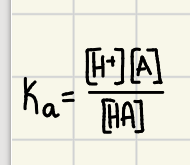
What is Ka and how does it relate to pKa?
Ka: describes acid strength
pKa: -log(Ka)
What determines whether a proton comes off?
How stable is Conjugate Base (A-)
What is pH
-log[H+]
Henderson Hassel-Bach
what is the main idea behind it
pH = pKa + log [A-]/[HA]
when pH = pKa
then [A-] = [HA]
deprotonated = protonated
When are buffers most effective
at their pka range (pH=pKa)
buffering range = ± 1
How do you determine the CHARGE of the ionizable group based on pH & pKa
pH < pKa → protonated form dominates
pH > pKa → deprotonated form dominates
then determine the charge of that form!
Titration Curve
equivalence pt
½ equivalence pt
equivalence point = 1eq base has been added for each ionizable proton→ fully deprotonated
½ equivalence point: the pt where [protonated] = [deprotonated] (pH = pKa)
![<p>equivalence point = 1eq base has been added for each ionizable proton→ fully deprotonated </p><p>½ equivalence point: the pt where [protonated] = [deprotonated] (pH = pKa) </p>](https://assets.knowt.com/user-attachments/ce2a9068-b9bd-4c4f-aafd-c4b15e96cfc3.png)
What is a Nucleotide
vs a Nucleoside
Base + Sugar (Ribose or Deoxy) + Phosphate(s)
vs
Base + Sugar
Ribose vs Deoxyribose
why does this matter
Ribose has C2’ -OH, Deoxy does not.
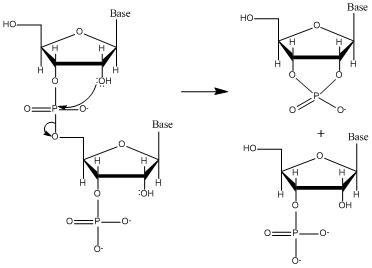
This -OH makes RNA much less stable because it means that it undergoes alkaline hydrolysis of phosphodiester bonds.
this means that in basic conditions the -OH can nucleophilic attack and break the backbone.
RNA → much faster hydrolysis
DNA → much more long-term stability
How to Number Nucleotide Sugars?
PRIME DESIGNATION
C1’ → forms glycosidic bond w nucleobase
C2’ → tells you DNA v RNA
C3’ → OH forms next phosphodiester bond
C’5 → attached to phosphate

What is a Sugar Pucker?
What are the conformations?
non-planar sugar conformation (due to steric strain)
e.g.
ENDO (atom out of plane is on same side as C5’)
or
EXO
4 standard conformations:
C2’ endo/exo
C3’ endo/exo
FREE nucleotides are more free to switch between conformations (isoenergetic)

Conformation of DNA sugar
C2’ endo sugar puckers
Why are the DNA base pairs complementary
Their shapes and H-bonding patterns allow specific pairing: A–T and G–C.
How many bonds hold A-T or C-G
A–T = 2
G–C = 3.
What is base stacking
Why analogous to the hydrophobic effect?
Adjacent aromatic bases stack on one another inside the helix, stabilizing DNA.
Nonpolar base surfaces cluster away from water, while water is excluded from the stacked interior.

H = change in enthalpy (heat content)
S = change in entropy (disorder)
T = abs temp (K)
@ Standard Conditions (1atm, 1M, 298K)

ΔG° = standard Gibbs free-energy change
R = gas constant = 8.314 J/(mol·K)
T = temperature in Kelvin
K = equilibrium constant
@ Standard Conditions (1atm, 1M, 298K)


at equilibrium?
ΔG° → standard conditions
ΔG → actual/current conditions
Q → what the reaction mixture currently has

How can reactions be driven forward?

Alkaline Hydrolysis
lkaline hydrolysis is the base-catalyzed cleavage of RNA's phosphodiester backbone, where OH⁻ promotes attack by the RNA 2′-OH on the adjacent phosphate.
What are Phosphoanhydride Bonds?
High energy bonds between phosphates
their hydrolysis can provide the energy that drives otherwise unfavorable biochemical reactions.

Beer Lamberts
Abs = E l c
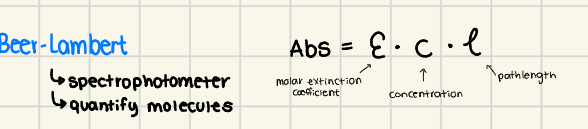
How does absorbance change with concentration?
They are directly proportional.
If you have more molecules, they absorb more light, so absorbance increases.
What is the wavelength for Nucleic Acids?
why
260nm
the nitrogenous base
What wavelength do amino acids/ proteins absorb at?
why?
280nm
aromatic aas (WYF)
Hyperchromic effect
means more ABSORBANCE at 260nm when double stranded DNA becomes single stranded.
due to less base stacking and h-bond interactions
What is the melting temperature
The temperature where about 50% of the DNA is denatured is the melting temperature (Tₘ).
How to increase melting temperature of DNA
increase the G-C content (stronger stack/h-bond interactions)
increase DNA length
What is a zwitterion?
a molecule that has both a positive charge and a negative charge at the same time, but its overall/net charge is zero.
An amino acid has two groups that can gain/lose H⁺:
Amino group:
–NH₂Carboxyl group:
–COOH
What happens to an Amino Acid at Low pH
lots of H+ floating around, AA becomes protonated (+ charge)
What is pI
The Isoelectric Point (The pH at which an amino acid has a net electrical charge of zero.)
the pI is the average of the two pKa values surrounding the neutral form.
pH of C vs N
pKa₁ (COOH) ≈ 2.3
pKa₂ (NH₃⁺) ≈ 9.6
What is the pI of a peptide with NO ionizable side chains?
6
Which amino acid is achiral
What
Glycine
What form of aa do people use
L form amino acids
What does it mean if a peptide has a pI > 7?
BASIC peptide, carries some + charge at pH 7
What does it mean if a peptide has pI < 7?
ACIDIC peptide, carries some - charge at pH 7

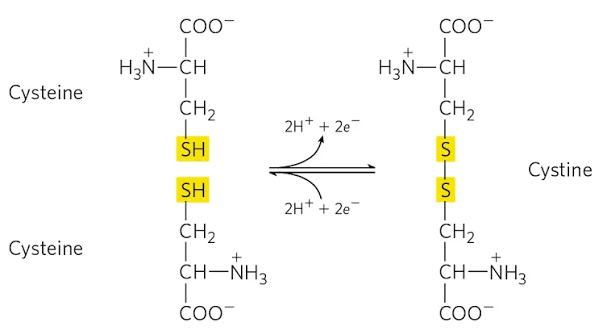
What is a Disulfide bond
2 Cys OXIDIZE
Strong COVALENT bond
stabilizes protein structure
weak 280 abs
Why do amino acids have two buffering regions
As you add base COOH loses H⁺:
Its pKa is around 2.3.
As you add more base, the NH₃⁺ loses H⁺:
Its pKa is around 9.6.
Peptide Bonds
formed via dehydration/ condensation
pecifically, it forms between:
the carboxyl group (–COOH) of one amino acid
the amino group (–NH₂) of another amino acid

What are the ionizable groups and their pKas
RKYCHED!
R - 12
K - 11
Y - 10
C - 8
H - 6
E - 5
D - 4
What does LABILE mean for a peptide bond/
easy to cleave under certain conditions
What is a Protein Sequence Alignment?
Lines up homologous sequences to compare corresponding amino acid positions.
Invariant/ Identical Residue
exact same amino acid.
Similar Residue
Different amino acid with similar chemical properties.
How to calculate % identity?
exact matches / total x 100
How to calculate % similarity?
exact + similar matches / total x 100