Nervous Tissue (CH 12 CONC)
 Call Kai
 Learn
 Practice Test
 Spaced Repetition
 Match
 Flashcards
 Knowt Play
1/71

There's no tags or description
Looks like no tags are added yet.
72 Terms
nervous system
Cells communicate via electrical and chemical signals
Rapid and specific
Usually cause almost immediate responses
2 parts
CNS
PNS
central nervous system (CNS)
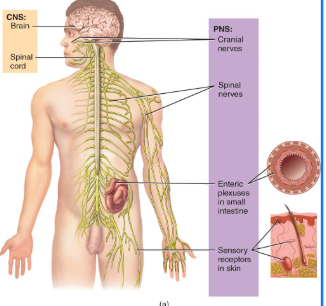
Brain and spinal cord of dorsal body cavity
Integration and control center
Interprets sensory input and dictates motor output
Peripheral nervous system (PNS)
Consists mainly of nerves that extend from brain and spinal cord
Spinal nerves to and from spinal cord
Cranial nerves to and from brain
2 divisions
sensory and motor

sensory division of PNS
(afferent/arrive)
carries info to CNS
Somatic sensory – information from skin, skeletal muscles, and joints
Visceral sensory – information from internal organs

motor division of PNS
(efferent/exit)
Carries commands AWAY from the CNS to muscles and glands
Somatic nervous system – controls voluntary skeletal muscle movement
Autonomic nervous system – controls involuntary functions (smooth muscle, cardiac muscle, and glands)

nervous system has 3 overlapping FUNC
Sensory input: Information gathered by sensory receptors about internal and external changes
Integration: Processing and interpretation of sensory input
Motor output: Activation of organs (i.e. muscles and glands) produces a response
Dendrites
A neuronal process that carries electrical signals, usually graded potentials, toward the cell body.

cell body
contains cytoplasm, a nucleus, and typical cellular organelles, including lysosomes, mitochondria, Golgi complex, ribosomes and Nissl bodies (rER)

Axon
long process of a nerve cell that propagates a nerve impulse toward the axon terminals

Myelin sheath
A space along a myelinated axon between the individual Schwann cells that form the myelin sheath and the neurolemma
insulate and increase speed of nerve impulse transmission

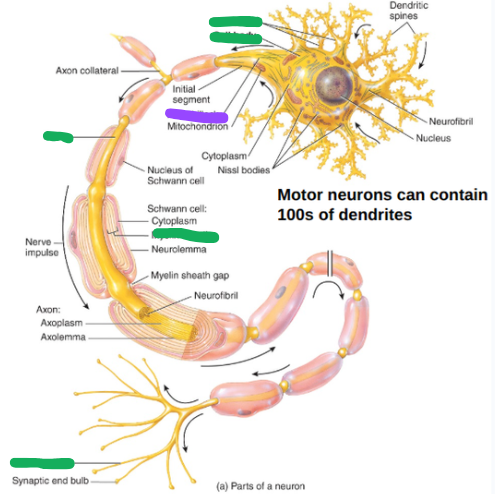
Axon terminal
region that secretes neurotransmitters, which are released into extracellular space
can excite or inhibit neurons in contact
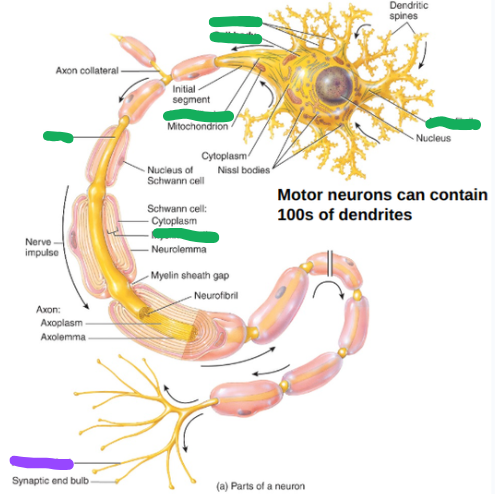
Axon hillock
nerve impulse is called…
action potential
Neuron classification
based on how many processes extend from cell body

Myelinated fibers:
segmented sheath surrounds most long or large-diameter axons
Myelination in the PNS:
formed by Schwann cells
Wraps around axon in jelly roll fashion
Myelin sheaths in the CNS
Formed by processes of oligodendrocytes, not whole cells
Each cell can wrap up to 60 axons at once
sensory neurons are classified as…
mostly unipolar
Cell bodies are located in ganglia in PNS
motor neurons are classifed as…
Multipolar
Most cell bodies are located in CNS (except some autonomic neurons)
interneurons…
Lie between motor and sensory neurons and most are entirely within CNS
99% of body’s neurons are interneurons
Neuroglia
Make up about half the volume of the nervous system
Can multiply and divide

CNS consists of…
oligodendrocytes
astrocytes
microglial cells
ependymal cells
oligodendrocytes- CNS
supports neurons and produces a myelin sheath around axons
atrocytes - CNS
involved in metabolism of neurotransmitters, involved in forming blood–brain barrier
microglial cells - CNS
carries on phagocytosis
ependymal cells - CNS
Neuroglial cell that covers choroid plexuses and produces cerebrospinal fluid (CSF
PNS consists of…
schwann cells
satellite cells
schwann cells - PNS
found on axons of the PNS and form a myelin sheath
Can participate in axon regeneration

satellite cells - PNS
flat cells the surround the cell bodies of neurons of PNS ganglia
exchange of materials between neuronal cell bodies and interstitial fluid

white matter
regions of brain and spinal cord with dense collections of myelinated fibers
Usually fiber tracts
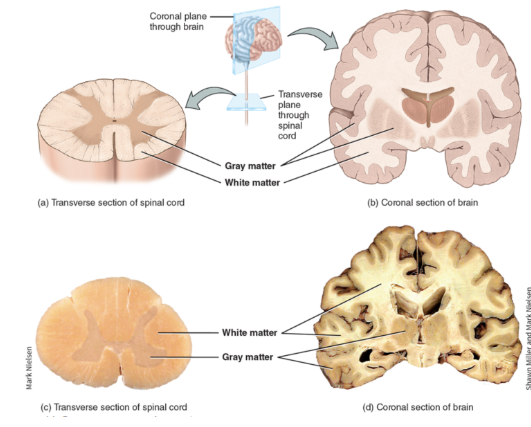
gray matter
mostly neuron cell bodies and nonmyelinated fibers

Electrical Signals in Neurons
Neurons communicate using Action Potentials (AP) and Graded Potentials (GP)
Both depend on the resting membrane potential and ion channels
voltage
measure of potential energy generated by separate charge
Measured in volts (V) or millivolts (mV)
Greater charge difference = higher voltage
Also called electrical potential

current
flow of electrical charge (ions) between two points
can be used to do work
Resting membrane potential (RMP)
Outside is more (+) and inside is more (-)
-70mV (40-90mV range)
Action potential (AP)
allows communication over short and long distances
Graded potential (GP)
allows communication over short distances only
Production of an AP or a GP depends on…
the existence of a resting membrane potential and the existence of certain ion channels
involved in relay of sensory, perception, and motor activity
Role of membrane ion channels
Large proteins serve as selective membrane ion channels (ie: K+ ion channel allows only K+ to pass through)
2 Types
leakage(non-gated)
gated channels
Leakage (non-gated) channels:
always open; K+ channels are more numerous than N a+ channels
alternate between being open and closed
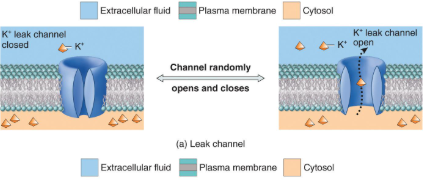
Gated channels overview:
part of the protein changes shape to open/close the channel
Types:
chem
voltage
mechanically
Chemically gated (ligand-gated) channels:
Open only with binding of a specific chemical
ex: neurotransmitter
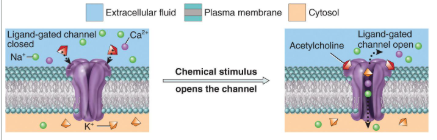
Voltage-gated channels:
Open and close in response to changes in membrane potential

Mechanically gated channels:
Open and close in response to physical deformation of receptors, as in sensory receptors

Graded potentials
small changes in RMP
What causes membrane potential to change
Changes in ion concentrations or membrane permeability to ions
hyperpolarizing GP
If response makes the membrane more polarized
more negative
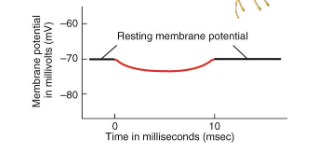
depolarizing GP
If the response makes the membrane less polarized
less negative
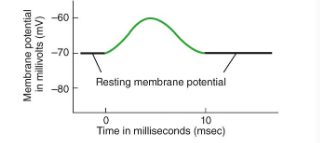
What determines the amplitude of a GP?
Strength of the stimulus
What happens when graded potentials are added together?
They combine to create a larger amplitude (summation)
When is an action potential generated?
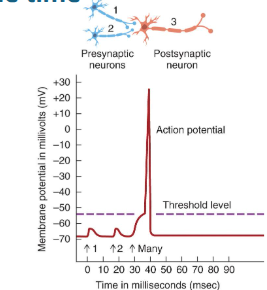
When graded potentials reach the trigger zone and reach threshold
refractory period
time where a neuron can’t trigger another AP
absolute refractory period
2nd AP cannot be generated, no matter how strong the stimulus
relative refractory period
2nd AP can be generated, but requires a stronger-than-normal stimulus
Factors That Affect Propagation Speed
axon diameter
amount of myelinaton
temp

Synapse
Junction between two neurons or between a neuron and an effector
What are the 5 types of synaptic connections?
axodendritic
axosomatic
axoaxonal
dendrodendritic
somatodendritic

What are the two types of synapses?
Electrical – gap junctions connect cells and synchronize activity
Chemical – one-way information transfer from presynaptic to postsynaptic neuron

Chemical synapse steps
AP arrives at axon terminal of presynaptic neuron
Voltage-gated Ca²⁺ channels open and Ca²⁺ enters
Ca²⁺ causes synaptic vesicles to release neurotransmitters
Neurotransmitters diffuse across synaptic cleft and bind to receptors on postsynaptic membrane
Receptor changes shape, opening ion channels
Ion movement creates a graded potential (postsynaptic potential)
If threshold is reached, an action potential is generated in the postsynaptic neuro
summation
The combined effect of graded potentials that may generate a nerve impulse
temporal summation
Graded potentials overlap in time, adding together to create a stronger effect

spatial summation
2+neurons fire simultaneously, and their graded potentials add together
Small molecule neurotransmitters
Acetylcholine
Amino acids
Biogenic amines
ATP and other purines
Nitric oxide
Carbon monoxide
Endorphins
inhibit pain by blocking release of substance P; may have role in memory and learning, sexual activity, control of body temperature, and mental illness
Angiotensin II
Stimulates thirst; may regulate blood pressure in brain. As a hormone, causes vasoconstriction and promotes release of aldosterone
Cholecystokinin (CCK)
Found in brain and small intestine; may regulate feeding as a “stop eating” signal
As a hormone, regulates pancreatic enzyme secretion during digestion, and contraction of smooth muscle in gastrointestinal tract
Neuropeptide Y
Stimulates food intake; may play a role in the stress response.
Acetylcholine (ACh):
Released at neuromuscular junctions
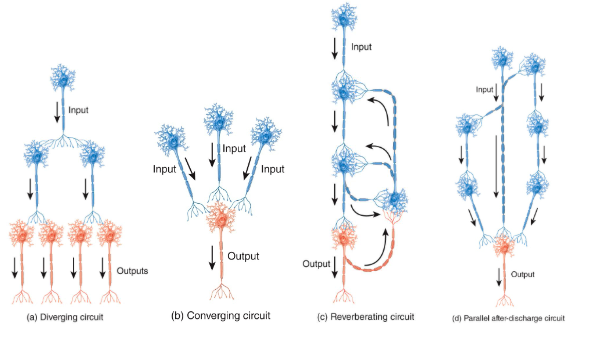
neural circuit
a functional group of neurons that process specific types of information
Why is regeneration limited in the CNS?
- Neuroglia → inhibit repair
- Lack of growth
- Rapid formation of scar tissue
Regeneration & Repair of Nervous Tissue
Although the nervous system exhibits plasticity, neurons have a limited ability to regenerate themselvesMultiple Sclerosis
Multiple Sclerosis
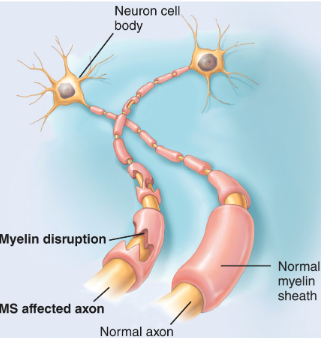
Autoimmune disease that causes progressive destruction of myelin sheath
Cause is unclear; may be genetic and/or environmental
Symptoms include muscle weakness, abnormal sensations and double vision