L7 W4 Simple Linear Regression
 Call Kai
 Learn
 Practice Test
 Spaced Repetition
 Match
 Flashcards
 Knowt Play
1/24

There's no tags or description
Looks like no tags are added yet.
25 Terms
why do we develop measures in psychology? what are some examples?
wish to use our scores on one measure to predict other behaviour(s)
In research, predict …
•social anxiety from scores on depression
•mind-wandering from scores on boredom
In applied settings, predict …
•job performance from cognitive ability test
•cognitive decline from scores of executive function
what is regression in comparison to correlation?
an application of correlation which allows us to predict scores on one variable from scores on another variable(s)
correlation: tells us the strength/direction of the relation btwn two variables
what are key terms for regression?
predictor (X)
criterion (Y)
what are the basics of regression using predictor and criterion?
we use the regression line to predict scores on Y’ from scores on X


what is the equation for the regression line?
a= intercept
b1= slope; “regression coefficient”

what is the interpretation of the equation for the regression line?
a = intercept
•Where the regression line crosses the Y axis. Adjusts for different scales of measurement of X & Y.
Tells us the expected value (the mean) of Y (criterion), when predictor (X) is zero
b = slope
•Called the (unstandardized) regression coefficient
Tells us the expected change in Y (criterion) per unit change in X (predictor)
what is the derivation of the equation for the regression line?

solve this regressional problem

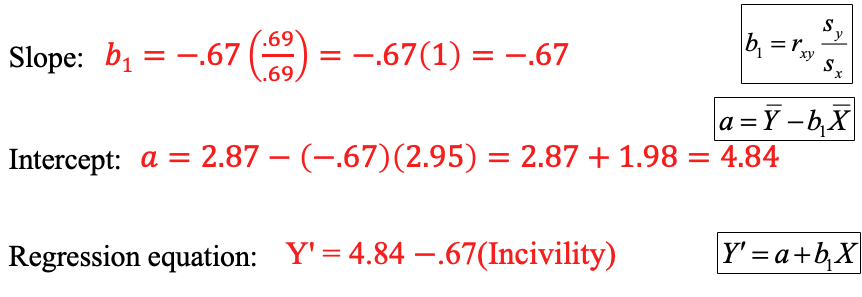
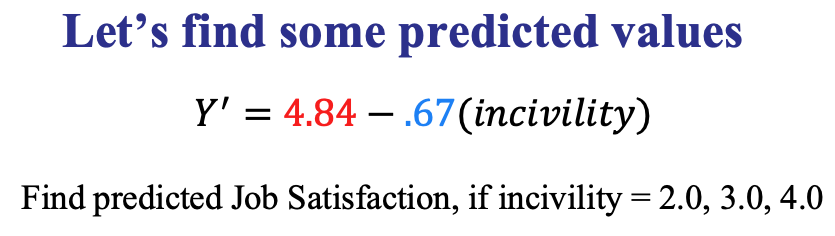
From the previous example, given the regression line, what is the predicted job performance when incivility= 3?


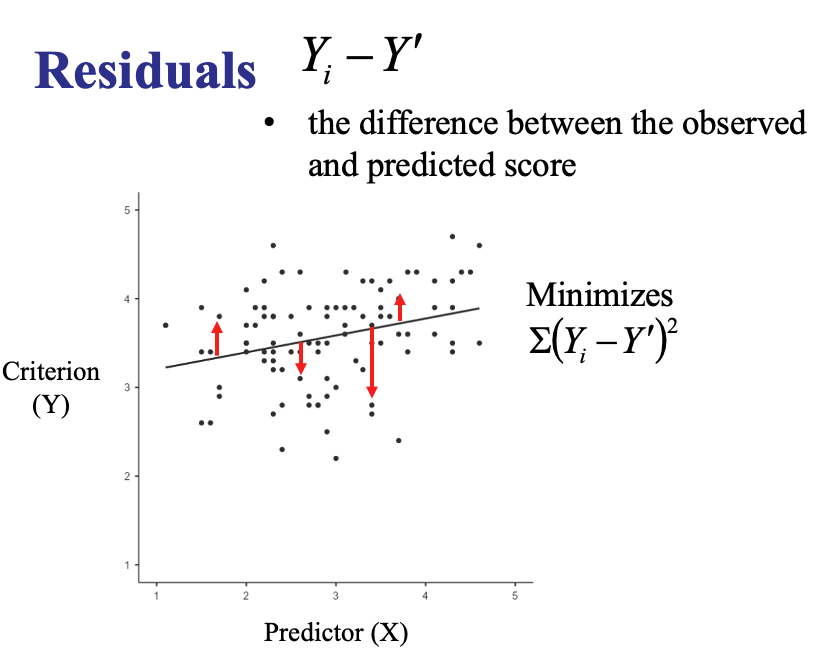
what are residuals? what is the equation for residuals?
the difference between the observed and predicted score
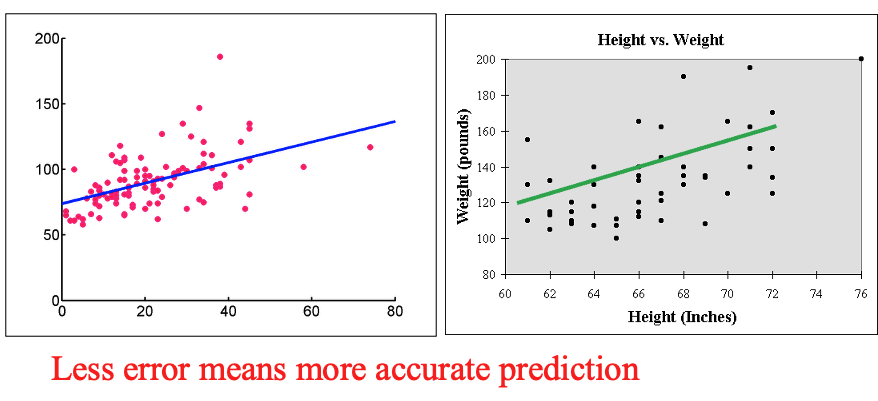
what is an index of error in prediction? what is its equation?
root mean squared error (RMSE)
average distance of the observed Y scores from Y′
estimates the overall error of prediction (smaller, better)
expressed in same units as Y
an index of the accuracy of prediction

in this example, which has greater error in prediction?
REVIEW AND FIGURE OUT
what is the formula for the coefficient of determination (R²)? MAKE SENSE OF THE EXTRA WRITING

NOW, whereas the SEE gives us an index of the error of the regression line,
We also get from Regression an R-squared value – we’ll return to this when we run regression with SPSS. But for now, it is (below).
BUT: w2018
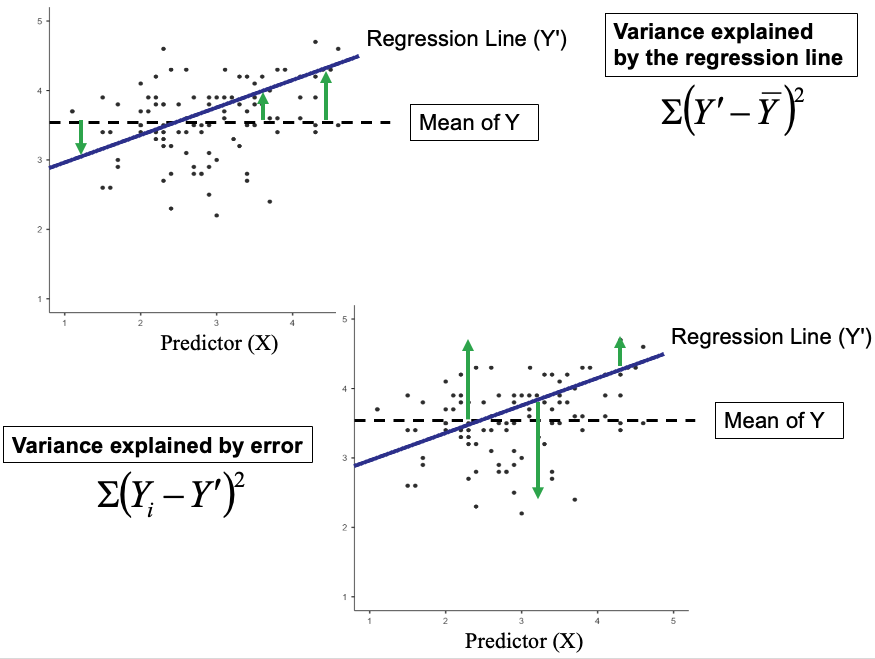
Note: R2 is the proportion of variance explained in the criterion by the regression line (yes)
Maybe better to say that R2 tells us what proportion of the variability in the Y (criterion) is accounted for/explained by the set of predictors in the regression model (beyond the mean on Y).
i.e., Variance explained by the regression line (sum(Y’ – meanY)) divided by total variance in Y
See extra slide.
This is why R2-squared and SEE do not equal 1. Maybe just give a heads up and come to later. They both tell us about the model fit, but they are in different units
Come back to this later when looking at SPSS output.
what is the derivation for the coefficient of determination (R²)?
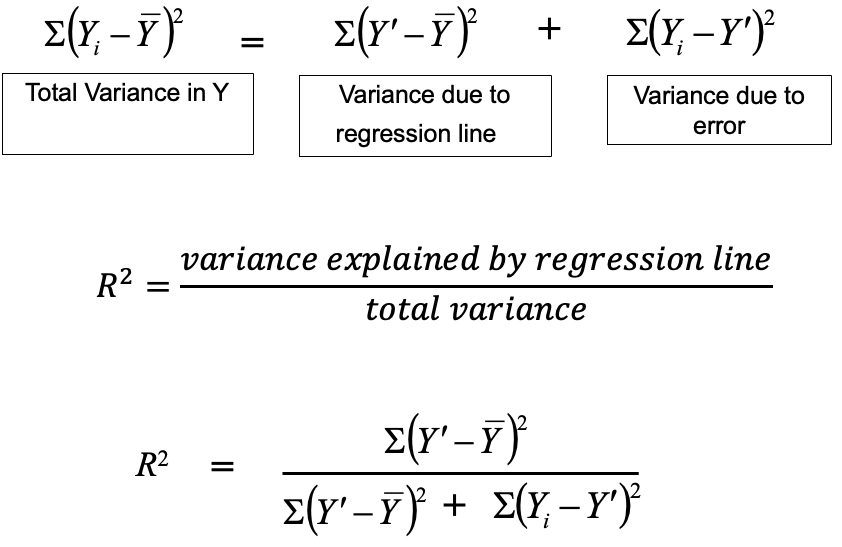
elaborate on digging deeper into regression for a fuller understanding of R²
regression partitions total variance in Y into two parts

What are the similarities of RMSE and R²?
RMSE and R2 are both indices of “model fit” (but not the same)
–They are in different units
–R2 most commonly reported (but both important)
causal inference and regression?
very tempting to draw causal inference from regression
what is a key clarification of prediction in regression?
•When we predict scores on a criterion in regression, this does not mean that the predictor and criterion are necessarily measured at different points in time
•Prediction in regression is a statistical concept
how does simple (bivariate) regression in jamovi work? (one predictor)

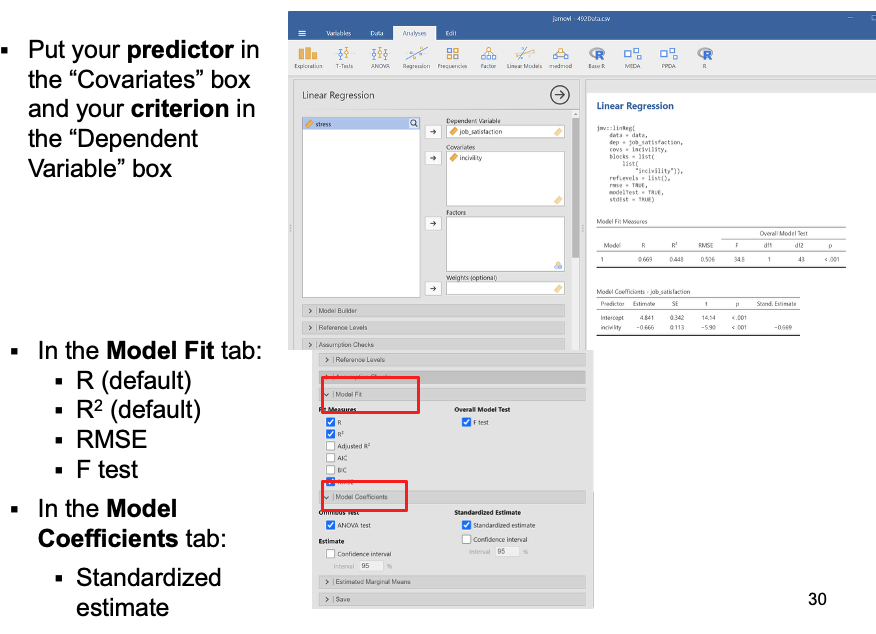
what do the jamovi tables mean?


what are predicted values from this example?


what are two issues to discuss from the standardized half of the table?

what is the following slide talking about?=in terms of the derivation of unstandardized?

what is the unstandardized regression coefficient?
–Amount of change in criterion (Y) for each unit change in the predictor (X)
–Use these estimates in the regression equation
what is the standardized regression coefficient?
–the relation between the predictor (X) and the criterion (Y)
•In simple regression, it is equivalent to the rxy
•In multiple regression, it is equivalent to a partial correlation between each X and Y