SocPsych Midterm 2
 Call Kai
 Learn
 Practice Test
 Spaced Repetition
 Match
 Flashcards
 Knowt Play
1/59

There's no tags or description
Looks like no tags are added yet.
60 Terms
Heider’s level of responsibility attribution theory
A framework that people utilize in order to make internal attributions about someone or something. There are 5 hierarchical levels. Association, causation, foreseeability, intentionality, justifiability. (REMEMBER ACFIJ) (like ackee, fish, remember that how you will)
Example: There are 3 people walking behind you and you get hit by a snowball. All three people are associated with the action because they are in the range to throw a snowball at you, but you do not yet have a strong internal attribution about any of them based solely on association. The next level is causation, if you can identify who actually caused the snowball to hit you (ie who threw it), you can now make an internal attribution about the perpetrator. The next level is foreseeability, if the perpetrator could reasonably foresee the outcome of their action, you would make a stronger internal attribution about them than a perpetrator that did not foresee that outcome. The next level is intentionality, you would make a stronger internal attribution about someone who did it intentionally rather than someone who did it unintentionally, even if you were mad regardless. The final level is justifiability, if there was a strong external reason to cause the perpetrator’s behavi!
or (ie you first threw a snowball at them), then that would dampen the internal attribution that you make about them.
Correspondent Inference Theory
Def: Analyse a person’s actions in context of what else they could’ve done (called an array), and look at commonalities vs rarities of choices: ppl are more likely to make a stronger internal attribution for a glaring difference among commonalities, among array.
Ex: if someone applied to JHU, UPenn, and UChi, vs JHU, Amherst, and Berkeley, the second group has a lot of differences, so we can’t attribute any one reason why you picked any school, however, say you pick JHU out of UPenn and UChi, they’re all similar in terms of urban, T20, associated with good med school, etc, so there must be a reason you picked JHU, such as finaid or legacy, which leads to a strong internal attribution
Better example (use this one on test): if you’re watching AGT, and there are 3 contestants, all equally attractive, intelligent, and talented (on outside, all equally positive), but you pick one, you would examine the difference that one choice has, for example, being from Maine, therefore, you can attribute that Dr. Drigotas has in-group bias to ppl from Maine bc he is from Maine.
Personalism
Def: you’re more likely to make a stronger internal attribution about someone if the behaviour they do is directed to you vs someone else
Example: you’re more likely to hate someone who cuts you off than someone else
Connection: self-reference effect
Hedonism
Def: more likely to make internal attribution if an action causes you pleasure or pain (a strong emotional response); it can happen to you or someone else, but if it causes you pleasure or pain, you will make a strong attribution
Ex: if u and ur friend see someone abusing a dog, and you love dogs, and your friend doesn’t, you’re more likely to make an internal attribution about the abuser because it’s more impactful to you than ur friend
Ex 2!: Lady yelled at Drigotas for driving over the curb because it caused her pain bc it was maybe unprofessional, and she aligned herself with JHU standards (BIRGing), so a violation of that was personal, so she made a negative internal attribution about Drigotas
Kelley’s Cube
A framework in which we utilize surrounding information about a person or situation in order to make internal attribution about them. For example, if a student is late to class, we compare that student to everyone else before making a judgement about them. If they were the only ones late to class, we might make a harsh internal attribution about them, but if almost every student was late to class, that indicates there is some external situation that is impacting the class, and you would not make as harsh of an internal attribution about that one student. It is similar to using the social comparison theory to compare an individual against a consensus. We make stronger internal attributions when someone’s behavior is socially undesirable. There are two more facets from which we can draw information, consistency and distinctiveness. Consistency is when we compare someone’s behavior from the past to their current behavior (eg comparing the student’s prior !
arrival times to now) and distinctiveness is comparing someone’s behavior from a similar past event (eg comparing the student’s prior arrival times to a different class). (Remember CCD: consensus, we make stronger internal attributions if behaviour is not socially desirable or hurts us; consistency, we make stronger internal attributions if this person always acts this way in this situation; distinctiveness, we make a stronger internal attribution if the person acts in a similar way always in other scenarios)
Fundamental Attribution Error (FAE)/ Correspondence Bias
Def: Ppl want to make internal attributions even in the face of strong external situations: ppl are more salient, we want strong personal schemas, so we stereotype
Ex: subjects have to give a speech (pro-life vs pro-choice); ½ can pick stance; ½ are assigned a stance, and the audience knows who picked vs who was forced. They’re asked “how much do you think the speakers believe their stance”: for the ppl who the audience knows picked their stance, they obv said great extent, but even for other group, they, without logic, made an internal attribution, showing the desire ppl have to make internal attributions, even in spite of known circumstances: FAE
Connection: this is what Heider’s and CIT (correspondent inference theory) say also; leads to Just World Phenomenon (u get what u deserve, ex: thinking rich ppl are hard workers and bums are “bums”; ppl are more likely to make internal attributions when behaviour is personally, or socially undesirable or harmful (this ties into hedonism and Kelly’s Cube)
Actor Observer Effect
An attribution bias in which we make the fundamental attribution error for other people’s actions, but not our own. This means that when we make attributions about ourselves, we greatly consider our external situation.
Why: We do this because we have a lot of information about ourselves (we know our own thoughts and memories and situations and experiences, but we don’t know other people’s). We also do this because we desire consistency from others (due to our stable schemas), but we don’t desire that from ourselves. It is also because others are more visually salient while we don’t typically see ourselves.
Example/study proof of salience issue: 6 subjects saw 2 subjects debating pro-choice vs pro-life. 3 subjects clearly saw the pro-choice debater and 3 subjects clearly saw the pro-life debater. The subjects made more internal attributions about the debater they saw more clearly; even the debaters themselves made more internal attribution about the other debater when they rewatched the debate from a perspective that clearly showed the other debater. This demonstrates the importance of visual salience.
Self-Serving Bias
Make internal attribution for personal success, and external for failure
Ex: If u fail, prof sucked, but if u get A, you’re smart
Archival Study: when coaches win, they say their players are awesome, he outwitted the other coach, they have good chemistry, etc; when they lose, they say the other team was better (they don’t say we were worse), or they say they got unlucky with calls or wind or pitch or wtv (we mustn’t forget it’s been raining)
Gambling: losers say it’s rigged, winners say they have a system, or they “knew” this machine was a winner, or they know the tech
Insurance: in single car accidents (like hitting tree), ppl will say tree came out of nowhere (impossible?), and that road needs to be maintained better
Reversed in ppl w/ depression (when they succeed, they say the got lucky, thus creates positive feedback loop of self doubt and sadness)
Public behaviour increases self-serving bias (bc want to keep up appearances)
Self serving bias is a coping mechanism bc it creates internal and external loci of control where you want it
The self: Self-concept; Cognitive Component
-Our self-concept is our knowledge about ourselves (so our traits, abilities, quirks, etc.) They are role dependent, we might think of ourselves as a boss in the gym, but we might be a coward when it comes to public speaking.
How gathered: We gather information about ourselves based on how others respond to us, this is the concept of the “looking glass self”. Example: If I tell a joke and someone laughs, I think of myself as funny, but if they don’t laugh, then I think of myself as not funny. We also gather information about ourselves through social comparison.
Example: Students who got a B on an exam were forced to compare either upwards or downwards (ie to A students or C students). The B students who compared to themselves to the A students felt worse about themselves and their abilities as a student. This motivated them to study harder and improve their grades. The B students who compared themselves to C students felt better about themselves and their abilities as a student and they were less motivated to subsequently study.
Self-Concept Once Gathered:
Complex and Resistant to Change
Ego-centric bias: ego protection and self-serving bias); we remember stuff in our favour
Ex: in a project, if u get an A, everyone will say they did 40% of the work, whereas if you get a D, you’ll say “that was all them”, sort of reverse BIRGing
Ex 2: in a relationship, when things are rocky, you’ll blame it on them, but when it’s good, you’ll say you’re holding it down or pulling the strings (smthn you’ve been doing, like being attentive or planning dates)
Connection: self-referential effect: we remember stuff that’s important or related to us Ex: when ur studying, you’ll remember a concept better if you use an example in your own life
Self-discrepancy theory
How we feel about our traits depends on our actual abilities vs how we would ideally stand on that trait. Example: If I am a millionaire, but my family is full of billionaires and I was brought up believing that I had to be a billionaire, I would be insecure about my wealth even though I am objectively rich. When we feel bad about ourselves, it is because our expectations for ourselves are too high, or our base abilities are genuinely bad, or it is often a mix of both factors. Even if our actual self is bad, if our idealized self is also bad, then we feel fine about ourselves. This is why psychopaths do not feel bad about who they are. The theory is heightened by self-awareness which can be increased through introspection, but this can be induced with a mirror or recording.
Example: When a kid is left alone on Halloween with a bowl and candy and quarters, they are less likely to take a bunch of candy and quarters when there is a mirror. They are more likely to take the candy and quarters when there is not a mirror and they are heavily disguised.
Observational study at a bank entrance with floor to ceiling mirrors: People who scored higher in physical attractiveness were more likely to look at themselves in the mirror. The opposite was true for less physically attractive people.
-Sometimes people will purposefully reduce their self-awareness through inebriation and lower the self-discrepancy theory so they do not feel as bad about themselves.
Self-esteem: affective component
Ego Protection devices:
Self-serving bias
Self-handicapping: when someone is forced to do badly/fail, they purposefully set up an external rzn for failure beforehand
Ex: subjects were told they’d be in a cognitive study, where they do a task, have a break, and do a task again: ½ were given an ez task, other ½ almost impossible; after break, they’re told the second task will be same difficulty, but they were offered a pill that the experimenters said they were interested in studying the impact on cognitive function, that it should decrease: PPL WHO FAILED FIRST TASK WAY MORE LIKELY TO TAKE PILL BC IT GIVES THEM AN EXCUSE TO FAIL (cope, plus self-serving bias)
Ex2: the classic phrase b4 playing pool is “I haven’t played in forever” giving you an out if you suck (like in the comedy videos)
Ex3!: Drigotas’ friend (Chris? Check video, 10/7) make a show of partying before a hard science exam, so when he failed, he could point to that as the reason, vs admit he knew he’d fail
Basking in reflective glory (BIRGing): ppl try to make an association with ppl or things that are doing well, so their success is associated with you (tenuously)
Ex: study done on how many ppl wear Michigan paraphernalia when the team wins vs loses: ppl wear a lot more when team wins so they can be associated with a winning team (glory hunting, like City fans)
Ex2: ppl will mention famous ppl they’re related to/have met/spoken to or wtv, but not infamous ppl (Booth)
Ppl like doing this with their friends (sharing joy ofc, but also as a way to show their value: “I can pick em”)
Muhammad Ali Effect: ppl pick the dimensions they’re best as important, and things they’re bad at as unimportant
Ex!: Muhammad Ali (cocky guy) was asked in an interview that he always says he’s the best, how come his grades are so bad (he wouldn’t have graduated if not for boxing): he said who cares about intelligence “I said I was the best [boxer] not that I was the smartest”
Ex2: ppl bad at art will cope that it doesn’t matter (or if they’re bad at one art form, and good at another, they’ll claim theirs is superior)
Ex3: in business school, ppl with good grades will say hard stats are most important to success, whereas ppl with worse grades, but good networks, will say connections are the most important
Downward Comparison (B student study from Self card)
Self-presentation: Behavior component
Impression management strategies: We are social animals who care what others think about us, thus we care about the impression of ourselves that we give to other people.
Our impression management ability relies on our self-monitoring abilities which is a variable that depends on our situational awareness (being able to pick up on social cues) and self-regulation (being able to regulate your behavior to fit in). Low self-monitors are bad at either trait or both. People who work in client facing fields (lawyer, actor, politicians) are high self-monitors.
Example: Prof’s friend is an introverted lawyer who acts super extroverted during retreats in order to fit in. They are a high self-monitor making it hard for other people to assess their true behavior.
-Impression management is taxing. Example: The Prof had a job interview which was so ego-depleting that by the end, he was drained and gave a poor performance which cost him the job.
Attitudes
Def: a tendency manifested by evaluation of objects/issues favourably or unfavourably (an internal bias, predisposition)
Components:
ABC model:
Affective (evaluation/manifestation)
Behavioural (debated as a component of attitudes: some ppl say behaviours are a pure manifestation of attitudes esp w/ high external validity, however some say a behaviour is a result of attitudes, not part of the definition, and u can predict behaviours w/ attitudes (ie, can’t define attitudes with behaviours bc behaviours are what attitudes lead to, but other side says behaviours can illuminate attitudes)
Cognitive (Beliefs)
Attitudes are Schemas (attitudes are made of many beliefs, but one overall feeling, therefore making it hard to shake:
Central Node:
Ex: the same lecture by the same lecturer is given to 2 groups: one is told he’s cold, one is told he’s warm: characterisation is a central node, so the group that was told he was cold liked the lecture less, horn effect, made up things like he was less funny, more irritable, and less sociable, and they also didn’t interact (self-fulfilling prophecy)
Direct Attitude Measurement
Surveys
Interviews
Behaviour (only valid for one type of psychological mindset, the other group would disagree)
Structured vs Unstructured:
Structured = set questions (series in an interview or survey)
Unstructured = subject talks abt wtv they want regarding attitudinal topic
Related:
Top-Down = Structured (top-down seems more algorithmic): strict series of question that are deemed most important for attitudinal topic (like asking about every factor known in the Investment Model to ppl in relationships)
Bottom-Up = subjects talks abt wtv they want regarding attitudinal topic (Freeform, related to unstructured)
Pros and Cons (of unstructured/bottom-up, think pyramid for association):
Pro: things might emerge from Freeform answers that were not thought about before (deductive approach, better if you don’t know about the field/if you don’t have preconceived notions like you do in the Investment Model)
Con: subjects have to take prompt seriously, also wording is a confounding variable (like how ppl talk about certain variables), also, some ppl can be more explicit given explicit questions, than js rattling everything off the top of their head (like me), chance of missing a known important variable/cannot compare subjects because they won’t talk about the same things in the same wording
Bottom-up and unstructured js more exploratory; it’s ingenious to come up with what’s most top of mind about attitudinal topic, vs promoted and they have to make a strong attribution to something they don’t care about/wouldn’t normally think of in regards to the attitude; can do unstructured first to explore, then structured to refine and get good usable data)
Likert Scale:
Def: A way of measuring an attitude abt smthn directly thru using pros and cons
Ex: Drigotas’ attitude on Dallas is influenced by his values; it’s easier to get around than the eastern cities he’s used to, the food is good and diverse, and he has an emotional connection there bc both his kids were born there (names?), however it’s too hot in the summer, so can’t do physical activities when most free and should be peak weather and stuff, and it’s also very bougie: nice cars all around and ppl dressed up for 9 AMs, compared to other school he’s worked at (name?)
Indirect Attitude measurement
Because there are some things that people will not want to admit to (like being racist, sexist, etc), some attitudes need to be measured indirectly. You can do this by measuring someone’s physiology (head, pupil, skin responses, etc), but this is not a reliable measure.
Implicit Association Test: Tests that measure how closely related something is subconsciously.
Example: You sign up for a study on memory and you are given pairs of words to memorize. You are on a computer and 2 words will flash on the screen and you have to click y if it is your pair and n if it is not your pair. You need to do this asap. Sometimes there are pairs of words that reflect an attitudinal topic. It might be a pair like Lithuanian and lazy. If Lithuanian and lazy are closely associated, you can respond immediately, if they are not closely associated, it will take longer to respond.
In studies, how do researchers use attitudes to predict behavior with higher consistency?
Measurement Relevance: The attitude and the behavior itself have to correspond almost exactly; if the attitude or behavior is too broad or narrow, then the attitude is not longer a good measurement. For example: If you ask someone about their attitude towards running to predict how likely they will exercise, that attitude is not a good predictor because running is a small subset of all exercise.
Strength/Stability of attitude: (Information; direct experience; personal importance)
Information: The more information we have, the more stable our schema, therefore the more stable our attitude. A stable attitude is stronger and a better predictor of behavior.
Direct Experience: When you have direct experience that contributes towards an attitude, that attitude is stronger and a better predictor of behavior.
Example: Freshmen at a university had to stay in the gymnasium because they overadmitted students and there wasn't enough housing. For the students who didn’t live in the gymnasium, their attitude towards the situation didn’t predict whether they were going to go to a protest about the situation because the situation didn’t directly affect them. For the students who did live in the gymnasium, their attitude towards the situation did predict whether they would go to a protest about it.
Personal Importance: When an attitude is formed because an issue is of personal importance, it is a strong predictor of behavior. Example: Famous athletes often support disease charities because their friends/family suffer from the disease, even if the athlete themselves do not have the disease.
Measurement Timings: The closer the attitude is measured relative to the behavior, the more accurate it is as a predictor. Example: Asking people about their political beliefs 6 months before an election is not a good predictor for their voting behavior because their attitude has a bunch of time to change.
RT PIE (hearty pie, relevance, timing, personal importance, information, direct experience)
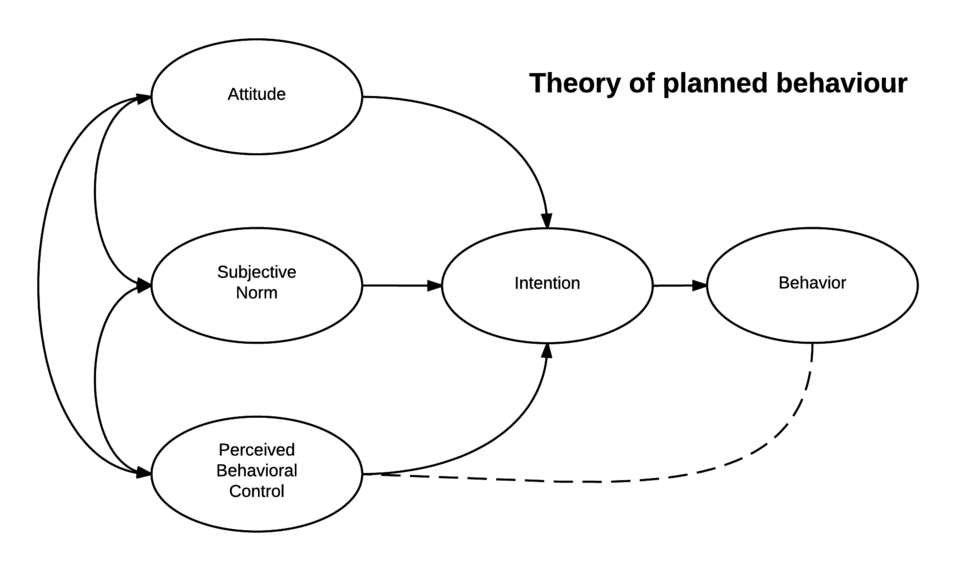
Reasoned Action Model (Theory of Planned Behaviour)
Behavioural intention is the best way to predict behaviour (asking someone if they plan to do the behaviour before when the behaviour would occur is the best way to predict if they’ll do said behaviour)
Attitude, subjective norms, perceived behavioural control predict behavioural intention (and they influence each other, behavioural intention can directly impact whether or not a behaviour happens).
Subjective norms are what the ppl around you think about the behaviour (more impactful on if you do a behaviour if they’re close or important to you, or if you care about their approval)
Ex: there was a study done to see if freshmen are sexually active; they measured attitudes and subjective norms: attitudes predicted behaviour well in women (prudes wouldn’t have sex, for example). But in men, personal attitudes didn’t predict well, but the best predictor was the attitudes of the people the individual hung out with (bc subjective norm took over individual attitude: made them think what would others think of me doing this, and therefore, what would they think of me because I did this? Positive, then do, negative, then don’t. They betrayed their values, leading do cognitive dissonance likely).
Ex2: Magic Johnson, bc of HIV, acted as a model to influence others to use condoms, and it worked (official CDC PSA)
Perceived Behavioural Control = am I able to do this thing?
Ex: Drigotas in freshman year of high school, before growth spurt, would not even attempt to dunk a basketball, even tho he had the attitude (consensus was that dunking was desirable), and he had the subjective norms, therefore, because he didn’t think he could bc he was 2 short, so it’s the SECOND STRONGEST PREDICTOR OF BEHAVIOUR
Remember: IC, AS (👀) as acronym for best predictors (strongest to least, intention, control, attitude, subjective norm, A and S interchangeable, but I didn’t want to do that in the acronym for obvious reasons)
Cognitive Dissonance
A factor of attitude change: cognitive, motivational, and internal.
Cognitive Dissonance is the bad feeling you get when your attitudes and behaviours or actions fine line up (sense of self/self-schema and behaviours don’t line up), when we feel this bad feeling, we either change our behaviour, or our attitude; cognitive dissonance usually occurs in public (bc there has to be the factor that you know someone is watching you be inconsistent, judgement, no shown dissonance in private decision-making), and it must be a proper decision (ie, by your own decision, or there is no dissonance/tension bc u can justify that u were forced)
Ex: Leon Festinger (founder) joined the Seekers Cult, which was a cult that said that aliens will come and destroy earth and take “the worthy ones” to build civilisation anew; the leader gave a date for this, when this didn’t happen, the believers said “we saved the world” (unfalsifiable claim, bc they can always js say, you never know what’d happen if we didn’t do this); some ppl did realise they got duped, but so many changed their behaviour that the leader did the whole thing again (set a new date)
Ex2!: classic: ppl who smoke likely know it’ll kill them, but their behaviour, smoking, is not in line with their attitude (knowledge that smoking kills, and desire to stay alive): some ppl deny the science, some ppl justify the behaviour (that it relieves stress, so you’re cutting your lifespan at one end, and extended it at the other, so no net change, also some ppl say they’re otherwise healthy, so same logic) (attitude change), but some ppl, when learning how bad it is (or seeing impacts, like scary pics on cig boxes), quit smoking (change behaviour to alone with attitude)
Nuts and Bolts Study
Subjects are told they are doing a study on motor coordination and they spend 20 min sorting through nuts and bolts, it is a really boring task. The researcher feigns surprise when only one subject comes in because there was supposed to be another subject who comes in to tell the future subjects how fun the task is. There is 1 control group that is simply done with the study and 2 experimental groups who are offered either 1 dollar or 20 dollars to tell the next subjects that the task is fun. Most subjects took the money and did the task. When asked how fun the task was, the subjects paid 20 dollars said the task was boring and the subjects who were paid 1 dollar said the task was fun because there was internal cognitive tension that they lied to other subjects and told them that the task was fun just for 1 dollar. To ease the cognitive tension, the subjects convinced themselves that they actually enjoyed the task, that way they could think that they didn’t really lie to the other subjects.
Initiation Study
Female subjects come to do a study on group interactions and the experimental condition is whether they have a hard initiation and an easy initiation. The easy initiation is to just read random tame words in front of a male research assistant, the hard initiation is to read sexually explicit material in front of a male research assistant. After the initiation, the researchers say that the group started without them and that they subjects could only listen in so they listen in and hear the group talking about the birds and the bees in a literal sense (a boring topic). Afterwards, the subjects are asked if they want to come back next week to join in on the discussion, the subjects with an easy initiation did not want to, the subjects with a hard initiation did want to come back. This is because the subjects with a hard initiation felt like they suffered and didn’t really get anything in return, so to reduce this internal cognitive tension, they either downplayed how embarras!
sing the initiation was, or they inflated how interesting the discussion was.
Eating Grasshoppers Study
Subjects sign up for a study on taste perception; when they fill in personality and demographics survey, the research assistant (RA) is genial to ½ the ppl (control), and mean to other ½ (your handwriting sucks, are you really wearing that to a study, did you even read the questions? these answers are nonsense, etc); then, the RA pleads the subject to eat fried grasshoppers bc nobody else agreed to, and they need data for that condition (80% agree). After, they’re told to get the credit slip and get credit, and the credit clerk asks them to rate the substance they ate (doesn’t say the word grasshopper, likely to remove demand characteristic): genial group said it was gross, mean group said they liked it: in their mind, they’re wrangling with the fact that they did a favour for an ahole, so they either justified their attitude, that he’s not an ahole, he’s js a buddy, pally guy, or they justified their behaviour, that they actually enjoyed the grasshoppers.
Free Gift Study
Researchers recruited middle class housewives (aged 35-40) for a supposed “research marketing study” for kitchen appliances. The women are told to mess with a bunch of appliances and then rate them. After the study, the researchers take 2 appliances that the woman rated equally (and they were mid-high ratings) and they are told that as compensation, the woman could take one home. 2 weeks later, the researchers pretend to lose the data and ask the women to come back and make the ratings and again and this time, the women inflate the rating of the appliance they took home and they deflated the rating of the appliance they chose to not take home. This is because the women like to think of themselves as savvy home owners (since they are housewives) and they have this internal tension of whether they made the right appliance choice, so in order to reduce this tension, they inflate their own choice and deflate the other option.
Forbidden Toy Study
There’s a shiny toy, kids are told not to play with it: control group has a harsh punishment for playing with it, experimental js gets a slap on the wrist; no kids played with the toy in either group: experimental group, when rating all toys, rated the shiny toy lower than the control group because their attitude (cool toy), and their behaviour (not playing with the toy, even tho they reasonably could’ve bc the joy from the toy would outweigh the consequence) were not in line, so they had to further justify their behaviour (or lack thereof), by saying they didn’t want to play with the toy anyways (tsundere). The experimental group had a reason for not playing with the toy, despite how much they wanted to (so ideals and reality not in check), so no cope needed for them, nothing they could’ve done simply js a sad situation.
Reactance (aka reverse psychology) (Attitude Change Theory: Cognitive Motivation)
The notion that if you think something has been taken away from you unfairly, you desire it much more. When Prof’s daughter (Claire) was 2 and didn’t like peas, when the Prof told her that she couldn’t eat peas, that made her want to eat peas.
-Romeo and Juliet effect: When you aren’t allowed to be with someone, you want them even more. When middle schoolers aren’t allowed to date each other because of their overprotective parents, they want to date each other even more.
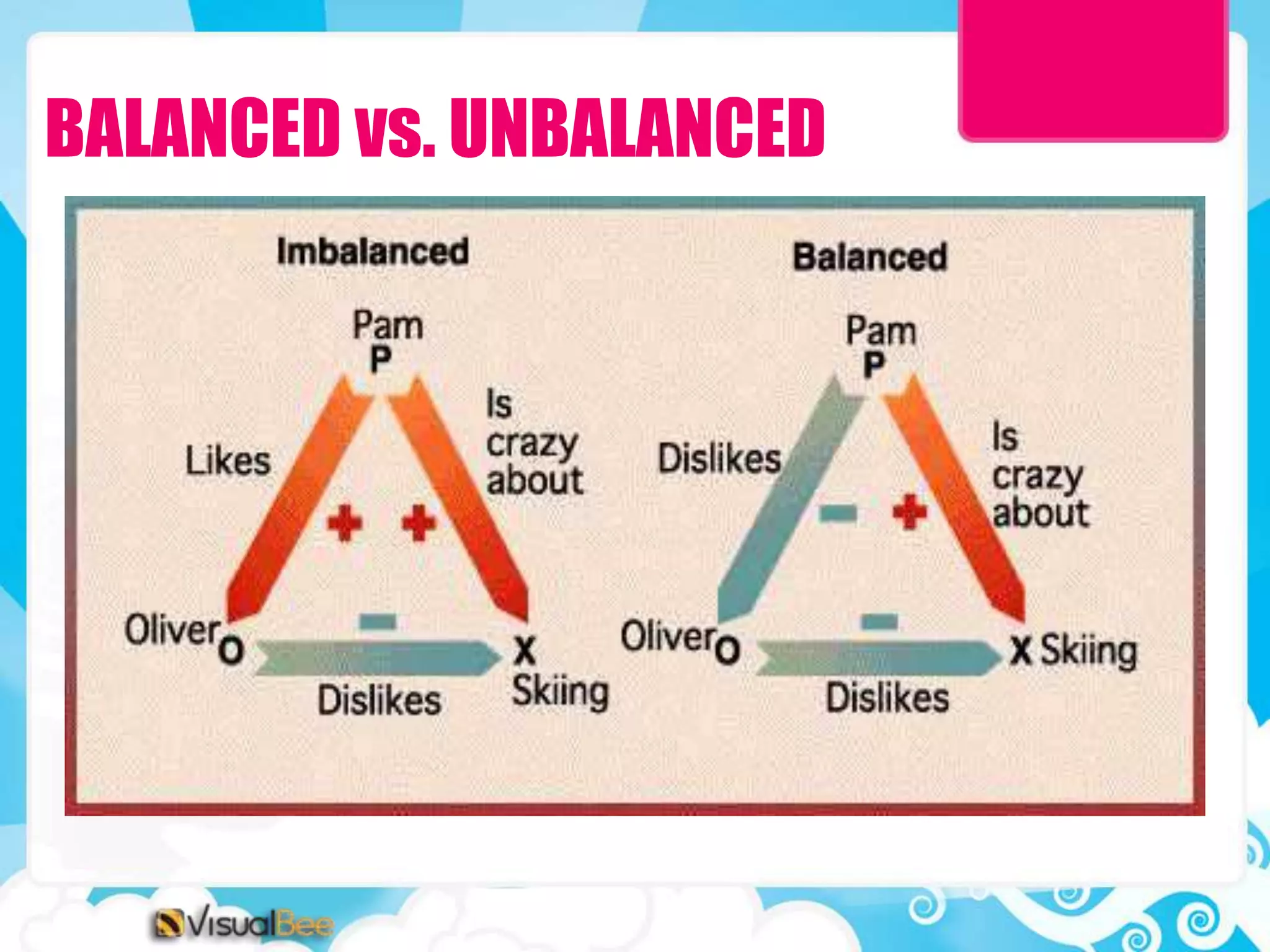
Balance Theory (Attitude Change Theory: Cognitive Motivation)
When there is a relationship between three entities, there needs to be balance in how all the entities feel about each other. When there is an imbalance, there will be motivation within the three to restore the balance. (To be balanced, either all the entities have to have a positive relationship, or 2 entities have to both have a negative relationship with the third entity.
Example: Prof and his girlfriend had a good relationship, the girlfriend and the roommate had a good relationship, but the Prof and the roommate had a bad relationship. (+ + -)=- which is unbalanced. To balance this, the girlfriend tried to make the Prof and roommate friends (+*+*+)=+, but what ended up happening is the girlfriend and roommate started drifting: (+*-*-)=+.
Ex2: if you and your partner are thinking about having children (this was the first thing to come to my mind, ‘low it), and you don’t like children, but your partner really does, either:
You will begin to want a child
You will convince partner to not want a child
You will begin to breed animosity towards you partner
Classical Conditioning
Aka Pavlovian Response: when you pair a neutral and unconditioned stimulus until the neutral stimulus elicits the same response as the unconditioned stimulus naturally did
Ex: Pavlov originally wanted to test dogs’ digestion (response to food, measure salivation as a result of what they smell and stuff), but noticed that the dogs would start salivating every time they heard the lock open to their door bc every time that lock opened, they got food, for which they needed saliva; this caused a problem for his initial study (can’t isolate saliva to a specific food cause if lock cause saliva), so he pivoted to learning theory:
if US→UR,
CS+US = CS→CR
(U= unconditioned, C= conditioned, R= response, S= stimulus)
Classical Conditioning in Humans
Motoric response: if u blow air into a person’s eyes, they will blink: if you play a tone every time right before you blow into their eyes, eventually, when they hear the tone, they’ll blink to protect their eyes, bc they’ll associate the tone with blowing into their eyes
Fear/threat: autonomic nervous system response:
Little Albert: baby named Albert liked a plush white rat; every time he saw/approached the toy, they’d play a startling sound that’d make him cry, eventually, seeing the rat that used to bring him joy would make him cry, and this also generalised to other white plushies; they did somewhat rehabilitate him tho: by showing him the plush w/o the scary sound, eventually he felt safe again around it (not fully tho, but this shows the ephemeral nature of fear)
Jaws: at the beginning of the movie, they introduce the minor second motif (semitone (E and F I think)), it’s ominous inherently, so that puts you on edge, but initially, nothing happens, so that relaxes you; next time you hear it, you’re relaxed, which makes what follows: a brutal shark attack, that much more jarring, next time it plays, you’re ready for the worst, but nothing happens, and since majority of the time, the sound has been chill (fear is salient tho), you’re mostly chill, so next time you hear it, the paired jumpscare hits hard (now, you associate the minor second with gore, which creates tension bc u don’t know when what will happen)
Ex3!: Drigotas heard Islands in the Stream when in the back of a car, being driven, car hits old woman, when he heard the song after, he’d get a visceral, queasy nausea response, but now, all he has is the memory, not the intimate response
Sexual stimulation:
In ads, sexual stimulation is often paired with the neutral product in order to stimulate arousal (general, not sexual, js brain activation) when you see it (like beer commercials)
Taste Aversions:
When you see a food, after getting an UNRELATED sickness after eating said food, you’ll be nauseous every time you see it (THIS IS WAY MORE PERMANENT THAN ANY OTHER ASSOCIATION BC OF BIOLOGICAL SURVIVAL DRIVE TO AVOID BAD FOOD)
Ex: Drigotas w/ mayo, or say you feel flu symptoms after eating a chicken parm (rlly bad, vomiting, cramping, fever, etc, probably more impactful as a taste aversion if the illness is like digestive tract-centred), every time you see chicken parm, or taste it, you’ll feel like vomiting (bc of fuzzy nodes, how close does it need to be? Can you do exposure therapy with like veal parm or smthn)
Ex: John Garcia had a problem with coyotes eating lambs, so after a coyote ate a lamb, he injected the coyote with an illness, and then put lamb in coyote pen: coyote circled lamb, but before pouncing, the coyote looked nauseous; the lamb was cowering, but after realising the coyote couldn’t eat it, the lamb chased the coyote out
Operant Conditioning: Learning Theory of Attitude Change Theories
Punishment and Rewards shape behavior.
Example: SGA wanted to know if they should have a spring fair right before finals. Researchers got involved and they had people call up students to ask them about their thoughts about the spring fair and the control condition was saying “uh huh” whenever the students said something positive about the spring fair and the experimental condition was saying “good”. The experimental group was subtly conditioned to be like the fair because their positive reactions to the fair were rewarded and subtly reinforced. The experimental group was more likely to be in support of the fair.
Why it can be ineffective:
-Rewards and punishments can be idiosyncratic.
Example: As a kid, naptime is the worst, as a college student, naptime is the best part of my day.
-Rewards and punishments are often admitted haphazardly
Example: When training a puppy, the puppy will only learn if you consistently reward/punish its behaviors, otherwise it will get confused over whether a behavior is actually good or not.
Overjustification effect
Intrinsic motivation is when you do something because it brings you internal rewards (eg it makes you feel good internally). Extrinsic motivation is when you do something for the external rewards (eg money, praise).
-When you do something out of extrinsic motivation, you no longer feel as intrinsically motivated to do it.
Example: When you pay your kid to read a book, they lose their internal motivation to read and they won’t read if they don’t get paid.
Example: Kids in a study are told to play with toys for 20 min. Control group has no conditions, experimental group is told that they will be rewarded if they play with the magic markers (they will get candy afterwards). 2 weeks later, the kids come back (the good old “oh no, I lost your data”). This time, there is no reward for playing with the magic marker. The control group plays with the magic marker for the same amount of time, the experimental group plays with the magic markers less because the initial extrinsic reward undermined their internal motivation to play with the magic markers.
Example: Kids always play in a lady’s yard. The lady pays the kids a quarter to play in her yard and then stops after a week and the kids stop playing because their extrinsic motivations undermine their internal motivations.
Example: When you choose a job based on pay, you have less intrinsic motivation to actually work, so people that chose a job out of passion are actually more successful in the long term (they are happier, do better work, and then get promoted).
Observation/Social Learning: Attitude Change Theories: Learning Theory
-Similar to operant conditioning; when you see someone get punished/rewarded for a behavior, it can change your own behaviors.
Example: If your friend tells the friend group about how good the movie “digger” is and the friend group starts flaming their movie recommendation, you will subsequently think the movie is bad.
Cognitive Response Theory (CRT) vs Heuristic Approach
Natural evolution of study on persuasion approaches (see previous card), answering why certain approaches are more effective:
Cognitive Response Theory: what matters is the nature of response to message
Controlled processing (ie, analysing content of message)
Heuristic Approach:
What matters is what heuristic is activated
Automatic processing (central node activation: eg, they’re attractive so you agree, not conscious, you’re js persuaded to think they’re more persuasive)
Both found data supporting their claims, this is a big debate, they accused each other of making up data, but meta analyses showed that both have merit: in controlled processing conditions (high motivation), CRT is valid, and in automatic processing conditions (routine decision/ego-depleted), heuristic approach is taken
Message Learning Approach, Persuasion: Attitude Change Theories
(A model that looks at 4 variables that determine how persuaded someone will be).
4 Variables: Source, message, recipient, medium
Source Factors: Subvariables: Attractiveness, Credibility, Power
Attractiveness: Physically attractive people are more persuasive (due to the Halo effect). This is why models for commercials are super attractive.
Credibility: We are convinced by experts, or people we think are experts.
Power: We are convinced by people who have power, or seemingly have power.
Example: Guy who is filling his parking meter is asked by either a regular guy to fill up the other meter, or he is asked by a guy with a security guard outfit. The guy is more likely to listen to the supposed security guard even though the security guard has no domain over parking enforcement.
Message Factors: Subvariables: Comprehensibility, Number of Arguments, Fear Arousal
Comprehensibility: If the person can’t comprehend the argument, even if its a great argument, they won’t be persuaded.
Example: OJ Simpson's prosecutor brought in an expert who explained the DNA evidence, but their explanation was so complicated that the jurors could not understand the damning DNA evidence.
Number of Arguments: People are more convinced by more arguments, even if there is no additional information or if the arguments are just rephrased.
Fear Arousal: Fear is a strong way to make people change their behavior. In other countries, cigarette boxes have a visual of a diseased lung to deter smokers. While it is powerful, it is more effective when you pair it with written instruction on how to actually change the behavior.
Medium Factors: Subvariables: Print vs Video; Face to Face vs Media
Print vs Video: At least historically, print is more effective than video for attitude change
Face to Face vs Media: People are more convinced by a face to face message than through virtual media.
Example: Hilary Clinton lost to Trump in the 2016 election in part because she did not do enough face to face campaigning in key swing states. She did not do enough in-person rallying.
Recipient Factors:
Intelligence and Self Esteem: People who have lower intelligence and self esteem are more easily persuaded and vice versa. But this also means that people with lower intelligence and self-esteem are more likely to flip flop between sides.
Elaboration Likelihood Model (swap out pic for slides when it comes out/on Wed)
(Only applicable when persuasive communication is given): if you’re not motivated to process info, you’ll go into peripheral route processing (PRP), if yes, if you can’t process the info (ego-depleted), you go into PRP, if you can’t process, you go into central route processing (CRP);
CRP leads to cognitive elaboration: if u have favourable thoughts towards the attitudinal topic, you have an attitude change towards positive, if you have unfavourable, attitude change towards negative, ambivalent or unbothered = PRP
When now in PRP (due to above cascade), if there is a peripheral cue present (see message learning approach), you will have an attitude change towards the peripheral cue, if not, no attitude change
Ex: in the OJ Simpson case, the most damning evidence was conveyed in jargon, so bc it wasn’t digestible (peripheral clue), the jury’s attitude change was towards the peripheral cue, which was against the attitude (that he did it)
Ex: presidential debate: most ppl are motivated and can process the info, but are also ambivalent, ergo, they go into PRP for their final decision: JFK mogged Nixon, so he was preferred by those who watch the debate (first debate to be watched), those who listened to the debate preferred Nixon bc they were in CRP bc he made points good enough to give them favourable thoughts
Ex2; the Microsoft surface ad is all peripheral cues (attractive ppl in expensive outfits doing choreographed dances; there are no stats bc the audience has no motivation to process info, ergo, they’re in PRP, but old tech ads’ audience were workers, so they needed stats bc workers were motivated to be in CRP)
Ex3: dumb ads with only peripheral cues (knife set ads with flashy choreography and bad two for one deals (they make profit bc it’s not a hair off their back to make another set, but they can up charge bc u think you’re getting a good deal, under using base rates) air at late night, when the audience is ego-depleted, or potentially inebriated

Obedience (mechanism of social influence)
Using power to make someone act as you want (against their want(
Six Bases of Social Power:
Reward: more effective than punishment, reward can create habituation (shiny thing doesn’t seem so shiny in context of other shiny things), rewards are idiosyncratic (what’s a reward to someone might be a punishment to another), also over justification effect
Coercion: (punishment) habituation is a problem again, the aversive might not seem so aversive, even normal, after a while; task leaders do coercion, best paired in leadership with a socioemotionally strong leader, who can give rewards and nurture
Expertise: having specialised knowledge in a relevant field can create obedience in those that need your help
Ex: if you have a tech problem, you call IT, and bc you need their help, ur at their mercy, so you’ll do anything for them (to gain the reward of their help), such as get them a coffee (even tho that’s unrelated to your problem, or their solution)
Ex2!: going camping, Drigotas and his friends’ boat won’t start, so his friends with hands on jobs (architect, engineer), start working on it, Drigotas is not of much help here, so when they ask him to jump into the water to get a screwdriver, he complies, bc he’s at their will; however, the guy who asked him to jump in (Dave) had relationship problems, and since that’s Drigotas’ area of expertise, he is now at his will, and Drigotas made him get him a beer (showing the contextual power of knowledge on people’s behaviour)
Information: not specialised, but dominion over something (more about the message content than the person’s qualifications)
Ex: everyone is nice to the administrative assistant bc she has power over the executives’ calendar (but no relative power), and ppl want access to that
Referent Power: when someone looks up to you, or you have charisma, you can make them do things
Ex: a younger sibling to an older (thought process is you’re my idol, so I want to be nice to you in hopes of becoming like you)
Ex2!: ppl with rizz are nice to be around, so it rewards you to please them so they like you: when Bill Russell walks into a room, ppl gravitate to him bc of his presence, and therefore, he could make ppl do things they might not want to initially (internally)
Legitimate Authority: influencer’s right to make request (or illusion)
Ex: Judge can make you be quiet bc he has dominion over the court room (his place, his rules, same as a homeowner)
Ex2: Police Officers’ position is instate to be obeyed (that’s their whole point)
Ex3!: Drigotas made us violate a norm bc he’s allowed to do that as his prof, but he couldn’t make us mow his lawn bc that oversteps his powers, and he would be checked
Ex4!: Drigotas was speeding on the NJ Turnpike, and when he saw a fire Marshall, he slowed down even tho he knows the fire Marshall won’t pull him over or anything, he’s conditioned to have obedience to a person of that fortified power (in this context)
IRACER (information, reward, authority, coercion, expertise, referent power, for example, a famous racer would have referent power, so the whole acronym works)
Milgram Study
Inspired by Nuremberg Trials (lower ranking officers did atrocities bc “higher up said to”, Americans couldn’t believe)
Collected ppl from all walks of life to put into study: told it’s a memory study (deception), subject is the teacher, there is a confederate learner; subject is told learner will memorise words, and teacher will test them, and administer shocks if the learner is wrong (indeed, they are given a shock to prove it works, but the confederate doesn’t get shocked, and is also assigned by a rigged coin flip, so the subject doesn’t know they’re a confederate). The confederate starts by getting things right, then they get a 20V shock when they get their first thing wrong. Everything the confederate says is a recording, so no randomness.
At 70V, they start yelping, at 100, they say “I don’t want to do this anymore” (atp, teacher says “we should stop”, but research assistant says, verbatim, “for the purpose of the study, pls continue, the shocks may be painful, but they aren’t dangerous”, this is not pulling rank). At 150, cries are worse, 200, he says he has a heart condition, 300 he says he won’t respond (the teacher is then told no response in 5 secs = wrong answer, and buzz), at 400, he stops responding (a dead silence, which is scary, bc he was yelping before)
It’s such a landmark study bc everyone thought no one would go past 200, but 65% shocked until the end.
When the confederate was a woman, 55-60% shocked to the end, but also the teacher was necessarily a woman, so hard to extrapolate
Huge ethical issue bc the subjects realised they’d fold under no pressure (during the experiment, they’d continue often after being told they’re not liable for harm), bc ppl want to distance themselves from pain
To target the original American FAE, it was done across the world, and results were always 55-85% shocked till the end (not allowed any more tho, this disconnect makes ppl think the older timers were more pushovers, and they wouldn’t do this, not true)
If another teacher was in the room (a confederate), and quit early, only 15% would shock till the end (social support), but if the other teacher went to the end, 90% of subjects did (bc of social comparison theory).
Another variation you could choose the shock level, and most ppl didn’t go above 50 (eliminating the argument that ppl are cruel, and that the power of teacher overtook their soul)
If during the experiment, the first research assistant was called out, and replaced, obedience decreased bc the authority of the research assistants was undermined
Death Dealing Nurses
When nurses are told by doctors to inject patients with 10x the amount of recommended epinephrine (deadly), 50% of nurses do it. Doctors back then held a lot of institutional power over nurses, so it represents the power of legitimate power, referent authority, and expertise.
2009 French Game Show (La Zone Extrême)
Producers created a game show that was designed to be like the Milgram study. A member of the audience would be selected to win prizes. If a confederate misses a trivia question, you would get a prize, but you have to give them a shock. It ran one time and then got shut down.
Compliance
Use subtle tricks to activate schemas to prey on someone in automatic processing to get smthn they normally wouldn’t
Ex: foot-in-the-door
Ex2: hypnosis
Conformity
Changing one’s beliefs or behavior to be consistent with group standards
Normative Social Influence
Desire to be liked
Example: When the Prof was a kid, in order to fit in with the cool kids, he hung out with them and threw rocks with them at cars.
Informative Social Influence
Desire to be right
Example: If I am at a governor’s ball and I don’t know the etiquette for how to act or eat my food, I will conform by copying everyone else who probably knows what the proper etiquette is.
Sherif’s Autokinetic Effect
Subjects were in a visual perception study and staring at a stationary laser point in a dark room. Due to involuntary eye jolting, the subjects thought that the point was moving and researchers recorded how far subjects perceived the points to move. When the subjects were in groups of 3 and asked to report together, while the subjects initially gave different answers, they soon reached a group census after a few minutes. Even when the original people were slowly replaced by other people (think group of theseus), the census stayed the same. This helps explain how traditions can form and persist.
Asch Line Study:
1 subject and 6 confederates were asked to look at lines and choose which of 3 lines matched the target line length. It was an obvious answer, but sometimes the confederates would intentionally say the wrong answer and 72% of subjects would also say the wrong answer at least once just to conform with the group.
Factors influencing the strength of conformity
Subvariables: Social Support; Desire to be in the group; Public vs. Private Behavior
Social Support: In the asch study, if at least one subject said the right answer or at least an answer that was different from the majority opinion, it freed up the pressure on the subject to conform and they would say the right answer.
Desire to be in the group: The more someone wants to be part of a group, the more they will conform to the groups standards in order to fit in.
Example: Prof throwing rocks at cars with the other kids.
Example: At a coed frat house, the President wanted at least one room to be nice for studying, so he designated one area to be the nice study area and it remained as the nice study area years later even after the President left. It is also an example of a tradition persisting.
Public vs Private Behavior: Conformity is ultimately an impression management device, so we only conform when it is public behavior. We don’t change our behavior in private.
PDS (like PEDs, bc they enhance your likelihood to perform (not be yourself, conform, and conform and perform rhyme))
Johnny Rocco Study
At a university, through pilot testing, researchers figured out whether students had a conservative or liberal view towards juvenile justice. They got 5 conservative students and 1 liberal students to discuss the fate of Johnny Rocco, a juvenile delinquent (and they tested different compositions). What they found was that the group would initially gauge how each person’s views and once the majority realized that they were the majority, they would bombard the minority with normative and informative social influences (aka they would say why are you rocking the boat, or they would try to use facts and logic) in order to persuade the minority to change their opinion.
-85% of minorities shifted their opinion
-When the minority was a confederate who held on to their opinion, the majority would ask the researcher to kick out the minority.
-When there was at least one additional minority, it diffused the pressure off of each minority and emboldened them to stand up for each other and hold onto their own opinion, making them less likely to conform.
Compliance
Known as “mindless conformity”; using reliance on heuristics of someone in automatic processing to get them to do something they normally wouldn’t.
Association with Positive Mood (Compliance Strategies)
When people are happy, they are simply more likely to comply. This can be done through flattery whether it be subtle or obvious. It can also be done through “Wine or dine” which is pretty much indirect bribery. This is why lobbyists and pharma reps have limits on how much they can spend on congressional candidates.
Example: Pharma Rep trying to push a certain drug tries to get doctors to prescribe the drug by visiting a hospital and giving all the doctors lobster rolls. The hospital cracked down by limiting how much the Pharma Rep can spend on food bribes.
Norm of Reciprocity (NOR)
If I do something for you, I can ask you to do something (usually bigger) for me (IOU basically)
Soda Study: NOR
Subjects are told they’re participating in a cognition study: they’ll do anagrams, then take a break (“in order to get you back to baseline”), then do another set of anagrams. You do the activities with another person, a confederate. During said break, the research assistant leaves, and so does the confederate; in the control group, he returns empty-handed, in the experimental group, he returns with two sodas because “he was thirsty, and figured you might want one too”. Most subjects accepted the soda. At the end, the research assistant leaves you two alone to get the credit slips, and the confederate takes this time to ask you to buy a $5 raffle ticket for his charitable organisation (after telling you about it and framing the ticket with its winning odds and that). Most people bought a raffle ticket in the experimental group (at least compared to the control group) because even tho all he did was give you a $.50 soda, you want to reciprocate the good deed he did at the next possible opportunity (you don’t know if you’ll ever see him again, plus, you don’t want to drag out this imbalance of good deeds), so you are motivated to help him out even if it is out of your way
Hare Krishnas (NOR)
The Hare Krishnas were a religious group that spread their religion by giving out pamphlets, talking to people, and soliciting donations. One strategy was to stand by airport arrival terminals and give people a flower and once the person received a flower, they felt more compelled to listen to the religion, donate, and accept a pamphlet (and the results support this).
-At its surface, a confounding variable might be that the people who accepted the flower might be interested in the religion to begin with, but considering that many people just threw away the flowers afterwards, this was not the case.
Door in the face strategy (NOR)
A compliance strategy that uses the norm of reciprocity;
It works by first asking someone for something high, but then as a favor to them, lowering it.
Example: I want to sell this car for 5k, but just for you, I can lower the car to 4k. This makes people more likely to buy the car for 4k than outright selling the car for 4k. It is also a framing strategy.
Ex: Watergate Scandal: G. Gordon Liddy was the general counsel for the Committee to Re-elect the President (CREEP). He was the one who came up with the idea behind watergate, but since it was illegal, he knew it would get rejected, so he first pitched a series of outlandish ideas like inviting Democrats to a yacht, getting them inebriated with drugs and alcohol, and then calling over call girls and taking photos of the Democrats with them to get blackmail. He let those ideas fail before pitching Watergate which seemed more reasonable and tame in comparison.
Zoo Study (NOR)
Study for the door in the face effect: The Big Brother association needed chaperones for a zoo trip, so they asked college students if they wanted to chaperone (control group), or if they wanted to be a big brother (long term mentor)—when they said no, they asked “ok, then can you at least chaperone our zoo trip?”. The people asked first to be a big brother, then for a lesser ask, were more likely to say yes to the question of if they wanted to be a chaperone because of the door in the face effect (they’re doing you the favour of lowering their ask, so you feel obligated to do something right for them after rejecting, also potentially a bit of commitment)
That’s Not All Effect (NOR)
Giving you something for free as a favour to trigger feelings of reciprocity
Cupcake study: in the breezeway between Krieger and Ames hall, they were selling cupcakes and cookies, price upon asking: the control group phrased it as “$1 will get you a cupcake and cookie”, in the experimental group, they said “if you buy a cupcake for $1, we’ll throw in a cookie for free”; experimental group more likely to spend because it seems like they’re making a kind exception for you, so you feel indebted to take them up on it
Free giveaways: if they offer you a free sample, you feel more obligated to buy the whole product because they’ve done you a favour, so you feel obligated to return it in kind
Commitment
Def: by engaging someone in work with you, you can make them do something else that you want because they’ll think it’s not too much effort to continue what they’ve started
One Strategy: Foot in the Door:
You get someone to do a smaller favor for you which makes them more likely to agree to a bigger favor later on.
Drive Safe Study:
Target Behavior: To get someone to put up a drive safely sign in their front yard.
Control Group: Simply asking the homeowner if they can put it up.
Experimental Group: First asking the homeowner if they would sign a petition supporting safe drivers. 2 weeks later, the homeowner would be asked to put up the sign and people in the experimental group were more likely to say yes.
Low Balling
When you get someone to commit to a low stakes request and once they agree, you up the stakes of the request.
Example: 7 am study:
Control Group: Asking students that need SONA credits outright if they were willing to participate in a study at 7am.
Experimental Group: First getting students to commit to being in a study, then once they agree, tell them that the study is at 7am. These students were more likely to participate because they already felt committed to being in the study.
Car Sales Tactic
Illegal now often: if you know exactly what car you want (the base model with no bells and whistles), and you tell a dealership owner, they’ll say you’re a savvy, shrewd, informed shopper, and check their inventory; they’ll then find that they don’t have the base model, but there’s one 15 miles away that could be there tomorrow, but while you’re here, you could drive the bells and whistles version because it’ll feel the same. You’ll do so, and like it, and be committed to the idea of buying this car tomorrow. When tomorrow comes, they’ll approach you sheepishly and curse out the other dealership, saying the car got sold underneath his nose, and there’s not another base model in a thousand mile radius. Since you were committed to buying the car today, you can buy the car you drove yesterday, and you will, even if it means paying extra for the unneeded features.
Also, another variation is you see an ad online without price, and since you’re already married to the idea of getting it, the price isn’t a deterrent, or; they’ll advertise a price, you’ll go there to buy it, and they’ll say the car with that price js sold (or deal ran out or smthn), but they can give you the car for slight more, and you accept because you’re committed since you came all this way, and you thought you were getting the car
Law of scarcity
When something is a “one time deal” and the time/supplies are running out, you are more likely to get it because you do not want to miss out. This is because it triggers loss aversion.
Defenses against compliance strategies
Be aware of the compliance strategies being used against you. Also, be in controlled processing because a lot of compliance strategies take advantage of your heuristics.
A lot of infomercials air late at night because that is when people are tired, inebriated or distracted (ego-depleted), so they are more susceptible to using their heuristics and using automatic processing.