biomechanics mmm11
 Call Kai
 Learn
 Practice Test
 Spaced Repetition
 Match
 Flashcards
 Knowt Play
1/19

There's no tags or description
Looks like no tags are added yet.
20 Terms

This term associated with the gait cycle is defined as the interval between two sequential initial floor contacts of the same foot. It is represented by the block arrow in the following diagram:
stride
Double stance refers to:
the time in gait during which both feet are contacting the ground
Double stance occurs twice in the normal gait cycle. When does double stance occur:
at the beginning and end of the stance phase, during initial contact and terminal stance
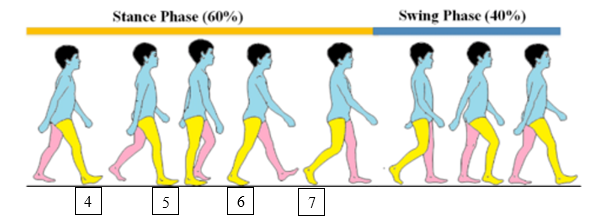
The following diagram depicts several phases of gait:We are considering only the actions of the right lower extremity. For each number listed above, choose the corresponding phase of the gait cycle.
4. This phase of gait begins the stance phase of the gait cycle.
initial contact
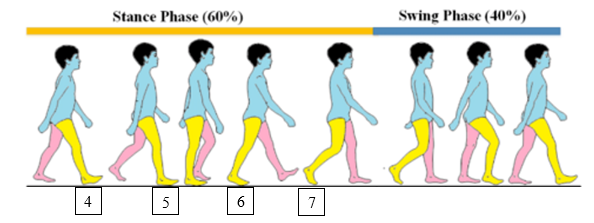
5. This phase of gait occurs next. It is the phase of the gait when the foot is lowered down to the ground and conforms to whatever surface the individual is walking on:
loading response

This phase of gait occurs after mid stance as the gastrocnemius begins to contract to propel the body forward:
loading response

This phase of gait occurs at the very end of stance phase. It is the last phase before the limb enters into the swing phase:
pre-swing
As the gait cycle moves from initial contact to loading response, which of the following muscle activities occurs to lower the foot to the ground:
eccentric contraction by the tibialis anterior and pre-tibial group
At what point in the gait cycle is the quadriceps most active:
just after initial contact or heel strike as the knee flexes to absorb shock and to prevent the knee from collapsing as the body weight is transferred on to the stance limb
Which of the following characteristics is typical of an antalgic gait:
decreased stance time on the painful side
The names of the movements occurring in the primary planes change when considering the movements of the foot and ankle. Movement in the frontal plane was typically called abduction and adduction. When considering foot movement, frontal plane movement is now called:
eversion and inversion
Movement in the horizontal plane was typically called internal and external rotation. When considering foot movement, horizontal plane movement is now called:
abduction and adduction
Tri-planar movement is movement of the foot and ankle that occurs simultaneously in all three primary planes. The terms pronation and supination are used to represent this movement. Open chain pronation consists of what three movements:
dorsiflexion, eversion, and abduction
Movement of the talocrural joint occurs primarily in the sagittal plane, although some movement occurs in the other two primary planes. This movement could be called supination and pronation because it is a tri-planar movement. However, because most of the movement occurs in the sagittal plane, talocrural movement is called:
dorsiflexion and plantarflexion
Which of the following statements best describes the arthrokinematics of the talocrural joint during dorsiflexion:
talus rolls anterior and glides posterior
Movement of the subtalar joint is truly tri-planar movement. Because of the tri-planar nature of the movement, movements of the subtalar joint are called:
pronation and supination
The movements of the subtalar joint change slightly in an open chain versus closed chain situation. During closed chain pronation, what movements occur and what joints are moving:
calcaneus everts, talus adducts and plantarflexes
Movement of the talus in the horizontal plane creates rotation of the tibia. During closed chain subtalar pronation in which direction does the talus and tibia move:
talus adducts, tibia internally rotates
Movement of the subtalar joint controls the amount of movement that can occur in the mid tarsal joints. When the subtalar joint pronates, what occurs at the midtarsal joints:
midtarsal joints unlock and move into their LPP
The pronation and supination of the subtalar joint along with the unlocking and locking of the midtarsal joints, allows the foot to accomplish its two main functions: 1) mobile adaptor - conforming to the walking surface and absorbing shock, and 2) rigid lever - pushing off the ground to propel the body forward. During the loading response phase of gait what is the subtalar joint doing and what foot function is created:
subtalar joint pronates, foot becomes a mobile adaptor