Bio 1.1: Chemical Elements...
 Call Kai
 Learn
 Practice Test
 Spaced Repetition
 Match
 Flashcards
 Knowt Play
1/113

There's no tags or description
Looks like no tags are added yet.
114 Terms
Role of Magnesium (Mg2+)
It’s an important component of chlorophyll (Photosynthesis), and is needed for mammal bones
Magnesium Deficiency
Reduced photosynthesis efficiency and fatigue
Role of Iron (Fe2+)
Used in haemoglobin which transports oxygen in red blood cells.
Iron Deficiency
Anaemia- fatigue and dizziness
Role of Phospate (PO43-)
Used in nucleotides and phospholipids for membranes
Phosphate Deficiency
Stunted plant growth and leaf discolouration
Role of Calcium (Ca2+)
Strengthens bones and teeth in animals, and plant cell walls
Calcium deficiency
Osteoporosis and stunted root growth
Inorganic Ions needed in biology
Magnesium, Iron, Phosphate, Calcium
Properties of water
High specific heat, high latent heat, polar, hydrogen bonds, surface tension, solvent, metabolite
High Specific Heat Capacity Definition
High amount of energy needed to heat 1kg by 10C
High Specific Heat Capacity Importance
Internal temperature doesn’t change and ocean temperature doesn’t change
High Latent Heat of Evaporation Definition
High amount of energy needed to evaporate into vapour
High Latent Heat of Evaporation Importance
Water within organisms doesn’t evaporate
Polarity Definition
Electrical charges within a molecule
Polarity Importance
Charge drives essential biological processes
Hydrogen Bonds Definition
Hydrogens of adjacent water molecules bonding
Hydrogen Bonds Importance
Adhesion which allows for capillary action up different vessels against gravity
Surface Tension Definition
Hydrogen bonding causes cohesion which increases surface tension
Surface Tension Importance
Organisms can be suspended on water
Solvent Definition
A substance that a solute can be dissolved in
Solvent Importance
Biochemical Reactions in organisms
Metabolite Definition
Water is used in many metabolic reactions
Water as Metabolite Importance
Product in condensation reactions and reactant in hydrolysis reactions
Low Density as a Solid Definition
Solid water (ice) is less dense than liquid
Low Density as a Solid Importance
Water freezes top down and so creates insulation for aquatic organisms.
Monosaccharide Definition
Single carbohydrate monomer
Monosaccharide Formula
Cn(H2O)n
Triose Sugar Formula
C3H6O3
Triose Sugar Example
Glyceraldehyde
Pentose Sugar Formula
C5H10O5
Pentose Sugar Examples (2)
Ribose, Deoxyribose
Hexose Sugar Formula
C6H12O6
Hexose Sugar Examples (3)
Glucose, Fructose, Galactose
Importance of Glucose
Main fuel for ATP production in all organisms
Glucose Isomers
Alpha glucose and Beta glucose
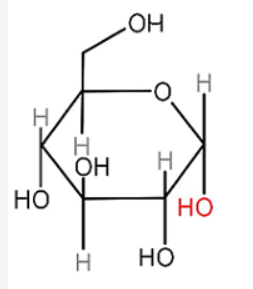
Which glucose isomer?
Alpha glucose

Which glucose isomer?
Beta glucose
Where is fructose found?
Fruit
Disaccharide Definition
2 monsaccharides bonded together
Disaccharide Examples (3)
Sucrose, Lactose, Maltose
Sucrose Structure
a-Glucose and Fructose
Where is sucrose found naturally?
Fruits and Vegetables
Lactose Structure
glucose and galactose
Where is Lactose found naturally?
Dairy
Maltose Structure
2 a-glucose
Where is maltose found naturally?
Grains
Maltose Use
Complex carbohydrates broken down to maltose before further digested to glucose during digestion
How many monosaccharides is a polysaccharide made of?
At least 10
Key polysaccharides (4)
Starch, Glycogen, Cellulose, Chitin
Where is starch found
Plants
What is starch used for
Plant storage
Starch sub-units
a-glucose
Different structures of starch (2)
Amylose, Amylopectin
Amylose bonds
a(1-6) glycosidic bonds
Amylose shape
Helical shape (not branched)
Amylopectin bonds
a(1-4 and 1-6) glycosidic bonds
Amylopectin shape
Branched
How much starch is amylose vs amylopectin
25-30% amylose, 70-75% amylopectin
Starch benefits
Insoluble in water, compact, amylopectin energy easy to access, amylose more compact
Where is cellulose found
Plant cell walls
What is cellulose used for
Strengthen plant cell walls
Cellulose sub-units
b-glucose
Cellulose bonds
b(1-4) glycosidic bonds
Cellulose shape
Every other monomer flipped 180o so straight and unbranched
Where is glycogen found
Liver and muscles
What is glycogen used for
Glucose storage in mammals
Glycogen sub-units
a-glucose
Glycogen bonds
a(1-4 and 1-6) glycosidic bonds
Glycogen shape
Branched
Where is chitin found
Exoskeletons and fungal cell walls
What is chitin used for
Strengthens exoskeletons and fungal cell walls
Chitin sub-units
N-acetylglucosamine
Chitin bonds
b(1-4) glycosidic bonds
Chitin shape
Every other monomer flipped 180o so straight and unbranched
Triglyceride structure
3 fatty acids + glycerol
Triglyceride properties
non-polar, hydrophobic, less dense than water
Triglyceride functions
energy store, buoyancy
Where are triglycerides found
Adipose (fat) cells
Phospholipid structure
2 fatty acids + glycerol + phosphate group
Phospholipid properties
hydrophilic head, hydrophobic tails
Phospholipid function
Cell membranes (bilayer)
Where are phospholipids found
Cell membranes
Saturated fatty acid
No double bonds
Mono-unsaturated fatty acid
One double bond
Poly-unsaturated fatty acid
Multiple double bonds
Groups on fatty acid ends
Methyl group and Carboxylic acid
Which fatty acid leads to atheromas
Saturated
What can too much saturated fatty acids lead to
Atheromas
Amino Acid structure
Central C, H, Amino group, Carboxyl Group, R Group
Amino Acid role
Bond to form specific proteins
Number of naturally occuring amino acids
20
Primary protein structure
Chain of amino acids
Primary protein structure bonds
Peptide bonds
Secondary protein structure
Alpha-helix or Beta-pleated sheet
Secondary protein structure bonds
Peptide and Hydrogen bonds
Tertiary protein structure
Several types of bond- more complex shape
Tertiary protein structure bonds
Peptide, Hydrogen, Ionic, Disulfide bonds
Quaternary protein structure
Multiple polypeptide chains
Quaternary protein structure bonds
Peptide, Hydrogen, Ionic, Disulfide bonds