Key Terms/Ideas/People ARC2701 (9-13)
 Call Kai
 Learn
 Practice Test
 Spaced Repetition
 Match
 Flashcards
 Knowt Play
1/61

Earn XP
Description and Tags
EXAM#3
62 Terms
Ptolemaic Egypt
Macedonian Dynasty in Egypt founded by Ptolemy I Soter, assumed kingship of Egypt in 305 BCE
Descendants ruled Egypt until Cleopatra VII’s death in 30 BCE
Wealthiest kingdom to emerge post-Alexander the Great
Politically + culturally powerful, last to fall under roman dominion
Set an example for other Hellenistic Kingdoms
Vendism
A religion for ALL, not just elites
4 ranks in society; Brahmans on top
polytheistic system, Indra highest ranked
Centered around ritual sacrifice of animals + soma (psychoactive substance). Fire sacrifices on brick platforms
began simple (no temples/statues), turned more complex, only Brahmans were trained to carry out correctly.
Widespread in Indian Kingdoms ca.1200 BCE
Altars, sacred rivers, procession of dieties.

Ghat
Passage/flight of steps leading to riverside
Burning Ghat
Place on the edge of a river where Hindus cremate their dead
Bhuddism
Religion/philosophy founded(ca.528 BCE) by Gautama Siddhartha (the enlightened one; ca. 563-483 BCE)
FOUR NOBLE TRUTHS:
existence is suffering
suffering=desire
suffering ends with achievement of Nirvana
Nirvana attained through the Eightfold Path:
right views,resolve, speech, action, livelihood, effort, mindfulness, concentration.
NO GODS
Karma: good actions rewarded; bad actions punished.
Ascenticism
Severe self-discipline and avoidance of all indulgence
Mahavira Jain
(ca, 599-527) Founder of the tenets of Jainism
Mauryan Empire
First to extend over most of the subcontinent
fiunded by Chandragupta Maurya, iverthrowing Magadha in northeast India
capital at Pataliputra, expanding westward
Became Jain ascetic, grandson Ashoka renounced and adopted Bhuddism as state religion in ca.260 BCE.

Stupa
Bhuddist funerary mound
Bell-like form platform at the top w/ stone railings
one of the 3 major elements of the bhuddist faith
distinct and purely religious monument
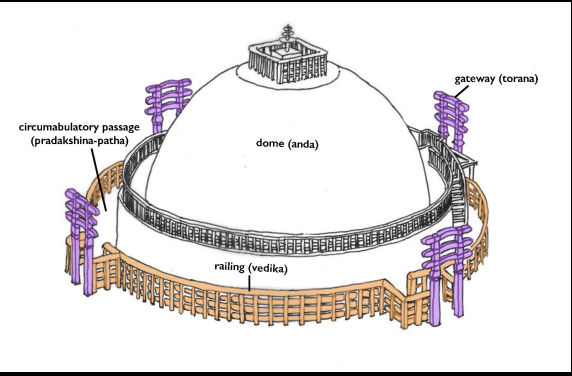
Parikarma/pradakshina
ritual of moving in a clockwise round a holy site as an indication of reverence.

chaitya, chaitya hall, or chaitya-griha
A hall of worship
one of the 3 major architectural elements of the bhuddist faith.

Vihara
Residence hall for the monks
square/rectangular court; cells occupied by Bhuddist monks, one sell reserved for a stupa.

The Etruscans
northern Italy, ca. 800-200 BCE
renowned for rich mineral resources + major trading power
culture+history obliterated or assimilated into Rome
evidence in tombs; wall paintings, roman adoption of clothing, religious practices, architecture,


Augury (auspicium)
practice of revealing future, hidden truths, obtaining guidence
observation+interpretation of natural signs
birds, celestial phenomena

Templum (pl. templa)
a space humans, represented by priests (augurs), interacted with the gods
locations of many official state functions—senatorial meetings, etc.
Roman Republic
ca. 509-27
over the nect 450 years, conquered all of Italy, France, Spain, Turkey, North Africa, and Greece
“Hellenized” art, archotecture, literacture, culture.
wealth= turmoil, collapse into civil war. Augustus took control as first emperor
Comitium
The cheif of political assembly in rome

Curia
Senate-house of Rome

Rostra
Speakers platform lay on the south side of the comitium

Tabularium
Official record office in home, housing law tablets constructed in 78 BCE

Basilica Sempronia, Basilica Aemilia
buildings serving as law courts

Temple of Vesta
Where eternal flame always burned, most sacred spot in Ancient Rome.

Celts (Gauls)
Indo-European people spread across europe from 1000-100BCE
British Isles, Northern Spain, Transylvania, Black Sea coasts, and Galatia
Iron Age culture that received luxury items through trade from Greece
Augustus (Who?)
Romes first emperor (27BCE-14CE)
era of relative peak: PAX ROMANA
Rebuilt parts of Rome, found rome a city of brick and turned it into marble
Colonnade
A series of columns in a straight line supporting an entablature
Exedra
Large semicircular niche-like building withs tone steads ranged around the walls.
Quadriga
Sculptured group representing a two wheeled chariot with a drive and drawn by r horses; usually associated with victory monuments.
Roman Empire
Started with Augustus in 27BCE, different emperors proceeded him for 500 years
expanded across Syria, Spain, Britian, and Egypt
3rd century CE: economic crisis, short-lived emperors, usurpers, barbarian incursions,
Castrum
Roman fortified camp. two main thoroughfares at right angles, the cardo maximus and via decumana, which each joined two gates set in towers with walls and towers around the whole.
Cardo
Main street in a Roman town running north to south
decumanus
Main street in a Roman town leading from east to west

Circus
Long, narrow building used by romans in chariot races
Emperor Hadrian
78-138 CE, reign began in 117CE
deepest interest in architecture. A poet, painter, and commander
interest in Hellenistic East (including Egypt and Syria), familiar with sun temples, mystery cults emphasized light and darkness.
Concrete
Structural material. Consists of hard, chemically inert particulate substance known as AGGREGATE, bonded together by cement and water.
Pozzolana
Hydraulic cement perfected by Romans. Made by grinding volcanic origin material with powdered hydrated lime, used in construction of pantheon and Baths of Caracalla.

Niche
Shallow ornamental recess in a wall containing a statue, urn, etc.


Aedicula/aedicule
Architectural frame around a doorway, niche, or window. Consists of two columns/ pilasters over an entablature with pediment.


Apse
Semi-circular recess covered by a hemispherical vault/semi-dome

Pilaster
A shallow rectangular column that projects slightly beyond the wall into which it is built and conforms precisely to the order or style of the adjacent columns.

Name each structural element
Entablature
cornice
column
aedicula
niche
arch
Parthian Empire
seminomadic people from east of the caspian sea
Romes great rival in the east, noted for their mounted archers
Between Rome and Han China, grew rich as middlemen, taxing silk and other goods.
ruled loosely
The Nabataeans
first recorded in 312BCE
Nomads who lived in tents, refusing to build houses or plant crops.
grew rich controlling caravan trade from southern Arabia.
Over time, settled, with Petra as their capital
last king, Rabbel I died, annexed by Emperor Trajan as the Roman province of Arabia.
Remained prosperous under Rome, but lost ground as trade routes shifted.
Emperor Qin Shu Huangdi
Ruler of the state of Qin in 246 BCE, declared himself emperor in 221 BCE.
Suppressed opposition of his rule on the grounds that he had a divine mandate to unify China
ordered frontier walls to be extended, forming the Great Wall of China
Unpopular; raised taxes, intolerant to those who supported him, deprived nobility of power.
Han Dynasty (206BCE-220CE)
two periods:
Western: When Chang’an (present day Xi’an)was the capital (Former Han)
Eastern: Luoyang as new capital, 230 miles east of Xi’an (Later Han)
Philosophy and Literature flourished, Confucianism became official government orthodoxy.
100 CE, trade along Silk Route flourished.
Confucianism
Dominated China until the early 20th century
Challenged Bhuddism’s inability to set out principles of an organized social and political order.
Bhuddism governs temples and Monasteries while court operated on Confucian principles.
Mound Builders
a range of North American cultures
lived in eastern woodlands and constructed platform mounds for ceremonial and burial purposes.
The Olmec
First elaborate pre-colombian civilization of Mesoamerica (ca.1200-400BCE)
culture influenced later Mesoamerican civilizations (the Maya and Aztec)
one of the first to introduce full scale agriculture to mesoamerica
monumental stone sculptures (colossal heads)

Talud-tablero
used in temple, pyramids, and platforms in mesoamerica. a sloping wall (talud) mounted by a table-like right angled panel inset (tablero)
Jesus
teachings made jewish hierarchy and Roman governers uncomfortable—”render unto Ceasar what is Ceasar’s and to God what is God’s”
thought to be seditious, died a martyr
twelve apostles elaborated on his life story of miracles and matrydom.
Fall of the Western Roman EMpire
Rise of Christianity coincided with the fall of the Western Roman Empire
suffered from a weakened army, foregin mercenaries, dwindling tax base and plauges.
raids by horsemen, Mongolian steppes, penetrated weakest points of empire
Rome loses political primacy in 3rd century, emperors rarely resided there
4-man executive system established in hopes of saving empire (tetrarchy)
Martyr
A person who dies willingly rather than renouncing their religious faith
martyrium
Circular/polygonal structure built over a tomb of a christian martyr; a mausoleum
Basilica
earliest usage designated any number of large roofed public buildings in ancient Rome and pre-Christian Italy: markets, courthouses, covered promenades, and meeting halls. Gradually, however, the word became limited to buildings of a more or less definite form: rectangular walled structures with an open hall extending from end to end, usually flanked by side aisles set off by colonnades (in large buildings often running entirely around the central area), and with a raised platform at one or both ends
nave
central and principal part of a Christian church. Extending from the entrance(narthex) to the transepts/chancel.
Aisle
portion of the church/basilica that parallels or encircles the major sections (nave,choir, or apse). often set up by columns.
Narthex
Long, narrow, enclosed porch, often colonnaded, crossing the entire width of a church at its entrance

Label each
apse
aisles
nave
narthex
transept
area of a cruciform church lying at right angles to the principal axis. The bay at which the transept intersects the main body of the church is called the crossing.
clerestory
any fenestrated wall of a room that is carried higher than the surrounding roods to light the interior space. In a large scale building, where interior walls are far from the structures exterior walls, this method of lighting wother wise enclosed, windowless spaces became a necessity.

pendentive
A triangular segment of a spherical surface filling the upper corners of a room, in order to form, at the top, a circular support for a dome.
Kingdom of Aksum
Powerful kingdom in Ethiopia during the earl Christian era
grew as a trading empire, challenging the Kingdom of Meroë.
Embraced christianity under King Ezana, linking Aksum to Byzantine Egypt religiously and politically in the 4th century.