3.4 Prokaryotic Cells
 Call Kai
 Learn
Learn Practice Test
 Spaced Repetition
 Match
Match Flashcards
 Knowt Play
1/17

Earn XP
Description and Tags
3.4. Know the ultrastructure of prokaryotic cells, including cell wall, capsule, plasmid, flagellum, pili, ribosomes, mesosomes and circular DNA.
Name | Mastery | Learn | Test | Matching | Spaced | Call with Kai | Chat |
|---|
No analytics yet
Send a link to your students to track their progress
18 Terms
Ultrastructure components prokaryotic cells
no membrane bound organelles
70S ribosomes
circular DNA
cell wall containing the glycoprotein murein
some may contain:
plasmids (loops of DNA)
capsules
flagella
pili
cell membrane that contains folds known as mesosomes
Plasmids structure
small loops of DNA
not present in all prokaryotes
Plasmids function
contain genes that can be passed between prokaryotes (e.g. genes for antibiotic resistance)
Capsule structure
some prokaryotes are surrounded by a final outer layer known as a capsule
not present in all prokaryotes
Capsule function
helps protect bacteria from drying out and from attack by cells of the immune system of the host organism
Flagella structure
long, hair-like structure that rotates
not present in all prokaryotes
Flagella function
enables the prokaryote to move
Pili structure
thread like structures on the surface of some bacteria
Pili function
enable the bacteria to attach to other cells or surfaces
Mesosomes
infolded regions in the plasma membrane of some prokaryotic cells
Mesosomes function
functions include: aerobic respiration, cell wall formation & DNA replication
Circular DNA structure
genetic material of prokaryotic cells is not contained in a membrane bound nucleus
Circular DNA function
genetic material
The area in the prokaryotic cell where the circular DNA is located is known as the…
nucleoid
Ribosomes size
70S (smaller than eukaryotic cells)
Ribosomes function
site of protein synthesis
Diagram of prokaryotic cells

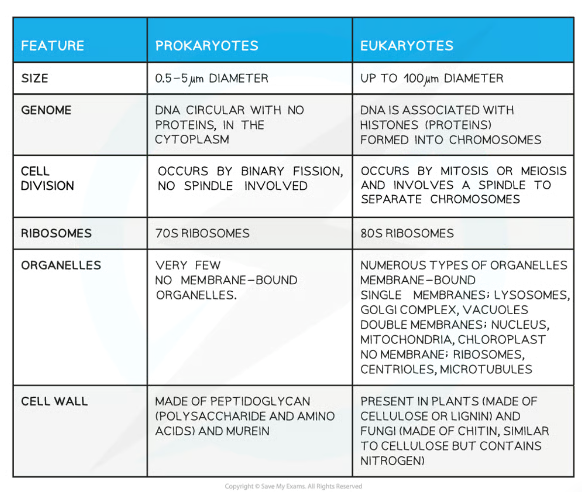
Comparison table eukaryotes vs prokaryotes