exam 3
 Call Kai
 Learn
Learn Practice Test
 Spaced Repetition
 Match
Match Flashcards
 Knowt Play
1/175

There's no tags or description
Looks like no tags are added yet.
Name | Mastery | Learn | Test | Matching | Spaced | Call with Kai | Chat |
|---|
No analytics yet
Send a link to your students to track their progress
176 Terms
electron configuration
list of all electrons in an atom or ion going from low energy electrons to high energy electrons
orbitals
where do electrons reside?
s, p, d, f
4 types of orbitals
2
how many electrons can each orbital hold?
an electron in an atom
each box on the periodic table represents what?
energy level of electron
each row on the periodic table represents what?
type of orbital
each section of the periodic table represents what?
pauli exclusion principle
rule where an orbital can hold only 2 electrons, and they must have opposite spins
valid ground state electron configuration
where rules for filling orbitals are followed (the electrons are arranged in the lowest-energy orbitals possible)
hunds rule
rule where you must put 1 electron in each orbital before filling more

orbital configuration
shows how electrons are arranged within the individual orbitals of an atom
outermost shell
what shell has the highest energy level?
aufbau principle
rule where you start with the lowest energy level & go up (don’t move on from orbital until you fill that orbital)
half full or totally full
what is the most stable electron cloud?
anomalous electron configurations
electron clouds one way from being half full or totally full (configurations ending in d9, f6, f13, d4)
orbitals
electron probability maps, surfaces that contain 90% of the total electron probability
outermost shell
where do valence electrons live?
find outermost energy level, add up electrons with that number
how to find valence electrons from electron configuration?
group numbers (columns)
what on periodic table tells number of valence electrons?
1
how many orbitals in s in each energy level?
sphere
what shape is s orbital?
3
how many p orbitals at each energy level?
dumbell
what shape is p orbital?
nodal plane
what cuts through the orbital (electrons not found here, only found in the lobes)
2
nodal plan cuts p orbital into how many parts?
5
how many d orbitals in each energy level
clover
what shape is d orbital?
4
2 nodal planes cuts d orbital into how many parts? (the fifth orbital creates a cone shape)
7
how many f orbitals in each energy level?
complex, multilobed shape
what shape is f orbital?
8
3 nodal planes cuts d orbital into how many parts?
the number before orbital type
principal energy level in electron configuration is what?
right
atomic radius decreases as you go which direction on periodic table?
more protons are added, nucleus becomes positive, so it pulls the electrons more strongly
why does atomic radius decrease as you move to the right?
down
atomic radius increases as you go which direction on periodic table?
right
atoms get smaller going in which direction on periodic table?
effective nuclear charge increases (electrons want to move away, but protons pull them in, making the atom smaller but heavier)
why do atoms get smaller going right on periodic table?
down, left
atomic radii get larger going ____ and _____
ionization energy
the energy required to remove an electron from a neutral atom, forming a positively charged cation
high ionization energy
an electron is held tightly and its hard to remove
low ionization energy
an electron is held loosely and its easy to remove
increases going up and to the right
ionization periodic table trend
electron affinity energy
energy required to place an electron on a neutral atom (gain electron), forming an negatively charged anion
increases going up and to the right
electron affinity energy periodic table trend
energy is absorbed
positive electron affinity energy means what?
energy is released
negative electron affinity energy means what?
noble gases
what elements are the exception to electron affinity? (don’t need to gain anymore electrons?) (very low electron affinity)
electronegativity
the tendency for an atom to pull the electrons closer to it when it’s in a bond
increases going up and to the right
electronegativity periodic table trend
lewis dot structure
keeps track of how electrons are bonding or not bonding in molecules of polyatomic ions
visualizing 3d structure
what does drawing out lewis dot structure help with?
count up total valence electrons
-use group number for each element and add them
-if there’s a charge on the ion, add or subtract it (ex: 2- charge you would add 2, 2+ charge you would subract 2)
draw structure of molecule
-element written first goes in middle (hydrogen never in middle) (central atom is most electronegative)
add single bonds (single bond has 2 electrons)
place remaining valence electrons not accounted for in single bonds as lone pairs (go until octet rule is satisfied).
-place on outer atoms, then center atom
4b. if it’s a polyatomic ion, add square brackets and charge
if there are too few electrons to fill octet rule (usually on center atom), add double or single bonds
5b. if there are too many electrons, put extras on center atom as lone pairs (expanded octet)
lewis dot structure drawing instructions
resonance
more than one way to draw a lewis dot structure. double arrow indicates this (real 3d structure will be a hybrid of the two lewis dot structures)
ionic bonding
atoms are so different that one or more electrons are transfered to form oppositely charged ions (> 1.9 electronegativity) (ex: NaCl)
non polar covalent bonding
two identical atoms share electrons equally (<0.4 electronegativity) (ex: H - H)
polar covalent bonds
atoms are not so different that electrons are completely transferred, but enough that unequal sharing occurs
(0.4 < x < 1.9 electronegativity) (ex: H - F)
Valence Shell Electron Pair Repulsion theory (VSEPR)
Electron groups around a central atom repel each other, so they spread out as far apart as possible to minimize repulsions. The number of bonds and lone pairs around the central atom helps determine the 3D shape of the molecule.
linear, trigonal planar, tetrahedral, trigonal bipyramidal, octahedral
types of electronic shapes (geometries) of molecules (depends on number of things attached to central atom - both bonds and lone pairs)

linear, 180
type of electronic shape with two things attached to central atom (bond or lone pair) and what is the degree angle between the two things?

trigonal planar, 120
type of electronic shape with three things attached to central atom (bond or lone pair) and what is the degree angle between the things?

tetrahedral, 109.5
type of electronic shape with four things attached to central atom (bond or lone pair) and what is the degree angle between the things?

trigonal bipyramidal, 90 & 120
type of electronic shape with five things attached to central atom (bond or lone pair) and what is the degree angle between the things?

octahedral, 90
type of electronic shape with six things attached to central atom (bond or lone pair) and what is the degree angle between the things?
number of bonds attached to central atom
types of shape of molecules just depend on what?
linear
molecule shape

trigonal planar
molecular shape

bent
molecular shape

tetrahedral
molecular shape

trigonal pyramidal
molecular shape

bent
molecular shape

trigonal bipyramidal
molecular shape

seesaw
molecular shape

t-shaped
molecular shape
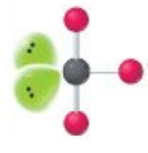
linear
molecular shape

octahedral
molecular shape

square pyramidal
molecular shape

square planar
molecular shape

t-shaped
molecular shape
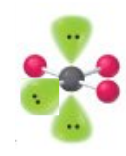
polarity
a lopsided distribution of electrons in a bond, molecule, or ion
bond polarity, molecule/ion polarity
two types of polarity
bond polarity
how unevenly the electrons are shared between two atoms in a chemical bond. It happens when the two atoms have different electronegativities (makes bonds asymmetrical which causes polarity)
dipole
what molecule has uneven distribution of electrical charge (has a slightly positive end and a slightly negative end)

polar
If molecular shape is asymmetrical, the molecule/ion is ____
nonpolar
If molecular shape is symmetrical, the molecule/ion is ____
less polar
similar electronegativities means what?
bonding continuum
a spectrum from equal sharing (non polar covalent) to unequal sharing (polar) to electron transfer (ionic)
covalent
what bond is usually nonmental + nonmetal
ionic
what bond is usually metal + nonmetal
nonpolar
any molecule shape that has the same atoms in all of the bonds and no lone pairs is ____ (symmetrical)
polar
all molecules with one lone pair are ____
individual shape
if molecule/ion has two lone pairs, look at ___________ to determine polar vs nonpolar
intermolecular forces
the attractive and repulsive forces between different molecules
intramolecular forces
the bonds inside a molecule or electrostatic attraction that forms the ionic compounds

dispersion force
when electrons get out of symmetry with the nucleus and forms a very short lived dipole (also called van der waals or london force) (everything has ______ force)

dispersion force
what is the weakest intermolecular force
increases
as molecular weight increases, dispersion forces _____

dipole dipole forces
what is the 2nd weakest/2nd strongest intermolecular force

dipole dipole forces
the attractive and repulsive forces for molecules with a permanent dipole (polar) (causes a more positive side and a more negative side, and those different sides repel/attract other molecules)
hydrogen bonding
what is the strongest intermolecular force
hydrogen bonding
special case & strongest case of dipole dipole forces. only occurs in compounds containing hydrogen bonded to highly electronegative elements N, O, F