UConn PNB 2264 Exam 2
 Call Kai
 Learn
 Practice Test
 Spaced Repetition
 Match
 Flashcards
 Knowt Play
1/61

There's no tags or description
Looks like no tags are added yet.
62 Terms
Exciteable Cells
Cells that are able to send and receive electrical information.
Electrophysiology
The study of excitability.
Compartmentalization
Having different homeostatic set points in two different parts of the body or cell.
Ions
Positively and negatively charged atoms. E.g. Sodium, Potassium, Calcium, Chloride.
Gate mechanism
Stimulus required to open or activate an ion channel. i.e. voltage gates and ligand-gates.
ligand-gated ion channel
Channels that are gated by a chemical messenger (ligand) on the inside or outside of the cell.
voltage-gated ion channels
Channels that are gated by a change in the charge of their surrounding environment inside the cell.
Think: membrane potential
Conformation
3D shape of protein
passive transport
The movement of ions down its concentration gradient; uses no energy.
Anions
negatively charged ions
Cations
positively charged ions
Electrostatic forces
Forces between atoms due to charge
Membrane potential (Vm)
Difference in charge between the intracellular environment and the extracellular environment. Expressed as a voltage.
Voltage
The potential difference measured in volts
Recording electrode
Sensor placed inside a cell to measure a voltage difference compared to the extracellular fluid.
Reference electrode
A second sensor placed in extracellular fluid that allows the membrane potential (voltage difference) to be measured across the cell membrane.
Equilibruim (Nernst Potential)
Electrochemical equilibrium point. Point at which there is no net ion difference across the cell membrane.
Nernst Equation
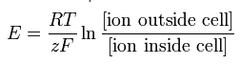
parallel conductance equation

Conductance (g)
The ability of an ion to carry a current across a membrane; different but related to permeability (P).
Goldman-Hodgkin-Katz equation

Conductance
Permeability
Resting Membrane Potential (RMP)
Steady state at which the movement of all ions is equal and opposite across the cell membrane (net flux is zero). Typically accepted as Vm=-70mV
leaky potassium channels
Potassium channels that are always open to allow potassium to leave the cell, down the concentration gradient. Causes the negative Vm resting potential.
Transduce
to convert from one form of energy to another
Dendrites
Projections of the neuron's cell membrane that are responsible for receiving signals from neurotransmitters. They contain special receptors for the neurotransmitters (ligand-gated channels).
Soma
The main body of the neuron.
axon hillock (trigger zone)
The site where action potential is generated. The point of connection between the soma and the axon.
Axon
The extension of a neuron that acts as a wire, transmitting an electrical potential to the post-synaptic neuron.
axon terminal (synaptic knob)
The endpoint of a neuron that contain voltage gated channels that release neurotransmitters upon the stimulation by an action potential.
Nissl Bodies
Sites of extensive protein synthesis in a neuron.
Anterograde transport
From the soma down the axon. Like signal transmission
Retrograde transport
From the axon terminal up the axon to the soma. Like signal receiving.
Dendritic Spines
Thousands of tiny projections from the dendrites.
initial segment (axon hillock)
AKA Trigger Zone; the beginning of the axon that contains many volgate gated Na channels.
trigger zone (axon hillock)
aka initial segment.
Mylenated
Describes the insulated covering of some axons.
Glial Cells
Nervous cells that do not play a role in signal transmission, but perform maintenance on neurons.
Synapses
Small gaps between the axon terminals of one neuron and the dendrites of another neuron
Pre-synaptic
Describes a neuron that is sending a signal
Post-synaptic
describes a neuron that is receiving a signal
Synaptic cleft
A synapse filled with interstitial fluid.
Synaptic potential
Change in membrane potential produced on post-synaptic neuron.
Graded potentials
A change in membrane potential that decreases in intensity over time and distance
Action potentials
Opposite of a graded potential, where a change in membrane potential remains consistent over time and distance
Axodendritic synapses
synapse formed between a pre-synaptic cell's axon terminals and a post-synaptic cell's dendrites
Signal input
A signal that is being transmitted
Depolarization
Membrane potential moving from rest to a more positive value (positive slope, above resting Vm)
Hyperpolarization
Membrane potential moving from rest to a more negative value (negative slope, below resting Vm)
Synaptic potentials
Graded potentials in the dendrites
excitatory postsynaptic potential (EPSP)
depolarizing synaptic potential
inhibitory postsynaptic potential (IPSP)
Repolarizing (negative slope above the resting Vm) synaptic potential
Decremental
Get weaker over time and distance. i.e. graded potentials
Temporal summation
individual channels that are activated repeatedly over a short time
Spatial summation
Multiple channels that are simultaneously opened
Integration
Essentially taking the summation of signals inputted into a neuron; done in the soma
Threshold
The membrane potential required to start an action potential
subthreshold stimulus
Synaptic potentials that do not cause an action potential to be transmitted
suprathreshold stimulus
A synaptic potential that leads to an action potential to be generated and transmitted.
Action Potential phases
1. Resting/RMP
2. Stimulus/Depolarization
3. Rising/Depolarization
4. Peak Phase
4. Falling/Repolarization
5. Hyperpolarization
6. After Hyperpolarization
7. Resting/RMP
Voltage-gated sodium channels
Channels that cause depolarization phase due to suprathreshold stimulus
Closed state
The state of a Na Voltage channel that does not allow sodium to pass through. Entire protein closes off, different from "inactive" state.