chapter 17 - Renal Physio
 Call Kai
 Learn
 Practice Test
 Spaced Repetition
 Match
 Flashcards
 Knowt Play
1/60

There's no tags or description
Looks like no tags are added yet.
61 Terms
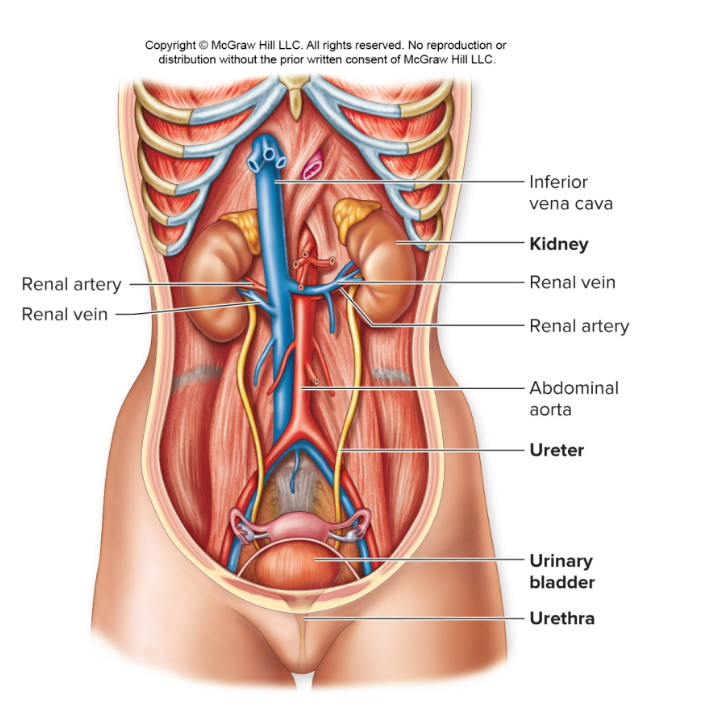
Describe the gross structure of the kidneys
2 Kidneys
2 Ureters
1 Urinary Bladder
1 Urethra
Describe the function of the kidneys
Regulation of the ECF environment in the body through the formation of urine
Regulation of the volume of blood plasma
Regulation of the concentration of waste products in, electrolytes in and the pH of the plasma
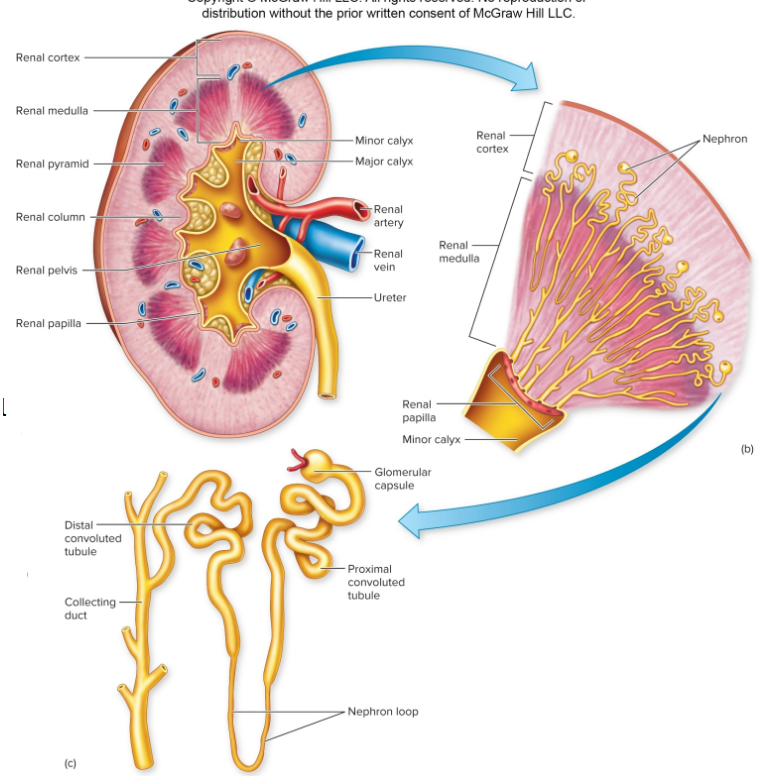
Where are nephrons primarily located?
In the renal cortex

What are the major parts of a nephron?
Renal corpuscle:
Glomerular capsule surrounding glomerulus
Renal tubule:
Proximal convoluted tubule
Nephron loop
Distal convoluted tubule
How/where is urine carried?
Collecting ducts carry urine to a minor calyx through the renal medulla
What type of muscle surrounds the urethral sphincter?
Internal urethral sphincter (smooth muscle)
External urethral sphincter (skeletal muscle)
From where does blood enter the glomerulus?
From the afferent arteriole
How many nephrons are cortical nephrons?
85%
Trace the flow of blood through the kidneys
Interlobar arteries —> Arcuate arteries —> Cortical radiate arteries —> Afferent Arteriole —> Glomerulus —> Efferent Arteriole —> Peritubular Capillaries
Trace the flow of filtrate through the kidneys to the collecting duct
Afferent arteriole —> Glomerulus —> Proximal Tubule —> Descending limb —> Ascending limb —> Distal convoluted tubule —> Collecting Duct

Define Filtration
Movement of materials from the glomerulus into the glomerular capsule
Imagine you are cleaning your backpack and you empty everything from the pack onto the table.

Define Reabsorption
Movement of materials from the renal tubule into the surrounding peritubular capillaries
Imagine you are cleaning your backpack and you are replacing most of the contents of the backpack and returning them to the bag
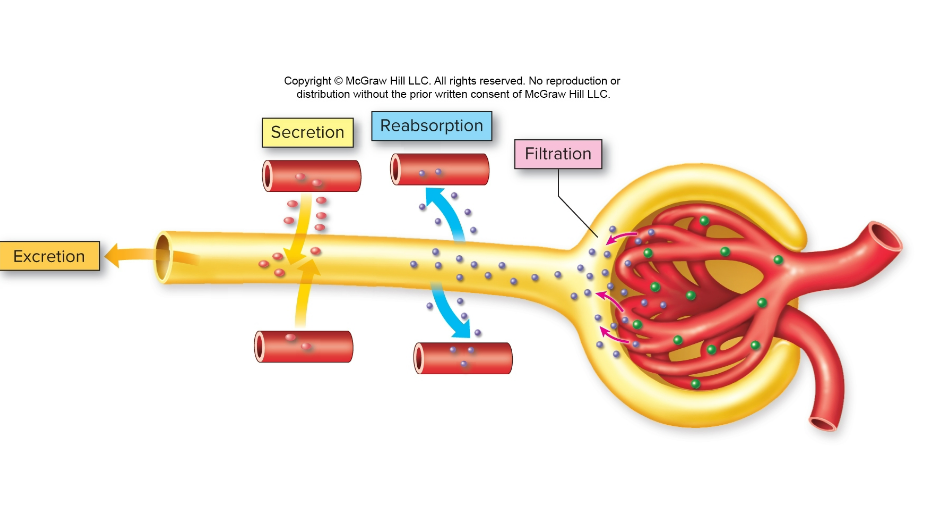
Define Secretion
Movement of materials from the peritubular capillaries into the renal tubule
Imagine you are cleaning your backpack and you are determining what needs to be thrown away given life’s needs at the time

Define excretion
removal of urine from the body
What are the three structures that make up the filtration membran?
Glomerular wall, basement membrane, podocytes
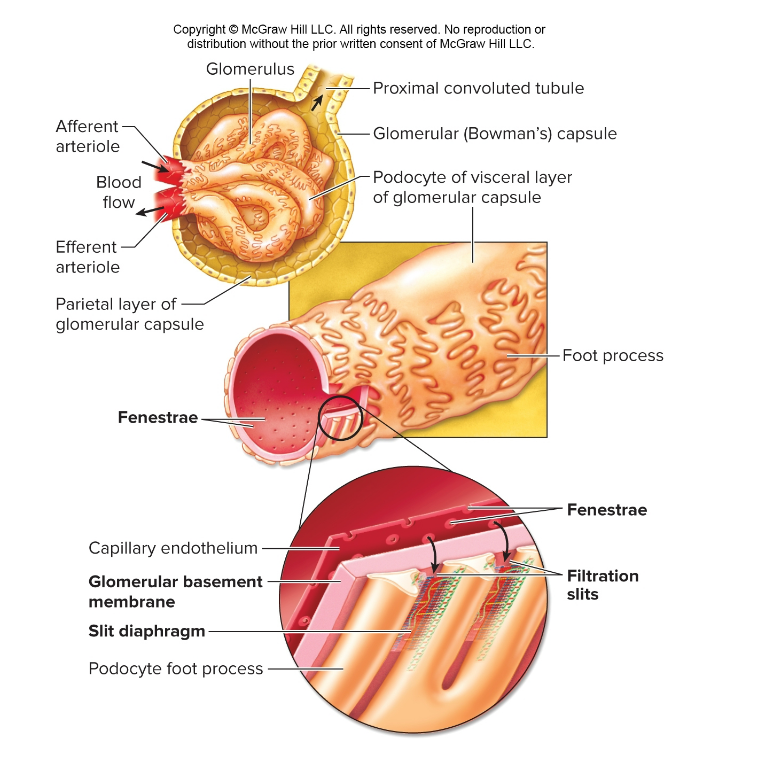
What kind of particles can pass through the filtration membrane of the glomerulus
Small particles:
Water, glucose, ions, amino acids
Large particles are held back in the plasma and do not enter the filtrate: Proteins and cells

When does filtrate form?
When plasma passes through the filtration membrane in the glomerulus

Define GFR
Glomerular Filtration Rate: Volume of filtrate produced by both kidneys per minute
What can have an effect on GFR?
Vasodilation or vasoconstriction of the afferent arteriole affects GFR.
This can occur by two mechanisms: Sympathetic nerve effects or Renal autoregulation
How does the SNS control the GFR?
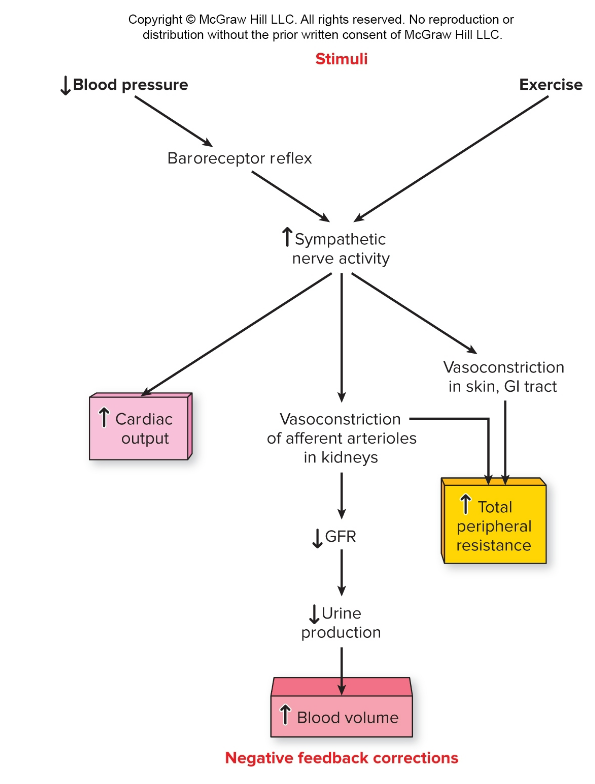
The SNS stimulates constriction of the afferent arterioles which decreases GFR and decreases rate of urine formation.
If blood pressure drops, we dilate the afferent arteriole
If blood pressure rises, we constrict the afferent arteriole. This preserves blood volume and diverts blood to the muscles and heart.
What happens when blood pressure drops? What changes in the kidneys?
The sympathetic nerves active and send messages to vasoconstrict the afferent arterioles in the kidneys.
This lowers GFR
The low GFR the lowers Urine production
The low production leads to increased blood volume
How does renal autoregulation of the GFR work?
We maintain a relatively constant GFR even with changing BP.
If blood pressure drops, we dilate the afferent arteriole
If blood pressure rises, we constrict the afferent arteriole
What are the names of the two mechanisms for renal autoregulation?
Myogenic mechanism
Tubuloglomerular feedback
What is the myogenic mechanism that is used by renal autoregulation?
Myogenic vasoconstriction of afferent arterioles in response to stretching
of the vascular smooth muscle with higher pressure – keeps GFR low and
protects glomerulus from too much pressure

Describe the tubuloglomerular feedback mechanism that is used by renal autoregulation?
Macula densa cells in juxtaglomerular apparatus detects high NaCl in distal convoluted tubule and signals to constrict the afferent arteriole to reduce filtration rate.
When there is high NaCl in the DCT, that means there is not enough time to reabsorb the NaCl in the PCT and it remains in the filtrate at high levels.

Where does 85% of reabsorption occur? What is reabsorbed?
Occurs in the Proximal Convoluted Tubule (PCT)
65% of H2O
65% of NaCl
All glucose
All amino acids
Most ions
Fluid/filtrate leaving the PCT is isosmotic to the plasma in the afferent/efferent arterioles

What is reabsorption?
Is returning water and solutes to the blood that were filtered. ~99% of what is filtered is reabsorbed
Describe reabsorption in the Nephron Loop
Descending limb is permeable to water
25% of reabsorption of water occurs in the descending limb due to osmosis
Ascending limb is permeable to Na+
25% of reabsorption of Na+ occurs in the ascending limb
Na+ is pumped out by active transport

What is the function of juxtamedullary nephron loops?
It creates the osmotic gradient in the medulla. At the medulla/cortex boundary, concentration is 300 mOsM.
As you move towards the papilla, the concentration increases.
If we did not have this concentration gradient, we could never concentrate urine beyond the concentration of blood.
The vasa recta keeps equilibrium of concentration

Explain the countercurrent multiplier/exchanger system
The hairpin turn of the
nephron loop and the
surrounding vasa recta
create a system where we
keep the osmotic gradient
in balance
Na+ pumped out of
ascending limb
Water reabsorbed in
descending limb by
osmosis
Vasa recta (blood vessels)
capture any excess Na+ or
water and preserve the
gradient

What hormones are released when blood pressure is low
ADH and Aldosterone
What is released when blood pressure is high?
Atrial natriuretic peptide (ANP)
Reabsorption in the collecting duct and DCT is dependent on hormones:
Water: ADH
Na+: aldosterone
Ca2+: PTH
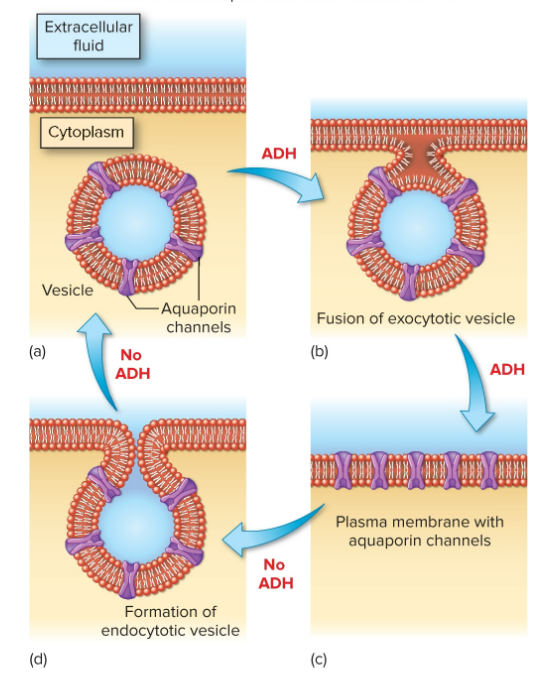
The DCT and collecting duct are not always permeable to water, only become permeable in the presence of ADH
What does the ADH do?
Released when BP is low or when we are dehydrated
ADH targets the collecting duct and DCT of the nephrons
Stimulates the formation of aquaporins in the membranes of the cells
Water is reabsorbed and urine formation decreases/urine concentration increases
ADH also stimulates urea secretion in collecting duct and reabsorption in nephron loop
This increases concentration in interstitial fluid outside nephron to draw more water due to osmosis
What role does urea play?
Water reabsorption increases when urea is reabsorbed out of collecting duct and secreted into Loop of Henle

What role does Aldosterone play?
Produced in adrenal cortex
Aldosterone stimulates Na+ reabsorption in the collecting duct when blood pressure is low/we are dehydrated
Aldosterone activates Na+/K+ pumps in the collecting duct and DCT
Will cause less urine production and increased concentration of urine
Will also cause K+ secretion
How do collecting ducts adjust urine concentration?
Collecting ducts use the osmotic gradient to adjust urine concentration

When we are overhydrated we do not…
We do not secrete ADH.
Water remains in collecting duct and we have a high volume of dilute urine

When we are dehydrated…
We secrete ADH.
Water goes out into medulla, so we have a small volume of concentrated urine.
Note, the collecting duct also secretes urea to maintain the concentration gradient in the medulla. Urea goes back into the filtrate in the loop of Henle (urea recycling)

Define Renal Plasma Clearance
Volume of plasma from which a substance is completely removed in one minute by excretion in the urine.
EX. inulin which is filtered but neither reabsorbed nor secreted.
Amount of inulin that enters the urine equals the amount that enters the glomerular filtrate
Renal plasma clearance of inulin is qual to the GFR

How do we estimate GFR (eGFR)
Creatinine is filtered in the kidneys and not reabsorbed, slightly secreted by the tubules
Its plasma concentration, together with a person’s age, sex, and weight is used in equations to calculate an eGFR
Define: Transport Maximum Concept
Carrier-mediated transport displays the property of saturation
This means that when transported molecule is at high levels in the blood, all the carriers become occupied and the transport rate reaches a maximal value which is the transport maximum.
When rate of glucose filtration is greater than the transport maximum of the carriers, the carriers become saturated and the excess glucose will continue through nephron and end up in urine
Urine flow in Kidneys:
Cortex (Nephrons) —> renal pyramids —> minor calyces —> major calyces —> renal pelvis —> ureter
What makes up the renal corpuscle?
glomerulus and bowman’s capsule
What are the layers of the Bowman capsule?
Outer parietal layer is made of simple squamous
Inner Visceral layer is made of podocytes
What cells make up the Juxtaglomerular apparatus (JG apparatus)
Macula densa cells and JG cells
What are the macula densa cells
Chemo receptors, detect Na+ content of fluid in DCT
Importance of JG cells
Make renin, can detect BP and fluid entering the……
Where does filtration occur?
All throughout until you get to the minor calyax
What do the pressures of the renal corpuscle do?
Outward pressures promote or enhance filtration (from glomerulus —> Bowman capsule)
Inward pressures limit or stop filtration (keeps fluids in glomerulus)
In regards to the tubuloglomerular feedback mechanism, what happens when GFR is too high?
NaCl content in the DCT is high
Response to lower GFR would be to constrict the afferent arteriole
In regards to the tubuloglomerular feedback mechanism, what happens when GFR is too low?
NaCl content in the DCT is low
Response to elevate GFR would be to dilate the afferent arteriole
Describe the RAAS mechanism
Renin is released when systemic BP is low
Renin converts angiotensinogen into angiotensin I
ACE converts angiotensin I into angiotensin II
Aldosterone is released Na+ reabsorption increases
ADH is released H2O reabsorption increases
Vasoconstriction of vessels
These reduce urine volume and increase conc of urine. helps conserve blood volume
What does ANP do
decreases sodium reabsorption to lower BP
K+ secreation occurs in the DCT and collecting duct when ______
when aldosterone is released
In the PCT, H+ are seceted when pH of the blood is _____
too low (acidic)
What happens when we need to concentrate our urine?
Urea is reabsorbed and secreted
name of the smooth muscle in the bladder
Detrusor muscle is the smooth muscle in the wall of the bladder
When we choose to void, what do we relax
We relax the external sphincter
What are the inward pressures
Capsule hydrostatic pressure
Blood colloid osmotic pressure (osmotic pressure of glomerulus)
What are the outward pressures?
Glomerular hydrostatic pressure
Colloid osmotic pressure of capsule
These outwards pressures promote filtarate formation