RAD 101 Unit 6 Positioning of the Forearm, Elbow, and Distal Humerus
 Call Kai
 Learn
 Practice Test
 Spaced Repetition
 Match
 Flashcards
 Knowt Play
1/33

There's no tags or description
Looks like no tags are added yet.
34 Terms
Positioning Considerations
-40 inches (100 cm) minimum SID
-Four-sided collimation when possible
-Long axis of part to long axis of IR
-Marker visible
kVp range for the Forearm, Elbow, and Humerus
65-75

AP Forearm
-Hand and arm extended with palm up
~Entire arm on same plane
-Include both wrist and elbow joints
-Humeral epicondyles same distance from IR
-CR at mid forearm

AP Forearm Evaluation Criteria
-Carpals to distal humerus included
-No rotation- Humeral
epicondyles are in profile
-Slight superimposition of radial head, neck and tuberosity over proximal ulna

Lateral Forearm
-Elbow flexed 90 degrees
-Entire arm on same plane
-Wrist and hand true lateral position (upper extremity position)
-CR to midforearm
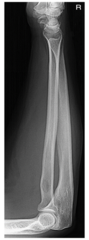
Lateral Forearm- Evaluation Criteria
-Carpals and distal humerus included
-Elbow flexed 90°
-No rotation-Head of ulna superimposed over radius
-Humeral condyles superimposed
-Radial head superimposed over coronoid process

AP Elbow-Fully Extended
-Elbow fully extended with hand supinated
-Entire arm on same plane
-Epicondyles parallel to IR
-CR to mid-elbow joint
Two Partially Flexed AP Projections (When Elbow Cannot Be Fully Extended)
-Humerus parallel to IR
-Forearm parallel to IR
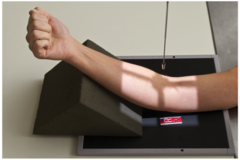
Humerus parallel to IR
CR perpendicular to mid-elbow

Forearm parallel to IR
CR perpendicular to mid-elbow
AP extended

Humerus parallel

Forearm parallel

AP Projections of Elbow anatomy will be obscured the
more the elbow is flexed
Oblique Projections of Elbow
-Medial oblique
(45° internal (medial) rotation
-lateral oblique
(45° external (lateral) rotation
Medial oblique (internal)-45 degrees of the Elbow
-Hand is pronated
-Rotate epicondyles and anterior surface of elbow is 45 degrees to IR
-"leaning" on medial epicondyle


Lateral oblique (external)- 45 degrees of the Elbow
-Hand is supinated
-Rotate epicondyles and anterior surface of elbow is 45 degrees to IR
-"leaning on lateral epicondyle
Evaluation Criteria: lateral/external oblique elbow
-Radial head, neck, and tuberosity free of superimposition over ulna
-Lateral epicondyle and capitulum in profile

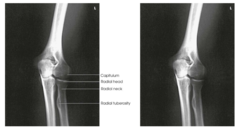
Evaluation Criteria: medial/internal oblique of the elbow
-Coronoid process in profile
-Radial head and neck centered over ulna
-Trochlea and medial epicondyle in profile
-Olecranon process seated in the fossa
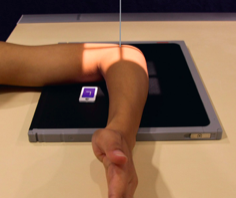
Lateral (lateromedial projection) Elbow
-Elbow flexed 90°
-Humerus and forearm parallel on same plane
-Hand and wrist in lateral position, thumb side up
-Interepicondylar plane perpendicular to IR
-CR at mid elbow joint or 1 ½ inches medial to olecranon process
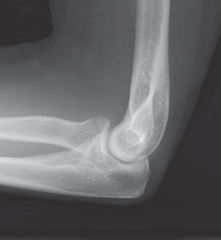
Evaluation Criteria: lateral elbow
-Three concentric arcs visible
-Olecranon process in profile
-½ of radial head superimposed over coronoid process
Radial head projections
-All four projections are done with the elbow in the lateral position
-CR is at radial head or 1" distal to the lateral epicondyle
-The hand position changes for each projection
-Different portions of the radial head are demonstrated

Radial Head Lateromedial Projections 1
-Hand supinated—maximum external rotation
-Radial head slightly anterior (facing away from ulna)

Radial Head Lateromedial Projections 2
-Hand lateral- thumb up
-Radial tuberosity superimposed over shaft of radius
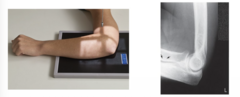
Radial Head Lateromedial Projections 3
-Hand pronated
-Radial tuberosity slightly posterior (pointing towards ulna)

Radial Head Lateromedial Projections 4
-Hand internal rotation—maximum internal rotation
-Radial tuberosity posterior in profile (pointing towards ulna)

Radial Head Lateromedial Projections 5
-Trauma Axial (aka Coyle Method)
-Hand pronated
-Cephalic tube angle 45 degrees toward the shoulder

AP Humerus Projection
-Include both shoulder and elbow joints
-May be done erect or supine
-Shoulder and proximal humerus in contact with IR
-Abduct arm slightly away from body
-Supinate hand so that humeral epicondyles parallel with IR
-CR to midhumerus

Evaluation Criteria: AP humerus
-Entire humerus demonstrated
-Greater tubercle in profile laterally
-Minimal superimposition of humeral head over glenoid
-Medial and lateral epicondyles in profile
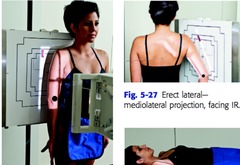
Lateromedial Humerus Projections
-Patient back to IR
-Shoulder and proximal humerus in contact with IR
-Interanlly rotate arm
-Epicondyles perpendicular to IR
-CR to midhumerus

Mediolateral Humerus Projection
-Patient facing IR
-Oblique 20-30 degrees to bring affected humerus in contact with IR
-Flex elbow 90 degrees
-CR at midhumerus

Evaluation Criteria: lateral humerus
-Entire humerus demonstrated
-Lesser tubercle in profile medially
-Humeral epicondyles superimposed

Horizontal Beam Transthoracic Lateral Humerus (Trauma)
-Affected arm against IR
-Affected arm is in neutral position and relax shoulder
-Unaffected limb raised over head.
-Lift unaffected shoulder if possible
-CR to mid aspect of involved humerus
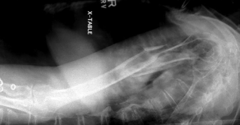
Evaluation Criteria: Horizontal Beam Transthoracic Lateral Humerus (Trauma)
-Include entire humerus
-No superimposition of unaffected humerus
-Affected humerus visualized anterior to T-spine