AP Biology Unit 3 + 4
 Call Kai
 Learn
Learn Practice Test
 Spaced Repetition
 Match
Match Flashcards
 Podcast
1/59

There's no tags or description
Looks like no tags are added yet.
Name | Mastery | Learn | Test | Matching | Spaced | Call with Kai | Chat |
|---|

60 Terms
Metabolism
all of the chemical reactions that occur within a living organism.
Catabolic
Processes that break down complex molecules into simpler ones
Anabolic
Processes that build (synthesize) complex molecules from simpler ones, requires energy.
Exergonic
Reactions that release energy during the process.
Endergonic
Reactions that absorb energy from their surroundings. Require an energy input
Activation energy
The minimum amount of energy required to initiate a chemical reaction.
Enzymes
Biological catalysts that speed up chemical reactions in cells. (Often a complex protein)

Induced fit
The fit between the enzyme and its substrate. Both the enzyme and substrate modify their shape for an ideal fit.
Substrate
The molecule upon which an enzyme acts.

Competitive inhibitor
A molecule that competes with the substrate for the active site of the enzyme.

Noncompetitive inhibitor
A molecule that inhibits enzyme activity by binding to a site other than the active site. (Slows down the enzyme)
Fermentation
The process of regenerating NAD+ (a vital enzyme) with an inorganic or organic compound; occurs in an absence of oxygen
Cellular respiration
The process by which cells convert glucose into energy (ATP) for their use in the absence of oxygen
Aerobic respiration
Cellular respiration that requires oxygen to convert glucose into energy (ATP).

Oxidation
The process of losing electrons during a reaction.

Reduction
The process of gaining electrons during a reaction.
Electron transport chain
A series of protein complexes in a membrane that transfer electrons.
ATP synthase
An enzyme that speeds up the process of synthesizing ATP by combining ADP and a phosphate.
Photosynthesis
The process by which autotrophs use sunlight to create(synthesize) energy and food from carbon dioxide, sunlight, and water. Light energy → chemical energy.
Autotrophs
Organisms that produce their own food from inorganic substances.
Heterotrophs
Organisms that obtain their food by consuming other living things.
Chloroplasts
Organelles in plant cells where photosynthesis occurs.
Stroma
The fluid-filled space inside chloroplasts where carbon dioxide and water are turned into sugars using energy from light during photosynthesis.
Chlorophyll
A green pigment found in plants that is used to capture light energy and cause the light reactions of photosynthesis.
Photon
Distinct quantity of light energy (released by the sun) absorbed in photosynthesis.
C3 plants
Plants that makes a three-carbon compound (3-phosphoglycerate) as the first product of the Calvin cycle (what occurs in the stroma of chloroplasts)
C4 plants
Plants that utilize a four-carbon compound by separating the steps of photosynthesis into different cells, allowing them to thrive in hot, dry environments.
CAM plants
Plants that use Crassulacean Acid Metabolism (CAM) to minimize water loss by only opening their pores at night to take in carbon dioxide.
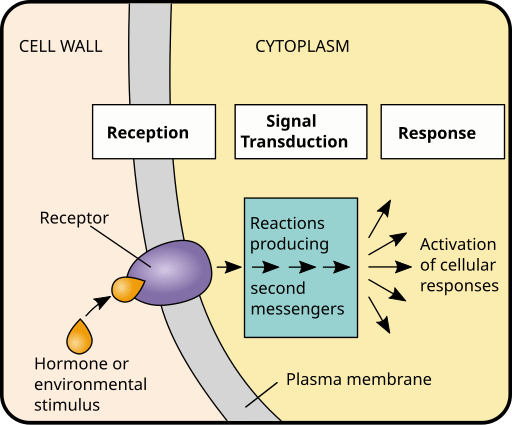
Signal transduction pathways
A series of molecular events that change an external cell signal into a specific internal cell response.
Hormones
A chemical signaling molecule, usually a protein or steroid, that is secreted by endocrine cells which act to control and regulate physiological processes.

G protein coupled receptors
a large, cell-surface receptor protein which detects molecules outside of the cell and activates signal transduction pathways in response
Receptor tyrosine kinases
(RTKs) membrane receptors that attach phosphates to the amino acid, tyrosine.

Ligand gated ion channels
A group of protein pores that open and close in response to certain chemical signals.
Phosphorylation cascades
a series of events where one enzyme (protein kinase) adds a phosphate group to the next enzyme.
Cyclic AMP
(cAMP) a small, non-protein molecule that is a second messenger. It relays and amplifies signals inside a cell during signal transduction.
Second messengers
a small, non-protein molecule that propagates a signal within a cell after the activation of a receptor causes its release.
Apoptosis
The process of programmed cell death that occurs in multicellular organisms.
Adenylyl cyclase
An enzyme in the cell membrane that converts ATP to cyclic AMP.
Genome
The complete set of genetic information present in a cell or organism.
Chromosomes
Structures within the nucleus, made of chromatin, that contain DNA and genetic information.
Chromatin
The material that makes up chromosomes, consisting of DNA and proteins.
Gametes
Reproductive cells (sperm, pollen, grain, or eggs) that contain half the genetic material of an organism.
Somatic cells
All cells within a multicellular organism except for gametes/reproductive cells.
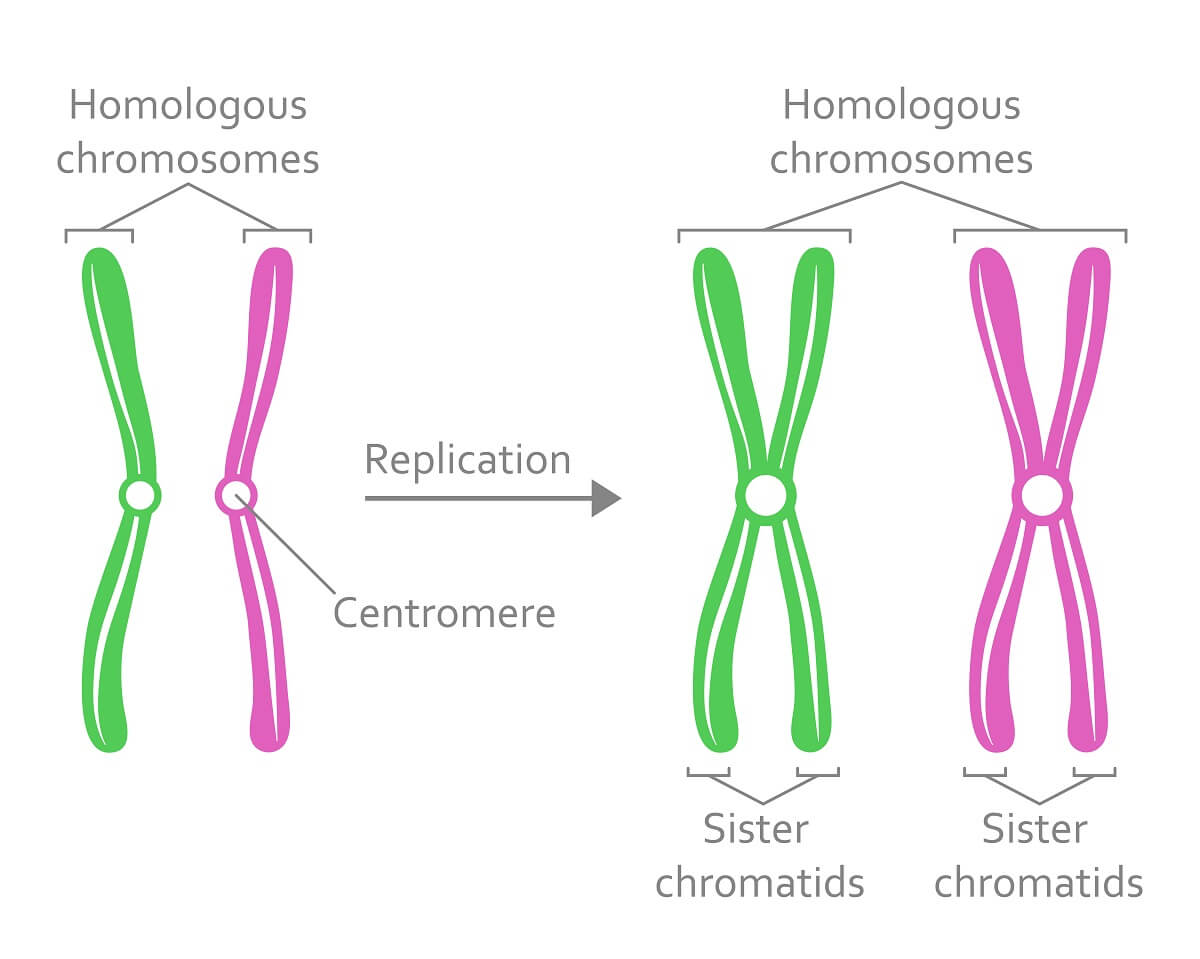
Sister chromatids
Identical copies of a chromosome, connected by a centromere.
Centromeres
The region of a chromosome where sister chromatids are joined.
Mitosis
the period of the cell cycle during which duplicated chromosomes are separated into identical nuclei.
Cytokinesis
The division of the cytoplasm following mitosis, that causes the formation of two separate daughter cells
Interphase
the period of the cell cycle leading up to mitosis; including G1, S, and G2 phases.
G1 phase
The first phase of interphase where the cell grows and prepares to replicate DNA.
S phase
The second phase of interphase where DNA is replicated.
G2 phase
The third phase of interphase where the cell prepares for mitosis.
M phase
The final phase of the cell cycle that includes mitosis and cytokinesis.
Mitotic spindle
A structure composed of microtubules which control the movement of chromosomes during mitosis.
Centrosomes
a small organelle in animal cells that act as a site to organize microtubules.

Metaphase plate
The imaginary plane between the two poles of a cell where chromosomes align during metaphase.

Cleavage
The early, rapid cell divisions of a fertilized egg into a multicellular embryo.

Cell plate
The structure that forms during cytokinesis which fuses at the metaphase plate; eventually leads to the formation of cell walls which separate the two daughter cells
Binary fission
A form of asexual reproduction common in prokaryotes where a cell divides into two identical cells.
Cyclin
A type of regulatory protein involved in the cell cycle. They regulate the progression of cells through the cell cycle.
Cyclin-dependent kinase
A protein that helps to regulate the cell cycle when it is bound to cyclin; it functions to phosphorylate other proteins that are either activated or inactivated.