7.2 writing genotypes, 7.3 phenotypes & 7.4
 Call Kai
 Learn
Learn Practice Test
 Spaced Repetition
 Match
Match Flashcards
 Knowt Play
1/27

There's no tags or description
Looks like no tags are added yet.
Name | Mastery | Learn | Test | Matching | Spaced | Call with Kai | Chat |
|---|
No analytics yet
Send a link to your students to track their progress
28 Terms
Gregor Mendel
•1822 – 1884
•Studied mathematics at university and was also an expert in agricultural breeding practices.
•He studied pea plants in the garden at his monastery and drew many conclusions on which the foundations of heredity is built.
•He was able to demonstrate that traits are passed from parents to offspring and that these traits form specific patterns over generations of cross-breeding.
Conclusion 1
•Because Mendel didn’t observe an intermediate between the tall and short, he concluded that inheritance is not a blending of traits, but rather definite ‘factors’ which may or may not be reflected in the outward appearance of the offspring.
•We now know these factors to be called genes, of which there are variations called alleles.
•The outward appearance of an organism is called its phenotype, dictated by its genotype.
•
Conclusion 2
•Because there were no short pea plants in the first generation and then they reappeared in the second generation, he was able to conclude that the factors could be either dominant or recessive.
•If the trait is reflected in the organism's phenotype, we know that the allele must be dominant.
•If the trait is not reflected in the organism's phenotype, we know that the allele must be recessive.
Conclusion 3
•Although Mendel knew nothing of chromosomes and genes, he suggested these factors were passed from parent to offspring via the gametes or sex cells.
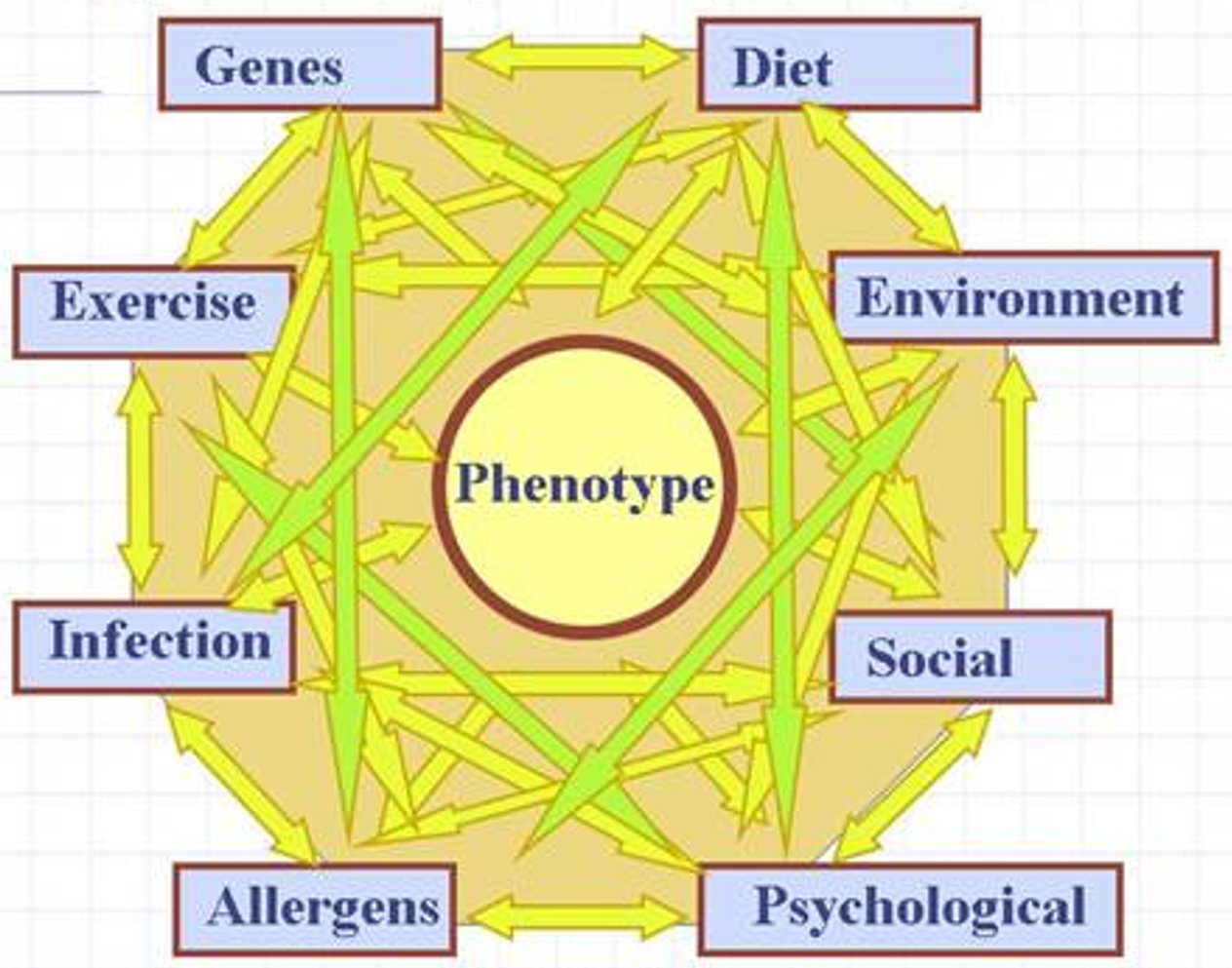
Phenotype:
•The outward expression or appearance of the organism.
•A combination of genetics (genotype) and the environment
•For example: brown eyes.
things that impact phenotypes
Genotype:
•Genetic make-up of the individual.
•The genes present for a particular characteristic
•The alleles that the individual has.
•Represented symbolically by letters.
•BB or Bb or bb
Allele:
•Alternative/different forms of a gene.
•They are located at the same place on the chromosome.
•Blue and brown are alleles for the gene eye colour.
Homozygous
•Genotype only contains one type of allele for a particular characteristic.
•Also termed ‘pure breeding’.
•Eg: BB or bb
Heterozygous:
•Genotype contains two types of alleles for a particular characteristic.
•Also termed ‘Hybrid’.
•Eg: Bb
Dominant:
•Allele that is always expressed in a heterozygous organism.
•Dominant over recessive version.
•Denoted by capital letter.
•Eg: B = brown eyes (brown allele is dominant over blue allele).
Recessive:
•Allele that is always masked/hidden a heterozygous organism.
•Recessive to dominant version.
•Denoted by lower case letter.
•Eg: b = blue eyes (blue allele is recessive to brown allele).
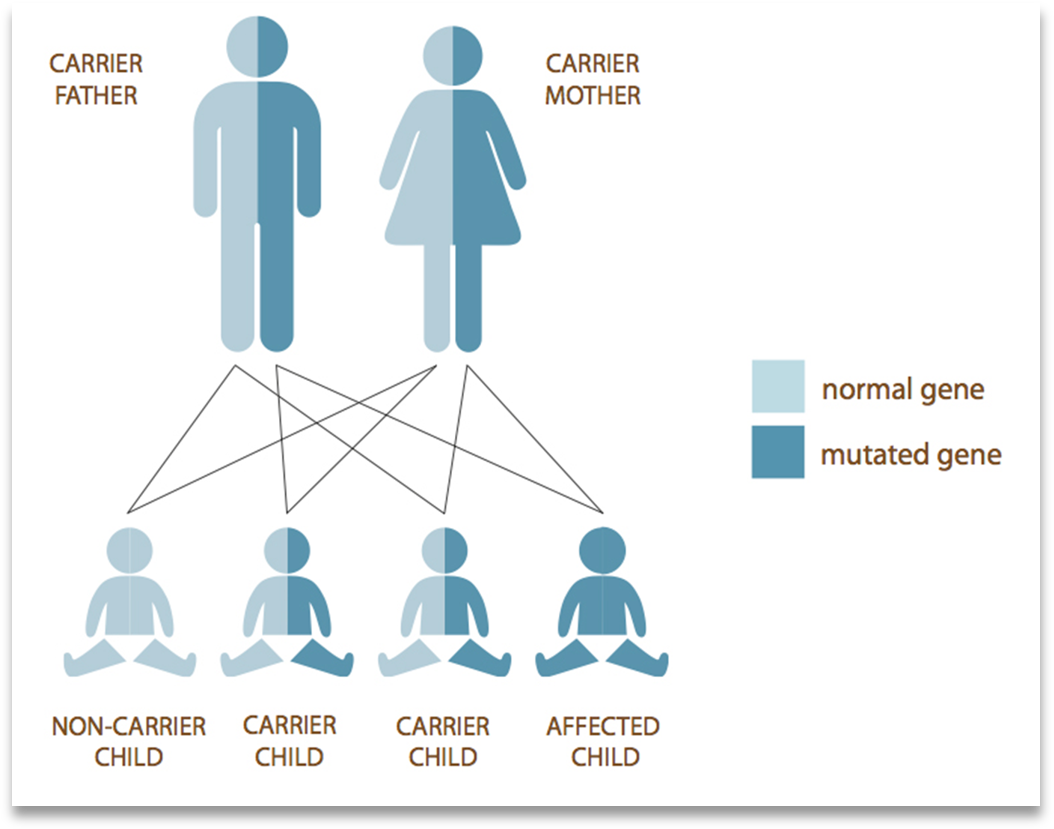
What is a ‘carrier’?
•If a person is heterozygous for a certain allele – they are generally unaware as it is not expressed in their phenotype…
•They may have children that show the recessive trait, however.
•We say that ‘carry’ the allele for that particular trait.
Punnett squares
•A diagram that is used to predict an outcome of a particular cross or breeding experiment.
•It is named after Reginald C. Punnett, who devised the approach.
•It is used by biologists to determine the probability of an offspring having a particular genotype.
•It is also a tabular summary of possible combinations of maternal alleles with paternal alleles.
Types of inheritance 1:
1. Complete dominance (dominant and recessive)
•Two alleles influence the one trait.
•The dominant allele ‘overrides’ the recessive allele and the dominant trait is expressed (phenotype).
•BB = brown eyes
•Bb = brown eyes
•If two recessive alleles are present, only then will the recessive trait be expressed.
•bb = blue eyes
•
Types of inheritance 2:
2. Co-dominance
•Two alleles influence the one trait.
•Both alleles are expressed at the same time (phenotype).
•SS = sickle cell anaemia
•NN = normal blood cells
•SN = both sickle and normal blood cells.
•Incomplete dominance is a pattern of inheritance in which neither allele is completely dominant over the other, so the heterozygous offspring show an intermediate (blended) phenotype.
blood typing alleles
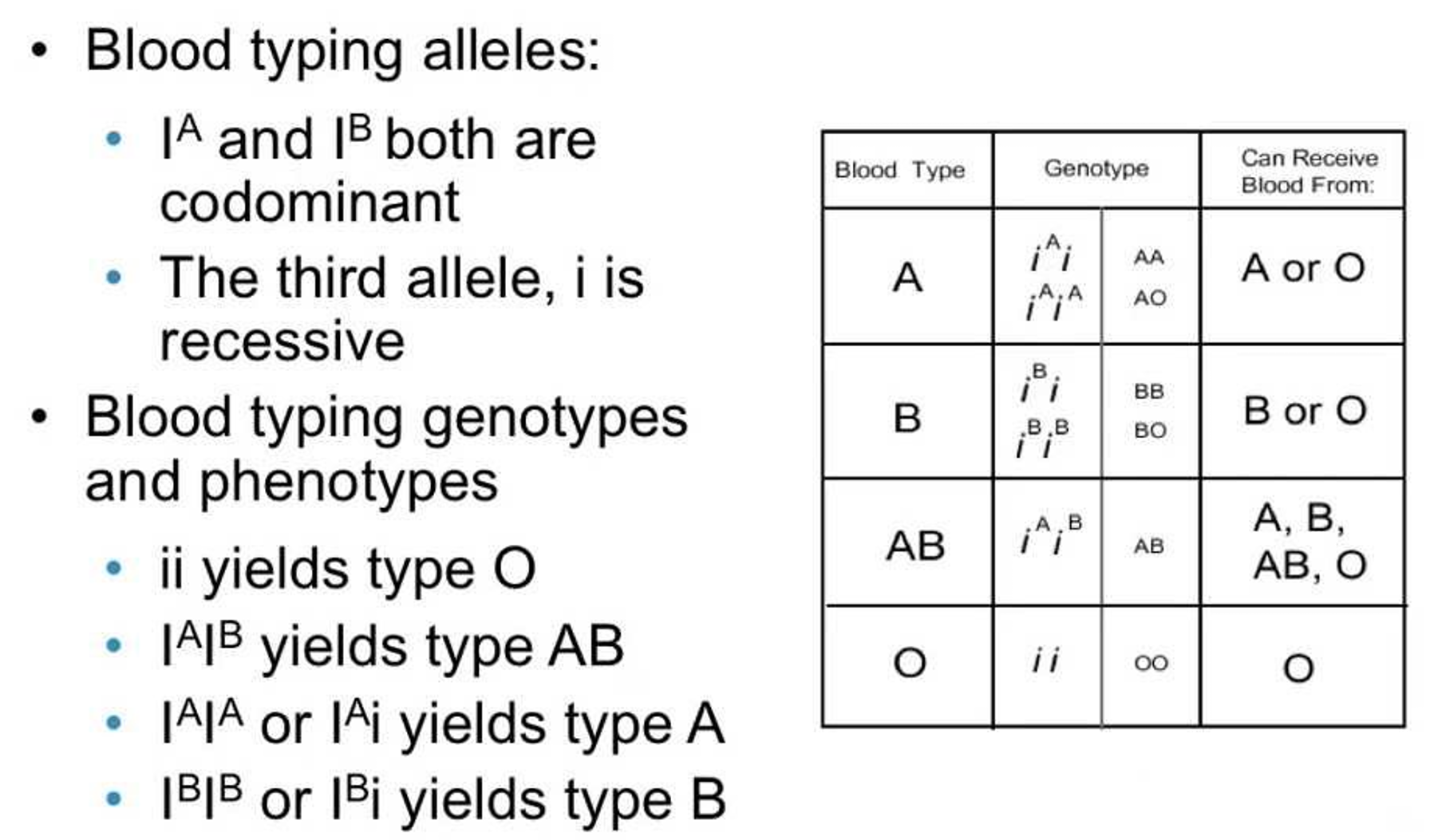
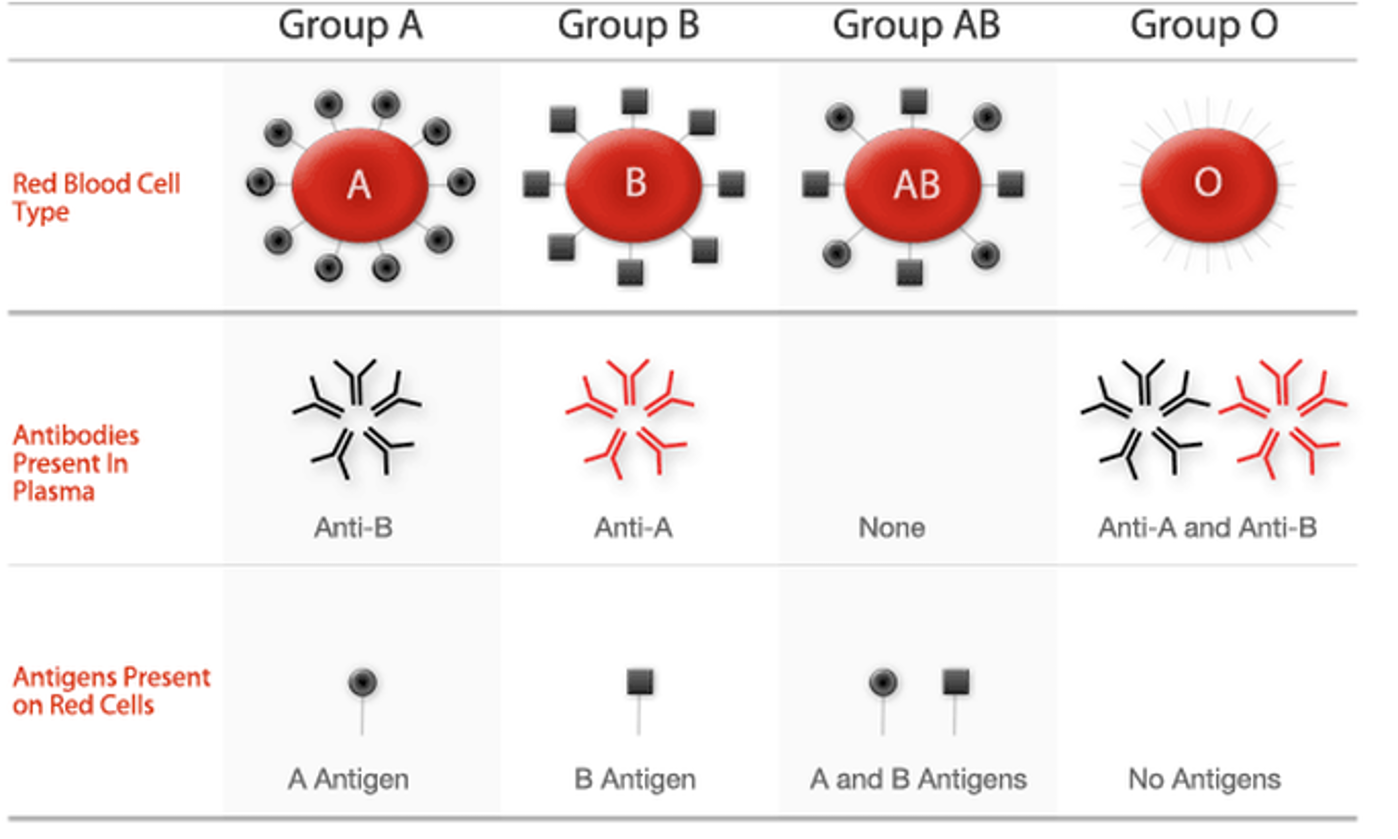
human blood types
What is Epigenetics?
•“Epi” – over, above, outer
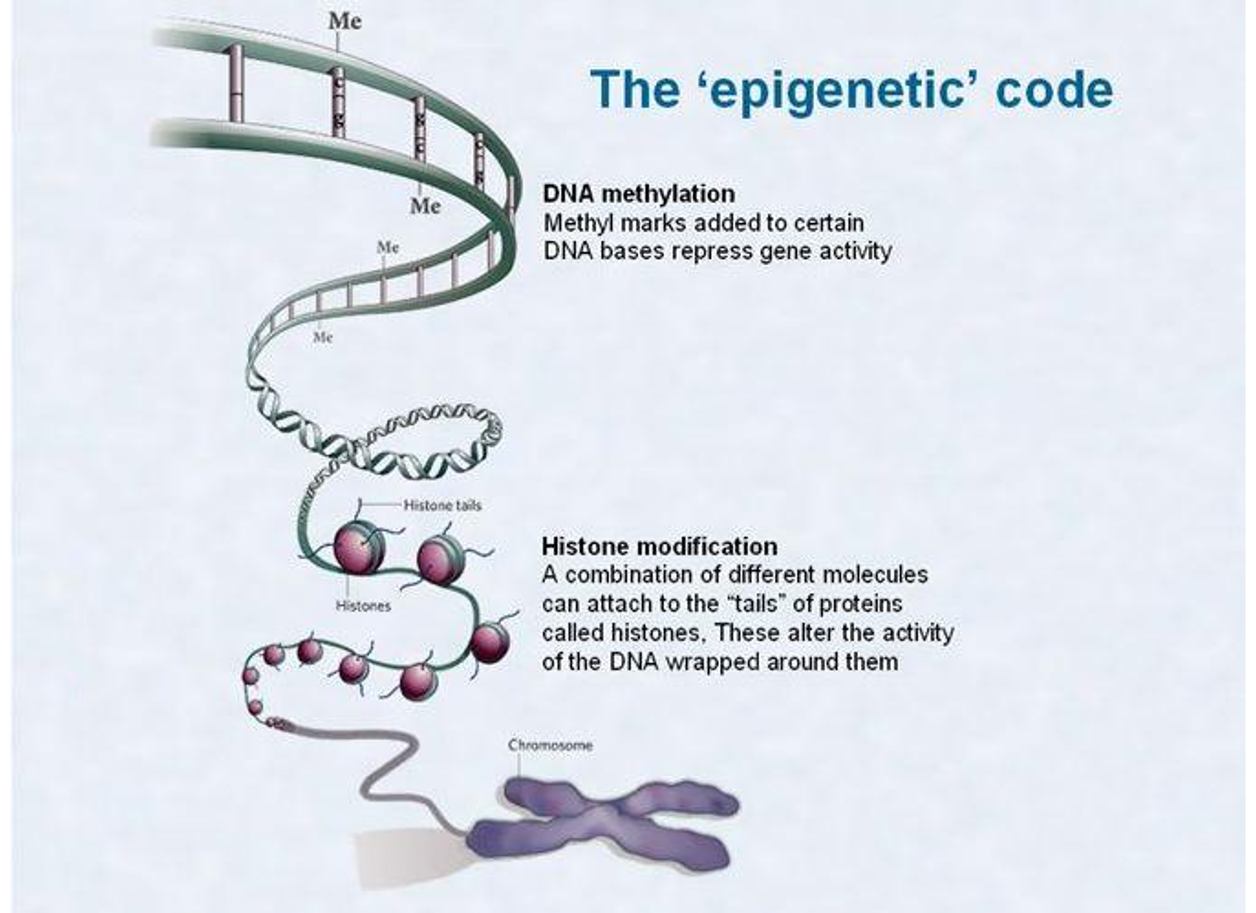
•Epigenetics – stably heritable phenotype changes in a chromosome without alterations in the DNA sequence
•Histone modifications
•DNA methylation
•Epigenomics – refers to the study of the complete set of epigenetic alterations
•“Epigenetic code” – epigenetic features that maintain different phenotypes in different cells
the epigenetic code
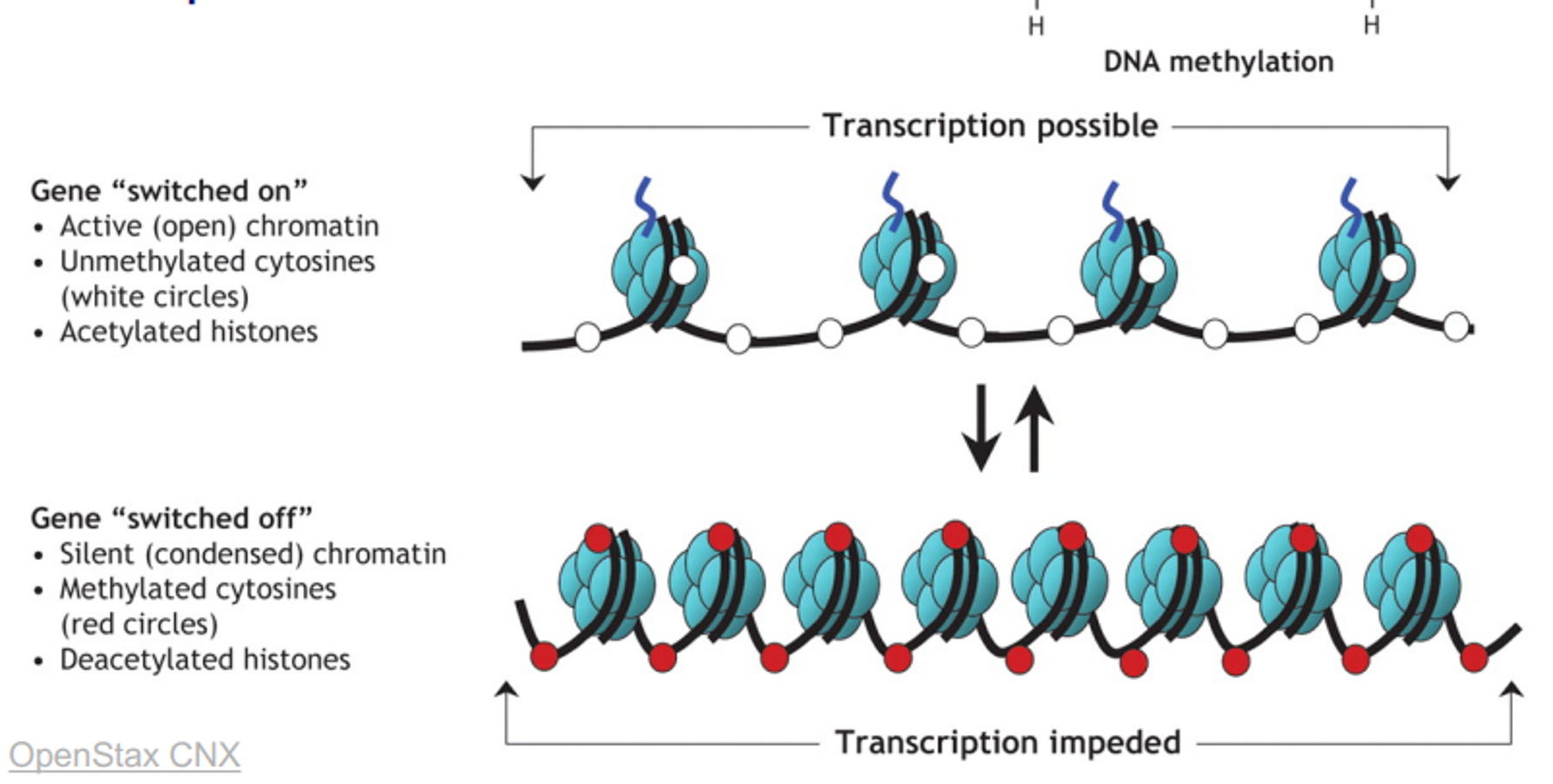
switched on and off genes
Examples of Epigenetic Inheritance
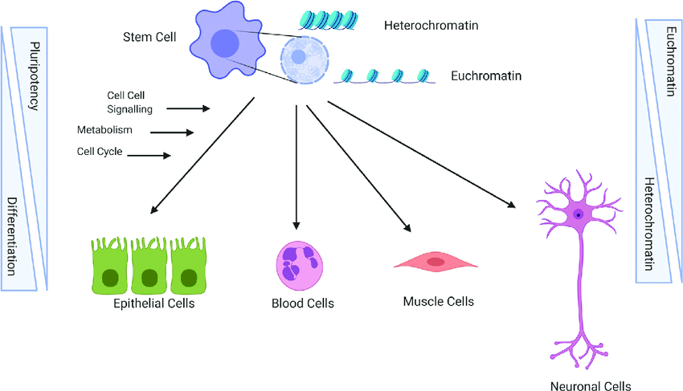
•Cell differentiation
•Cells differentiate into various types
•Over 200 cell types exist
•All cells share the same genotype
•Gene activity differs by cell type
•Epigenetics guide stem cell development paths
•
•X – inactivation
•One X chromosome in each female somatic cell is epigenetically inactivated early in embryonic development.
•This inactivation is inherited by all daughter cells through mitosis, maintaining the same inactive X chromosome.
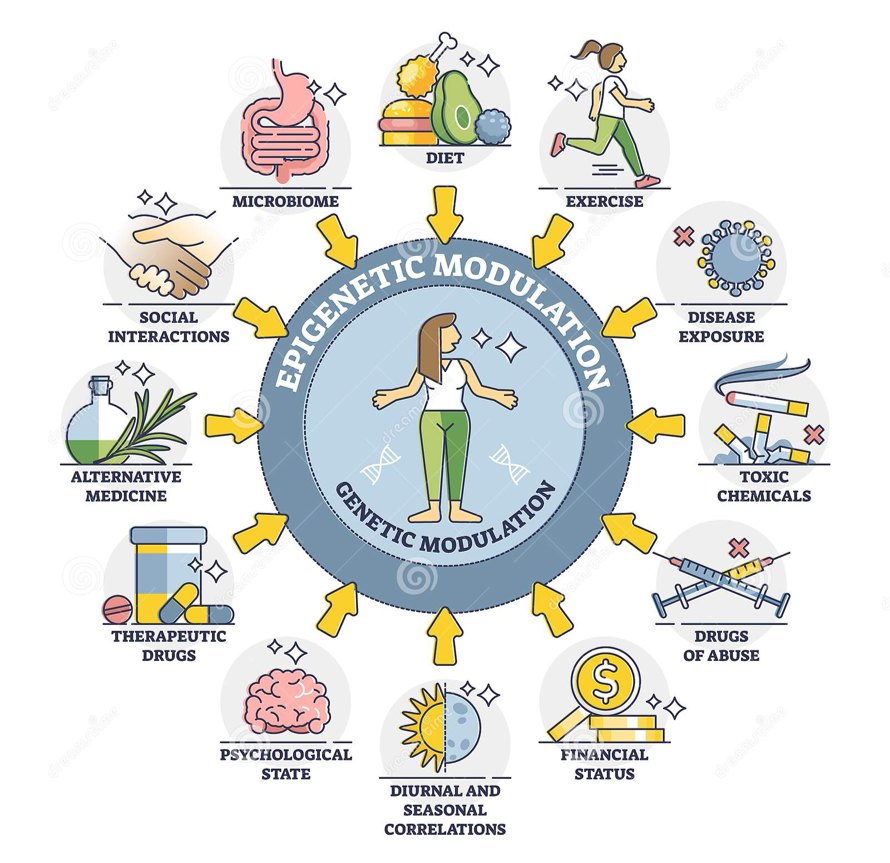
Smoking – Can add DNA methylation, changing gene activity.
Diet – Nutrients such as folate can alter DNA methylation and gene expression.
Stress – Chronic stress can change how genes involved in the stress response are expressed.
Exercise – Can switch genes involved in muscle growth and energy use on or off.
Maternal care in rats – High levels of licking and grooming reduce stress-related gene methylation in offspring.
Dutch Hunger Winter – Famine during pregnancy caused epigenetic changes linked to disease risk in children.
Agouti mice – A mother's diet changed offspring coat colour and obesity risk through DNA methylation.
Sun exposure – UV light can cause epigenetic changes in skin cells.
•
mor examples
•Imprinted genes
•Imprinted genes show different effects depending on whether they’re inherited from the mother or father.
•A deletion on chromosome 15 causes Prader–Willi syndrome if paternal, or Angelman syndrome if maternal
•
•Chemical action
•Vinclozolin alters sperm via DNA methylation across generations.
•Human studies suggest ancestral lifestyle affects descendants’ health.
•Diet, smoking, and stress impact gene expression.
•
Dutch Winter Hunger
•German’s blocked food to the Dutch in the winter of 1944.
•Calorie consumption dropped from 2,000 to 500 per day for 4.5 million.
•Children born or raised in this time were small, short in stature and had many diseases including, edema, anemia, diabetes and depression.
•The Dutch Famine Birth Cohort study showed that women living during this time had children 20-30 years later with the same problems despite being conceived and born during a normal dietary state.
Summary
•The phenotype of an organism can be the result of an interaction between its genotype and the environment.
•Epigenetics is the study of how cells with identical genotypes can show different phenotypes.
•Epigenetic factors act on DNA but do not change the base sequence.
•Methylation in DNA is one kind of epigenetic modification.
•Packaging of DNA is another means by which epigenetic factors can act.
•Epigenetic modifications may be inherited.
•