How enzymes speed up reactions
 Call Kai
 Learn
 Practice Test
 Spaced Repetition
 Match
 Flashcards
 Knowt Play
1/12

There's no tags or description
Looks like no tags are added yet.
13 Terms
What do enzymes do?
They catalyze reactions within a cell. They speed up reactions
Substrate
molecule that an enzyme acts on/binds to
Active site
the pocket where the substrate binds
What is usually thermodynamically favorable
Product is thermodynamically because it has a lower gibs free energy state than the substrate
Why is a reaction without an enzyme slow?
The activation energy to get to the transition state is very large therefore reaction is slow even if the product is thermodynamically favorable.
Activation energy
energy of the transition state minus energy of the starting state.
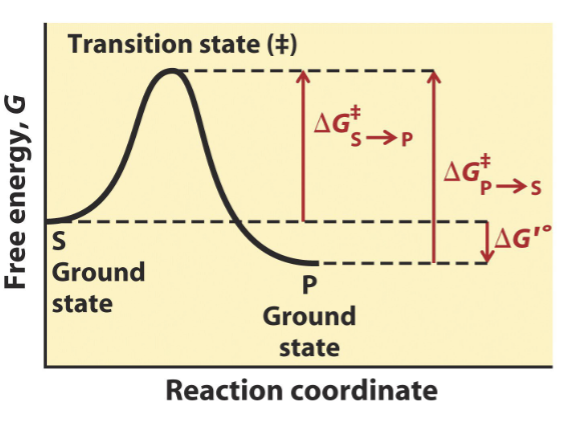
What is the transition state?
The highest-energy, very short-lived state along the reaction pathway with partially formed formed or broken bonds
How do enzymes speed up reactions?
Lower the activation energy, delta G (transition state), so reactions happen faster
Do enzymes shift equilibrium?
No, they speed both S→P, & P→S, so equilibrium is reached faster but does not shift.
Three ways enzymes lower activation energy
Stabilize the transition state
Bring/orient reactants together
Provide catalytic residues/groups
How do enzymes stabilize the transition state.
Enzymes bind to the substrate but bind to the transition state better
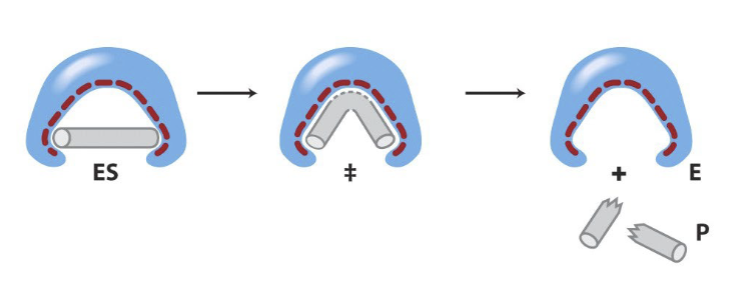
How does orientating reactants lower activation of energy?
Enzymes hold reactants close and line them up to react. Decreases entropy but non-covalnt interactions make up for it by lowering its free energy
How do catalytically active groups work?
They can serve as acids/bases, and nu: They drive the reactions so temp does not have to be raised