ARCH 4521 Etech Midterm: Key Terms & Definitions
 Call Kai
 Learn
 Practice Test
 Spaced Repetition
 Match
 Flashcards
 Knowt Play
1/109

There's no tags or description
Looks like no tags are added yet.
110 Terms
absolute humidity
the mass of water for a given mass of air
measure of water vapor/moisture in the air
adiabatic process
any process acting on closed system without adding/subtracting heat
ex: vertical flow of air in the atmosphere-air expands and cools as it rises
air barrier
a material or system in a building that prevents uncontrolled air from moving through the building envelope (walls, roofs, and floors)
air conditioning
system for controlling humidity, ventilation, and temperature in a building
albedo
reflection coefficient measured across a range of frequencies
ex: in architecture this relates to the reflection coefficient across the visible spectrum of sunlight
balance point
outdoor temperature that would not require heating or cooling for a building
bar effect
Wind speeds up and becomes turbulent as it flows over and around a long building.
bioclimatic chart
A diagram used in architecture to determine the best design strategies for maintaining indoor comfort based on temperature and humidity.
btu
british thermal unit- unit of heat; amount of heat required to raise temp of one pound of water by one degree F
channel effect
as the airs path compresses the wind moves with more velocity
chilled beams
HVAC systems that use chilled water to cool indoor spaces through ceiling-mounted units.
climate
outdoor environment
Clo
amount of clothing required by a resting person to be indefinitely comfortable at ambient conditions (70 degrees)
condensation
conversion of vapor or gas to a liquid
conductance (C)
how easily heat or electricity flows through a specific object
Depends on the material and its dimensions
conduction
transfer of heat through direct contact between materials or objects.
conductivity (k)
a material’s ability to conduct heat or electricity. it is a property of the material itself.
it does not depend on the material’s size and shape.
higher conductivity = heat or electricity travels through it more easily
convection
transfer of heat by a moving fluid medium
convective loop system
air circulating in an enclosed space, rising on the warm side and sinking on the cold side, which carries heat across the space.
Shorter version: Convective loop = air rising warm, sinking cool, carrying heat across a cavity.
cooling degree day
a measure of the cooling requirement of a climate, found by adding up the degrees the daily average temperature is above 65°F.
corner effect
velocities of wind increase around corners of tall buildings
cosine effect
a given beam of sunlight will illuminate a larger area as the sun gets lower in the sky
decoupled ventilation
separating the systems that control heating and cooling from those that control ventilation and humidification
ex: different exhaust supply systems for each (balance on/off systems)
dedicated outdoor air system
type of HVAC system that consists of two parallel systems
1. dedicated system for delivering outdoor air ventilation, that handles both the latent and sensible loads of conditioning the ventilation air
2. parallel system to handle the loads generated by indoor/process sources
direct gain system
passive heating technique generally used in cold climates
ex: sunlight admitted into the living spaces through openings
displacement ventilation
air distribution technology that introduces cool air into a zone at low velocity
dry bulb temperature
temperature reading from a standard thermometer
emissivity
ability of a material to emit radiation
ration of the energy emitted to the energy emitted from a black body
enthalpy
sum of sensible and latent energy
entropy
measure of the unavailable energy in a closed system
usually considered to be a measure of the systems disorder
first law of thermodynamics
energy can neither be created nor destoryed, only changed
gap effect
wind through gaps increases velocity
heat
thermal energy that is being transferred
heat capacity
The amount of energy required to raise the temperature of 1 kg (or 1 g) of a substance by 1 °C (or 1 K)
heat island effect
built up areas that are hotter than nearby rural areas, due to human activities.
The temperature difference is usually larger at night than during the day
heating degree day
a measure of the time in days multiplied by the difference between outdoor temp and a set temp (often 65 degrees)
HDD is a measure of the heating requirement of a climate
humidity
the concentration of water vapor present in the air
infrared light
a type of radiant energy that is invisible to human eyes but that we can feel as heat
insulation
materials used to reduce the rate of heat transfer

internal load dominated building
where most of the heat comes from inside the building rather than from the outdoor environment.
kWh
energy of 1,000 watts of work done over 1 hour. A watt is equal to 1 joule per second
latent heat
energy/heat related to substance change- condensation, evaporation, freezing, melting etc.
latent heat capacity
amount of heat required to convert 1g of ice to 1g of water (not full definition)
144 btu/lb for ice melting to water
970 btu/lb
long wave radiation
the energy radiating from the Earth as infrared radiation at low energy to Space.

low e-coating
helps keep indoor temp consistent by reflecting the interior temperatures back inside
mean radiant temperature
the weighted mean of the temperatures surrounding a point or object
-so if a point is half surrounded by an object at 30F, and half an object at 120F, then it would be 75F
-can be approximated in two dimensions
micro climate
the climate of a very small or restricted area, especially when it differs from the climate of the surrounding area
Ex: urban heat island
mixed-air system
HVAC system that uses a mixture of new outdoor air, and recycled indoor air that has already been heated or cooled
night insulation
moveable insulation for windows to keep heat in at night
passive heating key design issues
solar aperture, conservation, thermal storage, component integration, local climate
aperture, absorber, thermal mass, distribution, control
perm-rating
standard measure of water vapor in a material
phase change
transition from one state to another
phase-change material
substance which releases/absorbs sufficient energy at phase transition to provide useful heat/cooing
ex: by melting a solid the temperature is capable of storing and releasing large amount of energy compared to sensible heat storage
process dominated building
building where most of the heating or cooling demand comes from equipment, machinery, or industrial processes rather than people or outdoor temperatures.
psychrometer
a hygrometer consisting of a wet-bulb and a dry-bulb thermometer, the difference in the two thermometer readings being used to determine atmospheric humidity.
psychrometric chart
graphical representation of the processes of air

radiant barrier
installed in homes, usually in attics, primarily to reduce summer heat fain and reduce cooling cost

radiation
transfer of energy by electormagnetic waves (light)
ex: when molecules on the surface of a substance vibrate they emit radiant energy in the form this
reheat
the process of adding energy back into an air control system
reflectivity
the property of reflecting light or radiation, especially reflectance as measured independently of the thickness of a material.
relative humidity
the ratio of the actual amount of water vapor in air to the maximum amount of water vapor that such air could contain at the same temp, if it were saturated
roof pond
passive cooling technique based upon the increased heat capacity of cheap and widely available water
row effect
the reduction in wind speed as air passes through rows of buildings or trees, compared with the open-field wind velocity.
r value
R-value measures how well a material resists heat flow. The higher the R-value, the better it insulates.
second law of thermodynamics
heat transfer takes place in one direction only- from a hotter to a cooler body, or generally from a higher state of order to a lower state
sensible heat
heat related to temperature change
solar heat gain coefficient
fraction of solar radiation admitted through a window, door or skylight
short wave radiation
radiant energy with wavelengths in the visible, near-ultraviolet, and near-infrared spectra
skin dominated building
energy usage is mostly influenced by the impact of the outside climate on the buildings outer structure or "skin"
solar flux
concentrated sunlight, a measure of how much light energy is being radiated in a given area
solar spectrum
the entire span of electromagnetic wavelengths that the sun emits; includes radio waves, microwaves, infrared light, visible light, ultraviolet rays, x-rays, and gamma rays.

source energy
represents the total amount of raw fuel that is required to operate the building
specific heat capacity
the amount of heat energy required to raise the temperature of one gram of substance by one degree celcius
stack effect
results when air in the building warms, becomes more buoyant than the outside air and rises to escape out of openings high in the building
sunpath diagram
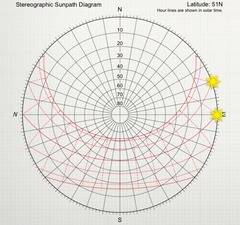
sunspace
an interior space designed to collect solar heat, and used as an extension of the occupied space only when the weather permits

temperate zone
moderate climate zone between the polar zones and the tropics

temperature
A measure of the average energy of motion of the particles of a substance.

3 personal influences of thermal comfort
Activity level (metabolism)
• Physiological adaptation
• Clothing
• Cultural norms
4 environmental influences of thermal comfort
-Air Temperature
-Mean Radiant Temperature
-Relative Humidity
-Air Movement
thermal comfort
the condition of mind that expresses satisfaction with the thermal environment and is assessed by subjective evaluation

thermal lag
the delay of heat transmitted through a wall
thermal storage wall
solar energy is collected and transferred predominantly by natural means; uses natural convection, conduction, or radiation to distribute thermal energy through a structure
transmittance
(t) the ratio of incident radiant energy that is transmitted, or which passes through a material (number between 0 and 1)
trombe wall
a passive solar building design where a wall is built on the winter sun side of a building with a glass external layer and a high heat capacity internal layer separated by a layer of air.
turbulence
violent or unsteady movement of air or water, or of some other fluid
ultraviolet light
form of radiation which is not visible to the human eye

u factor
A measure of the heat transmission through a building part (as a wall or window) or a given thickness of a material (as insulation) with lower numbers indicating better insulating properties.
vapor permeance
a materials ability to allow water vapor to pass through it
vapor retarder
a material or system that adequately retards the transmission of water vapor
helps prevent water vapor from moving into building assemblies
ventilation
the intentional introduction of outdoor air into a space mainly used to control indoor air quality by diluting and displacing indoor pollutant
can also be used for purposes of thermal comfort or dehumidifcation
venturi effect
Reduction in pressure of a fluid resulting from the speed increase as fluids are forced to flow faster through narrow spaces.
visible light
portion of the electromagnetic spectrum that is visible to the human eye
usually defined as having wavelengths in the range of 400-700 nanometer

visible transmittance
amount of light in the visible portion of the spectrum that passes through a glazing material
a higher this means there is more daylight in space
wake effect
area of reduced wind speed and turbulence that forms behind a building or obstacle.
weather
the state of the atmosphere at a place and time as regards heat, dryness, sunshine, wind, rain, etc.
weather barrier
part of the wall assembly; it prevents the passage of moisture, rain and wind through the walls and roof, and protects vulnerable building components from deterioration

wet bulb temperature
The lowest temperature that can be obtained by evaporating water into the air.
-always less than dry bulb temp
-the drier the air, the bigger difference between them

wind rose
a graphic tool used to view how wind speed and direction are typically distributed at a particular location

windbreak
Row of trees or hedges planted to partially block wind flow and reduce soil erosion on cultivated land.
-enhance crop production, protect people and livestock, and benefit soil and water conservation
