TEAS: Describe Cell Structure, Function, and Organization
 Call Kai
 Learn
Learn Practice Test
 Spaced Repetition
 Match
Match Flashcards
 Knowt Play
1/58

There's no tags or description
Looks like no tags are added yet.
Name | Mastery | Learn | Test | Matching | Spaced | Call with Kai | Chat |
|---|
No analytics yet
Send a link to your students to track their progress
59 Terms
What are the levels of the body's biological hierarchy, from simplest to most complex? (6)
Chemicals, cells, tissues, organs, organ systems, and organism
Why is the cell considered the fundamental unit of life?
All life functions can take place within it
(and more than 250 different cell types enable the human body to carry out its processes)

Organs are structures formed when…?
different tissues join together to carry out a single task
Give an example of an organ and its task. (2)
lungs; delivering oxygen to the bloodstream

What is an organ system?
A group of organs that work together to perform large-scale functions (they coordinate)
Give an example of an organ system and how it functions (2 step for function).
nervous system; collects/processes information and signals the muscular system
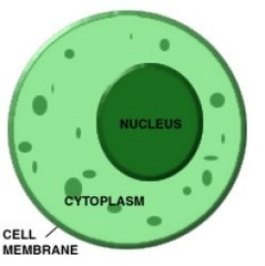
What are the three basic parts of a cell?
nucleus, plasma/cell membrane, and cytoplasm

Define synthesize
to build complex molecules from simpler parts
The nucleus is an organelle that… (2)
holds the genetic material and regulates cellular activity
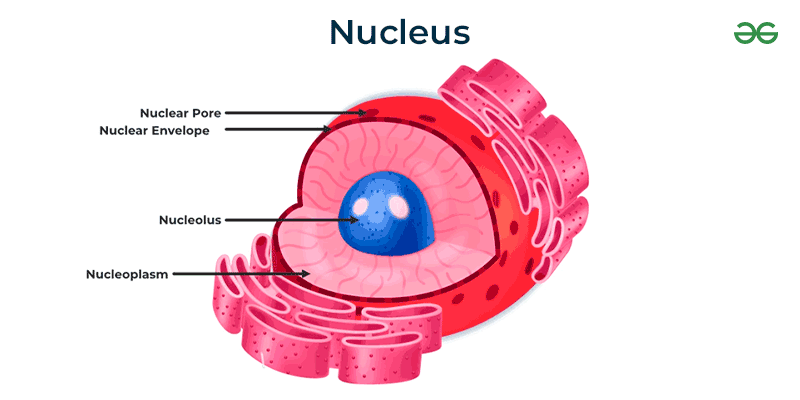
What does the nucleolus do within the nucleus? (2)
Assembles RNA and proteins into ribosomes
What is the plasma/cell membrane, and how does it function?
membrane surrounding the cell; maintains the cell's internal environment through selective permeability

What is cytoplasm? What are the 2 functions of it?
material inside cell membrane; supports and suspends cellular structures

What additional role does cytoplasm serve?
Transfers materials (required for cellular processes)

What is an organelle? Where is it found? What does it do?
specialized structure; cell's cytoplasm; performs a specific function
How does the number and type of organelles vary among cells?
depends on the cell's role or type
What is the mitochondrion? What does it do?
organelle that generates chemical energy in the form of ATP
Why do cells like skeletal muscle cells contain more mitochondria?
Because movement requires more energy
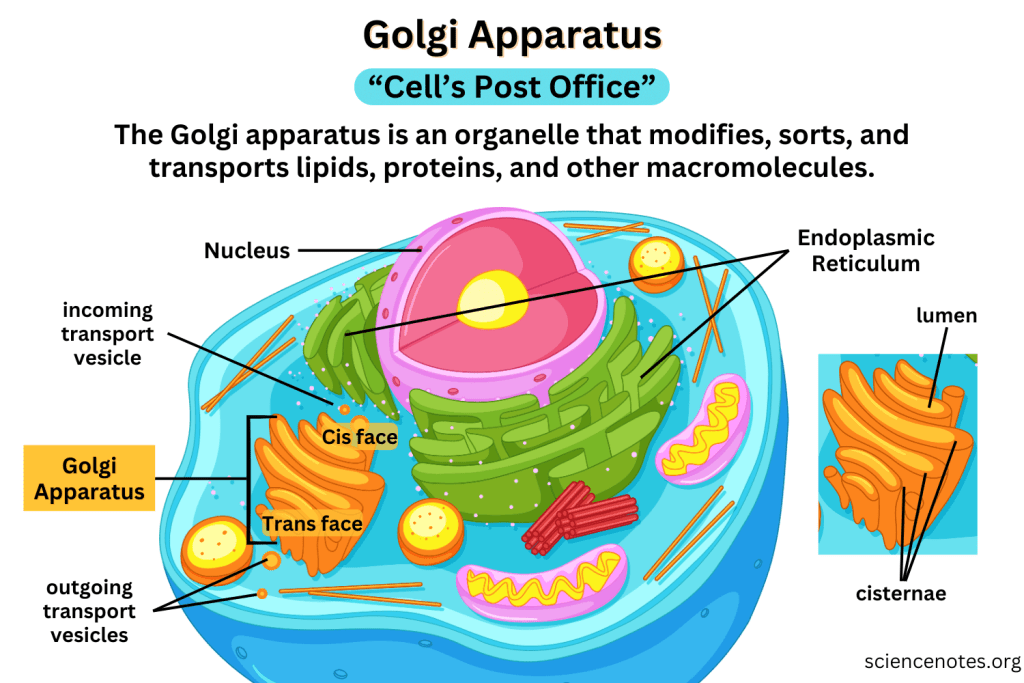
The Golgi apparatus is an organelle that does what? (3)
modifies, sorts, and packages proteins and lipids after they are synthesized
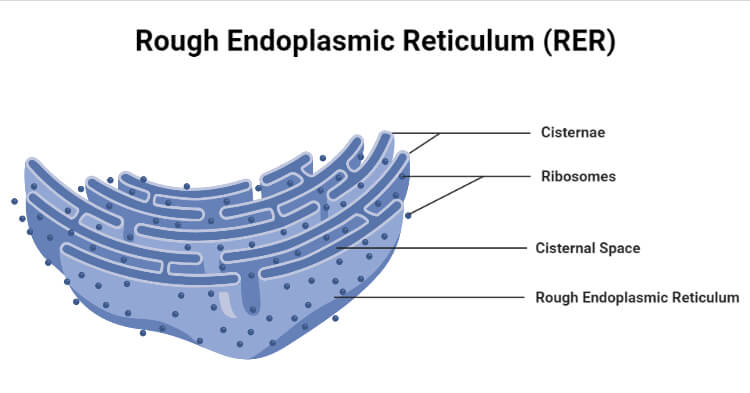
Describe the rough endoplasmic reticulum?
organelle with ribosomes
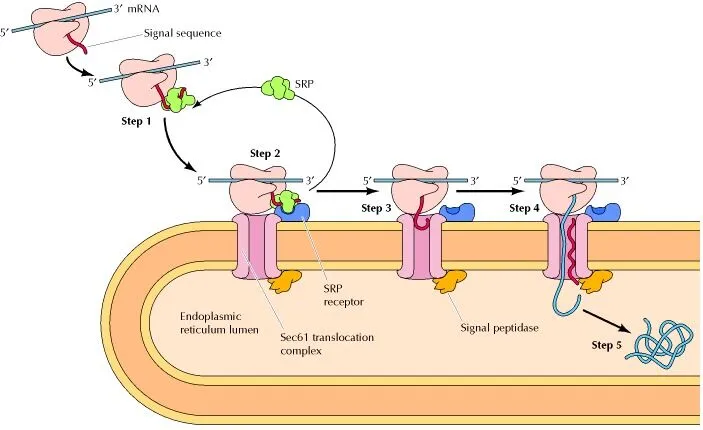
What does the rough endoplasmic reticulum do? (2)
Synthesizes and processes proteins in the cell
The smooth endoplasmic reticulum is an organelle that does 2 important things:
synthesizes and concentrates lipids and inactivates toxins/metabolic products in the cell

What is a ribosome?
The site of protein synthesis
Where are ribosomes typically found?
surface of rough ER (though some float freely in the cytoplasm)
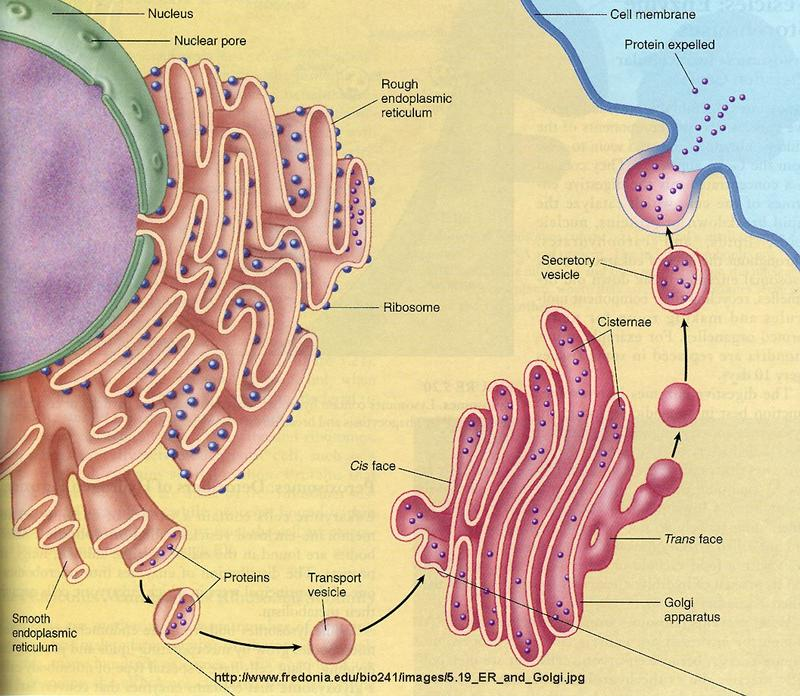
How do ribosomes, the smooth endoplasmic reticulum, and the Golgi apparatus work together? (3)
They build, process, and package proteins (cell's protein synthesis pathway)
What is a lysosome?
organelle that aids in digesting/recycling old cell materials
What additional role can lysosomes serve?
help destroy invading viruses and bacteria

A vacuole is an organelle that is used as a storage for the cell, holding substances like…? (3)
water, toxins, and carbohydrates
What is a molecule?
two or more atoms bonded together

What is mitosis? (describe it)
process where a cell duplicates to produce two genetically identical daughter cells
What is the purpose of mitosis? (2)
Tissue growth and repair
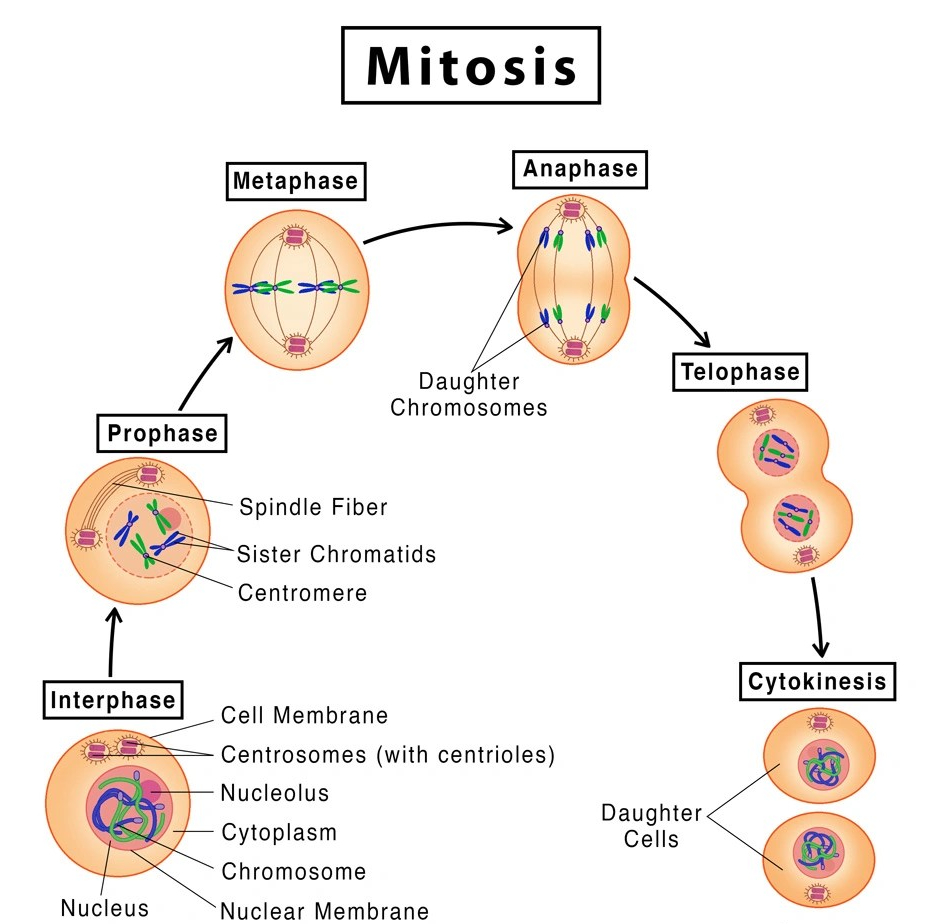
What happens during interphase?
DNA replicates (preparing the cell's genetic material to be divided between daughter cells)
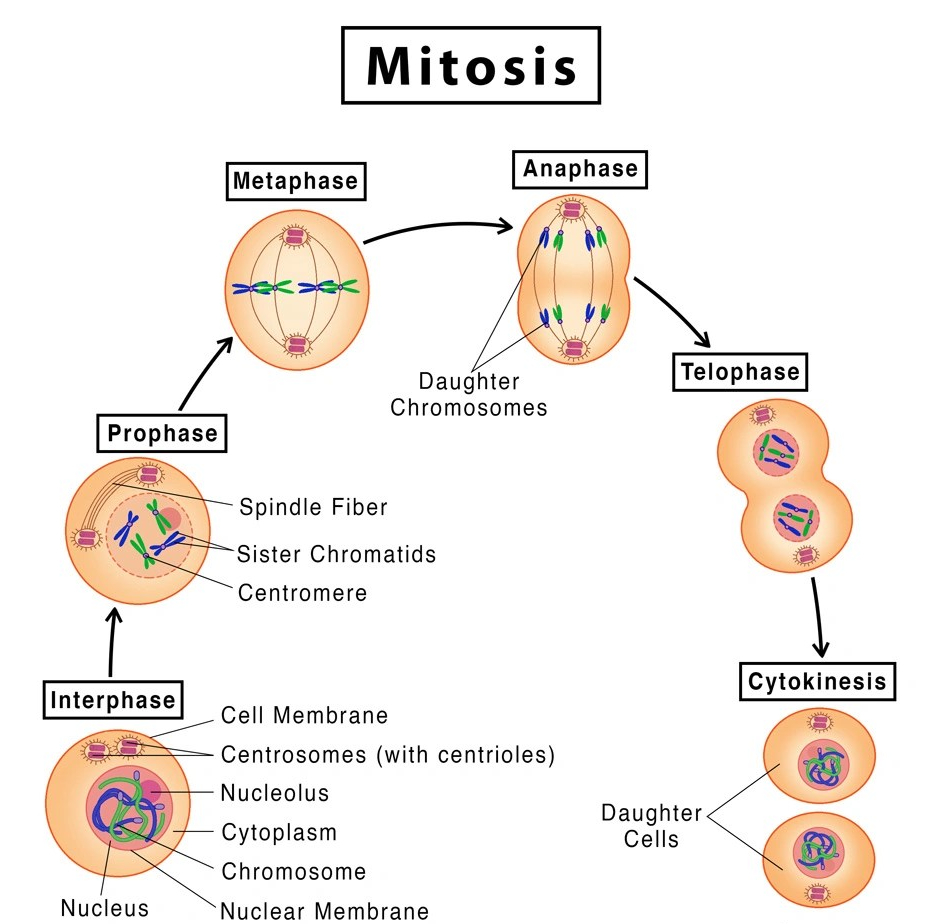
What happens during prophase of mitosis?
Chromosomes condense in preparation for separation
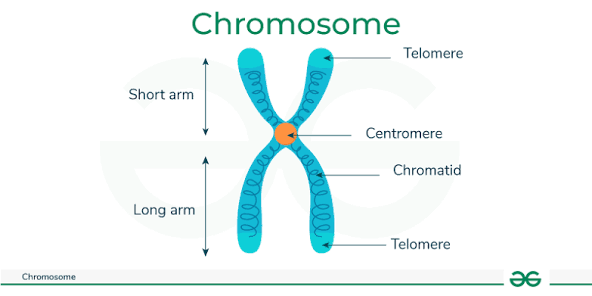
What is a chromosome made of (2)? What does it carry?
made of protein and a single DNA molecule; carries genetic information

Chromosomes line up along the center of the cell (in preparation for separation)

Chromosomes are pulled apart toward opposite poles of the cell (cell division begins)

Define cytokinesis (2)
cytoplasm divides, forming two new daughter cells

What happens during telophase of mitosis?
nuclear membranes form around the chromosomes (creating two new nuclei)
What happens after telophase?
cytokinesis
Name the steps of mitosis; start → finish (6)
interphase, prophase, metaphase, anaphase, telophase, cytokinesis

What is meiosis?
Two-stage cell division producing four genetically distinct haploid gametes
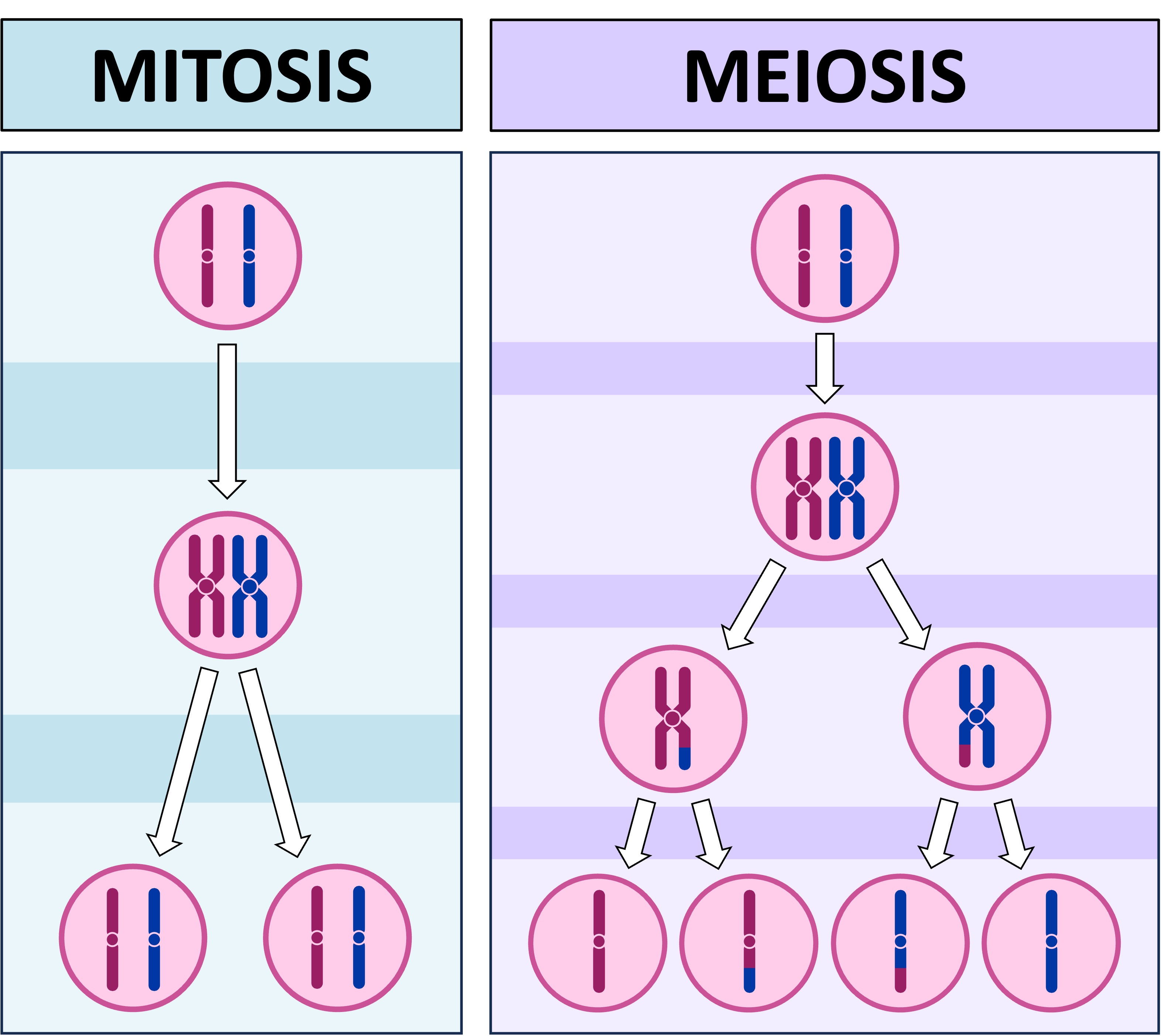
How does meiosis differ from mitosis?
Meiosis produces four genetically distinct haploid gametes, mitosis produces two genetically identical daughter cells

What is a gamete? What produces these? What does it carry?
A sex cell (sperm or egg) produced by meiosis; carries half the genetic information needed for sexual reproduction
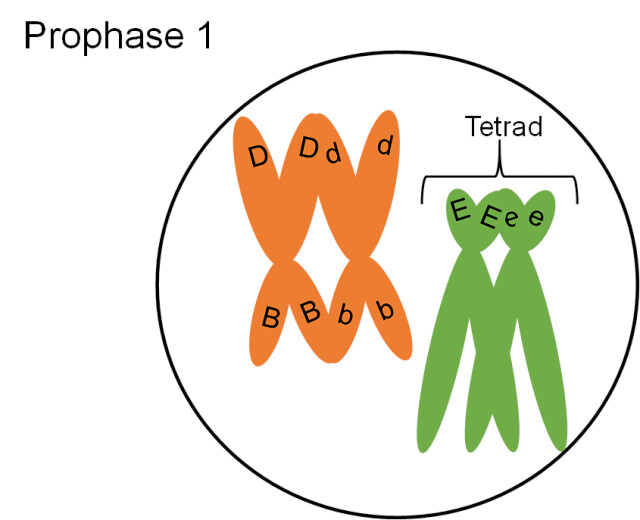
What happens during prophase I of meiosis (2)? What does that allow for?
Homologous chromosomes pair up and cross over; exchanging genetic material
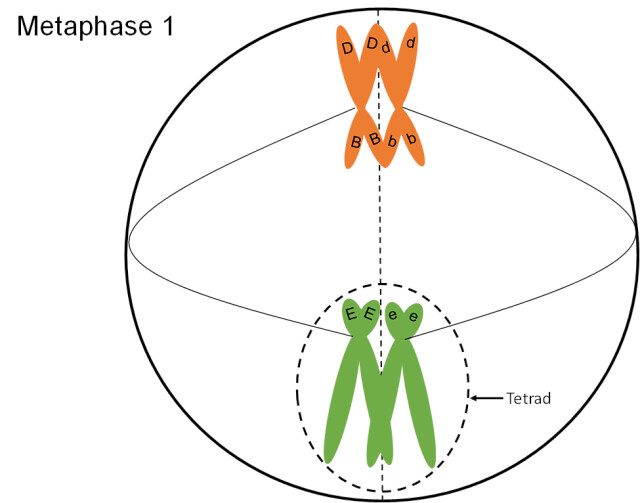
What happens during metaphase I of meiosis?
Homologous chromosome pairs line up at center of cell

What happens during anaphase I of meiosis? (2)
paired homologous chromosomes separate, moving towards opposite poles of cell
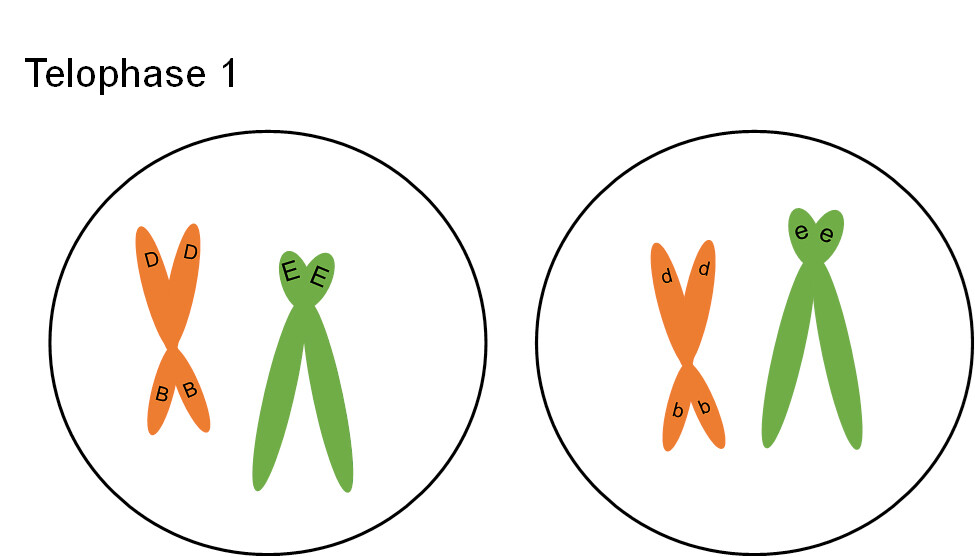
What happens during telophase I of meiosis? (what is forming, what does that create?)
Nuclear membranes form; cell separates into two haploid daughter cells

What do the chromosomes look like in cells after telophase I?
Each chromosome is made of two sister chromatids

What happens during prophase II of meiosis? (3)
chromosomes condense, nuclear envelope breaks down, new spindle forms (in each of the two haploid daughter cells)
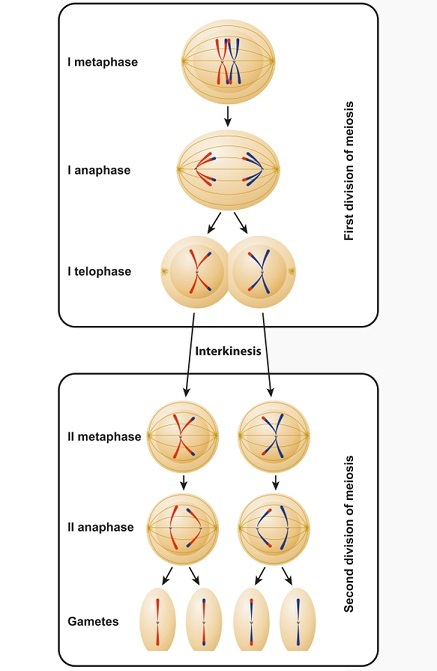
What happens during metaphase II of meiosis?
Individual chromosomes align at the center of each daughter cell

What happens during anaphase II of meiosis?
Sister chromatids separate and move to opposite ends of the cell
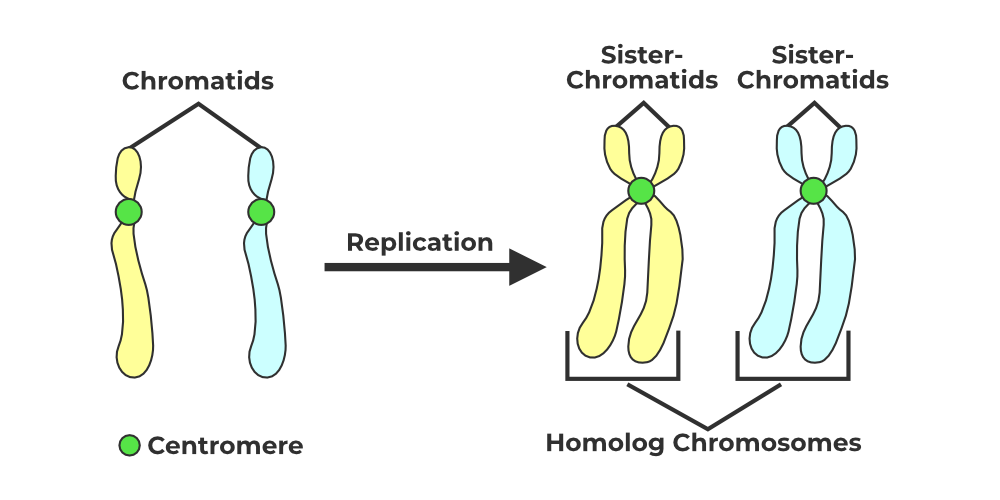
What is a chromatid?
one of the two identical halves of a copied chromosome
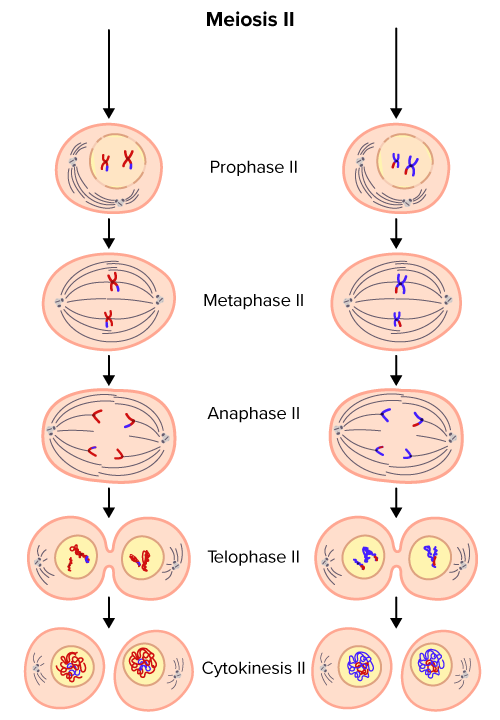
What happens during telophase II of meiosis?
Nuclear membranes form as the two cells from meiosis I separate into four haploid daughter cells
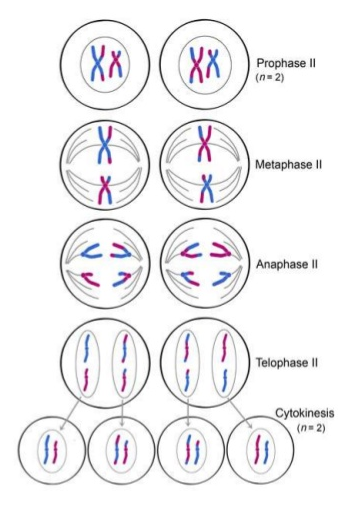
What do the chromosomes look like in the daughter cells after telophase II?
Each chromosome consists of a single chromatid