Genetics Exam 2
 Call Kai
 Learn
 Practice Test
 Spaced Repetition
 Match
 Flashcards
 Knowt Play
1/43

Earn XP
Description and Tags
CH 4, 5, 6, 7
Name | Mastery | Learn | Test | Matching | Spaced | Call with Kai | Chat |
|---|
No analytics yet
Send a link to your students to track their progress
44 Terms
Universal donor type
Type O blood
Universal recipients
Type AB blod
Transferases
Enzyme, catalyzes the movement of a functional group from a donot molecule to an acceptor molecule
In blood: catalyzes the addition of specfic sugars to the terminal sugar on the RBC surface
O allele produces no fucntional transferase
Red blood cell
Erythrocyte
White blood cell
Leukocyte
ABO gene
Codes for an antigen molecule on RBC that can induce an immune response
Contains the IA, IB, and i alleles
i (O) is recessive
IA and IB are codominant
Antigen
Foreign susbtance that can trigger the immune system
Antibody
Protein that can identify and neutralize foreign invaders
Co-dominant
When 2 alleles of the same gene are fully expressed in the phenotype
C gene
Codes for an enzytme active in the production of melanin.
Hypomorphic (leaky)
Partial loss of gene function
defined under Muller
Hypermorphic
Increases normal activity or amount of gene’s product compared to the wild-type allele, (gain of function)
Amorphic (null)
Complete loss of normal gene function
Wild-type (WT)
Standard, most common, non-mutated form of a gene as it naturally occurs in a wild population
Haplosufficient
An allele in a diploid organisms is enough to produce a normal phenotype
Haploinsufficient
One allele is inactivated, deleted, or mutated, and the single remianing functional copy is not enough to produce the normal amount of protein needed for healthy function.
Lethal alleles
Mutant alleles that are deadly, homozygosity is lethal, always recessive, low frequency, present as distortion in offspring ratios
Agouti gene
controls the distribution and type of melanin pigment produced in mammalian hair
Gene promoter
A specific region of DNA located just upstream (towards the 5' end) of a gene that acts as a "landing pad" and on/off switch to initiate the transcription of that gene into RNA
Sex-limited gene expression
The trait is only ever seen in one of the sexes
Located in autosomes: any numbered chromosome that is not a sex chromosome
Require male or female hormones foe expression
Sex-influenced gene expression
The trait can be seen in either sex, but is more common or more pronouced in one sex
Result in different phenotypes in males and females of the same genotype
Can be seen in either sex if homozygous
Penetrance
Degree to which the phenotype matches the underlying genotype
Complete penetrance: genotype and phenotype always match
Nonpenetrant: Genotype doesn’t produce the corresponding phenotype at all
Incomplete penetrance: The phenotype matches the genotype in some indivduals but not all
Expressivity
The intensity of the phenotype, can vary among indivudals with the same genotype
Phenylketonuria
Metabolic disorder where the body cannot break down the amino acid phenylalanine. Commonnewborn screening
Autosomal recessive; missing enzyme for phenylalanine breakdown
Pleiotropy
When a mutation in a single gene alters multiple distinct traits
Epistatis
The expression of one gene is masked, inhibited, or modified by the expression of one or more other genes
most often occurs between genes in the same pathway
In dihybrid cross the phenotype ratio of F2 will not be 9:3:3:1
Law of Segregation
The two alleles for a trait segregate when gametes are formed, and one allele randomly goes into each gamete
Law of Independent Assortment
During gamete formation, the segregation of alleles at one locus in indpendent of those at another
Dihybrid cross — 9:3:3:1 phenotypic ration in F2 generation
Parental gametes
Contain the same allele combination as members of the P generation
Nonparental gametes
Inherit one maternal and one paternal allele
Syntenic genes
Located on the same chromosome
Genetic linkage: Occurs when two syntenic genes cannot assort independently, leads to greater parenta; combinations of alleles
Recombinants
Gametes in which crossing over has separated the two parental alleles (AKA nonparental gametes)
Recombination frequency is r (the distance between the two genes)
Number of recombinants/total number of offspring
Test Crosses
Purpose: For analyzing linkage of two (or three) genes
Complete or incomplete
What is r?
How far apart are they?
Method: cross between a known heterzygote (F1) and a known double recessive individual
Intereference
The proportion (%) of expected double crossover (DCO) offspring that are “missing” from the total.
1 - (Observed DCO/ Expected DCO)
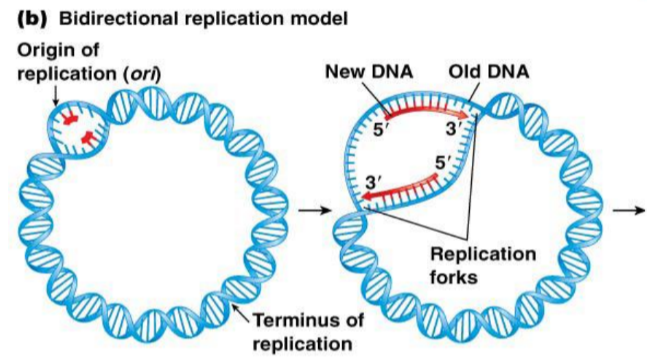
Origin of replication
Site where DNA helix unwinds to begin replication (created replication bubble)
bacteria have a single origin of replication
Eukaryotes have multiple

Replication forks
Ends of replication bubble where nucleotides are added to newly-synthesized strands
Replisome
Protein complex consisting of helicase, Topoisomerase, single-strand binding proteins, primase, DNA polymerase, sliding clamp, and ligase

Helicase
Breaks hydrogen bonds between bases to “unzip” the helix
One helicase at each replication fork
This creates the replication bubble
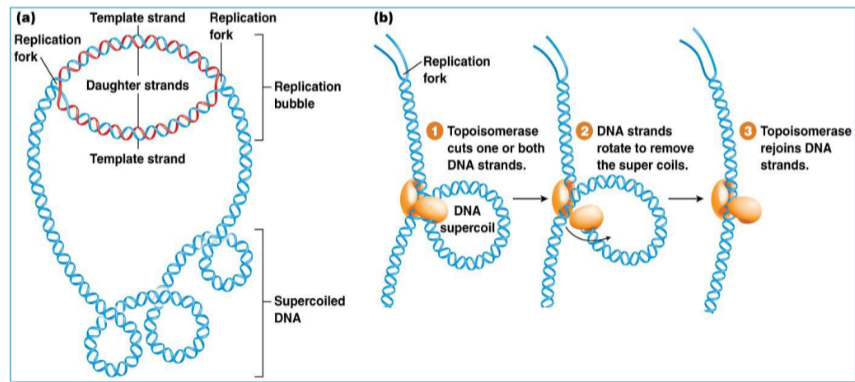
Topoisomerase
Relaxes supercoils. Makes one (Topo I) or two (Topo II) cuts in the DNA backbone to allow the DNA to rotate, releving torsional stress
Then the backbone is sealed again
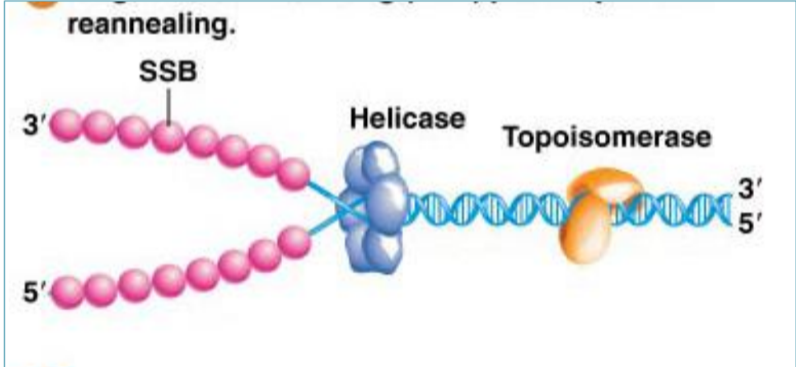
Single-strand binding proteins (SSBP)
Bind to the newly separated DNA strands
Prevent hydrogen bonds from re-formed between separated strands
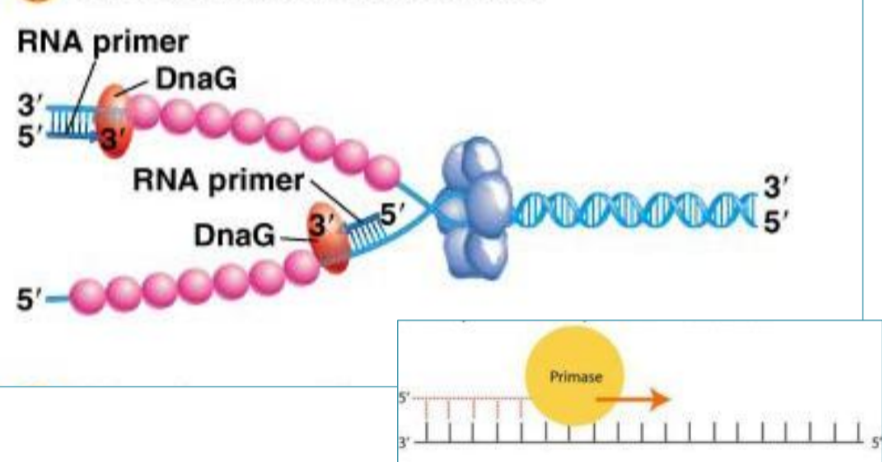
Primase
Gets new strands started
Type of RNA polymerase
Builds an RNA primer to start new strands
DNA polymerase
Can’t begin replication by itself- only adds nucelotides to previous nucleotides
DNA polymerase III adds nucleotides to the 3’ end of a growing DNA strand
Leading strand
Continous synthesis toward the replication fork
Lagging
Discontinuous synthesis away from replication fork
Okazaki fragment