CSIS 2200 Systems Analysis and Design Comprehensive Review
 Call Kai
 Learn
 Practice Test
 Spaced Repetition
 Match
 Flashcards
 Knowt Play
1/53

Earn XP
Description and Tags
Comprehensive vocabulary flashcards covering Data Communications, Internet/Intranet/Extranet technologies, Systems Planning, Requirements Modeling (DFDs), Object Modeling (UML), Database Design (ERDs), System Implementation, and E-Commerce fundamentals.
54 Terms
Data Communication
The electronic transfer of data from one location to another, enhancing decision-making efficiency and organizational productivity.
Bandwidth
The amount of data that can be transferred from one point to another in a certain time period.
Conducted Media vs. Radiated Media
Conducted media provide a physical path (such as twisted-pair wires, coaxial cable, or fiber optics) on which signals are transmitted, whereas radiated media use an antenna to transmit broadcast radio, spread spectrum, cellular, microwave, satellite, or infrared data through air or water.
Distributed Processing
A configuration combining centralized control with decentralized operations, offering easy modular provisioning, improved fault tolerance, and shared resources across geographical distances.
Open Systems Interconnection (OSI) Model
A seven-layer standardized architecture defining network transmission: Application, Presentation, Session, Transport, Network, Data Link, and Physical layers.
Star Topology
A network layout consisting of a central host and a series of nodes; it allows easy problem detection and node additions, but entire network operation fails if the central host goes down.
Bus Topology
A layout connecting nodes along a single network segment with hardware terminators at each cable end to absorb signals, keeping cabling costs low but risking bottlenecks under heavy traffic.
Mesh Topology
A layout (also known as plex or interconnected) in which every node is connected to every other node, providing high reliability but high cabling, maintenance, and expansion costs.
Client/Server Architecture
A network architecture that divides processing between one or more client devices (handling the user interface) and a central server (handling data storage, access, and database management).
Fat Client vs. Thin Client
A fat (thick) client locates all or most application processing logic on the client machine, whereas a thin client design places all or most processing logic on the server for better centralized performance.
Convergence
The integration of voice, video, and data so that multimedia information can be utilized seamlessly for organizational decision-making.
Internet Backbone
A foundation network linked with fiber-optic cables that supports high bandwidth, composed of interconnected government, academic, commercial, and high-capacity data routers.
Domain Name System (DNS)
A system that translates human-readable, language-based domain names into numerical Internet Protocol (IP) addresses via DNS servers.
Intranet
A private network within an organization configured behind a firewall that utilizes Internet technologies and protocols to securely share internal resources and enhance employee productivity.
Extranet
A secure interorganizational network that connects the intranets of business partners, typically located within a DMZ (demilitarized zone) between inner and outer firewalls.
Web 2.0 vs. Web 3.0
Web 2.0 focuses on read-write community interaction, blogs, wikis, and tagging; Web 3.0 (Semantic Web) focuses on personal, portable, and smart applications using artificial intelligence and data representations such as RDF and OWL.
Internet of Things (IoT)
A network of physical objects connected to the Internet and each other using RFID devices, barcodes, and wireless sensors to gather and share automated data.
Systems Development Life Cycle (SDLC)
A structured development methodology dividing information systems creation into five sequential phases: Systems Planning, Systems Analysis, Systems Design, Systems Implementation, and Systems Security/Support.

Business Process Modeling Notation (BPMN) Core Elements
A standardized set of shapes consisting of rounded rectangles (activities), circles (start/end events), diamonds (gateways), and solid arrows (sequence flows) used to map business processes.
Pool and Lane (BPMN)
Organizational constructs in BPMN where a Pool captures a broad resource class or business party (e.g., an entire company), and a Lane partitions a specific department, software system, or internal role within that pool.
SWOT Analysis
A strategic planning framework evaluating internal Strengths and Weaknesses along with external Opportunities and Threats regarding technical, human, and financial resources.
Fishbone Diagram
An analysis tool (also called a cause-and-effect diagram) used during preliminary investigations to identify root causes of a problem rather than mere symptoms across categories like People, Environment, Management, and Machines.
Pareto Chart
A bar chart displaying the causes of a problem in priority order, based on the principle that roughly 80% of operational problems stem from 20% of root causes.
Project Triangle
A project management model demonstrating the necessary balance among three interdependent factors: Cost, Scope, and Time.
Expected Task Duration Formula (PERT)
A weighted average calculation used to estimate project activity duration: Expected Task Duration=6B+4P+W, where B is the best-case estimate, P is the probable-case estimate, and W is the worst-case estimate.
Critical Path
A series of project tasks which, if any single task within it is delayed, will directly postpone the overall completion date of the entire project.
System Requirement
A feature or characteristic that must be included to satisfy business requirements and be acceptable to users, categorized into outputs, inputs, processes, performance, and controls.
Halo Effect
A bias that occurs during questionnaires and interviews when the impression or attitude formed in answering one question carries into the response on subsequent questions.
Data Flow Diagram (DFD)
A graphical model that illustrates how data moves and transforms throughout an information system without depicting internal program logic or physical hardware specifications.

DFD Symbols (Gane and Sarson vs. Yourdon)
The standard symbols for processes (rounded rectangle vs. circle), data flows (arrows), data stores (open/partitioned rectangle), and external entities (shaded square vs. rectangle) used to model systems.
Spontaneous Generation Process
A DFD error occurring when a process produces output data flows without having any incoming data flows.
Black Hole Process
A DFD error in which a process has one or more incoming data flows but produces no outgoing data flows.
Gray Hole Process
A DFD error where the input data flows connected to a process are logically insufficient to generate the specified output data flows.
Context Diagram
The highest-level, most abstract DFD that depicts system scope and boundaries via a single process labeled Process 0, showing external entities and primary data flows, but omitting data stores.
Leveling and Balancing
Leveling decomposes complex processes top-down into functional primitives using decimal numbering; balancing ensures that input and output data flows of a parent DFD are strictly preserved in child DFDs.
Encapsulation
An object-oriented programming concept (also known as data hiding) that bundles an object's attributes and methods together into a single unit, hiding implementation details from other classes.
Polymorphism
The capability in object-oriented systems where sending the same message to different objects causes each object to perform its own distinct, specialized method.
Use Case
A UML representation of the steps within a specific business function or process, initiated by an external actor interacting with the system.
Inclusion (<
In UML use case diagrams, <
Self-Sourcing
The development of custom information systems by end users using off-the-shelf software with minimal or no formal assistance from the centralized IT/IS department.
Computer-Aided Systems Engineering (CASE)
Software tools that automate parts of the application development cycle, ensuring diagram consistency, centralizing repository documentation, and supporting code generation.
Entity-Relationship Diagram (ERD)
A graphical data modeling tool showing entities (rectangles), relationships (diamonds/lines), attributes (ovals), and cardinality among data entities in a database.
Associative Entity
An entity introduced in an ERD to resolve a many-to-many (M:N) relationship into two one-to-many (1:M) relationships, storing attributes specific to the interaction between the parent entities.

Crow's Foot Cardinality Notation
A graphical convention using bars, circles, and crow's feet across relationship lines to denote numeric cardinality: one and only one (1), one or many (1..∗), zero or one (0..1), and zero, one, or many (0..∗).
Test-Driven Development (TDD)
An agile implementation philosophy where developers write automated unit test scripts for a feature before writing the actual code, focusing on end results throughout each iteration.
Direct Cutover
A system changeover method where the old system is immediately discontinued when the new system becomes operational; it is the least expensive method but carries the highest risk.
Parallel Operation
A system changeover method where both the old and new systems operate fully concurrently for a set period, offering low risk at the highest operating cost.
Pilot Operation vs. Phased Operation
Pilot operation implements the entire new system at a single selected company location before widespread deployment, whereas phased operation introduces the new system in incremental functional modules to all users.
E-Business vs. E-Commerce
E-business covers all activities a company performs using computers and communication technologies (e.g., procurement, SCM, ERP), whereas e-commerce focuses specifically on buying and selling goods and services over the Internet.
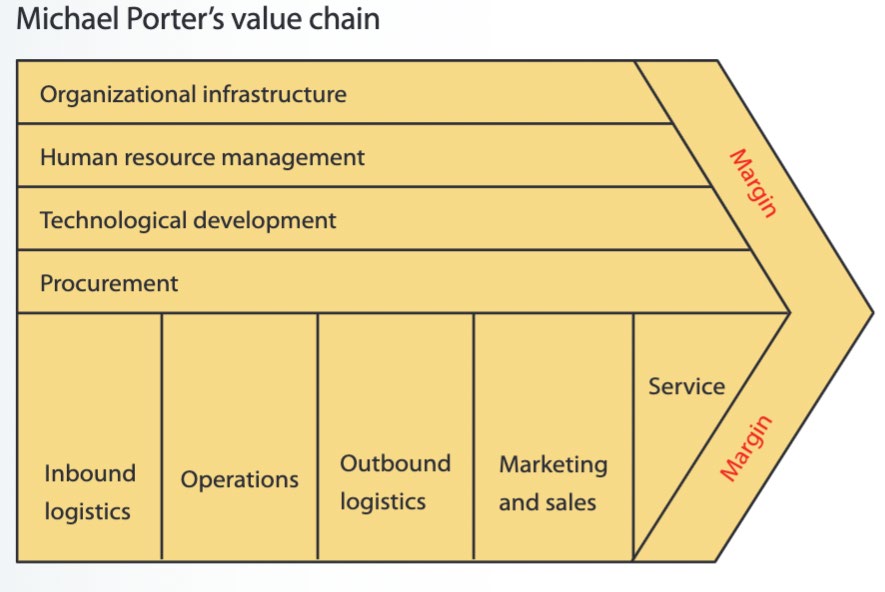
Michael Porter's Value Chain
A model dividing corporate activities into five primary activities (Inbound Logistics, Operations, Outbound Logistics, Marketing and Sales, Service) and four support activities (Infrastructure, HR, Tech Development, Procurement) to generate a competitive profit margin.
Omnichannel Strategy
A customer-centric retail strategy that seamlessly integrates physical brick-and-mortar storefronts, desktop websites, and mobile channels into a unified shopping experience.
Third-Party Exchange Marketplace
An independent B2B electronic market generating revenue from transaction matching fees, organized as either vertical (focused on a specific industry) or horizontal (focused on a specific business function).
Social Commerce
A subset of electronic commerce that leverages social media networks and online community interaction to influence purchasing decisions and facilitate sales transactions.
Search Engine Optimization (SEO)
A method for increasing the volume and quality of organic, unpaid web traffic to a website using strategic keywords, page titles, relevant content, and inbound links.