econ unit 1
 Call Kai
 Learn
 Practice Test
 Spaced Repetition
 Match
 Flashcards
 Knowt Play
1/68

There's no tags or description
Looks like no tags are added yet.
69 Terms
Fallacy
A hypothesis that has been proven false but is still widely accepted as true because it seems to make sense.
Appeal to pity/guilt fallacy
A fallacy that points out a bad consequence that might happen, such as the claim that adopting a puppy is urgent because it will be euthanized.
Slippery slope fallacy
Assuming that a small action will lead to an extreme outcome, like claiming marijuana leads to hard drug use.
Fallacy of composition
The mistaken belief that what is true for one is true for all, for example, assuming all farmers will plant corn because corn prices are high.
Post hoc fallacy
The mistaken belief that what occurs just before an event caused that event.
Fallacy of single causation
The mistaken belief that a particular event has only one cause.
Law of increasing relative costs
The increase in relative cost of producing more of one good relative to another due to resource allocation.
Law of diminishing returns
The eventual decline in the rate of extra outputs produced when one input is held constant and others are increased.
Law of increasing returns to scale
An increase in the rate of extra outputs produced when all inputs are increased.
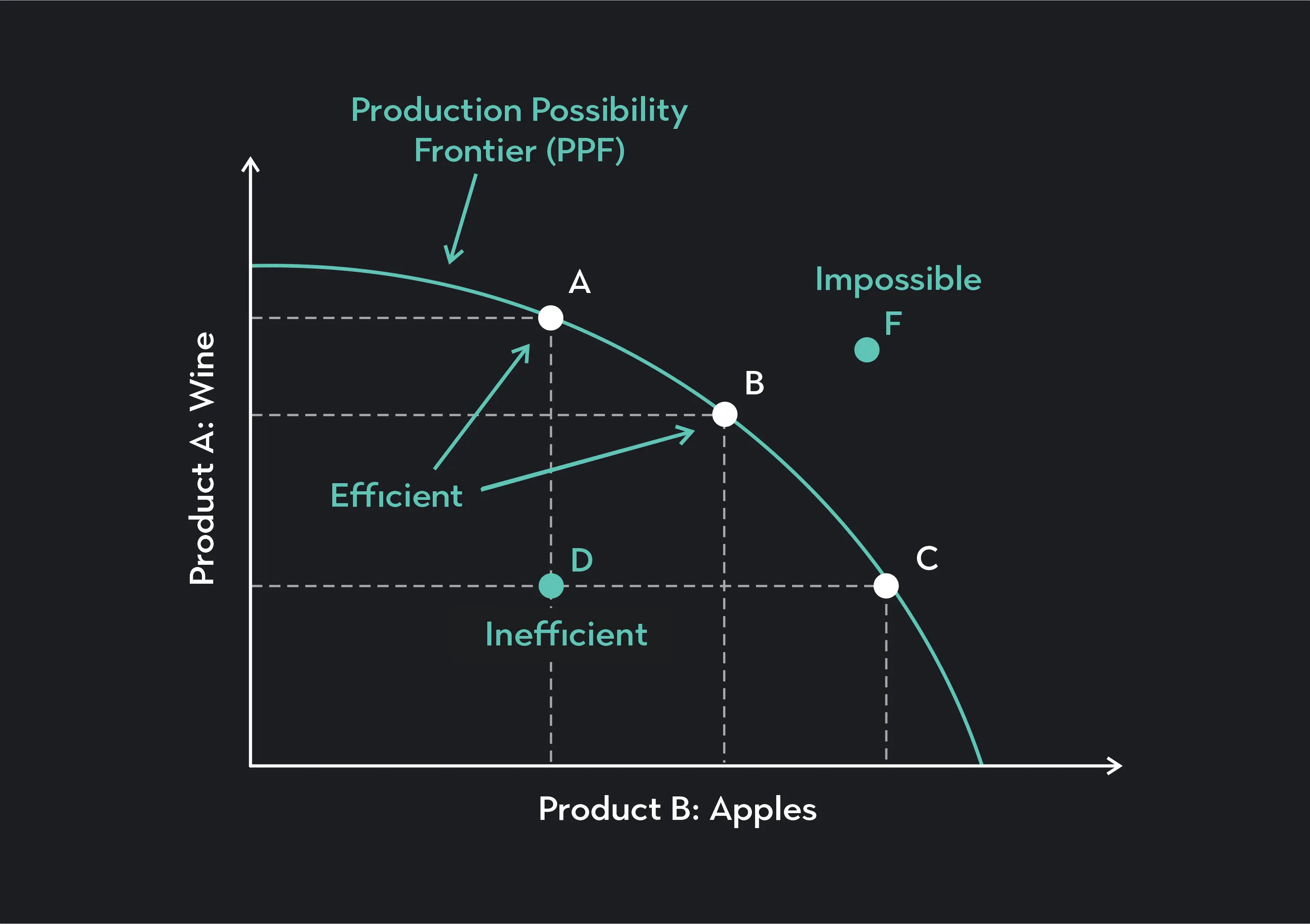
Production possibility curve (PPC)
A graph that shows the maximum feasible quantities of two products that can be produced using fixed resources and technology.
Resources (Factors of Production)
Inputs used to produce goods and services, including land, labor, capital, entrepreneurship, knowledge, and environment for enterprise.
Land (Resource)
Includes all natural resources used to produce goods.
Labor (Resource)
Includes all physical and mental efforts contributed by people.
Capital (Resource)
Includes machinery, tools, equipment, and money used to produce goods/services.
Entrepreneurship (Resource)
The contribution made by an owner or manager who organizes land, labor, and capital.
Knowledge (Resource)
Includes experience, specialized education and training, and applied technology.
Environment for enterprise and business (Resource)
Includes the climate of political and economic stability, social values supporting business, and a good work ethic.
Tangible Resources
Physical resources that are visible and easily quantified (land, labour, capital).
Intangible Resources
Resources that are less visible and hard to quantify (entrepreneurship, knowledge, environment).
Crown Land
Land owned by the government (comprising 89% of Canada).

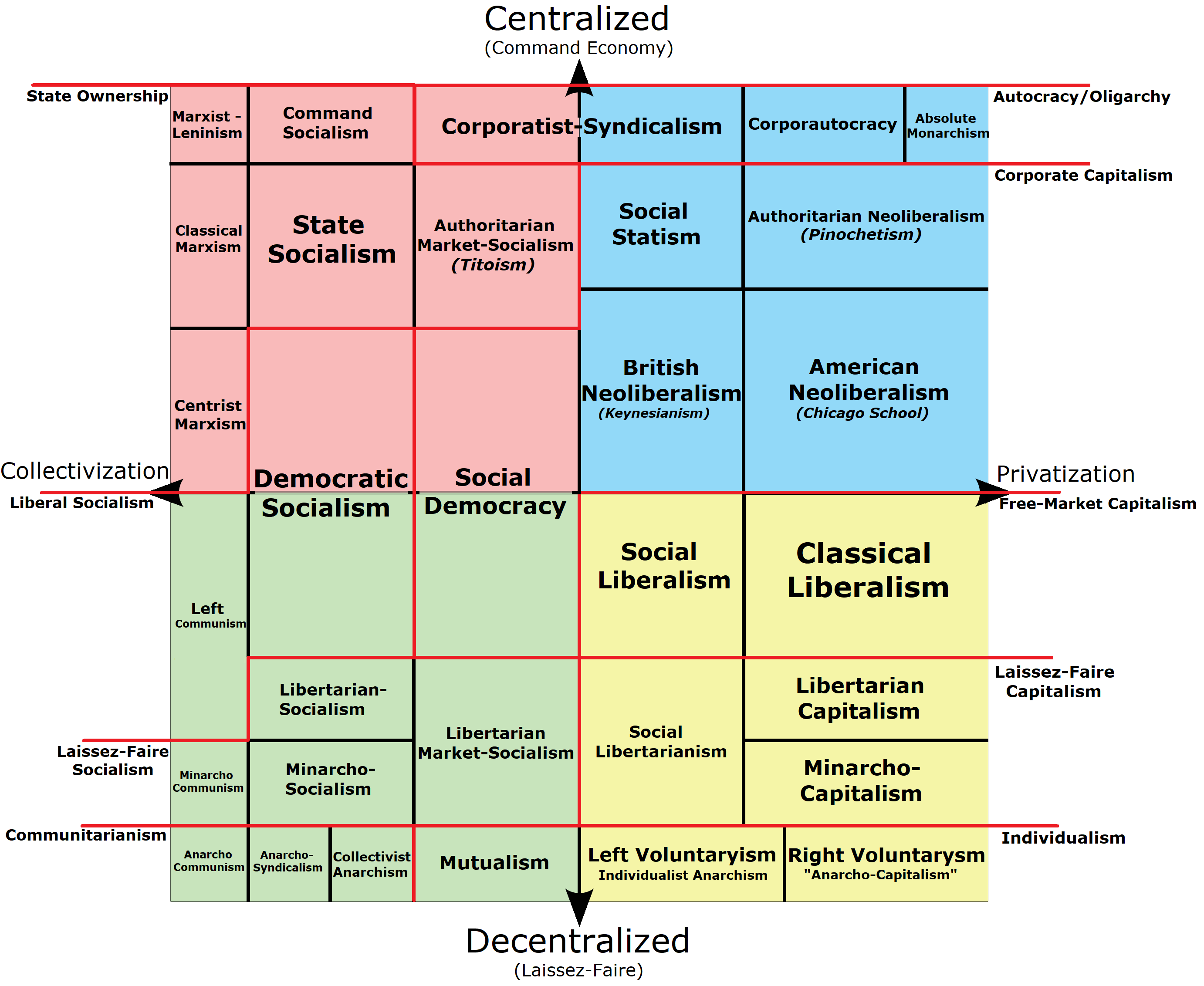
Ideology
A system of ideas forming the basis of economic or political theory.
Liberalism
Enlightenment movement replacing traditional conservatism with individualism, rights, and representative democracy.
Democracy
Political system with a freely elected government representing the majority for a set term.
Conservatism
Movement to preserve traditional institutions, customs, and values.
Dictatorship
Political system where absolute authority is exercised without free elections.
Capitalism
Moderate right ideology featuring private ownership, profit motive, and democratic elections.
Communism
Extreme left ideology based on Marx, featuring community ownership and command economy.
Socialism
Moderate left ideology featuring public ownership and democratic, peaceful elections.
Fascism
Extreme right, non-democratic government with a dictatorship and free-market economy.
Political Stability
Stable government helping long-term planning, investor confidence, and economic growth.
Reduced Public Debt
Addressing rising public debt and yearly government budget deficits.
Economic Growth
An increase in GDP (production of goods and services)
Productivity and Efficiency
Maximizing productivity so scarce resources are used efficiently
efficiency results from healthy competition
Equitable Distribution of Income
Fair distribution of wealth (subjective & controversial due to diff defs and many stakeholders)
Price Stability
Stable prices indicating a healthy economy, measured by the CPI
Inflation
General increase in prices or money supply causing declining currency purchasing power.
Deflation
The general decrease in prices of goods/services
Full Employment
Defined as between 6% and 7% of the labor force out of work.
goal for optimal production targets
Viable Balance of Payments and Stable Currency
Accounts tracking currency transactions between Canada and foreign countries.
If Canadian imports > exports, -effect on employment rates and CAD
Economic Freedom
Choices available to workers, consumers, and investors, including consumer sovereignty.
Environmental Stewardship
Economic activity pursued without significantly harming the natural environment.
Canada's 10 economic goals
Political stability
Reduced public debt
Economic growth
Increased productivity and efficiency
Equitable distribution of income
Price stability
Full employment
Viable balance of payments and stable currency
Economic freedom
Environmental stewardship
what can economic growth result from?
discovery of natural resources
increase in skilled labour
tech innovations
more efficient production
what is a budget deficit
when a government spends more than what it receives in revenue
four policies of great leap forward
four pests, peoples communes, development of industrial areas, backyard furnaces
impacts of great leap forward
great chinese famine, 20-43million died due to improper grain growing and distribution—result of government overreach (central planning committee) and heavy economic control
what was mao influenced by
nationalism, modern concepts of progress, marxism, western industrialization
economics
practical and social science that studies the way society makes decisions abt the use of scarce resources
economy
self-sustaining system with independent transactions in a society that create distinct flows of money and products
economic system
laws, institutions, and common practices that help a nation determine how to use its resources to satisfy as many of its peoples needs and wants as possible
effective use of resources
Using resources ethically to produce product, may result in higher costs
efficient use of resources
Using bare minimum of resource to produce the most amount of product, may not be ethical for environment / human rights
scarcity
limited resources, like natural resources
three production questions
what to produce, how to produce, for whom to produce
types of economies
traditional, command, market, mixed market
traditional economy
Practices of the past determine answers to the production questions
goods/services produced are traditional, same as olden
barter trade
practices = passed down, output doesnt change much year/year
command economy
Central planning authority answers the questions and makes the decisions (ex. Mao’s china)
indiv has obligation to serve state and authorities reward them
resources/production owned by state
leaders influence entire economy
market economy
aka free-enterprise bc evb acts for themselves (out of self-interest)
buyers and sellers alone answer the production questions
everything privately owned
mixed economy
Decisions of central planning authority plus actions of indiv buyers and sellers work together to answer the three production questions
beauracracy
govt with lots of red-tape and specialization of functions, heavy hierarchy of authority
agrarian economy
Economy based in rural areas that is centered on production, consumption, trade, and sale of agriculture (incl plants and livestock)
industrialization
increasing mechanization of a society
mercantilism
barber has a weird def…
System was based on state control of econ production and trade w goal of exploiting goods and importing few foreign goods
result of age of exploration and revolve around cash crops
protectionism
government policies that restrict int’l trade to support domestic industries, often through tariffs, quotas, and subsidies
laissez faire
Doctrine of non-interference so that things can work out naturally
adam smith
basically he made up capitalism and the free-market from the ideas of the physiocrats
Since ppl have a natural tendency to serve their best interest + acquire wealth, pursuit of self-interest would benefit all indivs if they were left alone to create more wealth
the invisible hand
Market competition orders the econ towards the most efficient and productive state
self-interest
each person is motivated by self-interest and to better our condition
Profit motive provides the major stimulus for econ growth and prosperity
Society requires greater production to satisfy wants
It doesnt appeal to generosity of producers, but to their desire to increase their own profit
opportunity cost
the amount you give up (of the second best alternative) by making your choice