Audiogram Degree, Type, Configuration
 Call Kai
 Learn
 Practice Test
 Spaced Repetition
 Match
 Flashcards
 Knowt Play
1/58

There's no tags or description
Looks like no tags are added yet.
59 Terms
air conduction
we can classify the degree of hearing loss (different descriptive categories) based on the person’s _______ threshold values
normal
slight
mild
moderate
moderately severe
severe
profound
7 degrees of hearing loss
-10 to 15 dB HL
normal hearing loss
16 to 25 dB HL
slight hearing loss
26 to 40 dB HL
mild hearing loss
41 to 55 dB HL
moderate hearing loss
56 to 70 dB HL
moderately severe hearing loss
71 to 90 dB HL
severe hearing loss
91+ dB HL
profound hearing loss
attenuation
reduction in sound level (How much quieter a sound needs to be before it becomes difficult for someone with hearing loss to hear it)
The greater the hearing loss, the louder sounds generally need to be for the person to hear them
everyday situations
it’s important to consider how much the hearing loss affects someone's ability to understand speech and communicate in _________, not just the threshold number
slight
which hearing loss category is typically used in children
conductive hearing loss
loss of energy due to external and middle ear
sensory/neural hearing loss
loss of energy due to inner ear of 8th nerve
mixed hearing loss
loss of energy occurs due to problems in the external or middle ear, AND inner ear or 8th nerve
type of hearing loss
describes how the loss of sound energy or sound attenuation is occurring
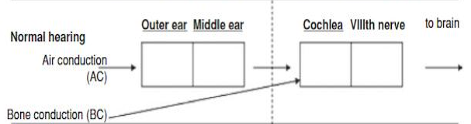
The outer/middle ear and cochlea/auditory nerve are not damaged, and both AC and BC are normal
what is normal hearing?
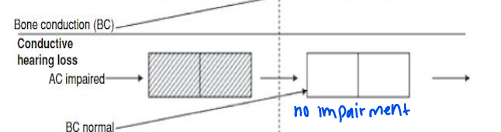
The outer or middle ear is damaged, the cochlea/auditory nerve are not damaged, AC is impaired, and BC is normal.
What is conductive hearing loss?

The outer/middle ear is not damaged, the cochlea or auditory nerve is damaged, and both AC and BC are impaired.
What is sensorineural hearing loss?

The outer/middle ear and the cochlea or auditory nerve are damaged, and both AC and BC are impaired.
What is mixed hearing loss?
presence or absence of air bone gap
how do we determine the type of hearing loss?
AC value - BC value > 10dB HL
air bone gap is present if what? (AC is worse than BC)
yes
can ABG occur at any frequency
conductive (or mixed)
if an air bone gap is present, what type of hearing loss is present?
normal hearing
AC normal
BC normal
no ABG

conductive hearing loss
AC abnormal
BC normal
ABG gap present/abnormal

SNHL
AC abnormal
BC abnormal
no ABG gap

mixed hearing loss
AC abnormal
BC abnormal
ABG gap present/abnormal
mixed hearing loss
abnormal BC + ABG gap = ?
SNHL
abnormal BC + no ABG gap = ?
bone conduction thresholds
type of hearing loss is assigned based on _______ and hoe they relate to AC thresholds
pinna, ear canal, eardrum, middle ear
what structures are in external/middle ear?
basilar membrane, hair cells, auditory nerve pathway
what structures are in inner ear?

classical pattern of conductive hearing loss
Bone conduction is normal (≤25 dB HL), but air conduction shows hearing loss, with an ABG greater than 10 dB at every tested frequency

classical pattern of SNHL
Classical: AC and BC responses are worse than 25 dB HL and ABGap ≤ 10 dB HL from one another

variation pattern of SNHL
unable to measure BC due to limited audiometer output (testing equipment could not generate a loud enough vibration to test your bone conduction (BC) at certain high frequencies)
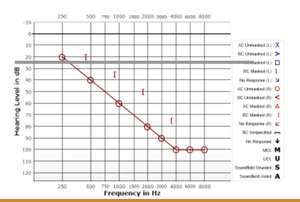
classical pattern mixed hearing loss
BC responses are worse than 25 dB HL, but they are > 10 dB HL better than the AC threshold at each pitch

variable pattern mixed hearing loss
One frequency has CHL, another pitch has SNHL, and another has mixed HL
central hearing loss, nonorganic hearing loss/pseudohypacusis
two other types of hearing loss that can’t be diagnosed with audiogram
central hearing loss
Once sound information reaches the brain, there is disorganization or inefficient processing of information that leads to loss of understanding.
-Not a “loss of energy,” but a loss of processing
-Causes: brain injury, neurological disorders, degenerative diseases, etc
Non-organic hearing loss/pseudohypacusis
No detectable physiological or structural damage in the ear or auditory system, but patient reports hearing problems
-Hearing loss may be exaggerated or faked, often due to external motives or psychological factors
configuration of hearing loss
attempts to describe the shape of the threshold line for each ear (how audiogram moves from one frequency to another)
flat, sloping/falling, rising, peaked/reverse cookie bite, cookie bite/trough, notched
types of configuration
flat configuration
< 5 dB change from frequency to frequency (per octave)
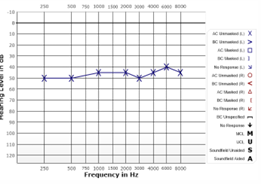
classical flat configuration
no more than 10 dB different across all pitches tested

variation flat configuration
maximum of 30 dB difference across 5 octaves
sloping configuration
5-12 dB change from frequency to frequency (best threshold occurs in low frequencies)

classical sloping configuration
gradual slope

variation sloping configuration
steep slope, precipitous slope or “ski slope”
rising configuration
> 5 dB change from frequency to frequency (best threshold occurs in the high frequencies)
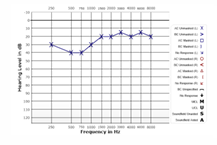
classical rising configuration
gradual rise

variation rising configuration
steeper rise
notched configuration
≥ 20 dB loss at one pitch compared to adjacent frequencies (Best threshold in the high or low frequencies)
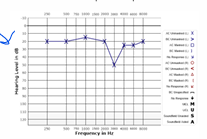
classical notched configuration
one frequency in the notch (3000 Hz)
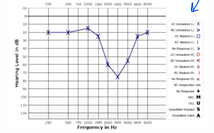
variation notched configuration
multiple frequencies in the notch (2000-4000 Hz)S

cookie bite / trough configuration
≥ 20 dB loss at mids compared to highs & lows (best threshold in the high or low frequencies)
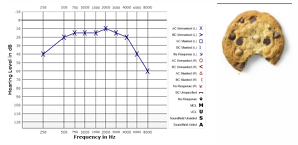
reverse cookie bite / peaked loss / tent
≥ 20 dB loss of highs & lows compared to mids (best threshold in mid-frequencies)

asymmetric Configuration
Different degrees of hearing loss between right and left ear
15 dB difference in air conduction values at 3 consecutive pitches between two ear
Example 1: 4000-8000 Hz right is ≥ 15 dB better than left
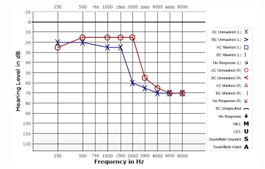
asymmetric Configuration
Different degrees of hearing loss between right and left ear
Some clinics also use 20 dB different at 2 consecutive frequencies, or ≥ 30 dB difference at one frequency
Example 2: 2000 Hz left ear is 45 dB worse than the right ear