2) Foraging trade-offs
 Call Kai
 Learn
Learn Practice Test
 Spaced Repetition
 Match
Match Flashcards
 Knowt Play
1/36

There's no tags or description
Looks like no tags are added yet.
Name | Mastery | Learn | Test | Matching | Spaced | Call with Kai | Chat |
|---|
No analytics yet
Send a link to your students to track their progress
37 Terms
what is behaviour shaped by
evolution, under natural or sexual selection
foraging optimally, energy and time spent per resource unit is as low as possible
foraging optimally
most desirable/favourable outcome
based on cost/benefit analysis of the situation
seen in many different behaviours (mating, predator avoidance, parental care)
richest area of food, gives higher quantity and quality of food
what are optimal foraging decisions
which food types to eat (optimal diet)
which patch type to feed in (optimal patch choice)
how much time in different patches optimal patch time)
optimal patterns and speed of movements while foraging
what is the original optimal foraging theory
animals should behave as if they are tring to maximize energy gaind/time spent
maximizing fitness, not food
eat enough, not endlessly, must consider trade-offs
what are important things to consider for foraging
what offers highest return given all the factors and constraints
cost/benefit analysis. if costs>benefits, then behaviour would not evolve
trade-offs: gecko sunbathing, what could the gecko do other than sunbathing, needs to because cold-blooded, but can’t spend whole day doing it
explain oystercatcher example
they ate all the middle-sized mussels
if there are larger mussels available, they should forage the big ones, but they didn’t
because the larger mussels are harder to open, have more barnacles on them, difficult to crack open. and smaller mussels are able to be opened quicker, have less meat inside, not worth it
what are conclusions from optimal foraging theory
development of models may provide insights into behaviour that would be missed
even over-simplified or incomplete models may have heuristic value
development of OFT changed study of foraging from descriptive to predictive
what is charnov’s model
forager should leave a patch when the instantaneous rate of resource gain in a patch drops below the average rate of gain available in the environment, factoring in travel time between patches
what is example of charnov’s model
when hummingbird arrives at fresh flower patch, nectar is abundant and easy to collect, as it continues feeding, nectar becomes depleted, and rate of energy gain slows
according to MVT, it should leave the patch long before all the flowers are empty, when rate of nectar intake falls below the average rate it could achieve by visiting other patches, considering the time and energy needed to travel
what are key factors in foraging decisions
rate of gain: over time, rate of gain slows as resources deplete: diminishing returns
travel time to next patch: if next patch is far or risky to reach, animals may stay longer in current patch, while shorter travel time encourage earlier departure
average rate of gain in environment: compare current rate of gain to average rate elsewhere, if current rate drops below that average, then leave patch
predation risk and competition: high predation risk of competition may force longer stays or earlier departure
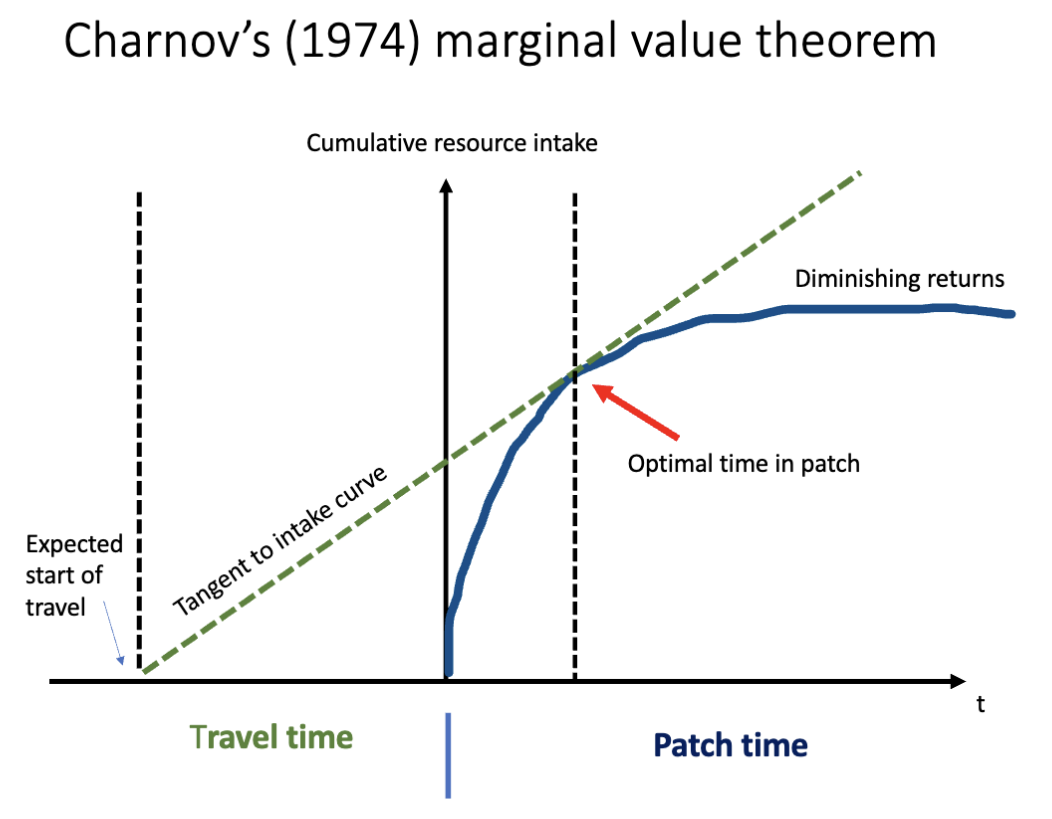
explain this graph
include travel time to patch, actual time spent in patch, and diminishing returns curve
when you arrive in a patch, all food is readily available
vertical line from the intersection between tangent line and intake curve
what are factors that will influence how many caterpillars a starling brings back?
travel time, competition, handing of food (weight, size, time taken to pickup), beak size (may have to come back anyway even if patch is good)
explain foraging starlings example
fly certain distance, could collect multiple prey items, number of prey items collected per visit and time spent at feeder were recorded
currency: rate of delivery of food for offspring. amount per unit time, time for trip = travel time and searching time
constraints: ability of starlings to find larvae, number of larvae that can be held in bill, flight speed (fixed, but travel time is influenced)
decision variable: load size/search time
what did they find with the starlings?
shorter travel time leads to not filling beaks, longer travel time leads to filling beaks more

explain this graph
optimal load of worms is 7, could potentially get 8 worms, but that gain is less than 7 worms
if starling finds a site closer to the nest, the optimal load size changes.
the optimum load is estimated by drawing a line from the travel time (negative section) towards the diminishing returns curve. find the intersection between this tangent time and the curve, then extend that straight towards the y-axis and that is the optimum load for that travel time
honeybee weight example
attached a weight to honeybees, made it more costly to forage for longer times and distances
bees with weights brought back less nectar, removed weights and bees still brought back less
in the paper, they said maybe bees had a limited lifetime fuel, less energy to forage because of the weights
explain great tit example
conveyor belt with 2 diff types of food, looked at which the bird will prefer to eat
when encounter rate of both prey items is low, birds should not be selective
hardly any food, just take all the food
when encounter rate of both pray items is high, birds should be selective
more food coming through, prefer foods with most nutrients
what are types of foraging movements
area-restricted search: when food is clumped together, reduce speed and increase turning rates after finding food
straight-line movement: use when food is sparse or evenly distributed
random walk: movement with no apparent direction of pattern
what impact does cryptic prey have
more difficult to discover
slow speed of predator increases detection of prey, but faster speed of predator increases the frequency of encounter of prey
details on vigilance for foraging
if animals can see predator, they may continue eating because they can see where they are, and gain of resources is perhaps more important in that situation
if there are danger zones, increase vigilance
sticklebacks
prefer high prey density in absence of predator, but prefer low density patches after exposure to a predator
less prey in the tank means fish are able to be more vigilant, higher density of prey, moving around more, confusing, more susceptible to predators
what is foraging behaviour influenced by (predator edition)
travel distance: closer to safety, will take more trips
handling time: takes longer to eat, will hide to eat, so less time exposed to predation
hunger state: if hungrier, will risk more when risk of predation = risk of starvation
risk averse vs risk prone
risk averse: go for consistency for more chance of survival, be risk averse if our expected 24 hour energy budget is positive (daily energy intake >> daily energy exposure)
risk prone: go for variability to have the chance of more seeds, be risk prone if your expected 24 hour energy budget is negative (daily energy expenditure >> expected daily intake)
trade-offs for great tits fat accumulation and predation
small birds must accumulate considerable amounts of body fat to survive long cold winters, but larger amount of fat increase cost of flight, and reduce ability to escape predators
increased hawk presence, average body mass decreased, but without hawks, average body mass increased
what is ideal free distribution (IFD)? what does it assume? why might this not be the case?
a group of foragers should distribute themselves between two patches in a ratio proportional to the availability of food in these patches
assumes all foragers are equal, have perfect knowledge of the environment, and are free to move between patches with negligible travel costs
if predators are around, stay in bigger groups and won’t disperse as much, though will be susceptible to competition

what is despotic distribution
as density increases, weak competitors suffer a steep decline in the realized habitat quality compared to strong competitors, they will begin migrating towards poorer habitat
at density 1, strong competitors are all present in rich habitat
for the weak competitors, the realized habitat quality has diminished to the level of fundamental habitat quality of the poor area
at density 2, the weak competitors are better off occupying the poor habitat exclusively, because the realized quality of rich area and fundamental quality of poor area are now equal
at density 3, strong competitors may begin using poor habitat, because the realized habitat density for them is now equal to the best possible version of the poor habitat
what can we do if optimal foraging models fail?
perhaps model is incorrect or incomplete
consider simpler decision rules
include additional constraints (predation risk, minimum nutrient requirements, avoidance of toxins, starvation risk avoidance)
consider currency other than profitability (such as efficiency (Egained/Espent)
what types of hoarding are there?
larder hoarding: storing food into a centralized location
hamsters storing seeds in underground chambers
scatter hoarding: storing food in many distinct locations
chickadees, grey squirrels
intermediate/multiple-central hoarding: storing food in clusters of caches
how will animals adapt hoarding strategies for different competition levels?
scatter if competition is high
larder if competition is low
details on social cognition and food caching in jays
birds are observant and steal caches from other birds
spatial memory of these birds is more developed than other birds that don’t hoard/cache
larger hippocampus, and seasonally variable, reduciton in size when not storing
what are types of social learning
social facilitation: group activity stimulates same behaviour
individual that is resting may begin grazing when nearby herd members start grazing
social learning/cultural transmission: young learning migration routes from experienced females
stimulus enhancement: animals investigating an area because other animals are seen there
soaring vulture sees other vultures gathered on the ground and investigates that location
observational learning: primates acquiring novel foraging techniques through observation, like washing potatoes
details on information centers
roosts/nesting colonies (large, unrelated individuals)
informers gain predation protection while foraging
eavesdroppers gain location of food
little cost if patch is undefendable
details on roosts
consist mainly of unpaired juveniles, which recruit to food by calling or retrieving from communal roost sites
individuals that slept together fed together
during brooding, house sparrows are in pairs, but otherwise in groups
they will only call to recruit if there’s enough food to share with others
what is cooperative hunting
two or more animals work together to capture prey, increasing individual and group success rates
can tackle larger or more dangerous prey
common in wolves, lions, dolphins, orcas
lions: take down larger prey, surprise faster prey,
individual specialization (hunts more successful when playing preferred positions)
food intake per lion is lowest when both lion and prey are in groups (gregarious)
lions go in groups for benefits of territory defences against infanticide
details on game theory of evolution
fitness of phenotype depends on their frequency in the population
optimal solution for parent is not the same as for the offspring
offspring wants to eat as much as they can, but are dependant on the parent, which needs to feed all offspring and themselves
offspring are not genetically identical to parents, which causes parent-offspring conflict and also sibling rivalry
what is ESS
evolutionarily stable strategy
only the strategies that cannot be invaded will be maintained in the population
if everyone adopts stealing food strategy, there will be no more food to to steal and will waste energy by hiding and stealing
behaviour is not only governed by optimality, but also what?
what other strategies are found in the population
the success of one animal’s chosen strategy depends on the strategies of the other individuals involved
producers vs scroungers
producers search for food on their own
scroungers steal food from producers
it’s good to be a scrounger if there’s no other scroungers around, but with increasing scroungers, there’s less to steal from, and being a producer becomes better