GENETICS EXAM 4
 Call Kai
 Learn
 Practice Test
 Spaced Repetition
 Match
 Flashcards
 Knowt Play
1/57

There's no tags or description
Looks like no tags are added yet.
58 Terms
All EXCEPT which of the following factors were crucial to the success of Gregor Mendel's experiments?
He always allowed all pea plants to self-fertilize, avoiding contamination from other individuals.
Name the single individual whose work in the mid-1800s contributed to our understanding of the particulate nature of inheritance as well as the basic genetic transmission patterns. With what organism did this person work?
Gregor Mendel; Pisum sativum
Which of the following best describes the relationship at the molecular level between mutant alleles and phenotype?
A mutant allele can have different effects depending on the gene product's function.
Which two genotypes in an individual would be expressed as the same phenotype in a diploid organism?
homozygous dominant and heterozygous
The offspring of the P1 generation is known as the _______ generation.
F1
A recessive allele in dogs causes white spots. If two solid colored dogs are mated and produce a spotted offspring, what is the percentage chance their next puppy would be solid colored?
75%
Polydactyly is expressed when an individual has extra fingers and/or toes. Assume that a man with six fingers on each hand and six toes on each foot marries a woman with a normal number of digits. Having extra digits is caused by a dominant allele. The couple has a son with normal hands and feet, but the couple's second child has extra digits. What is the probability that their next child will have polydactyly?
1/2
Tightly curled or wooly hair is caused by a dominant gene in humans. If a heterozygous curly-haired person marries a person with straight hair, what percentage of their offspring would be expected to have straight hair?
50% straight
You have identified a plant in your garden with a new flower color. You want to determine if this phenotype is dominant or recessive. Which cross would tell you this?
crossing the plant to one you know has the recessive trait
Assume that a black guinea pig crossed with an albino guinea pig produced 5 black offspring. When the albino was crossed with a second black guinea pig, 4 black and 3 albino offspring were produced. What genetic explanation would apply to these data?
albino = recessive; black = dominant
The process that leads to development haploid gamete is best described as ________.
segregation?
If an F2 generation from a self-cross always yields offspring in a 3:1 phenotypic ratio, which of the following P crosses could have occurred?
AA x aa
Assume that in a series of experiments, plants with round seeds (W ) were crossed with plants with wrinkled seeds (w ) and the following offspring were obtained: 220 round and 180 wrinkled. What is the most probable genotype of each parent?
One parent is ww , the other is Ww.
Assume that in a series of experiments, plants with round seeds (W ) were crossed with plants with wrinkled seeds (w ) and the following offspring were obtained: 220 round and 180 wrinkled.
What genotypic ratio is expected?
_____Ww: ______ww
1:1
Assume that in a series of experiments, plants with round seeds (W ) were crossed with plants with wrinkled seeds (w ) and the following offspring were obtained: 220 round and 180 wrinkled.
What phenotypic ratio is expected?
______round: ______wrinkled
1:1
Assume that in a series of experiments, plants with round seeds (W ) were crossed with plants with wrinkled seeds (w ) and the following offspring were obtained: 220 round and 180 wrinkled.
If there are 400 progeny total, what are the expected (theoretical) numbers of progeny in each phenotypic class?
200
Mendel indicated that traits were made up of unit factors. Today, we call unit factors ________.
alleles
Assuming a typical monohybrid cross in which one allele is completely dominant to the other, what ratio is expected if the F1s are crossed?
3:1
Albinism, lack of pigmentation in humans, results from an autosomal recessive gene. Two parents with normal pigmentation have an albino child. What is the probability that their next child will be wild type?
3/4
In an individual that is heterozygous for a particular trait, expression of the recessive allele is masked.
True
Round (R ) seed shape is dominant to wrinkled (r ) seed shape in pea plants. If an RR plant is crossed with an rr plant, what is the frequency of phenotypes in the F2 generation?
3 round seeds, 1 wrinkled seed
If the first three F2 offspring grown from the cross described above are round, what is the probability that the next F2 offspring will be wrinkled?
25%
Which types of phenotypic ratios are likely to occur in crosses when dealing with two gene pairs for which all the genotypic combinations are of equal viability?
9:3:3:1
Epistasis classic example is the _______
Blood Type- Bombay phenotype
Which of the following describes the product law?
The probability of two or more independent events occurring simultaneously is equal to the product of their individual probabilities.
What is segregation?
During gamete formation, allele pairs are separated to form haploid gametes.
Assuming no crossing over between the gene in question and the centromere, when do alleles segregate during meiosis?
anaphase I
Albinism, lack of pigmentation in humans, results from an autosomal recessive gene (a ). Two parents with normal pigmentation have an albino child. What is the probability that their next child will be an albino girl?
1/8
Chi-square analysis can help us to decide whether __________.
our observations of an event differ from our expectations
The Chi-square test involves a statistical comparison between measured (observed) and predicted (expected) values. One generally determines degrees of freedom as ________.
one less than the number of classes being compared
In what ways is sample size related to statistical testing?
By increasing sample size, one increases the reliability of the statistical test and decreases the likelihood of erroneous conclusions from chance fluctuations in the data
In a Chi-square analysis, what general condition causes one to reject (fail to accept) the null hypothesis?
usually when the probability value is less than 0.05
If one is testing a goodness of fit to a 9:3:3:1 ratio, how many degrees of freedom would be associated with the Chi-square analysis?
3
What information can be obtained from a human pedigree?
how a gene is inherited
In studies of human genetics, usually a single individual brings the condition to the attention of a scientist or physician. When pedigree are developed to illustrate transmission of the trait, what term does one use to refer to this individual?
proband

Imagine that you attempted to recreate Mendel's work with garden peas. You began by crossing true breeding violet-flowered, tall plants with white-flowered dwarf plants. After self-crossing the F1 generation, you obtain the following phenotypes in the F2 generation:
80 tall, violet flowers
36 tall, white flowers
39 dwarf, violet flowers
5 dwarf, white flowers
90
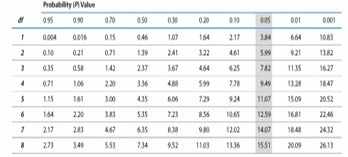
Imagine that you attempted to recreate Mendel's work with garden peas. You began by crossing true breeding violet-flowered, tall plants with white-flowered dwarf plants. After self-crossing the F1 generation, you obtain the following phenotypes in the F2 generation:
80 tall, violet flowers
36 tall, white flowers
39 dwarf, violet flowers
5 dwarf, white flowers
30
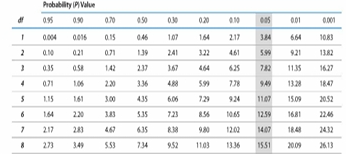
Imagine that you attempted to recreate Mendel's work with garden peas. You began by crossing true breeding violet-flowered, tall plants with white-flowered dwarf plants. After self-crossing the F1 generation, you obtain the following phenotypes in the F2 generation:
80 tall, violet flowers
36 tall, white flowers
39 dwarf, violet flowers
5 dwarf, white flowers
How many dwarf plants with violet flowers were expected? Express your answer as a whole number.
30
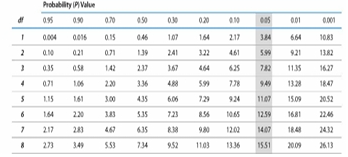
Imagine that you attempted to recreate Mendel's work with garden peas. You began by crossing true breeding violet-flowered, tall plants with white-flowered dwarf plants. After self-crossing the F1 generation, you obtain the following phenotypes in the F2 generation:
80 tall, violet flowers
36 tall, white flowers
39 dwarf, violet flowers
5 dwarf, white flowers
How many dwarf plants with white flowers were expected?
10

Imagine that you attempted to recreate Mendel's work with garden peas. You began by crossing true breeding violet-flowered, tall plants with white-flowered dwarf plants. After self-crossing the F1 generation, you obtain the following phenotypes in the F2 generation:
80 tall, violet flowers
36 tall, white flowers
39 dwarf, violet flowers
5 dwarf, white flowers
Use a chi-square analysis to test the hypothesis that the F2 data for
stem length (tall:dwarf) is consistent with Mendel's law of
segregation.
Calculate the chi square value.
0.53

Imagine that you attempted to recreate Mendel's work with garden peas. You began by crossing true breeding violet-flowered, tall plants with white-flowered dwarf plants. After self-crossing the F1 generation, you obtain the following phenotypes in the F2 generation:
80 tall, violet flowers
36 tall, white flowers
39 dwarf, violet flowers
5 dwarf, white flowers
Use a chi-square analysis to test the hypothesis that the F2 data for
stem length (tall:dwarf) and flower color (violet:white) is consistent
with Mendel's law of independent assortment.
Calculate the chi square value.
7.51
Why was the garden pea a good choice as an experimental organism in Mendel's work? Check all that apply.


A gain-of-function mutation _______.
results in an increased quantity of the normal gene product
A mutation in a gene often results in a reduction of the product of that gene. The term for this type of mutation is ________.
loss of function or null (in the case of complete loss)
Assume that a mutation occurs in the gene responsible for the production of hexosaminidase A, such that only about 50% of the enzyme activity is found in the heterozygote compared with a homozygous normal individual. If heterozygotes are phenotypically normal, we would say that the mutant allele is ________ to its normal allele.
recessive
What is the most prevalent form of an allele called?
wild type
Which of the following symbols indicates a wild-type allele?
+
Typically, when one wishes to represent a gene, the symbol used is _________.
in italics
With incomplete dominance, a likely ratio resulting from a monohybrid cross would be _______
1:2:1
The trait of medium-sized leaves in iris is determined by the genetic condition Pp. Plants with large leaves are PP, whereas plants with small leaves are pp. A cross is made between two plants each with medium-sized leaves. What is the term for this allelic relationship?
incomplete dominance
The following coat colors are known to be determined by alleles at one locus in horses:
palomino = golden coat with lighter mane and tail
cremello = almost white
chestnut = brown
The following table gives ratios obtained in mating's of the above varieties:
Assign gene symbols for the genetic control of coat color on the basis of these data.
C1C1 = cremello, C2C2 = chestnut, C1C2 = palomino
In a cross between two strains that are true breeding for purple and white flowers, the F2 phenotypic ratio would be ¼ purple, ¼ white,
and ½ lavender if the flower color phenotype exhibits incomplete dominance.
True
Which of the following statements about an individual with the Bombay phenotype is correct?
The individual lacks the enzyme required to produce the H substance.
Incomplete dominance is shown in the flower color of snapdragons, as shown in this figure.
Choose the offspring phenotypes you would expect from the following cross: R1R1XR1R2