HISTO/CELL BIOLOGY - CELL CYCLE
 Call Kai
 Learn
 Practice Test
 Spaced Repetition
 Match
 Flashcards
 Knowt Play
1/78

There's no tags or description
Looks like no tags are added yet.
79 Terms
What is the cell cycle?
Period from formation of a cell by division until that cell itself divides
life cycle of an individual cell
Do all specialized cells continue dividing?
Most never divide again after growth and specialization; some unspecialized cells retain ability to divide.
Is the length of the cell cycle constant?
No; very variable.
What are labile cells?
Continuously cycling cells - “continuously divide throughout life to replace lost cells.”
e.g., epidermis and GI tract epithelium.
What are stable cells (facultative dividers)?
Quiescent cells that can re-enter the cycle - “usually remain in resting state but can re-enter cell and divide when needed.”
e.g., hepatocytes.
What are permanent cells?
Non-dividing cells
e.g., neurons and cardiac myocytes.
What does G0 represent?
Non-dividing (quiescent) state
→ outside the active cell cycle
Which checkpoints are shown in the cell-cycle diagram?
G1/S: DNA damage
G2/M: damaged or unduplicated DNA.

What are the two basic periods of the cell cycle?
relatively short dividing period
nondividing period (interphase)
What is interphase?
Period between mitotic divisions
intense metabolic activity
not a resting period
What happens in the nucleus during interphase?
nucleus involved in protein synthesis
chromatin is copied/replicated
What is cell division composed of?
Nuclear division followed by cytoplasmic division.
How can nuclear divisions differ?
Daughter cells retain same chromosome number OR receive half the parent number.
What are the stages of the cell cycle in order?
G1 → S → G2 → M (mitosis and cytokinesis).
Which interphase stage is longest/most variable?
G1; may last days or longer. **highly variable
What does the diagram show for S phase?
DNA synthesis in each chromosome, histones of daughter chromatid produced; notes about 6–8 hours.
What does the diagram show for G2 phase?
Preparation for division; notes about 2–4 hours.
What happens during G1 (first gap)?
Cells grow and perform specialized functions.
What happens during S phase?
DNA synthesis in each chromosome; histones of daughter chromatids produced.
What happens during G2 (second gap)?
Relatively short; cells prepare for mitotic division.
Which phases have relatively constant durations?
S, G2 and M: several hours each.
How long may G0 last?
Entire lifespan of the organism.
What does the DNA replication diagram show?
DNA double helix is copied → to produce duplicated DNA

Define mitosis.
Division of nucleus producing two nuclei with identical chromosome sets (replicative division).
When does mitosis take place?
organsim growth
tissue repair
also asexual reproduction
What are the four main mitotic stages?
Prophase → Metaphase → Anaphase → Telophase (PMAT).
What happens in prophase?
Chromatin condenses into visible chromosomes; spindle forms; nuclear envelope/nucleolus disappear.
Annotation: What is each duplicated prophase chromosome made of?
Two sister chromatids.
Annotation: Where do duplicated centrioles move in prophase?
To opposite poles.
What happens during metaphase?
Chromosomes align at the equatorial plane; spindle fibers attach at centromere/kinetochore.
What happens during anaphase?
Sister chromatids separate and migrate to opposite poles by mitotic spindles.
What happens during telophase?
Chromosomes reach opposite poles; nuclear envelopes re-form.
What does the final interphase illustration show?
cytoplasm divides, produces two daughter cells with nuclei containing chromatin.
Identify the mitotic phase with diffuse chromatin and intact nucleus.
Interphase (image 1).

Identify the phase with chromatin beginning to condense.
Early prophase (image 2).

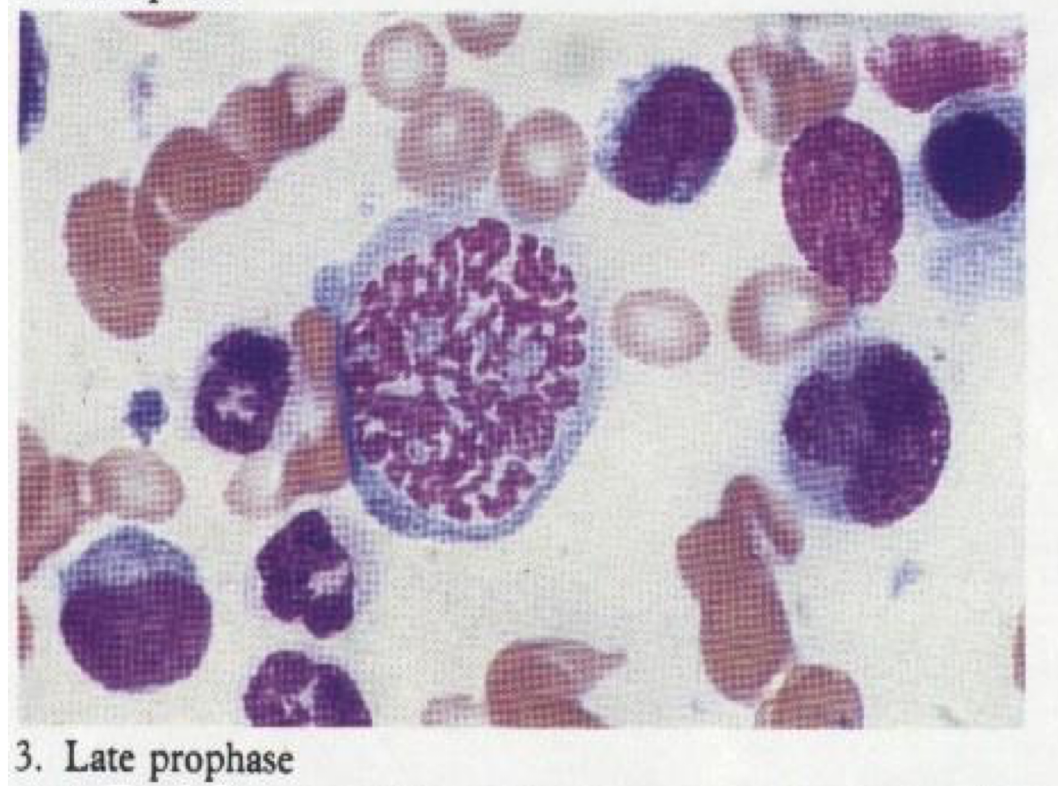
Identify the phase with visibly condensed chromosomes.
Late prophase (image 3).
Identify the phase with chromosomes at the equator.
Metaphase (image 4).

Identify the phase when sister chromatids start separating.
Early anaphase (image 5).

Identify the phase when chromatids approach opposite poles.
Late anaphase (image 6).

Identify the phase with two reforming nuclei and cell division.
Early/late telophase and cytokinesis (images 7–8).

Define cytokinesis.
division of cytoplasm
usually follows nuclear division
What happens to organelles during cytokinesis?
Become distributed between daughter cells.
Does cytokinesis always distribute equal cytoplasm?
No; daughter cells may have unequal amounts.
What results when mitosis occurs without cytokinesis?
Binucleate or multinucleate cells.
How does cytokinesis begin in animal cells?
Cell membrane invaginates at cell equator → forming cleavage furrow which then extends to divide the cytoplasm into two cells
What causes cleavage furrow constriction?
Contraction of ring of microfilaments beneath the surface of the cleavage furrow
Cytokinesis occurs as a result of its contraction
Define meiosis.
Nuclear division producing four daughter nuclei with half the number of chromosomes of original nucleus (reductive).
What is the role of meiosis in reproduction?
Precedes gamete formation
helps keep chromosome number constant from generation to generation.
What happens when two gametes fuse in sexual reproduction?
chromosome number of the new cell (zygote) is doubled by the amalgamation of two nuclei.
How many successive nuclear divisions occur in meiosis?
meiosis I and meiosis II.
What separates in meiosis I?
Homologous chromosomes.
What separates in meiosis II?
Sister chromatids.
What happens to homologous chromosomes in prophase I?
homologous chromosomes appear long, slender, & very thin
approach, line up, and pair point for point (with exception for XY).
What is crossing over?
Interchange of chromatid segments between two paired homologous chromosomes.
When does crossing over occur?
During prophase I.
What are homologous chromosomes?
Paired maternal and paternal chromosomes corresponding to each other.
What is a chiasma (shape) in the diagram?
Point where paired homologous chromatids have crossed over.
→ points of interchange temporarily remain united
What are recombinant chromatids?
Chromatids with exchanged segments after crossing over.
What occurs at the chiasma stage?
Blocks of genes exchanged between homologous chromosomes.
What happens to homologous chromosomes after pairing?
Orient on spindle and migrate to opposite poles.
What is in each daughter cell after meiosis I (human)?
23 double-structured chromosomes (one member of each homologous pair).
How much DNA is in each cell after meiosis I?
each daughter cell equals that of a normal somatic cell
What is interkinesis?
Period between meiosis I and meiosis II; no DNA synthesis.
What happens to chromosomes in meiosis II?
23 double-structured chromosomes divide at centromeres; chromatids separate.
What is the chromosome complement after meiosis II (human)?
23 single-chromatid chromosomes per daughter cell.
How much DNA is in each cell after meiosis II?
Half that of a normal somatic cell.
What are the two purposes of meiosis?
genetic variability
haploid number of chromosomes germ cells with half somatic-cell DNA amount.
How does meiosis produce genetic variability?
Crossing over + random distribution of homologous chromosomes.
What separates during anaphase I?
Homologous chromosomes separate, migrate to opposite poles of the cell
What separates during anaphase II?
Sister chromatids seperate
→ newly separated chromosomes of the two daughter cells move to opposite poles of their spindle.
Annotation: Is DNA duplicated between meiosis I and II?
No DNA duplication; only separation/splitting in meiosis II.
What is the result of meiosis I?
Two daughter cells with haploid sets of duplicated chromosomes.
What is the result of meiosis II?
Four daughter cells with haploid sets of unduplicated chromosomes.
What is the chromosome number after mitosis vs meiosis?
mitosis: diploid (2n)
meiosis: haploid (n), in typical human cells.
What type of reproduction uses mitosis vs meiosis?
mitosis: asexual
meiosis: sexual reproduction
How do mitosis and meiosis differ in daughter-cell genetics?
mitosis: genetically similar/identical daughter cells
meiosis: genetically different daughter cells
How many stages are compared in the lecture table?
mitosis: 4
meiosis: 8 (4 in each of 2 rounds).
In which organisms does mitosis occur according to lecture table?
all organisms except viruses
In which organisms does meiosis occur according to lecture table?
occurs only in plants, animals, and fungi