To monitor the rate of production of oxygen from hydrogen peroxide using manganese dioxide as a catalyst
 Call Kai
 Learn
Learn Practice Test
 Spaced Repetition
 Match
Match Flashcards
 Knowt Play
1/9

There's no tags or description
Looks like no tags are added yet.
Name | Mastery | Learn | Test | Matching | Spaced | Call with Kai | Chat |
|---|
No analytics yet
Send a link to your students to track their progress
10 Terms
Theory
• Hydrogen peroxide (H2O2) decomposes slowly into water and oxygen
• The rate of reaction may be increased by adding a manganese dioxide (MnO2) catalyst
H2O2 —MnO2→ H2O + ½ O2
• The rate of this reaction is measured by measuring the volume of oxygen gas that is collected at regular time intervals
Procedure
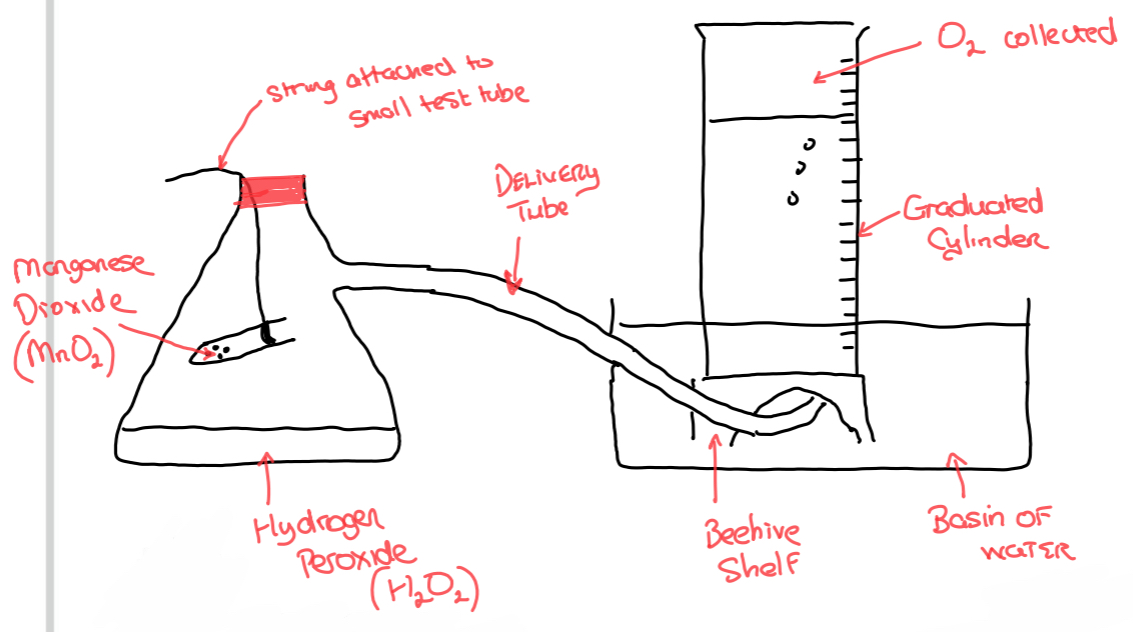
➢ The apparatus in the diagram is set up
➢ The manganese dioxide is added to the hydrogen peroxide from a small test tube in the conical flask, the mixture is shaken, and the stopwatch is started at EXACTLY THE SAME TIME
➢ The oxygen gas produced is collected over water using a beehive shelf and graduated cylinder
➢ The volume of oxygen gas evolved is measured using the graduated cylinder at regular time intervals until the reaction is completed
➢ The results are entered in a table and graph of volume of oxygen (y axis) Vs time (x axis) is plotted.
➢ From the graph, the average rate of reaction and the instantaneous rate of reaction at any point can be found
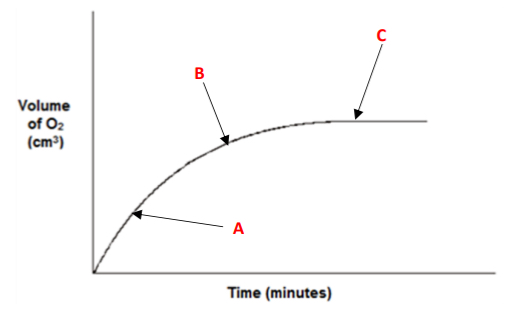
Explain the general trend in the curved obtained when a graph of volume of oxygen vs time is plotted
A- Slope steepest – reaction occurring at its fastest rate, most volume of gas evolved per time
Concentration of reactants is greatest – more collisions means more effective collisions
B- Slope becomes less steep - reaction slows down, less volume of gas evolved per time
Concentration of reactants decreased – less collisions means less effective collisions
C- Slope is 0 – reaction is finished, no gas evolved
Reactant used up; no more product formed
Write a balanced equation for the catalysed decomposition of hydrogen peroxide using manganese dioxide
H2O2 —MnO2→ H2O + ½ O2
What is the appearance of the manganese dioxide catalyst?
Black powder
How is it ensured the stopwatch is started at exactly the same time as the reaction starts?
• The manganese dioxide is added to the hydrogen peroxide from a small test tube in the conical flask
• The mixture is shaken, and the stopwatch is started at exactly the same time
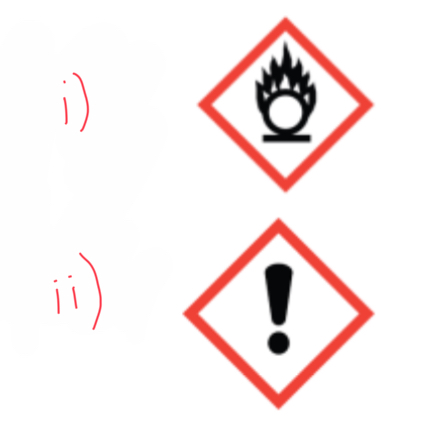
What chemical hazard symbols are associated with i) hydrogen peroxide ii) manganese dioxide?
Explain their meaning and suggest how you could manage their risk
i) Hydrogen peroxide Oxidiser - Keep away from other substances
ii) Manganese dioxide Irritant - Wear gloves
What effect would increasing the mass of the catalyst have on the rate of reaction? Explain
• No effect
• Catalysts are only required in very small amounts
What type of catalysis is involved in this reaction? Explain
Heterogenous catalysis - the solid manganese dioxide catalyst is in a different phase to the reactants(liquid) and products
Name and describe the mechanism for the action of the manganese dioxide in speeding up the decomposition of hydrogen peroxide
Name: Surface adsorption theory - always used for a solid catalyst
Mechanism:
i. Adsorption - The hydrogen peroxide reactants are adsorbed onto the surface, forming temporary bonds
ii. Reaction - The hydrogen peroxide reactants are now in high concentration on the surface of the catalyst and are more likely to collide
The bonds within the hydrogen peroxide molecules are weakened and collisions of reactants are more likely to be effective i.e. the activation energy is lowered
iii. Desorption - The water and oxygen products are formed and leaves the surface of the catalyst