L03: The changing Earth
 Call Kai
 Learn
 Practice Test
 Spaced Repetition
 Match
 Flashcards
 Knowt Play
1/56

Earn XP
Description and Tags
Given by: Prof. Simon Mudd
57 Terms
Cyclic change
Natural, predictable, and re-occurring patterns of alternation in the Earths physical systems overtime
What determines the Earths daily cyclic change?
Earths rotation
What determines the Earths seasonal cyclic change?
Earths orbit of the Sun and axial tilt (obliquity)
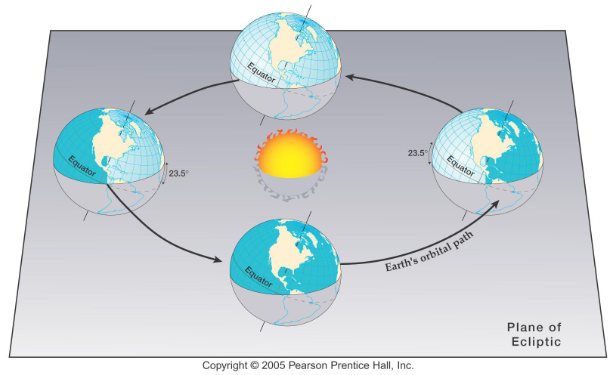
What does this diagram show?
Earths orbit of the Sun and axial tilt (obliquity)
What is the present obliquity of the Earth?
About 23.4o
What three factors impact the Earths seasonal change?
Change in daylight hours
Change in weather patterns in terms of temperature and indirectly: precipitation, and ice and snow melt
Changing heat budget (with latitude)
What three examples of the biosphere respond to the Earths seasonal change?
Animal behaviour (eg. migration)
Reproduction
Vegetation growth
What two factors are the Earths orbit of the Sun and axial tilt (obliquity) key in controlling?
The warmth of the Northern Hemisphere’s summers and the melting of the winter snow
What are the three Milankovitch cycles?
Changes in eccentricity (orbit shape)
Changes in obliquity (axial tilt)
Axial precession (wobble)

What does this diagram show?
Changes in eccentricity (orbit shape)
How often does the Earths eccentricity change?
100,000 year cycles

What does this diagram show?
Changes in obliquity (axial tilt)
How often does the Earths obliquity change?
41,000 year cycles
What does a greater axial tilt (obliquity) mean for Earth?
More sunlight in the polar regions

What does this diagram show?
Axial precession (wobble)
How often does the Earths axial precession change?
26,000 year cycles
In what two ways do solar cycles (the Sun) impact the Earths cyclic change?
Sunspots and solar flares

What does this diagram show?
Sunspots
What determines sunspot cycles?
Variations in the Sun’s output
In what way do sunspot cycles impact Earth?
High/low sunspot’s are related to higher/lower atmospheric temperatures

What does this diagram show?
Solar flares
What determines solar flare cycles?
The reversal (flip) of the Sun’s magnetic field during each solar cycle
In what way do solar flare cycles impact Earth?
They create major disturbances in Earth’s magnetic field, known as solar storms
In what way do the Croll-Milankovitch cycles impact the Earths cyclic change?
They act as the driver of glacial-interglacial oscillations
What method is used to measure the Croll-Milankovitch cycles?
Isotope stages (18O)
In what way do super-continent cycles impact the Earths cyclic change?
Continental crust
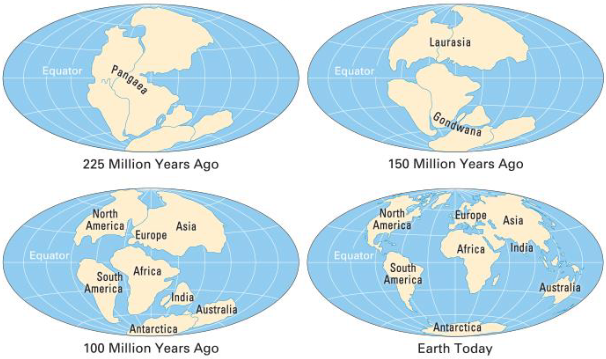
What does this diagram show?
Super-continental cycles
Continental crust
This type of crust is viscous and carries plate crusts above, which then move around on the surface of the Earth as continents
What five geographical impacts does the movement of plate crusts cause?
Climate
Environments
Ocean currents
Mountain building (due to collisions)
Sea-levels
What two biological impacts does the movement of plate crusts cause?
Evolution and migration
How often do continents change (how long can one super-continental cycle be)?
They come together and pull apart every few 100 million years
Example: one super-continental cycle
Pangea to present day
What happens when continents come together?
They can cause mountain collisions (called a mountain belt)
Negative feedback
A process that regulates the output of a mechanism, process, or system in a manner where it is fed back to reduce the changes in the output, caused by changes in the input
What are two examples of natural sources that output carbon dioxide into the atmosphere?
Terrestrial and submarine volcanism
Example: a negative feedback system
The ‘Snowball Earth’ hypothesis
The ‘Snowball Earth’ hypothesis
The idea that carbon dioxide being outgassed by volcanic activity helped end the Marinoan glaciation during the Cryogenian period
What two factors determine the severity of episodic/catastrophic change?
Frequency and magnitude
What is the trend between frequency and magnitude when it comes to episodic/catastrophic change?
High frequency = low magnitude, and low frequency = high magnitude
What are two examples of physical events that follow the ‘frequency = magnitude’ trend?
Earthquakes and floods
Example: major Earthquake
West Java, Indonesia (2022)
What causes an Earthquake?
When tectonic plates meet (fault lines), one will go under the other into the mantle of the Earth (the subduction zone), requiring a lot of force, sometimes these plates will get stuck and when they become unstuck due to a build-up of pressure, they will snap and slide, causing an Earthquake
Example: major “super” volcanic eruption
Yellowstone (last known major eruptions: 640 ka; kilo annum)
Example: major underwater volcanic eruption
Hunga Tonga-Hunga Ha’apai, Tonga (2022)
What causes a tsunami?
The movement of entire columns of water triggered by an Earthquake, or a terrestrial or submarine landslide or volcanic eruption
At what distance from the source of tsunami can still cause catastrophic destruction?
1,000s kms
Example: tsunami
Hunga Tonga-Hunga Ha’apai, Tonga (2022)
How long was the fault rupture that caused the Japan tsunami in 2011?
At least 500 km
Example: asteroid impact event
Chicxulub crater, Mexico (Cretaceous-Paleogene)
What percentage of life went extinct after the Cretaceous-Paleogene extinction event?
75% of life (including all non-bird dinosaurs)
Example: pandemic
1918 influenza “Spanish flu” pandemic (1918-1920)
How many people did the 1918 influenza pandemic affect and kill?
Affected: 500 million worldwide, killed: 50-100 million
What are two examples of chaos change?
The ‘Butterfly Effect’ and deterministic chaos
The ‘Butterfly Effect’
Simple systems of equations can result in non-repeating behaviour that is very sensitive to initial conditions
What is one (geographically relevant) example of deterministic chaos?
Meteorology
What are three implications of deterministic chaos
Complex effects can arise from simple non-linear relationships
Complex patterns of change do not necessarily arise from complex causes
Some natural systems may be inherently ‘unpredictable’
What are three examples of cases where direct human-induced changes resulted in more significant indirect natural changes?
Atmospheric carbon dioxide concentrations
The global mean temperature
Sea-level rise