chp. 32: adaptive immunity
 Call Kai
 Learn
 Practice Test
 Spaced Repetition
 Match
 Flashcards
 Knowt Play
1/90

There's no tags or description
Looks like no tags are added yet.
91 Terms
What are the 3 major functions of the adaptive immune system?
Recognize non-self
respond to non-self
effector response → do something
anamnestic response → forget it
remember non-self

Effector response
Cells that put into action
Anamnestic response
Memory cells, remember a germ or vaccine it has met before so it can fight it off much faster the second time around
What is different about the adaptive immune system
Takes longer to activate than innate system

B and T cells both have
Effector and memory cells
originate as CD34+ stem cells
have lymphocytes and leukocytes
Can be found in secondary lymphoid organs after encountering an antigen
Which lymphocytes are a part of innate and adaptive immunity?
B and T cells
What lymphocytes are only a part of innate immunity?
NK cells
Are B cells continuously produced throughout life?
Yes - come from bone marrow
Do B cells all look different or the same?
Same (undifferentiated)
B cell process
CD34+ stem cells —> B cells —> mature in bone marrow —> circulate as naïve B cells —> activated by antigen in lymphoid tissues —> plasma cells —> secrete antibodies (humoral immunity)
What do mature B cells have on their surface?
IgM and IgG
Are T cells continuously produced throughout life?
No, finite production cuz mature in thymus and it becomes fatty tissues in ur 20s
T cell process
CD34+ stem cells —> bone marrow —> mature in thymus (primary lymphoid tissue) —> naïve unactivated T cells circulate in blood/lymph tissue —> antigen binds for activation + replication —> activated T cells —> helper T cells (TH) or cytotoxic lymphocytes (CTLs/TC) —> secrete cytokines
What do mature T cells have on their surface?
CD4 or CD8 coreceptor
B cells/lymphocytes
Originate as CD34+ stem cells
mature in bone marrow → leaves as inactive naive B cell '
circulate in blood and can settle in lymphoid organs
after maturation and activation are called plasma cells and secrete antibodies
production is continuous throughout life
become part of humoral immunity
humoral immunity
(also called antibody-mediated immunity) is the branch of the adaptive immune system that defends against pathogens and toxins circulating in extracellular body fluids (blood, lymph, and mucosal secretions) using antibodies produced by B cells.
naive B cells
have small cytoplasm and large nucleus. Eventually differentiate into plasma cells and secrete antibodies
plasma cells
B lymphocytes differentiate into this and then secrete antibodies
have large cytoplasm
T cells/lymphocytes
Can be activated and differentiate into helper T cells (TH) and cytotoxic lymphocytes (CTLs/TC) → secrete cytokines, not antibodies
Originate as CD34+ stem cells
mature in thymus - production is limited cuz thymus turns into fatty tissue in ur 20s
can remain in thymus, circulate in blood (naive T cells), or in lymphoid tissue
REQUIRE antigen binding to receptors for activation and continuation of replication (more picky)
which cell requires antigen binding to receptors for activation?
T lymphocytes
Antigens
Antibody generators. Any substance that can be recognized by the immune system and be used to "generate antibodies". Includes PAMPs, proteins, nucleoproteins, polysaccharides, and glycolipids but must be large and complex molecules ( > 10,000 Da)
includes:
immunogen → antigen thats recognized by the immune system AND elicits an immune response.
hapten → antigen thats too small to be recognized by the immune system and must attach to some carrier molecule to induce a response.
Immunogen
Complex, large molecules that is recognized by the immune system AND elicits an immune response
a type of antigen
Haptens
Antigens that are too small to elicit an immune response on their own. Must attach to some carrier molecule to induce a response.
Epitope
The part of the antigen recognized and bound by an antibody
number of binding sites = valence
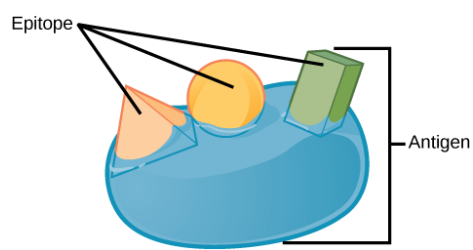
valence
the number of binding sites (epitopes) on antigen or antibody
paratope vs epitope
An epitope is the specific binding site on an antigen (foreign molecule) that the immune system recognizes, while a paratope is the complementary antigen-binding site on an antibody (or B-cell/T-cell receptor) that attaches to it
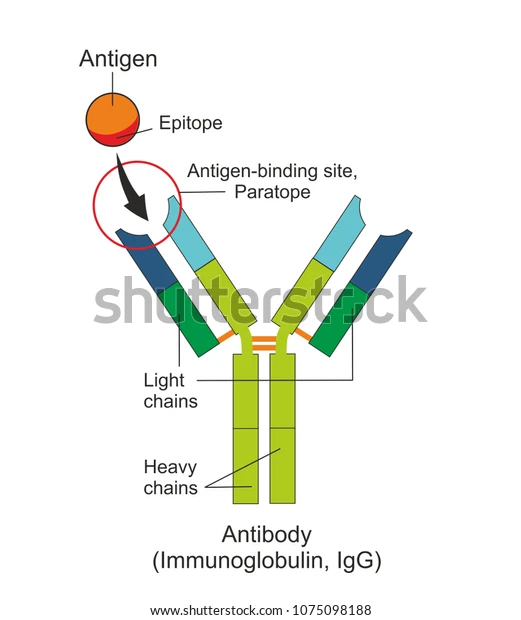
Paratope
The part of the antibody that binds to the antigen

Avidity
The overall strength of binding between an antigen and antibody
how many binding sites do u have
affinity vs avidity
lots of binding sites = high avidity
only 2 binding sites but more specific = high affinity cuz binds stronger
ex: IgM has 10 binding sites, IgG has 2 binding sites
Affinity
Strength of binding on a single binding site on a antigen-binding site interaction
Natural immunity
Acquired through normal life experiences and not induced through medical means

Artificial Immunity
Produced purposefully through medical procedures (also called immunization)
Active immunity
Person developing their own immune response to a microbe. We make our own antibodies and memories
Passive immunity
Person receiving immunity made by another person. U DONT make memories
natural active immunity
Producing your own immune cells via non-medical procedures
ex: Getting strep for the first time
natural passive immunity
Having immune cells passed to you via non-mediclal procedures
ex: Maternal antibodies passed during breastfeeding (concn decreases over time)
dont make memories,
artificial active immunity
Producing your own immune cells via medical procedures
ex: Vaccinations
artificial passive immunity
Having immune cells passed to you via medical procedures
ex: Immunoglobulin therapy or antiserum (antivenom)
dont make memories
Major histocompatibility complex (MHC)
Differentiates between self and non-self - T cells
MHC Class I (what is it, where, binds to, found in what kind of cells?)
Endogenous antigen processing (in cytoplasm), binds to CD8+ T cytotoxic cells, found in all nucleated cells (not rbc) - virally infected/mutated cells
MHC Class II (what is it, where, binds to, found in what kind of cells?)
Exogenous antigen processing, binds to CD4+ T helper cells, found in APC (antigen presenting cells - DC, macrophages, B cells)
T helper cells (TH)
CD4+ activated by antigen on MHC class II - release cytokines
Cytotoxic T lymphocytes (Tc)
CD8+ activated by antigen on MHC class I - identify and destroy infected, cancerous, or foreign cells using cytotoxins
What are the two pathways for cytotoxic T cells?
Perforin (cytolytic) and CD95 (apoptotic - process cell death)
Regulatory T cells (Treg)
Control/regulate other cells + suppress immune response to prevent a bold reaction
How do we get autoimmune diseases?
Bold reactions
T cell receptors (TCRs)
Recognize and bind fragments of antigens
Can T cell receptors be secreted?
No
Binding site of TCR
a and b gene
Can B cell receptors be secreted?
Yes
BCR binding site
light and heavy
T cell activation - first signal
MHC class II to TCR
T cell activation - second signal
B7 and CD28, if no second signal —> it is an anergic cell (functionally inactive)
T cell activation - third signal
Cytokine release (differentiates naïve T cell —> effector cell)
Staphylococcal enterotoxin A and B, toxic shock syndrome toxin, mouse mammary tumor virus, putative proteins from Epstein-Barr and rabies viruses are all
Superantigens (SAgs) that contribute to microbial pathogenicity
Superantigens (SAgs) are a type of
exotoxin, trick T cells into activation which causes cytokine storms and pyrogenic cytokines (fever inducing)
B cells differentiate into
Plasma cells that secrete antibodies
B cells have what receptors for specific antigens
Immonoglobulin receptors
Do BCRs require APC for presentation?
No
Each B cell has a BCR specific for one
epitope
B cell activation —>
Proliferation and differentiation into plasma cells
B cells can be activated with and without
T cells
B cells are activated which make
plasma cells —> antibodies (also immunoglobulin and BCR)
What are antibodies also known as
Immunoglobulin (Ig)
What does immunoglobulin serve as
BCR
Fab
Part of immunoglobulin that binds to antigen, 2 of them
What is Fab made up of
Heavy + light chain
Fc
Constant region - effector of immunoglobulin
What is Fc made up of?
Heavy chain
Antibodies can be used as an
opsonin
IgG (binding sites, affinity, avidity, highest what, activates, how many to activate, can cross?)
Monomer with 2 binding sites, high affinity, low avidity, highest serum immunoglobulin, activates complement pathway, 2 required to activated classical complement pathway, can cross placenta (natural passive immunity)
IgD (binding sites, part of, signals, how to know its mature?)
Monomer with 2 binding sites, part of BCR, signals B cells to start antibody production, IgD + IgM on surface tell its mature
IgM (binding sites, affinity, avidity, first in what, activates, how many to activate?)
Pentamer with 10 binding sites, low affinity, high avidity, first Ig in all immune responses, activates complement (one required to activate classical complement pathway)
IgA
monomers and diamers, Secretory IgA
IgE (lowest what, does what, what cell binds to what portion, activated to what?)
Lowest Ig serum level, opsonization, mast cells bind Fc portion, activated to release histamine)
Primary antibody response is the
first time you see pathogen
Lag/latent period in primary antibody response
May last days to weeks because it takes awhile to start making antibodies, no antibodies detectable in blood
Antibody titer
Antibody concentration is low in lag period for primary antibody response
Which immunoglobulin appears first and second in primary antibody response?
IgM then IgG (antibody class switching)
Secondary antibody response
Memory response, so doesn’t require T cell activation, so faster
Secondary antibody response is characterized as having
Shorter lag, more rapid log phase, longer persistent, higher IgG titer (concentration), production of antibodies with higher affinity
What is the basis of a vaccine
First exposed = primary antibody response, next exposure = secondary antibody response
True or false - antibodies directly lyse and kill infected cells
False, they DO NOT do this
What do antibodies do to mark as bad?
Neutralization, opsonization, immune complex formation
Toxin neutralization
Antitoxin, ingestion by macrophages
Viral neutralization
Complement component
Primary (congenital) immunodeficiencies
Born with it, from genetic disorder
Acquired immunodeficiencies
Gained during life
What are the primary congenital immunodeficiencies?
Chronic granulomatous disease, X-linked agammaglobulinemia, DiGeorge syndrome, severe combines immunodeficiency disease (SCID)
What is the acquired immunodeficiency?
HIV —> AIDS (less than 200 CD4 T cells per microliter of blood)