PID quiz 4
 Call Kai
 Learn
Learn Practice Test
 Spaced Repetition
 Match
Match Flashcards
 Knowt Play
1/116

There's no tags or description
Looks like no tags are added yet.
Name | Mastery | Learn | Test | Matching | Spaced | Call with Kai | Chat |
|---|
No analytics yet
Send a link to your students to track their progress
117 Terms
what is symbiosis?
an association of two organisms which can not exist independently of each other
what are symbionts?
organisms that live in close association with each other
what are 4 categories/types of symbiosis?
phoresis
mutualism
commensalism
parasitism
what is phoresis?
an association in which two organisms are merely traveling together
what is mutualism?
an association in which both organisms are benefited
what is commensalism?
an association in which one partner is benefited and the other is unaffected
what is parasitism?
an association in which one partner is benefited and the other is harmed
what is a host in parasitism?
the partner who is harmed
what is a parasite in parasitism?
the partner who is benefited
who is usually bigger the host or the parasite?
host is usually bigger
what are the 5 categories of hosts?
definitive host
intermediate host
paratenic host
reservoir
incidental host
what is a definitive host?
harbors adult/sexual stage of parasite
what is intermediate host?
harbors larval/asexual stage of parasite
what is paratenic host?
host harbors a parasite that does not undergo required development, it just transfers parasite from one host to
what also call a paratenic host?
transfer host
what is a reservoir?
an definitive host that serves to maintain the parasites life cycle in nature
what is an incidental host?
an unusual host that is unnecessary for the maintenance of the parasite in nature
all parasites have an ____ host but not all parasites have an ____ host
all have a definitive host
not all have a intermediate host
what host types are dogs in his example? hosts for what parasites?
reservoir for leishmania spp.
definitive for toxocara canis and echinococcus
whats an example of an incidental host?
trichinella spiralis in human muscle
what is a vector?
an organisms thats usually an arthropod responsible for transmitting a parasite from one host to another
what are the 2 categories of vectors? describe each
biological: parasite develops or multiplies in vector
mechanical: parasite is unchanged in vector
whats an example of a biological vector?
female anopheles mosquito
whats an example of a mechanical vector?
Houseflies carry entamoeba histolytica
what host type can biological vectors be?
definitive or intermediate
what is an example of a definitive host vector?
a mosquito for malaria parasite sexual stage
what is an example of an intermediate host vector?
a mosquito for heartworm with larval stag L1-L3
what are 3 types of parasites?
obligate
temporary
facultative
what is a temporary parasite? ex?
parasite is parasitic for limited periods for either feeding or reproduction
-ticks
what is a facultative parasite?
organisms that are normally not parasitic can survive for a limited period when they accidentally find themselves in another organism
what ae the 2 terms to describe where a parasite lives/parasitizes?
ectoparasite
endoparasite
what is an ectoparasite? where does it live?
lives on host
causes infestations
what is an endoparasite? where does it live?
lives in host
causes infections
whats an example of a human ectoparasite?
Human body louse (pediculus humanus)
what is an example of an endoparastie?
round worm (ascaris suum)
what is a zoonosis?
any disease of vertebrate animals that is transmissible to humans
what do you have to specify in zoonosis that it is from a vetrebrate animal?
if it was from an invertebrate it would be a vector
what are 7 examples of zoonosis?
trichinellosis
chagas disease
schistosomiasis
giardiasis
toxoplasmosis
amebiosis
echinoccoocsis
where do protozoa multiply?
in definitive host
do helminths multiply in definitive host?
no, they can reproduce if theres more than one helminth in the host
-helminths do not multiply as they dont just go from one to two like a bacteria or protozoa could do
for a helminth what is the severity of disease proportional to?
the worm load introduced into the host
what is host specificity?
Parasites have a specificity for a particular definitive and intermediate host as often the parasites lifecycle can only be completed in a particular host
what parasites are particularly specific?
helminths
what can disease manifestations of a host differ depending on?
whether they serve as a definitive, intermediate or incidental host
the parasites that are the best adaptive are the ___ pathogenic
least pathogenic
what is the time length of host parasite interaction specifically?
long term/chronic
do parasites adapt to every niche in host?
yes
what are 4 conditions required for endemic parasitism?
reservoir of infection
means of transmission to susceptible hosts
ability to invade and establish in new hosts
ability to reproduce
what re the 3 groups of eukaryotic organisms that affect the health and well being of animals?
protozoa
helminths
arthropods
what are 3 subtypes of helminths? what are ex of each?
nematode-roundworm
cestode-tapeworm (flatworms)
trematode-fluke (flatworms)
what type of parasitization/ what type of parasite are helminths?
endoparasites
what type of parasitization/ what type of parasite are arthropods?
ectoparasites
what are the 2 categories of arthropods that are often parasites of animals?
arachnids
insects
what is the phylum and class of roundworms?
phylum: nemathelminthes
class: nematoda
what is the phylum and class of flatowrms?
phylum: platyhelminthes
class: cestoda (tapeworms) and trematoda (flukes)
what phyla of the kingdom of protozoa are parasites to animals?
nine hyla contain at least one genus of veterinary importance
what are 4 characteristics of nematodes used to identify them?
round/cylindrical shape
have complete alimenatry canal
have celom/body cavity
sexes are usually separate
the bigger the host the ___ the parasite
bigger the parasite
what pasta do nematodes look like?
spaghetti as they are roundworms
what are 6 characteristics of cestodes used to identify them?
-flat body with no colem (body cavity)
-no alimantary canal
-hermaphroditic
-have a scolex (head) with 4 suckers (bothria)
-a strobila (body) that is segmented
-all are parasitic with an indirect life cycle
what pasta do cestodes look like?
fettuccine (as they are flatworms)
what are 5 characteristics of trematodes used to identify them?
dorso-ventrally flattened like a leaf
have an incomplete alimentary canal (one opening that acts as both mouth and anus)
no celom
hermaphroditic
have oral and ventral suckers for attachment
if given a question on test and know its a worm and it tells you that it is not hermaphroditic what worm type is it?
nematodes (roundworms) as the other 2 types are hermaphroditic
what are the 4 insect types we are focusing on as parasites? what are their orders?
flies: diptera
fleas: siphonaptera
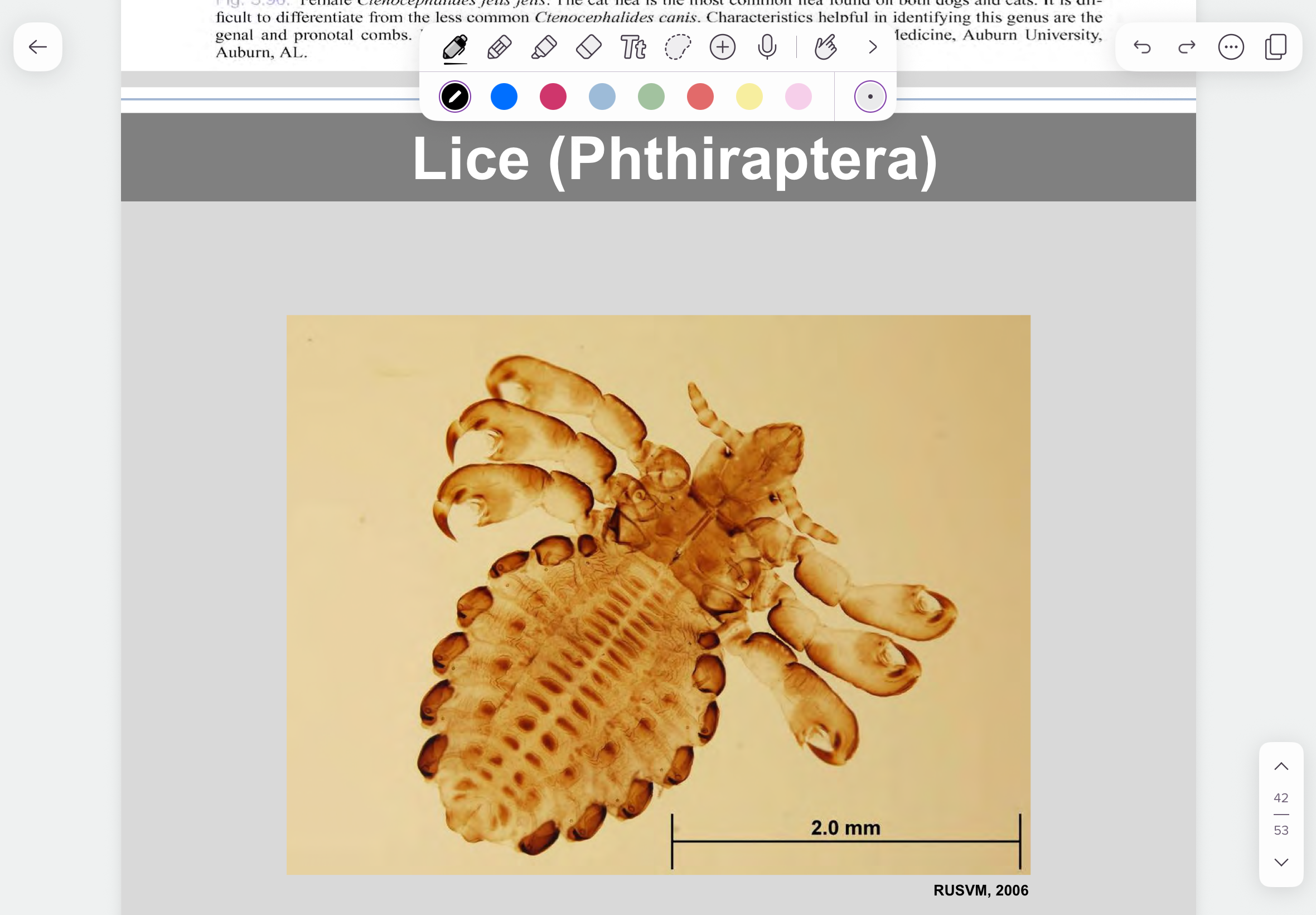
lice: phthiraptera
hemiptera
what are the 2 arachnids we are focusing on as parasites?
ticks
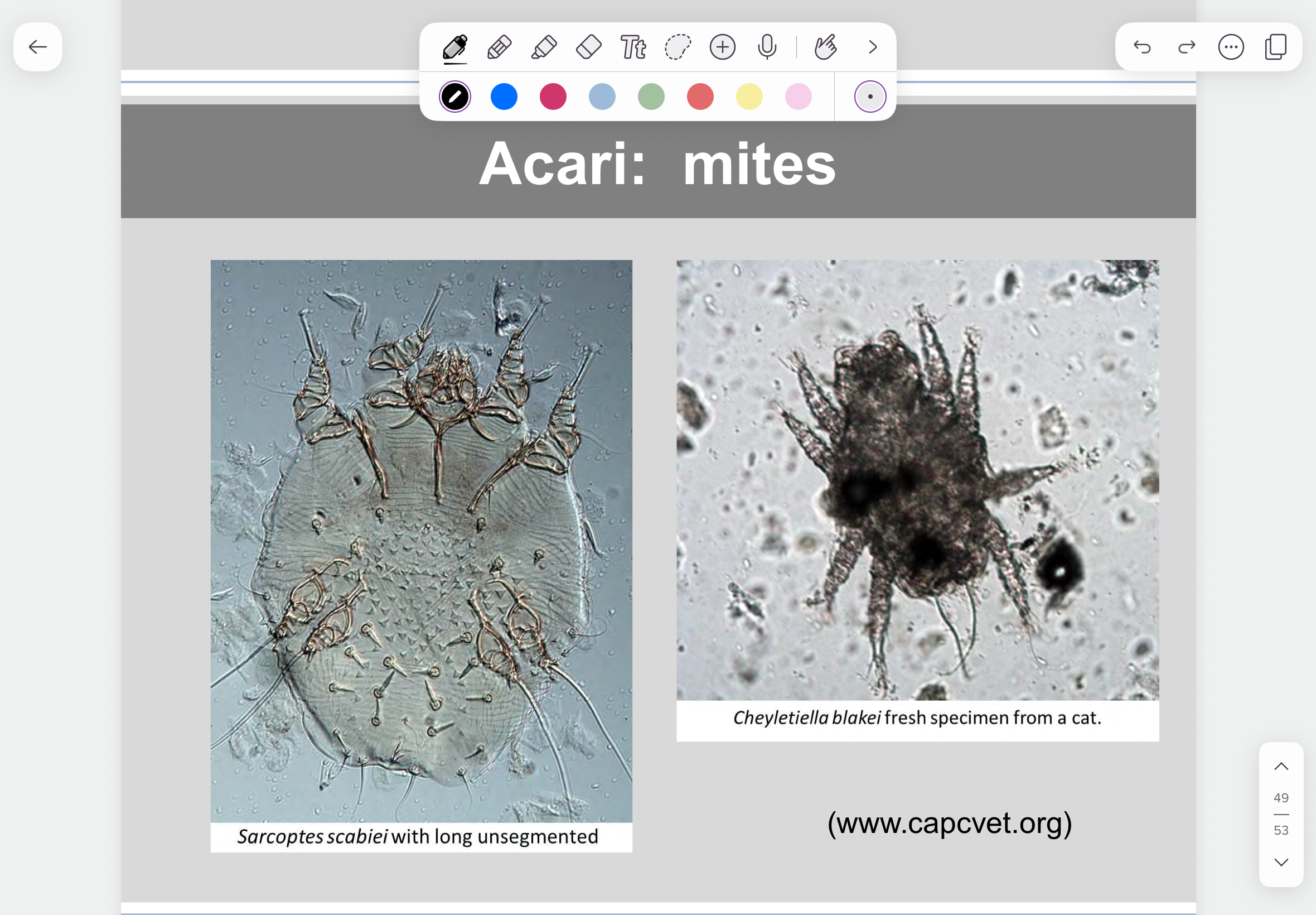
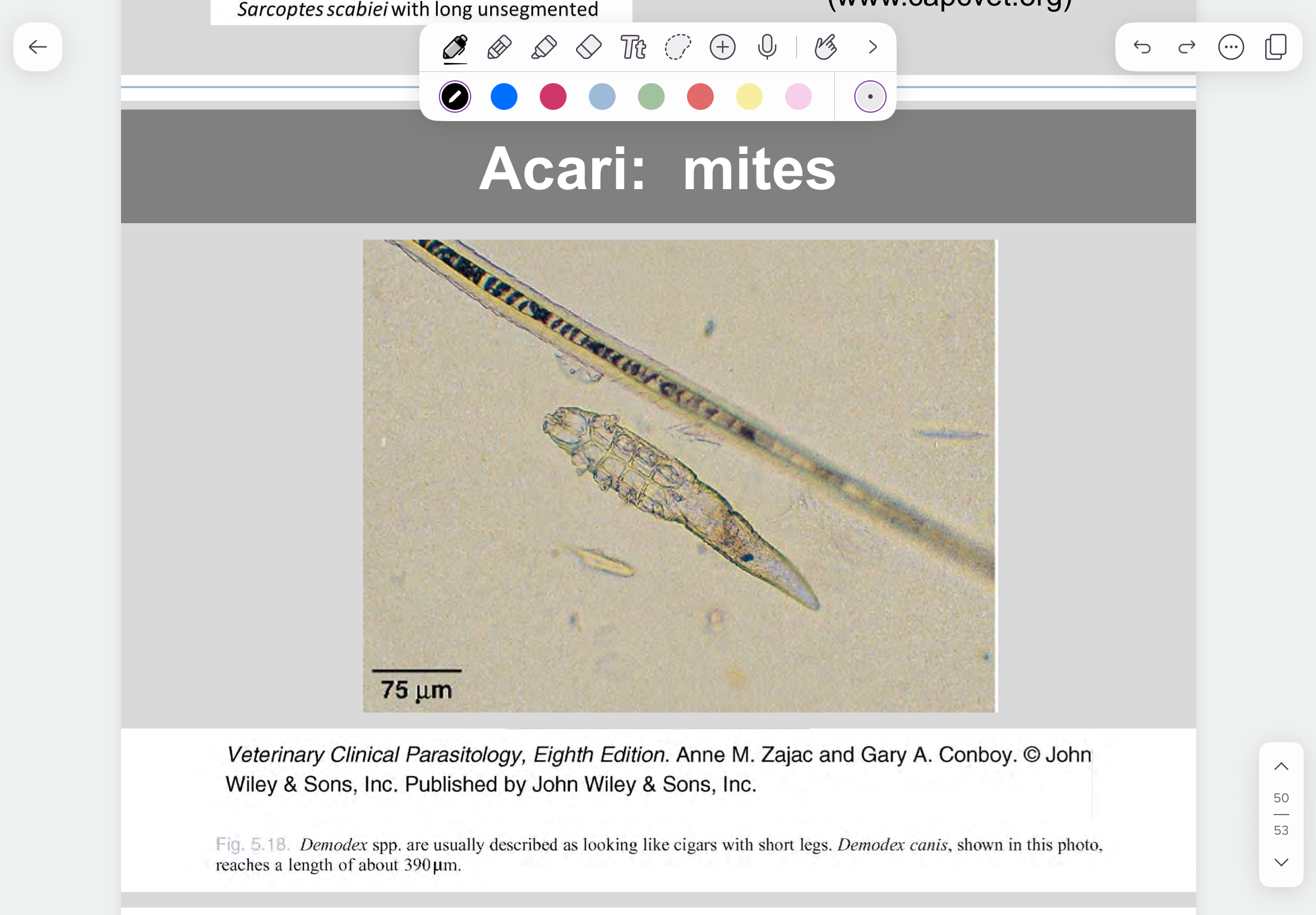
mites
what are 3 characteristics use to identify if looking at an insect?
adults have 3 pairs of legs
have head, thorax and abdomen
have antenna
what are 5 characteristics use to determine if looking at arachnids?
nymphs and adults have 4 pairs or legs
larvae have 3 pairs of legs
the body is a cephalo-thorax and abdomen
have no antennae
have palps
what 3 characteristics use to determine in looking at mite/acari?
they are microscopic (less than 1mm long)
the body has scales, spines and setae
legs may have claws or suckers used to attach to host
are protozoa unicellular?
yes
what 4 things can protozoa use for locomotion?
pseudopodia
flagella
cilia
gliding movements using no locomotion organelle
what are protozoa classified by?
the mode of locomotion







how tell difference between a trophozoite and a cyst of a protozoa?
trophozoite is larger and has cilia and a kidney bean shaped nucleus
true or false all helminths including nematodes, tapeworms and flukes have complete alimentary canals?
false
which type of host would it be if there is a dog in which a larva develops to adult stage?
definitive host
which type of host would it be if theres a pig in which an egg develops into a larvae?
intermediate host
which type of host would it be if there is a cat with a protozoa that undergoes sexual reproduction?
definitive host
what are 3 life cycle types?
direct with no intermediate host
indirect with an intermediate host
indirect with a vector
whats an example of a direct life cycle with no intermediate host? explain
Intestinal hookworms
eggs are in feces which hatch and develop into larva in environment where it then can penetrate human skin and then become an adult in the human intestine and their eggs are shed out in the humans feces
whats an example of an indirect life cycle with an indirect host?
T. solium
eggs in feces in the environment which are injected by pigs who are the intermediate host. The oncosperes (eggs) hatch in pig and develop in pig muscle which can then be eaten by a human who is the definitive host where become adult in small intestine and are shed out to enviroment in human feces
whats an example of an indirect life cycle with a vector?
Meta promastigote
have procyclic promastigote which matures into metagcyclic promastigote and can infect macrophage of mammal, and can be picked up by sand fly and transferred to another mammal
Disease manifestations may be different depending on whether an animal serves as a _____, ____, or _______ ____
serves as an definitive, intermediate, or incidental host
can humans serve as both definitive and intermediate hosts? ex?
yes
human is a definitive host and a intermediate host for taenia solium
for taenia solium when a human is a definitve host what is the consequence? what about when human is an intermediate host?
definitive: generally asymptomatic
intermediate: severe consequences
are the outcomes of parasite on host highly variable?
yes
what 4 things help to determine the outcome a parasite has on a host?
-type of host (definitive vs intermediate)
-severity (infection dose and number of organisms)
-route of exposure
-if its chronic
what are 6 common routes of exposure to parasite? ex of each?
ingestion: giaradia, toxoplasma gondii, cryptosporidium, cestodes, some nematodes, some trematodes
skin or mucosal penetration: hookworm, schistosomes
transplacental (prenatal): toxoplasma gondii, toxocara canis, strongyloides stercoralis
transmammary (milk): toxocara canis, T. cati, ancylosotma caninum
arthropod bite (vector): babesia, heartworm, leishmania, tyrpanosomes
sexual intercourse: tritrichomonas foetus
where does protozoa multiply?
in host