Cryptography and Security
 Call Kai
 Learn
Learn Practice Test
 Spaced Repetition
 Match
Match Flashcards
 Knowt Play
1/59

There's no tags or description
Looks like no tags are added yet.
Name | Mastery | Learn | Test | Matching | Spaced | Call with Kai | Chat |
|---|
No analytics yet
Send a link to your students to track their progress
60 Terms
Cybersecurity
The management of attacks and risks by adversarial and malicious elements on computers and networks that support modern businesses and economy involving business, government and community.
Information security
Focuses on the secure exchange and processing of information on modern computers and networks.
Cryptography
A method of ensuring information security that refers to techniques used to ensure data is protected from potentially malicious elements.
Diffie-Hellman Key Exchange
A method of secure key exchange that uses exponentiation under a modulus to share a key.
Discrete Logarithm Problem
Given (g, h, p). Find x such that g^x=h (mod p)
Computational Diffie-Hellman Problem
Given (ga, gb, g) for a random generator g and random a, b ∈ {0, …, q-1}. Find gab
Passive
Type of attack in which a unauthorized user monitors, intercepts, or observes network traffic and communications
Active
Type of attack where an attacker directly interacts with, alters, disrupts, or destroys a system, network, or data
Kerckhoff’s Principle
Security through obscurity is not recommended. It is unwise to make the security of information reliant on how the encryption algorithm works. Instead, we rely on the secrecy of the shared key
Unconditional security
The security of the cipher is independent of the computing resource available to the adversaries
Computational security
Adversaries have limited computational resources and the security is reliant on the size of the computations needed to break the cipher.
Substitution
Principle of encryption algorithm that maps plaintext characters to different values
Transposition
Principle of encryption algorithm that maps plaintext characters to different positions in the ciphertext
Caeser cipher
Classical cipher in which each character is shifted k places
Affine Cipher
Classical cipher in which each character mapped using ap + b mod n
Monoalphabetic cipher
Classical cipher in which each character mapped to a different character
Row transposition cipher
Classical cipher in which the plaintext is written in rows and the ciphertext is built from the columns arranged in a particular order.
Polyalphabetic Cipher
Complex classical cipher that involves a set of monoalphabetic ciphers being applied
Vigenere Cipher
Complex classical cipher that involves rotating set of caeser ciphers being applied, changing each letter of the plaintext
Hill cipher
Complex classical cipher that involves converting the plaintext into a vector and performing matrix multiplication with the key (matrix)
Product cipher
Complex classical cipher that involves combining several substitution and transposition ciphers
Block cipher
Cipher that breaks message down into fixed length blocks before encrypting
Stream cipher
Cipher that generates a key stream and applies it to an incoming plaintext stream.
Vernam Cipher
A Vigenère Cipher where the length of the key is equal to the length of the message
One time pad
An extension of the Vernam cipher that uses a truely random key to provide perfect secrecy
Diffusion
Principle of encryption that dissipates statistical structure of plaintext over ciphertext
Confusion
Principle of encryption that makes relationships between ciphertext and key as complex as possible
Iterated block cipher
A block cipher that involved several repetitions of an iterated round function
Fiestel Cipher
Iterated cipher that involves breaking the plaintext into two parts Ri and Li, moving Ri to the left and XORing Li with the encrypted version of Ri
Data Encryption Standard
A type of Fiestel cipher that has a block size of 64 and key size of 56 bits
DESX
Extension of DES that involves XORing additional keys before and after applying the DES algorithm.
Electronic Codebook

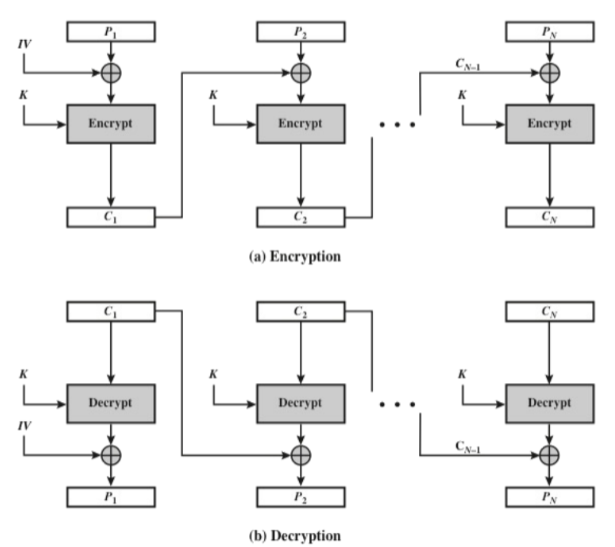
Cipher Block Chaining
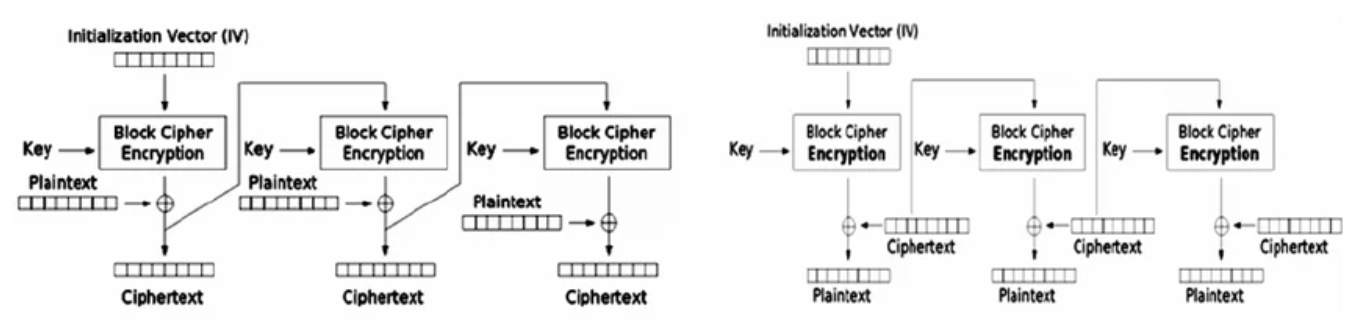
Cipher Feedback Mode
Output Feedback Mode

Counter Mode

Advanced Encryption Standard
Symmetric Encryption algorithm commonly used today that is more secure than DES
SubBytes
1st AES operation: each byte is replaced with a different value from a lookup table
ShiftRows
2nd AES operation: each row in the grid moves by a different amount
MixColumns
3rd AES operation: finite field arithmetic used to transform bytes in each column
AddRoundKey
4th AES operation: result is XORed with round key
Symmetric
Type of cryptography that uses a single, shared key for each pair of communicators
Asymmetric
Type of cryptography that uses a public/private key pair per communicator
RSA
Asymmetric encryption/signature algorithm that is based on the assumption that factoring an integer that is the product of two primes is hard.
Factorisation Problem
Given n (where n is the product of two primes p, q), find p and q
RSA problem
Given (n, e, C = Me) determine the e-th root of C mod n
Chosen Plaintext
Type of attack on encryption in which the adversary can produce a ciphertext for any given plaintext
Chosen Ciphertext
Type of attack on encryption in which the adversary can produce a plaintext for any given ciphertext (ciphertexts must all be chosen in advance)
Adaptive Chosen Ciphertext
Type of attack on encryption in which the adversary can produce a plaintext for any given ciphertext (ciphertexts can be chosen in response to previous plaintexts)
Optimal Asymmetric Encryption Padding
Way of formatting RSA messages to prevent against chosen plaintext attacks
Timing Attack
Type of attack in which the attacker observes the behaviour of the cryptographic algorithms and use the experience to break the secret directly.
Constant time
Counter measure against timing attack that ensures all operations take the same amount of time
Random delay
Counter measure against timing attack that adds in random amounts of extra time to computations
Blinding
Counter measure against timing attack that involves multiplying the input and output of RSA by a random number to change timing of algorithm,
Digital Signature
An electronic tag used to ensure the integrity and authentication of a message
Existential forgery
An attack where an adversary successfully creates a valid digital signature for at least one new message
Redundancy function
Tool applied to input of RSA function to prevent blinding attacks on digital signatures
Mathematical Attack
Type of attack that uses an exception/edge-case to a hard problem to help break an encryption/signature algorithm
Broadcast problem
Flaw in RSA when the same e value is used for the same message (can be broken using CRT)
Elementary attack
Attack that is possible when two users use the same values for e/d in RSA and so can use their own information to break each other’s encryption.