BIO Physio Exam
 Call Kai
 Learn
 Practice Test
 Spaced Repetition
 Match
 Flashcards
 Knowt Play
1/1350

There's no tags or description
Looks like no tags are added yet.
1351 Terms
physiology
branch of life sciences concerned with understanding how organisms work
proximate level of causation
physical and chemical mechanisms responsible for a function
refers to the most-immediate causes of an observation
ultimate level of causation
how physiological systems evolved and how they impact fitness
refers to a final end-point in terms of causation
hierarchy of physiological systems
molecules cells tissues organs systems whole organism
molecules
consist of atoms joined by covalent bonds
cells
membrane-bound structures that form the fundamental unit of life
tissues
groups of cells that perform a common function
organs
structures that consist of two or more tissues and perform a specific function
nerve cell (brain neuron)
tiny brain neuron -receives electrical information from many other neurons -processes that information -transmits processed information to a large set of other neurons
motor neuron
sends electrical signals from the spine to a specific muscle over a meter way
diffusion
movement of ions or molecules from regions of high concentration to regions of low concentration -occurs passively and spontaneously (without input of energy) -results from random movement of substances in solution
gradients
exist when concentration of an ion or molecule differs from one are to another, or amount of electrical charge differs from one area to another
steeper the gradient the faster movement will occur via diffusion
almost all gradients result from differences in concentration or charge on one side of a cell membrane versus the other
what happens when concentration gradient exists
ions and molecules will move from regions of high concetration to regions of low concentration by diffusion
each type of ion or molecule experiences its own concetration gradient
when theres an electrical potential gradient
result from an overall difference in charge, no matter which types of ions are involved
ions will move towards areas of opposite charge
movement driven by forces of electrical repulsion and attraction
Every ion of the same charge experiences the electrical gradient in the same way
ions rarely cross membranes on their own—they require assistance from transport proteins
transport proteins
have structures that allow them to embed in cell membranes and interact with the solutions on either side
categorized as transmembrane proteins or integral membrane proteins
serve as a path for ions and molecules that are unable to cross a membrane easily
3 general types: channels, carriers, pumps
Channel (transport proteins)
opening or pore that allows, under certain conditions, a specific ion or molecule to travel down its concentration or electrical gradient from one side of the membrane to another
passive movement, no energy used because substances are moving spontaneously down their concentration or electrical gradients
Carriers (transport proteins)
binding site that is specific to a particular molecule. When that molecule hits the binding site and sticks to it, the carrier changes shape in a way that allows the molecule to diffuse down its concentration or electrical gradient, into the solution on the opposite side of the membrane
passive movement, no energy used because substances are moving spontaneously down their concentration or electrical gradients
Pumps (transport proteins)
involved in active transport
these proteins use energy in the form of ATP to move ions and molecules against their concentration or electrical potential gradient, from one side of a membrane to the other.
in many cases, pumps function to create concentration or electrical potential gradients that later drive passive transport through channels or carriers.
lung of surface area importance
The air you breathe in carries oxygen molecules that have to diffuse across the surface area of your lungs to enter your bloodstream. Conversely, carbon dioxide molecules in your bloodstream diffuse across the same surface area to enter the air that you exhale. The amount of gas exchange that can occur is in part a function of the amount of surface area your lungs have.
food example of surface area importance
When nutrients in the food you eat have been broken into small molecules, they have to diffuse or be transported across the surface of your small intestine to enter your bloodstream. The more surface area in your small intestine, the more nutrients can move into your body and be used.
heat surface area importance
You exchange heat with the environment across your skin. On a cold day, the amount of heat that is lost from your body is a function of the surface area of exposed skin.
how size affects volume and surface area
As structures like lungs, small intestines, or whole-bodies get larger, their volumes increase much faster than their surface areas increase
In the case of structures like lungs and intestines, natural selection has favored alleles that increase surface area
grey matter
thin surface overlying a large volume of white matter
neurons in grey matter are primarily responsible for processing information
white matter
neurons primarily responsible fore sending information to sections of the brain that have distinct functions
4 types of Tissues
epithelial
connective
muscle
nervous
epithelial tissue
structure:
arranged in sheets of closely packed cells
maximize cellular surface area
they also provide for the opportunity for polarization
function:
protective barriers that line organs and body cavities
regulating interactions with the external environment
additional functions to support this through secretion of certain chemicals, detection of sensations like touch, absorption, and protection
cell polarization
where one side of the cell is distinct from the other
allows apical surface(outer/top) to be optimized for interaction with a body cavity or the external environment while the other surface (called the basal surface) is optimized to convey that signal to the adjacent tissue
Connective tissue
structure:
made of many different types of cells that form a loose web of fibers that form an extracellular matrix
can be highly specialized
adipose tissue is optimized for fat storage, cartilage is optimized for absorbing forces without breaking, and bone is optimized for rigidity
Some cells stay fixed within this matrix, and others, such as the macrophage (an immune cell), move in and out in response to certain chemical signals
function:
provide necessary support and connection for other tissues
can bind and support other tissues, store energy, protect organs, and facilitate the transport of nutrients and waste
Some types of connective tissue include dense tissues like cartilage and bone and more fluid tissues like blood and lymph
muscle tissue
structure:
composed of specialized cells that can contract and generate force
three types: skeletal, cardiac, smooth
function:
main function is in movement
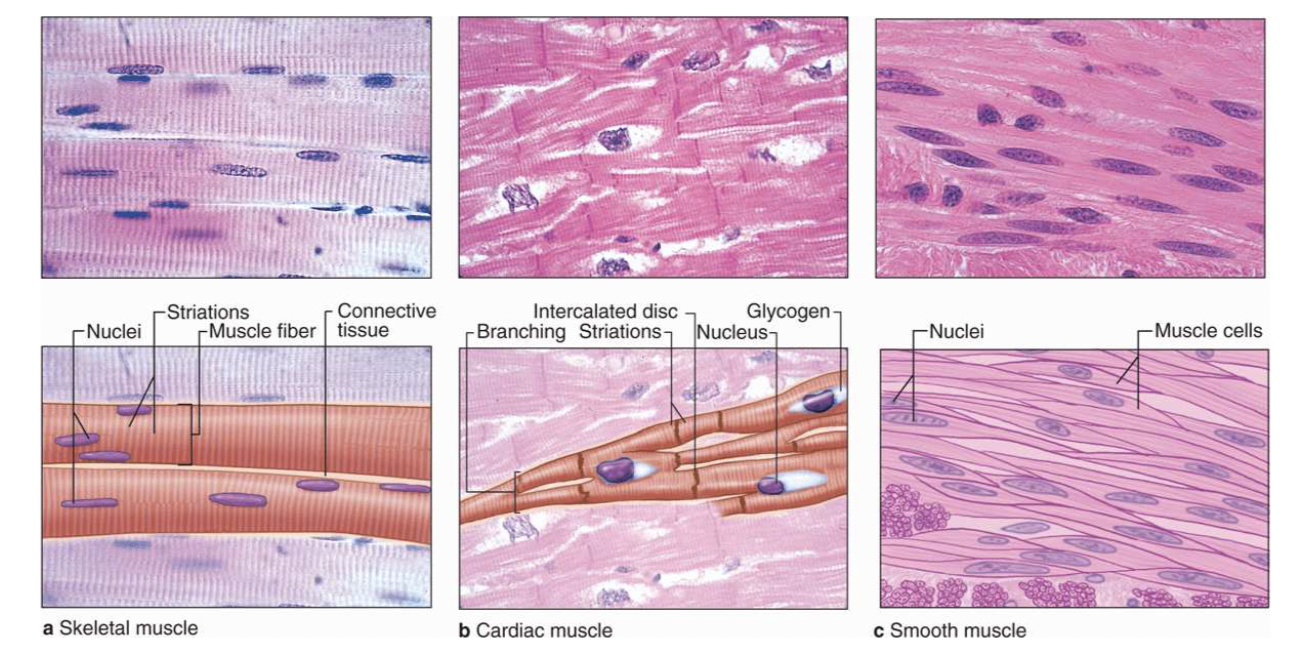
skeletal muscle
structure
made up of cells that are long and cylindrical
shows striations (lines/stripes) due to the arrangement of actin and myosin filaments within the cells
cells are also multinucleated, with more than one nucleus per cell
function
attached to bones throughout the skeletal system to allow for voluntary muscle contractions
Cardiac muscle
structure:
made of short and thick cells that undergo branching
branch ends meet other cells at specialized junctions called intercalated discs
the intercalated discs let electric signals pass freely between cells to contract the heart
function:
found in the heart to facilitate the distribution of blood throughout the body
smooth muscle tissue
structure:
composed of cells that are short and non-striated (don't have lines/stripes), with a single, centrally located nucleus per cell
function:
lines the walls of hollow internal organs such as the stomach and intestines for involuntary muscle contractions
nervous tissue
structure:
consists of neurons and glial cells
three main parts: soma, dendrites, axon
cell body of the neuron (also called the soma), the branches off of the cell body (dendrites), and the long tail (axon)
dendrites transfer the nerve impulse to the soma and then to nearby cells through the axon
function:
facilitates communication, information processing, and regulation of body functions
interacts with each of the other tissue types, and is essential for voluntary skeletal muscle contraction
main function of the neurons is to receive and transmit electrical impulses, while the glial cells have more unique supportive roles
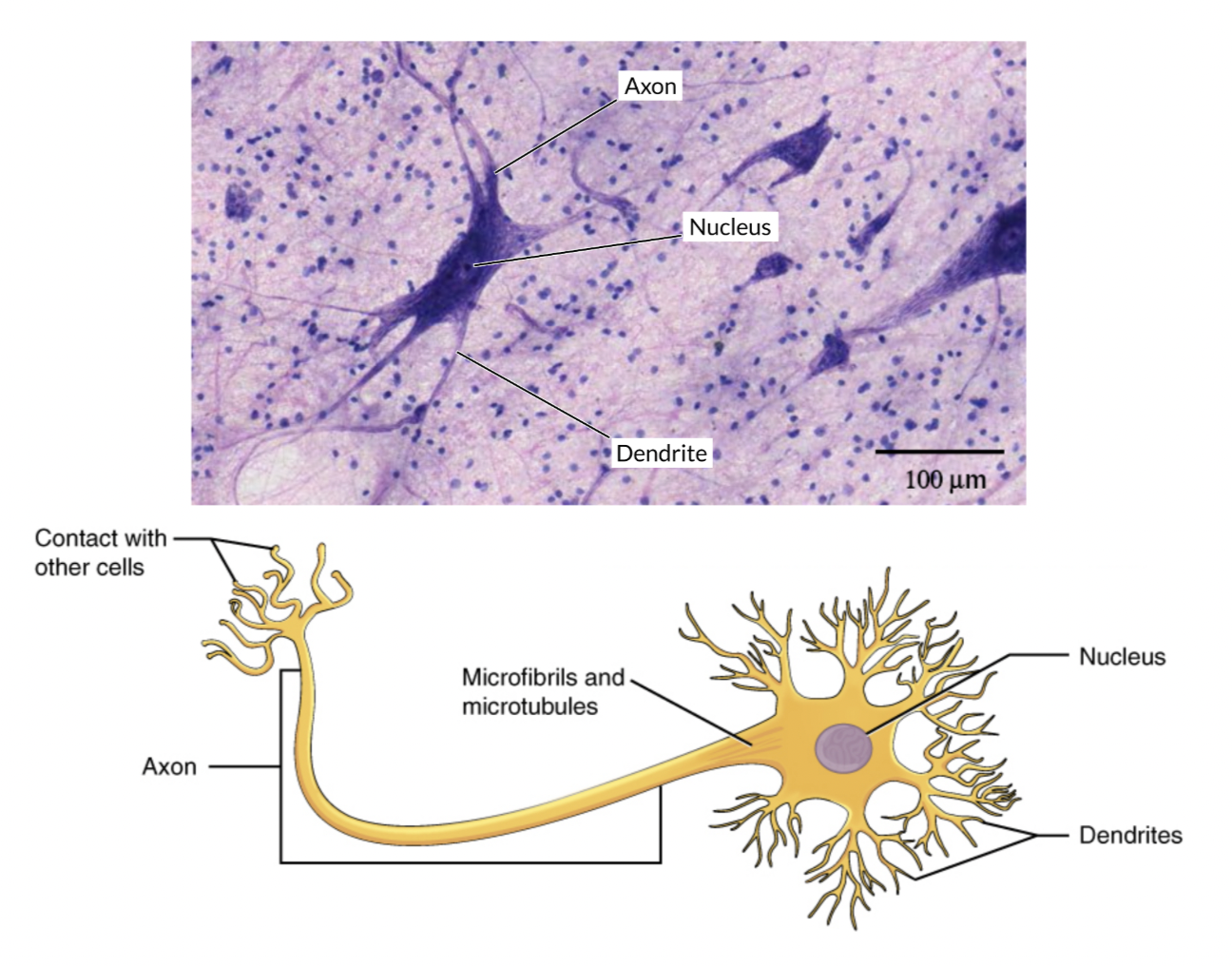
neurons
transmit signals through electrical impulses
glial cells
support and protect neurons
many different types of glial cells as well, each with their own distinct structure to optimize their specific supportive function in the nervous system
homeostasis
self-regulating biological processes that maintain stable conditions in the cell or in the organism in the face of changing external conditions
if homeostasis is disrupted, illness or death results
Feedback is one of the most central concepts in homeostasis and is a key element of all homeostatic systems
homeostasis in vertebrates regulates:
body temperature;
the concentration of K+ (potassium), Na+ (sodium), Fe2+ and Fe3+ (iron), Cu2+ (copper), Ca2+ (calcium), and other ions in cells and tissues;
blood pressure and levels of glucose, O2, CO2, and H+ (pH) in the blood; and
H2O, or overall level of hydration.
homeostasis in plants regulates:
temperature regulation;
the concentration of Fe2+ and Fe3+ (iron), Cu2+ (copper), Zn2+ (zinc), P (phosphorus), Mg2+ (magnesium), Ca2+ (calcium), and other ions in cells and tissues;
H2O, or overall level of turgor; and
the concentration of photosynthate (molecules produced during photosynthesis).
negative feedback
response by a physiological system that returns the regulated condition back to the normal and preferred level
corrective, self-limiting step or event
positive feedback
response by a physiological system that increases the amount that a regulated condition differs from the normal level
opposite of a corrective, self-limiting step
extremely rare in biological systems
ex: Release of the hormone estrogen during the menstrual cycle that culminates in release of an egg, or ovulation// Accumulation of the structures called platelets during blood clotting
homeostatic systems 4 connected elements
stimulus
sensor
comparator
effector

Stimulus (homeostatic systems)
Also called the variable or condition, this is the physical entity that is monitored
common to find homeostatic control over any physical condition that threatens the organism's fitness should its level become too high or too low
Sensor (homeostatic system)
type of cell or protein that changes activity in response to high or low levels of the stimulus
the monitor or detector—the element in the system that documents the level of the stimulus
Comparator
called the control center, this is the element in the system that compares the level of stimulus detected against a reference or standard
this reference is often termed the set point
comparator detects deviations from the set point and changes activity in response
set point
set point of a homeostatic system is the preferred value or range for the stimulus
effector (homeostatic system)
any activity that acts on the stimulus to change its level in a way that returns it to the set point
regulating blood glucose
humans and other vertebrates, it is critically important to regulate the levels of glucose in the blood
high and low levels of blood sugar can lead to serious illness or death
Uptake of glucose by liver and muscle cells in response to insulin signaling acts as a negative feedback when glucose levels are too high
release of glucose from liver cells acts as a negative feedback when glucose levels are too low

plant way of life summarized in 3 points
do not move under own power. Instead, they stay in one place for their entire lives. That does not mean that they are static, however. They change constantly, altering their growth and activity in response to information they take in about the conditions around them.
harvesting diffused resources. This means that the molecules and supplies that plants obtain to stay alive and reproduce exist at low concentration in the environment. These resources include carbon dioxide (CO2), water (H2O), selected wavelengths of light, and small molecules that furnish nitrogen, phosphorus, potassium, and other key atoms.
using those resources to manufacture all of the macromolecules required to grow and reproduce
molecules at the site of infection (plants
cells at the site of the invasion contain molecules that act as pathogen-alerters, when they bind to molecule from invader it triggers response
Specialized receptor proteins on the cell surface can detect pathogens in the fluids outside the cells
Resistance proteins encoded by a plant's R (for resistance) genes detect intruders that enter the cell interior
Hypersensitive response (cells and tissues nearby)
happens when an R-gene product has bound to a molecule from an invader and the infected cell sends a chemical signal
leads to
suicide in cells close of the site of infection
wall thickening in cells slightly more distant from the infection site
guard cells on nearest leaf or stem surfaces closing to block the pores where gas exchange occurs
localized responses deprive the invader of food, create a thick "fence" around the site of infection, and prevent additional invaders from entering
Tissues and organs impacted by hypersensitive response
leaves and stems are organs at the site of infection that are impacted by the hypersensitive response
resistence protein also sends a signal to distant organs
salicylic acid carried to leaves and stems throughout the plant via a specialized vascular tissue called phloem
Response from salicylic acid signal
cells in leaves and stems far from the original site of infection begin producing pathogenesis-related (PR) proteins
PR proteins are specialized for killing fungi, viruses, or bacteria
SAR (Systemic Acquired Resistance)
chain of events triggered by salicylic acid spreading throughout the plant
resistance proteins are acquired in response to an infection and are produced throughout the shoot system
Leaf’s job
capture light, perform photosynthesis, and export sugars to the rest of the body
Importance of maximizing surface area
Almost every process that depends on an exchange of materials across a surface depends on the amount of surface area available
To maximize the amount of surface area in a structure, natural selection has favored the evolution of several general categories of shapes
Folded elements like the lining of your small intestine, where the digested products of your last meal are being absorbed into your bloodstream
Narrow tubes that form branching networks, like the capillary beds that are delivering oxygen and nutrients to your tissues right now.
Stomata
openings in leaves where gas exchange occurs (the singular form of the term is stoma) located in crypt
gas exchange can only occur through stomata because the leaf surface is covered with a waxy layer called cuticle that is impervious to gases
openings are regulated, when open:
CO2 diffuses from the atmosphere into the leaf interior down its concentration gradient
O2 that is a waste product of photosynthesis diffuses out of the leaf interior and into the atmosphere
water vapor (H2O) also leaves the leaf interior and diffuses into the atmosphere, following a concentration gradient from humid leaf interior to dry atmosphere
stomata are open during the day when photosynthesis is actively occurring and closed at night when photosynthesis is not occurring
stomata location
in crypts that only occur on underside of leaf
pocket like structure criss-crossed with tiny hairs
Species that grow in wetter environments do not have crypts, so both sides of the leaf are flat (some have stomata on upper and lower surfaces)
fitness trade off
unavoidable conflict between two features or elements of a trait, meaning that neither can be optimized
Animal way of life (in contrast to plants)
move around to find and eat ready made macromolecules from other organism
synthesize few macromolecules
phenotypic plasticity
state of constant change in size, shape, and activity
photosynthesis overview
processes that transform light energy into chemical energy
source of the sugars that most organisms use to fuel cellular respiration and make ATP
Like cellular respiration, photosynthesis is a complex, multipart process that involves a large number of small steps
inverse of cellular respiration
product: molecule called glyceraldehyde 3-phosphate (G3P)
results in carbon-containing molecules that provide the energy and structural stuff that makes life, growth, and reproduction possible
6CO2+6H2O—> C6H12O6+6O2
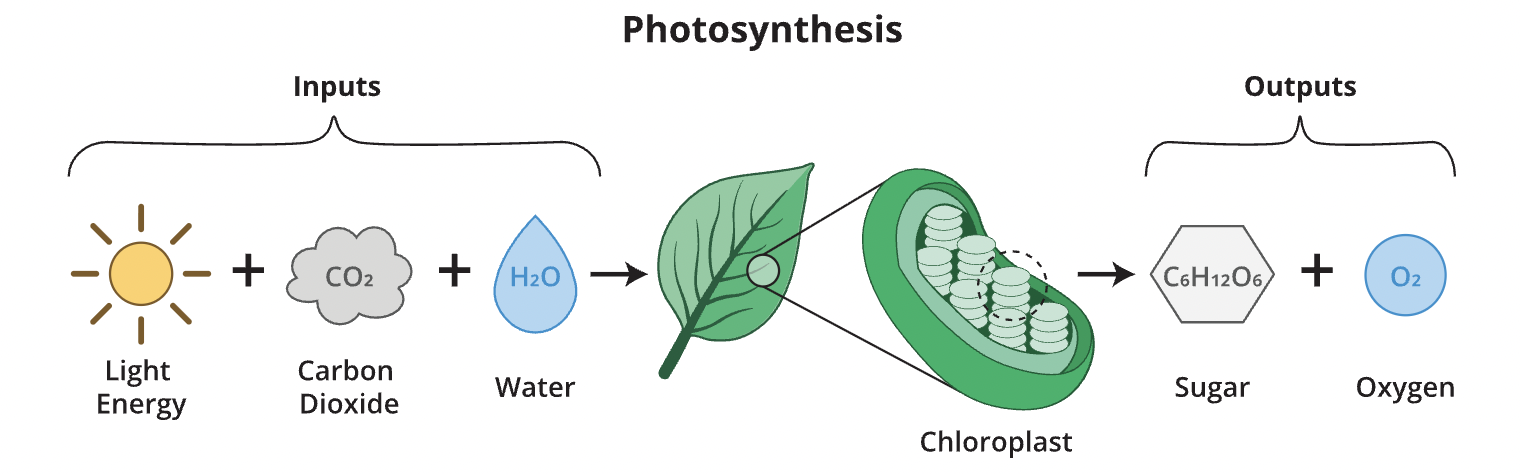
what is G3P used for
Produce glucose (C6H12O6) that can be
shipped all over the plant body
stored as starch
used by mitochondria to produce the energy in the form of ATP that is required to stay alive and grow
Furnish the building block materials required to synthesize the amino acids, nucleic acids, carbohydrates, and lipids needed to maintain the plant body and grow.
Cellular respiration
series of chemical reactions that break down glucose and oxygen to produce carbon dioxide, water, and usable cellular energy in the form of ATP (adenosine triphosphate) and heat
purpose:
break down the glucose and oxygen produced by photosynthesis to release usable chemical energy in the form of ATP for cellular work
Glucose formula
C6H12O6
plasticity
ability of the same genotype to produce different phenotypes in response to different environmental conditions
What 3 classes of material plants need to survive
Mineral nutrients such as nitrogen, potassium, phosphorus, calcium, magnesium and sulfur;
Water
Sugars
source
the place the substance comes from or originates
sink
location where a substance is used or stored
substance movement pattern in plants from sources to sinks
Mineral nutrients move from roots to shoots;
Water moves from roots to shoots;
During the growing season, sugars move from shoots to roots for immediate use by root cells or storage;
After a period of dormancy, meaning when growth stops and metabolism slows due to dry or cold conditions, sugars move from storage areas back to the shoot system.
how do nutrients in soil get into plant body
Direct acquisition via active transport (which requires energy) of nitrogen, phosphorus, and other mineral nutrients from soil to the interior of root cells.
Acquisition via barter—specifically, an exchange of sugars for mineral nutrients supplied by symbiotic fungi called mycorrhizae.
2 key observation of nutrient absorption by plants
Mineral nutrients are at much higher concentration inside the plant body than they are in the surrounding soils;
Most mineral nutrients are acquired as ions such as NO3- (nitrate), HPO42- (hydrogen phosphate), K+ (potassium ion), or Ca2+ (calcium ion) that dissolve in water due to their charge.
key points about travel of nutrients between roots and soil(charges and potential energy)
Key points:
There is a difference in overall charge between the outside and inside of most cell membranes;
A separation of charges creates a voltage;
A voltage is a form of potential energy;
Potential energy is defined as any form of energy that is based on position. In this case, the position is the location of positive and negative charges on ions located on either side of a phospholipid bilayer.
epidermal cells of plant roots
remember: cell membranes are batteries
epidermal cells of plant roots, and especially in root hairs, the battery is created by membrane proteins called proton pumps
proton pumps
actively transport H+ (hydrogen ions, or protons) out of the interior of the cell to the exterior
use ATP to create a separation of charge, and thus a voltage
Specifically, the inside of the cell becomes less positive and thus more negative than the outside
once a proton pump has established an electrical gradient, positive ions can enter the cell through specific membrane channels
in addition to containing many proton pumps, root hair membranes contain many ion channels for K+, Ca2+, Mg2+, and other key nutrients
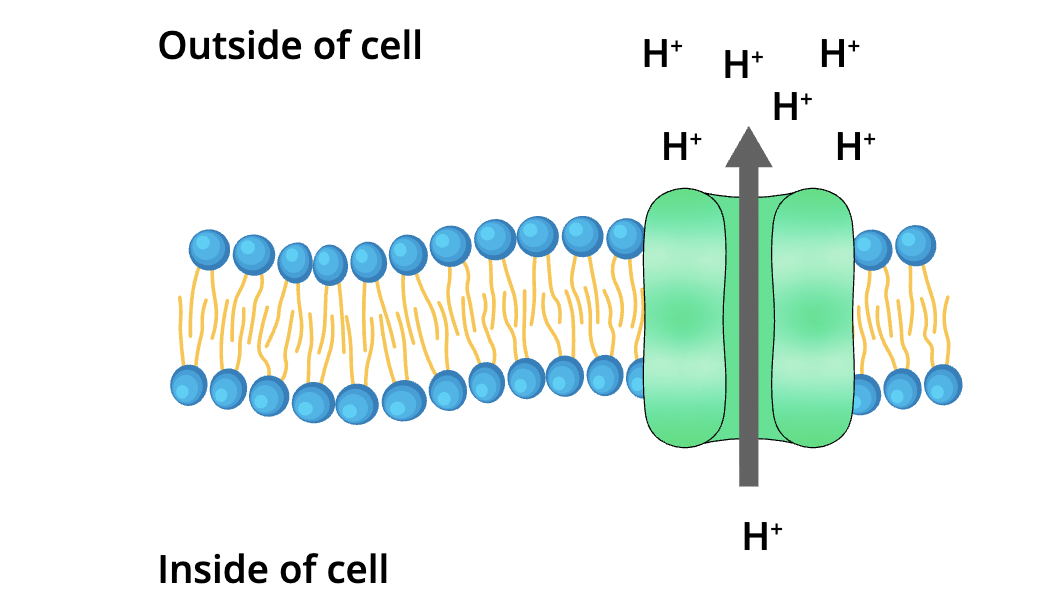
co-transport
occurs when a membrane protein transfers one substance across the lipid bilayer down its electrochemical gradient along with another substance that is moving against its electrochemical gradient
In effect, the electrochemical gradient favoring the entry of protons is so steep that the movement of a proton "pays the way" in terms of the overall energy change required for another ion to move against its electrical gradient

battering with mycorrhizal fungi
species that live in soil and interact with root systems of majority of plants
barter for nitrogen and phosphorus— highest demand in terms of fueling the plant's growth and reproduction
Fungal cells penetrate the root system itself and either grow between the cell walls of root cells or actually enter the cytoplasm of root cells
plant-fungal interface, sugars produced by photosynthesis flow from the plant to the fungus, while nitrogen, phosphorus, or other nutrients harvested from the soil by the fungus flow into the root cells
"Paying" Nitrogen-fixing Bacteria with Sugar
few plant lineages have evolved association with bacteria that that have the ability to fix nitrogen
Bacterial species that join this partnership have a sophisticated enzyme complex called nitrogenase; plants that join the partnership produce sugars that can be used to generate ATP in mitochondria and supply the energy needed
fixation
type of chemical reaction where the atoms in atmospheric nitrogen gas (N2) are converted into ammonia (NH3) or amino groups (-NH2), which are forms of nitrogen that organisms can use to make important biological molecules
reactions are extremely complex and energy-intensive
plant vascular system
plants don't expend any energy at all when water moves from roots to shoots. Not a single molecule of ATP is required. Water flows up passively
branches to form a continuous network that transports material to all parts of the plant
xylem
water-conducting tissue in plants
two major types of cells: tracheids and vessel elements

vessel elements
short, fat cells that stack end to end, with openings at the top and bottom of each cell that allow water to flow straight up as through a pipe
tracheids
long, thin cells that have numerous gaps in their cell walls where water flows from one to the next
cohesion-tension theory
1. Water reaches the leaf by traveling through the xylem.
2. Water evaporates from the leaf.
3. Evaporation creates a curved water surface, causing surface tension. As water evaporates, the remaining water forms tiny curved surfaces called menisci where water meets the air. This creates an uneven distribution of forces at the surface, producing surface tension.
4. The tension pulls on the water below due to cohesion. The water molecules in the xylem are strongly attracted to one another through hydrogen bonds. This attraction is called cohesion. Because the water molecules are connected to one another, the tension created by evaporation at the leaf can be transmitted down through the continuous column of water.
5. Water is pulled upward from the roots.
is water polar
water is polar (one side that holds a slight negative charge (the oxygen-containing side), and it has one side with a slight positive charge (the hydrogen-containing side)
difference in charge allows it to interact with other molecules through two main types of intermolecular forces (cohesion and adhesion)

cohesion
partially positive hydrogen of one water molecule interacts with the partially negative oxygen of another water molecule through the formation of a hydrogen bond
Adhesion
The water molecules attract to different kinds of molecules (not water) through this difference in charge
sugar transport
not a passive process
expend large amounts of ATP to transport the products of photosynthesis from leaves to meristematic tissues, where cell division and expansion is rapid, and to storage cells in roots
phloem
sugar-conducting tissue in the vascular system
found adjacent to xylem in the plant body and comprises two main types of cells: sieve elements and companion cells
highly branched network that extends throughout the plant body

sieve elements
stacked end-to-end and make direct connections with each other via open pores
stripped-down cells that often lack a nucleus or other organelles
get most or all of the proteins, ATP, and other molecules they need from companion cells
function as pipes that move the sugary solution called sap
companion cells
found alongside sieve elements
bulk flow
pressure-based movement
sugars move from areas of high pressure to low pressure
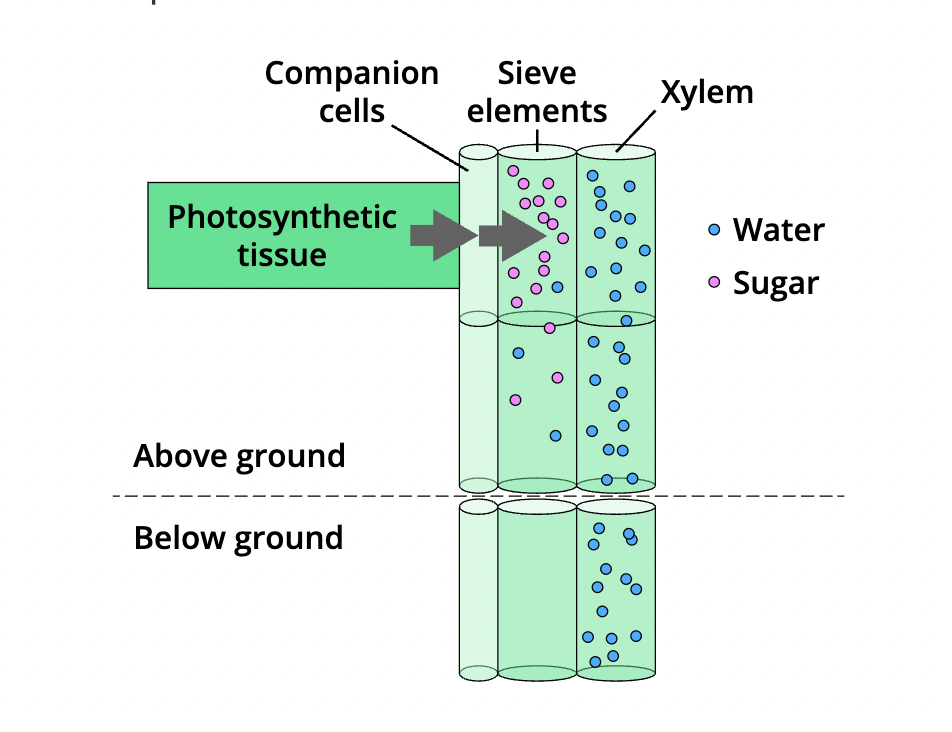
sugar movement in vascular system (pressure-flow hypothesis)
Sugars are actively loaded into phloem in leaves and stems where photosynthesis is occurring, leading to a high concentration of sugars near sources.
Near sources, water moves from xylem to phloem via osmosis. The influx of water builds up pressure in the phloem.
Sugary sap moves passively down its pressure gradient, from sources to sinks.
Sugars in phloem sap are actively transported from the phloem into root storage cells and other cells that act as sugar sinks. This "offloading" step keeps the concentration of sugars in the phloem near sink cells low, and thus maintains the pressure gradient that moves sap from sources to sinks.
pathogen
Any agent that causes disease—usually a fungus, virus, or bacterium.
dormancy
A period when growth is not occurring, usually because conditions are too dry or too cold to support photosynthesis.
proton pump (vocab)
A membrane transport protein that actively transfers protons against their electrochemical gradient.
co-transport (vocab)
Transport of two substances across a cell membrane by a membrane protein: one down its electrochemical gradient and one against its electrochemical gradient.
Cohesion-tension theory
Tension created by menisci in leaves and the cohesion of water molecules throughout the vascular system draws water passively from roots to replace water lost when stomata open.
Pressure-flow hypothesis
Movement of sugars from areas of high to low pressure, with high- and low-pressure areas in phloem created by the ATP-powered movement of solutes.