Orthodontic materials 1
 Call Kai
 Learn
 Practice Test
 Spaced Repetition
 Match
 Flashcards
 Knowt Play
1/48

There's no tags or description
Looks like no tags are added yet.
49 Terms
What are orthodontic materials/appliances used for?
Align teeth in their most aesthetic and functional positions
Moves teeth and affect growth in the maxilla and mandible

2 Types of appliances?
Removable and fixed
Removable appliances are used in what arch?
removable?
consist of 2 things
Used in the upper arch
Removed from the mouth by the patient for cleaning
Wires and acrylic base plate

Removable appliances can be what 2 categories in terms of what they do?
e.g P and A
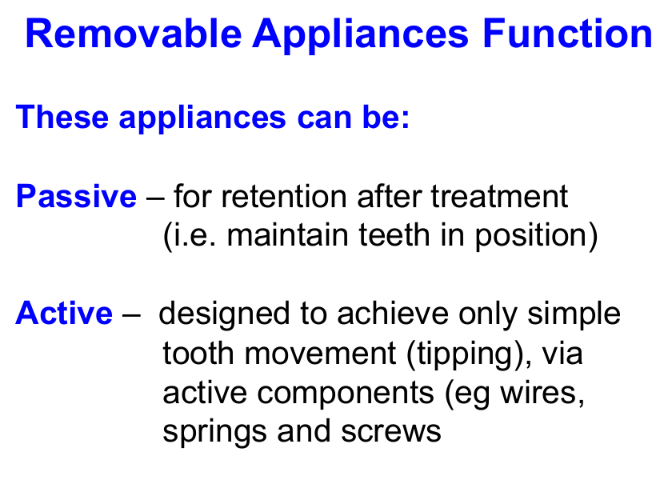
Passive: for retention after tx
Active: Designed to achieve only simple tooth movement via active components such as wires, springs and screws
Base plate:
Made of what - be specific - cure?
Primary function and other functions (4)
thickness?
Acrylic resin, room temp cured
Primary - incorporate all the components together as a functional unit
Provide support to wire components
Helps in anchoring appliance in place
helps in distributing forces over a larger area
1.5-2mm

In the production of acrylic base plates, what dental materials are involved? (3 main materials for each stage)
Impression materials
Gypsum products
Acrylic based materials

What material could be used but isn’t used and why?
Elastomer based impression materials can be used but these are more expensive
Precision is not a requirement
Alginates commonly used

What is the name of the gypsum product used to pour casts for appliance construction?
Orthodontic stone
Properties of orthodontic stone? (4)
Not as strong as dental stone - doesn’t need to be
Facilitates model trimming
Longer working time
Addition of whiteners to improve appearance of study models

Base plate construction:
after the stone sets what happens?
Separate the alginate from the mould
The bent wires are held in place by sticky wax
Separator applied to the gypsum model
Then acrylic (orthodontic resin) is applied incrementally on the gypsum model to build up the acrylic resin base until the desired thickness is reached
How is the acrylic dispensed? (2)
Powder and liquid system or in a gel form

The method of dispensing is based on what monomers and how are they cured
Powder and liquid: PMMA
UDMA presented as gel that is light cured (photocured)

Removal of excess resin is eaier in powder liquid form or gel form?
Excess resin is easily removed if a gel is used rather than P/L system
As the gel only cures when a light source (visible light) is directed on to it

Powder/liquid acrylic resins for base plate:
when powder and liquid are mixed, they are either x or x cured?
heat cured or self cured
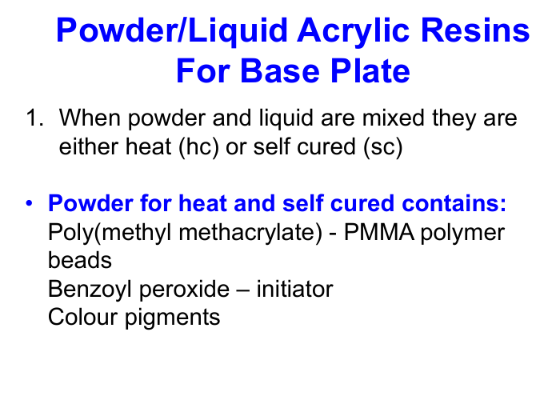
What is found in powder for heat and self cured resins? (3)
PMMA polymer beads
Benzoyl peroxide - initiator
Colour pigments
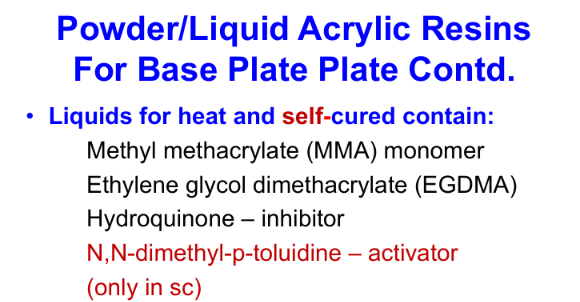
Liquid for heat and self-cured contains what? (4)
MMA
EGDMA
HQ - inhibitor
In self cure - activator - DMPT
P:L ratio, what happens to the polymer when mixed with the monomer?
2.5:1
Polymer beads dissolve in the monomer

What reaction occurs in both heat cured and self-cured?
Free radical polymerisation reactions
What components of the P:L are involved in the HC ?
Under what conditions?
cooling process and why?
MMA + BP + heat - to form HC PMMA
10 hours to cure in water bath
7 hours at 70 degrees and 3hrs at just below 100 degrees
slow cooling process
reduces stress?

What components of the P:L are involved in the SC ?
How long does it take?
MMA + BP + tertiary amine - self cured PMMA
20 minutes

MMA - PMMA

Gel for light cured contains what? (5)
UDMA
pigments
fillers
CQ
DMPT or DHPT

What is the reactions that occurs in light cured resins?
Free radical addition polymerisation
What components of the gel are involved in the LC?
How long does the presence of light?
UDMA + DMPT + CQ + visible light - light cured poly(UDMA)
5 minutes of visible light

ADV of heat cured compared with self cured orthodontic resins? (4)
More stronger/robust
Less porous
More resistant to abrasion
Contains less monomer
Adv of self cure compared to heat cured? (2)
Cheaper to produce
less technician time

DIS of:
heat cured
self cured:
HC: cost, technician time increased
More prone to water uptake, residual monomer may cause hypersensitivity

DIS of removable appliances? (5)
Pt can leave them out for long periods of times
Affect speech
Technician input required
Inefficient for multiple tooth movements
Lower removable appliances are more difficult to tolerate

What do fixed appliances in orthodontics consist of?
Arch wires attached to teeth by brackets and band and ligatures
Brackets and bands attached to teeth using cements

What are fixed orthodontic devices and what can they do (2)?
Attached to the teeth - cannot be removed by the patient
capable of causing precise tooth movements and multiple teeth movement in an arch
When might fixed appliances be used? (4)
Correct moderate skeletal discrepancies
closure of spaces
intrusion/extrusion
overbite reduction

Two types of components of fixed appliances?
active and passive compoenets
Name some active components? (4)
separators - metal or elastic
arch wires
elastics
springs
Passive components of fixed appliances? (4)
Brackets
Bands
Lock pins
Ligature wires
Other accessories

What is the definition of an elastomer?
A material that stretches easily to several times its length and returns to its original shape

What are the rubber bands used for?
forces from the bands?
Used to apply forces to teeth
Changed by the pt several times a day
the force of the rubber decays overtime

Elastic ligatures:
What are they for?
Small and used to secure the arch wire into the slots on the bracket
Stretched around wings of bracket
look liek small o rings
Uses of elastic ligatures?
Direct teeth in a particular direction-

Materials ligatures can be?
elastic or metal
2 groups of ligatures - not material?
Single elastic ligatures - variety of colours, size uniform - lose strength overtime
Connected elastic ligatures - power chains or c-chain ligatures - variety of colours and strengths
Used to close spaces between teeth, or move specific groups of teeth together at the same time

2 types of elastics? - materials
Latex elastics and synthetic elastics
What is the source and chemical name of latex elastics?
Poly cis-isoprene - natural rubber from trees
3 dis to latex elastics?
Oxygen atoms in the air can attach to the carbon atoms making them brittle and lose elasticity - antioxidants can be incorporated to prevent this from happening
Contact with oils and sunlight harms them
Patient may have latex allergy

what does oxygen attack in the poly-isoprene molecules?

What is the synthetic elastics made form?
polyurethane rubber
What linkage do they contain and what polymerisation is it - C or A?
C
urethane link
di-isocyanate NCO and polyether glycol

Synthetic rubber vs natural rubber?
greater resistance to heat, cold, withstand stresses, pressure and resist abrasion
Dis of synthetic rubber PU?
Tend to distort permanently with time in the mouth and lose elasticity
Chemical degradation with water - long term
Elastics and ligatures
the o rings are changed by the orthodontist
the rubber band - changed by pt multiple times a day
