Biology Chapter 10
 Call Kai
 Learn
 Practice Test
 Spaced Repetition
 Match
 Flashcards
 Knowt Play
1/77

There's no tags or description
Looks like no tags are added yet.
78 Terms
Mendel’s Law of Segregation
Mendel’s law stating that the two alleles of each gene are packaged into separate gametes. Applies to all diploid species.
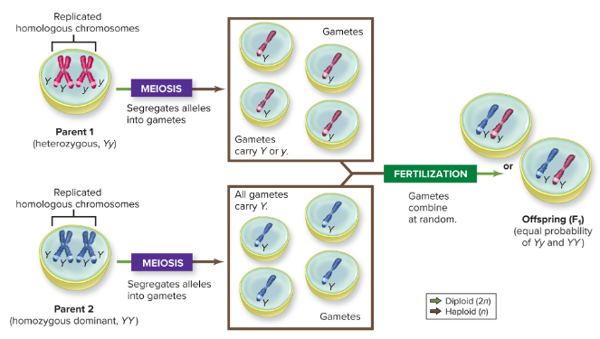
Mendel’s Law of Independent Assortment
Mendel’s law stating that during gamete formation, the segregation of the alleles for one gene does not influence the segregation of the alleles for another gene
The exception to Mendel’s Law of Independent Assortment
genes that have loci very close to one another on a chromosome tend to stay together during meiosis. If genes are present on the same chromosome are close together, they tend to be inherited together. In summary, linked genes are the exception.
Gene
sequence of DNA that encodes a specific protein or RNA molecule
Allele
one of two or more alternative forms of a gene. Different versions of a gene.
Diploid cell
a cell containing two full sets of chromosomes, one from each parent; also called 2n. Chromosomes are paired in diploid cells, making each chromosome a member of a homologous pair of chromosomes. Diploid cells have two alleles for each gene.
Haploid Cell
cell containing one set of chromosomes; also called n. Gametes in humans.
True-breeding
When an organism that is homozygous for one or more traits produces offspring identical to the parent for those traits upon self-fertilization.
Hybrid
When an organism that is heterozygous for one or more traits produces a mix of offspring with different variations of those traits upon self-fertilization (mixed genotypes and phenotypes).
Genotype
an individual’s combination of alleles for a particular gene. Written as a pair of letters representing the alleles for diploid organisms since they have two alleles per gene.
Phenotype
an observable characteristic of an organism. Most result from a complex interaction between genes and environment.
Homozygous
when an individual possesses two identical alleles for a particular gene. All homozygous plants are true-breeding because all of their gametes contain the same allele.
Heterozygous
when an individual possesses two different alleles for a particular gene. Heterozygous plants are not true-breeding because they may pass on either the dominant or the recessive allele.
Homozygous dominant
when an organism has two identical dominant alleles for a specific gene, one inherited from each parent. If both alleles are dominant. (Represented by two upper case letters)
Homozygous recessive
when an organism has two identical recessive alleles for a specific gene, one inherited from each parent. If both alleles are recessive. (Represented by two lowercase letters)
Self-fertilization
When the gametes that fuse, the egg and sperm, are from the same plant. Form of sexual reproduction. Less genetically diverse compared to cross-fertilization. When the sperm from the pollen from the male part of a plant fertilizes the egg in the female part of the same plant.
Cross-fertilization
When the gametes that fuse are not from the same plant, but are from plants of the same species. The sperm from one plant fertilizes the egg of another plant. More genetically diverse. Form of sexual reproduction.
P generation
the first generation in a genetic cross. The parents in this generation are true-breeding. The first set of individuals being mated. True-breeding (homozygous) parents.
F1 generation
the offspring of the P generation in a genetic cross.
F2 Generation
the offspring of the F1 generation in a genetic cross
Testcross (What is it and when is it used?)
A mating of an individual with a dominant phenotype of unknown genotype to a homozygous recessive individual to reveal the unknown genotype of an individual with a dominant phenotype, which is either homozygous dominant or heterozygous. The genotype of the unknown parent can be deduced from the ratio of phenotypes among the offspring.
Codominance
Mode of inheritance in which two different alleles are fully expressed in a heterozygote’s phenotype. Both alleles code for functional proteins.
Incomplete Dominance
Mode of inheritance in which a heterozygote’s phenotype is intermediate between the phenotypes of the two homozygotes
Pleiotropy
When a single gene affects multiple, seemingly unrelated phenotypes. Arises when one protein is important in different biochemical pathways or affects more than one body part or process. Multiple, seemingly unrelated phenotypic effects of one genotype.
Epistasis
Interaction in which one gene masks the phenotype associated with another gene. When one gene’s product influences the expression of another gene.
Multiple Allele Systems
genes with three or more alleles in a population. (Ex. ABO blood types).
Protein Interactions
When many proteins interact to contribute to one phenotype. Complicates the analysis of inheritance patterns because mutations in different genes can produce similar or identical phenotypes.
Linked genes
Genes on the same chromosome. The farther apart the two alleles of the linked genes on the same chromosome are, the more likely crossing over is to separate them. They do not assort independently during meiosis. So, when genes are linked, inheriting one allele influences the likelihood of inheriting a linked allele, making it the exception to Mendel’s Law of Independent Assortment.
Understand how to solve genetic problems that involve monohybrid and dihybrid crosses, codominance, incomplete dominance, and pleiotropy and how they determine probability
Practice problems from lab
Monohybrid cross
mating between two individuals that are heterozygous for the same gene. Genotypic ratio 1:2:1 (homozygous dominant: heterozygous; homozygous recessive). The phenotypic ratio is 3:1 (dominant: recessive).
Dihybrid Cross
mating between two individuals that are both heterozygous for same two genes. Phenotypic ratio 9:3:3:1 (dominant for both genes; dominant for gene 1 and recessive for gene 2; recessive for gene 1 and dominant for gene 2; recessive for both genes).
What do Punnett squares show?
They all show the probabilities that apply to each offspring. So, if one couple has four children, there will not necessarily be exactly one with FF, two with Ff, and one with ff.
Autosomal Dominant inheritance patterns
A dominant autosomal allele is expressed in homozygotes and heterozygotes. So, an autosomal condition is expressed whether a person inherits one or two copies of the associated allele.
Typically appears in every generation
Because the allele is dominant and located on an autosome, one or both of an affected individual’s biological parents must also have the condition/trait.
With one homozygous recessive and one heterozygous parent, children have a 50% chance of inheriting and displaying the trait.
Autosomal dominant
inheritance pattern of a dominant allele on an autosome
Autosomal dominant trait
condition caused by dominant allele on a nonsex chromosome; expressed if an individual inherits one or two copies of the allele.
Autosomal dominant disorders
Achondroplasia, Huntington’s disease, and Hutchinson-Gilford progeria. Marfan syndrome.
Autosomal Recessive Inheritance Patterns
Autosomal recessive alleles are expressed only in homozygotes. So, an autosomal recessive condition requires that a person inherit the associated allele from both parents.
Heterozygotes are carriers and do not have the trait
A child of two carriers has a 25% chance of expressing the trait.
Carriers have a 50% chance of passing the recessive allele to the next generation
May appear to skip generations
Autosomal recessive
inheritance pattern of a recessive allele on an autosome.
Autosomal recessive trait
condition caused by recessive allele on nonsex chromosome; expressed only if an individual inherits two copies of the allele.
Examples of Autosomal Recessive disorders
Albinism and Tay-Sachs disease
Characteristics of X-linked Recessive inheritance patterns
Traits associated with recessive alleles on the X chromosome appear more frequently in men than in women. So, more males than females have X-linked recessive genetic disorders.
Males have only one X chromosome and can express a single recessive allele. So, to express a recessive disorder, they only need to inherit one X-linked recessive allele.
A female heterozygote has two X chromosomes and may not show symptoms.
Females can be symptomless carriers if they only have one recessive allele; males cannot.
Females must receive a recessive allele on both X chromosomes to express an X-linked recessive disorder.
Males transmit an X only to their daughters, not to their sons
Characteristics of X-linked Dominant Inheritance patterns
Typically less severe in females than in males. May be lethal to males.
Has varying effects on girls depending on how many cells inactivate the X chromosome carrying the associated dominant allele. Ex., for a female who is heterozygous for an X-linked gene, she will express the dominant allele in only some of her cells. As a result, she experiences less severe symptoms than an affected male, who expresses the dominant allele in every cell.
Why do males and females express recessive X-linked alleles differently?
Each female has a pair of X chromosomes, whereas a male has only one X chromosome. Any trait a male has on his X chromosome will be expressed. Recessive alleles on an X chromosome of a female may be masked by dominant alleles on her other X chromosome.
Examples of X-linked dominant disorder
Rett Syndrome, extra hairiness, hypophosphatemic rickets, and retinitis pigmentosa
Examples of X-linked recessive disorders
Red-green color blindness, Duchenne muscular dystrophy, and Hemophilia A
Locus
the position of a gene on a chromosome. The physical location of a gene on a chromosome.
Wild-type
the most common allele, genotype, or phenotype
Mutant
an allele, genotype, or phenotype that is not the most common in a population or that has been altered from the “typical” (wild-type) condition. Arises when a gene undergoes a mutation.
Probability
a measure of the chance that a particular outcome will occur
Punnett Square
a grid used to calculate the probability of genotypes and phenotypes in offspring. (Be able to use one). Uses the parents' genotypes to show which alleles the offspring may inherit. Shows how the alleles in two parents’ gametes might combine at fertilization.
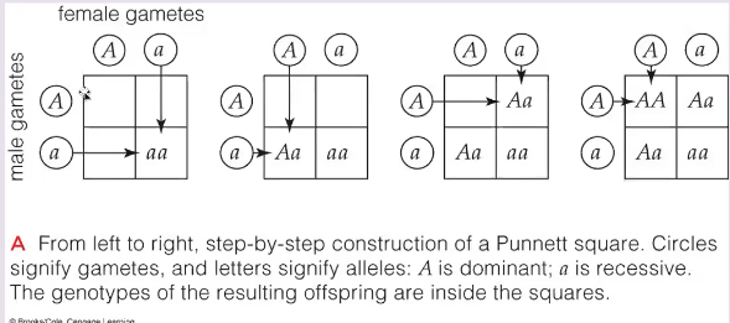
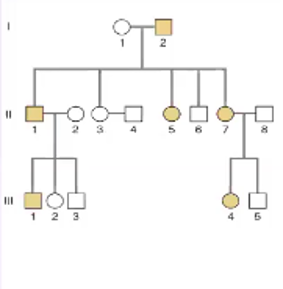
Pedigree
A diagram that depicts family relationships and phenotypes. Can be used to interpret autosomal dominant disorders and autosomal recessive disorders and to determine a disorder’s mode of inheritance.
Squares: males
Circles: females
Colored shapes: individuals with the condition.
Half-filled shapes: known carriers
Horizontal lines connect parents and siblings are connected to their parents by vertical lines and to each other by an elevated horizontal line.
Polygenic Trait
a phenotype that is affected by more than one gene.
Polygenic
caused by more than one gene; polygenic traits are typically expressed as a continuum of possible phenotypes
Chromosome
a molecule of DNA and its associated proteins. A continuous molecule of DNA wrapped around protein in the nucleus of a eukaryotic cell; also, the genetic material of a prokaryotic cell
Sex chromosome
a chromosome that carries genes that determine sex. Female has two X chromosomes and a male has one X and Y chromosome.
Autosomes
a nonsex chromosome. Numbered 1-22 in the human karyotype.
Human Karyotype
contains 22 homologous pairs of autosomes and one pair of sex chromosomes. So 23 pairs in total and 46 chromosomes in total.
Human genome
46 chromosomes, arranged in 23 pairs.
Homologous Pair
two chromosomes, one from each parent, that look alike and have the same sequence of genes. Are not identical and may carry different alleles. Each person inherits two alleles for each gene in the human genome.
Meiosis
a specialized form of cell division that occurs in diploid germ cells and gives rise to haploid gametes. Division of genetic material that halves the chromosome number and yields genetically variable nuclei
Gamete
a sex cell; sperm or egg cell. Are the cells that convey chromosomes from one generation to the next.
Fertilization
the union of two gametes. Unites the gametes from two parents, producing the first cell of the next generation.
Dominant Allele
allele that is expressed whenever it is present. Encodes a protein that exerts its effects whenever it is present. Represented by a capital letter. Encodes a functional protein.
Recessive Allele
allele whose expression is masked if a dominant allele is present. Encodes a protein whose effect is masked if a dominant allele is also present. Represented by a lowercase letter corresponding to the dominant allele’s capital letter. Typically encodes a nonfunctional protein.
Product Rule (make sure to know how to use this)
the chance of two independent events occurring equals the product of the individual chances of each event

Linkage Group
all of the genes on a single chromosome that tend to be inherited together because they are on the same chromosome. The number of linkage groups is equal to the number of homologous pairs of chromosomes
Crossing Over
exchange of genetic material between homologous chromosomes during prophase I of meiosis. May or may not occur between two linked genes. If this occurs between two alleles, some offspring will inherit recombinant chromatids; otherwise, offspring will inherit parental chromatids.
Parental Chromatid
chromatid containing genetic information from only one parent
Recombinant Chromatid
chromatid containing genetic information from both parents as a result of crossing over
Linkage Map
diagram of gene order and spacing on a chromosome, based on crossover frequencies
Recombinant Offspring
an individual that inherits a recombinant chromatid.
Sex-linked
describes genes or traits on the X or Y chromosome. Phenotypes that affect one sex more than the other are sex-linked.
Y-linked
describes traits controlled by genes on the Y chromosome. Scientists know very few Y-linked disorders; most involve defects in sperm production.
X-linked
describes traits controlled by genes on the X chromosome. Most human sex-linked traits are X-linked.
X-inactivation
turning off all but one X chromosome in each cell of a mammal (usually female) early in development. Each cell of a female mammal shuts off all but one X chromosome, preventing a “double dose” of every X-linked gene. This process happens early in embryonic development. Which X chromosome becomes inactivated is random. So, a female expresses the paternal X chromosome alleles in some cells and the maternal alleles in others.
Epigenetics
the study of changes in gene expression that do not involve changes in the DNA sequence
When do Punnett Squares and the Product Rule not work?
Punnett squares and the product rule assume two genes are sorting independently. Does not work if genes are linked, since inheriting one allele influences the likelihood of inheriting a linked allele.
Complete Dominance
one allele masks the expression of another in a heterozygote.