Chem chp 21
 Call Kai
 Learn
 Practice Test
 Spaced Repetition
 Match
 Flashcards
 Knowt Play
1/68

There's no tags or description
Looks like no tags are added yet.
69 Terms
study of reactions that involve changes in nuclear structure (proton/neutron transfer, not electron transfer)
nuclear chemistry
single type of nucleus
nuclide
Carbon-14
(element name-mass #)
Remember: atomic # always determines
The identity of atom/element!
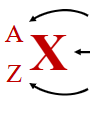
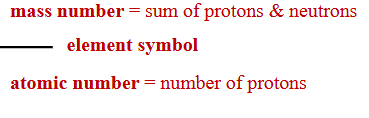
mass number =
sum of protons & neutrons
atomic number
number of protons
If a nucleus consists of protons and neutrons collectively called “nucleons”), what holds these together in close proximity (despite the positively charged protons that want to repel each other)
strong nuclear force
energy produced when atoms’ nucleons are bound together (or the energy required to break the nucleus into its constituent protons & neutrons)
nuclear binding energy
The difference in calculated mass and experimentally measured mass of helium-4
is called the mass defect. This lost mass is converted to energy as the atom forms.
What does it mean for a nucleus to be “stable
the nucleus can’t be transformed into something else without outside energy input
a 1:1 ratio of protons:neutrons generally gives a stable nucleus
Band of stability-For heavier nuclei,
more neutrons are needed than protons to compensate for increasing electrostatic repulsions (among the positively charged protons)
Band of stability-For lighter nuclei,
Nuclides change spontaneously (i.e. decay) into other nuclei that are either in or closer to the band of stability
Outside of band = unstable/radioactive
Note: After Bi (Z = 83), all isotopes with
greater atomic numbers are unstable.
Outside of band = unstable/radioactive
One unstable isotope (radioisotope) à different, more stable, isotope(s)
reactions that involve changes in nuclei atomic #, mass #, or energy states (These equations show nuclides with mass #s, atomic #s, and particles involved.)
nuclear reactions
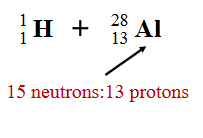
Balancing Nuclear Reactions *Remember:
Follow conservation laws!
Conservation laws - Sum of mass #s of reactants
sum of mass #s of products Mass #s & atomic #s must balance!
Conservation laws - Sum of charges of reactants
sum of charges of products Mass #s & atomic #s must balance!
the spontaneous change of an unstable nuclide into another
radioactive decay
Ernest Rutherford’s Experiment (to help determine the
nature of radioactive decay
Types of Radioactive Decay: Positron emission
emission of a positron (antimatter) from the nucleus (antimatter = particle with same mass but opposite state of another property of ordinary matter)
Types of Radioactive Decay: Electron capture
inner electron captured by the atom’s nucleus (inner shell valence electron combined with a proton to form a neutron & then an outer electron drops into the vacancy that was produced & emits energy, usually in the form of an X-ray
Types of Radioactive Decay: Alpha (𝜶) decay
loss of an ⍺-particle (helium-4 atom) from the nucleus (common in heavy nuclei, because daughter nuclide has larger neutron:proton ratio than parent nuclide)
Types of Radioactive Decay: Beta (𝜷) decay
emission of an e- from the nucleus (kind of like conversion of a neutron into a proton)
Types of Radioactive Decay: Gamma (𝜸) emission
when a nuclide in an excited state decays to ground state (release of a 𝛾-ray = quantum of high-energy electromagnetic radiation (no change in mass #; no change in atomic #)
Alpha (𝜶) decay

Beta (𝜷) decay

Gamma (𝜸) emission

Positron emission

Electron capture
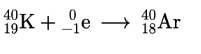
Heavy elements follow a
chain of successive disintegrations/decays
Recall that for first-order kinetics, molecules have consistent/constant half-lives (t1/2)
time required for half of atoms in a sample to disappear/decay
In the context of radioactive decay, the appropriate integrated rate law is especially useful for…Determining how long a useful
amount of the radioisotope will be available
In the context of radioactive decay, the appropriate integrated rate law is especially useful for Determining how long a dangerous isotope will stick around
(i.e. how many days do we need to store it until the radiation level is low enough to dispose of it safely?
Applications for Radioisotopes Radiometric
dating
An isotope is
elements with the same atomic number but different mass numbers
Applications for Radioisotopes Medicinal uses
pet scans radiation therapy cancer treatment
Applications for Radioisotopes Laboratory/
research uses
Applications for Radioisotopes Industrial uses
Sterilizing medical equipment Food irradiation for preservation x ray scanner TSA
Radioisotope Safety & Means of Detection Plexiglass preferred for
𝛽-emitters
Radioisotope Safety & Means of Detection 𝛼-particles are
usually not dangerous if outside the body
Means of Detection
(a) Geiger counter ionizing radiation
(b) Scintillation counter an instrument used to detect and measure ionizing radiation by observing flashes of light produced when radiation strikes a reactive material
(c) Dosimeter a portable device that measures and records an individual's or object's cumulative exposure to external ionizing radiation


Know the types of materials that can stop 𝛼,
paper
Know the types of materials that can stop beta
Metal
Know the types of materials that can stop neutron
water
Know the types of materials that can stop gamma rays
lead

Mass(es) of isotopes can replace concentrations here
May need to use t1/2 to find k and then the other eq. to find t
For any element other than hydrogen to exist, what repulsive forces must be overcome?
the repulsion between protons and other protons
If neutron:proton ratio is too low then how can it attain stability?
either electron capture or positron emission.
Which type of radiation has the greatest penetration ability?
gamma rays
Carbon-10 is unstable because it
has too few neutrons.
As the atomic number increases, the ratio of neutrons to protons in a nuclide
generally increases
All nuclides with Z >83
are unstable
If carbon-14 decays via emission of a beta-particle, this process can effectively be viewed as…
the change of a neutron into a proton.
Sum of protons and neutrons
mass number
The plot of number neutrons vs number of protons for stable nuclei reveals that stable isotopes
fall into a narrow band this region is called band of stability
The straight line on a n:p ratio graph reveals
1:1 ratio of n:p
Unstable nuclei are indicated in green
Stable nuclides are blue
Nuclei to the left or right of the band of stability are unstable and
exhibit radioactivity. They change spontaneously (decay) into other nuclei that are either closer to the band of stability