Organic Chem
 Call Kai
 Learn
Learn Practice Test
 Spaced Repetition
 Match
Match Flashcards
 Knowt Play
1/55

There's no tags or description
Looks like no tags are added yet.
Name | Mastery | Learn | Test | Matching | Spaced | Call with Kai | Chat |
|---|
No analytics yet
Send a link to your students to track their progress
56 Terms
nucleus of an atom
contains protons and nuetrons
ion
something that has electrical charge
atomic number (Z)
number of protons
mass number (A)
number of protons and nuetrons
valence electrons
electrons in the outer most shell (participate in bonding)
molecule
collection of atoms that are attached by chemical bonds
chemical bond
2 positively charged core atoms mutually attached to the negative charged electrons that are shared between them
checklist for a legitimate lewis structure
must show the correct number of total valence electrons, the sum of valence electrons around each hydrogen must be 2, the sum of valence electrons around each C, N, O, or F must be 8 (octet rule)
formal charge
formula: group # - # of lines - # of dots (helps draw diagrams, does not equal to actual charge)
oxygen formal charge pattern
normally makes 2 bonds and 2 lone pairs
formal charge without formula
more bonds than expected = more positive, fewer bonds than expected = more negative, carbon is the exception to the rule
X
placeholder for halogens (F, Cl, Br, I)
R
placeholder for Hydrogen or an alkyl group (molecule made only of carbon and hydrogen)
Z
placeholder for any atom or group of atoms
What is the formal charge of any nitrogen with four bonds?
positive
What is the formal charge of any nitrogen with three bonds?
neutral
What is the formal charge of any nitrogen with two bonds?
negative
What is the formal charge of any oxygen with three bonds?
positive
What is the formal charge of any oxygen with two bonds?
neutral
What is the formal charge of any oxygen with one bond?
negative
What is the formal charge of any halogen (X) with two bonds?
positive
What is the formal charge of any halogen (X) with one bond?
nuetral
What is the formal charge of any halogen (X) with zero bonds?
negative
What is the formal charge of any carbon with only three bonds?
positive
What is the formal charge of any carbon with four bonds?
neutral
What is the formal charge of any carbon with three bonds and a lone pair?
negative
Valence Shell Electron Pair Repulsion Theory (VSEPR)
electron domains repel each other and electrons around a central atom will orient themselves to minimize the electron-electron repulsion between the domains.
bond angle with two electron domains
180 degrees (BeH2, O2N+, CO2, HCN)
bond angle with three electron domains
120 degrees (BH3, H3C+, CH2, H2CO)
bond angle with four electron domains
109.5 degrees (CH4, NH3, H2O, H4N+)
Bond Angle
angle defined by any three atoms in a molecule
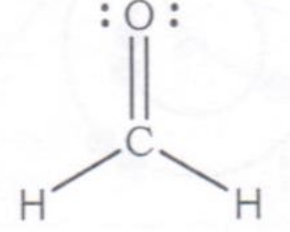
Both the HCH and HCO bond angles of H2CO (formaldehyde) are very close to 120°, but one is slightly smaller than the other. Predict which is smaller, and explain your reasoning
HCH bond angle is smaller because the greater electron density in the double bond of the HCO angle creates stronger repulsion against nearby bonds
what are the 5 molecular shapes
linear, bent, trigonal planar, pyramidal, tetrahedral

what molecular shape is this?
bent
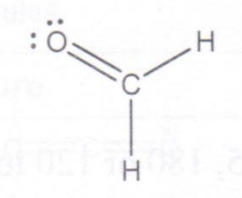
what molecular shape is this?
trigonal planar (3 electron domains, no lone pair, it is flat)

what molecular shape is this?
pyramidal (4 electron domains, 3 bonds, 1 lone pair)
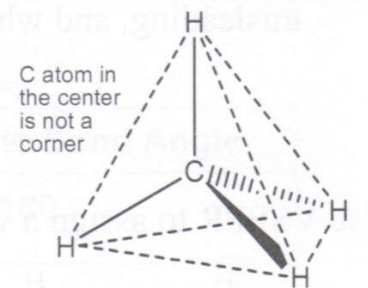
what molecular shape is this?
tetrahedral (4 electron domains, 4 bonds, no lone pair)

what molecular shape is this?
linear (2 electron domains)
A student makes the following statement: "The shape of water is tetrahedral because the four electron pairs about oxygen are approximately 109.5° apart and point to the corners of a tetrahedron." What misconception does this statement convey?
confuses electron pair geometry with the actual molecular shape.
orbital
the 3d region of space where the electron cloud is likely to be found
electron cloud
a mist of negative charge concentrated in a region of space (like in a bond between two atoms)
how can orbitals be filled?
Each orbital can be empty (zero e-), half filled (one e-), or full (two e-)
What is the maximum number of electrons that can fit in a single orbital (2s, 2px , 2py , or 2pz )?
2 electrons
which is lower in potential energy, an electron in a 2s orbital or in any of the three 2p orbitals?
An electron in a 2s orbital is lower in potential energy than an electron in any of the three 2p orbitals because the territory of an s orbital is closer to the nucleus than that of a p orbital in the same shell
how is a covalent bond formed?
by an overlap of orbitals
what are the two types of orbitals
Head to head overlaps called sigma bonds and side to side overlaps called pi bonds
single bond type
one sigma bond
double bond type
one sigma bond and one pi bond
triple bond type
one sigma bond and 2 pi bonds
hybridization
involves combining s and p orbitals to form an equal number of new orbitals that are averages of the originals
sp3 hybrid orbital angle
109.5 degrees
sp2 hybrid orbital angle
120 degrees
why can single bonds can rotate freely but double bonds cannot?
the pi portion of a double bond prevents the bond axis from rotating
sp hybrid orbital angle
180 degrees
what molecular shapes does sp3 hybridized produce?
tetrahedral, pyramidal, bent 109
what molecular shapes does sp2 hybridized produce?
trigonal planar, bent 120