Week 11: Memory
 Call Kai
 Learn
 Practice Test
 Spaced Repetition
 Match
 Flashcards
 Knowt Play
1/70

There's no tags or description
Looks like no tags are added yet.
71 Terms
What is Working memory?
Temporarily holding and manipulating information in your mind.
ex. Mentally multiplying two numbers.
What is Episodic memory?
Remembering personal experiences that happened at a particular time and place
ex. Remembering what you did two days ago.
What is Semantic memory?
Relatively permanent knowledge of facts, concepts, and meanings.
ex. Knowing that the human body has 206 bones.
What is Collective memory?
Memories, stories, and historical experiences shared among members of a group.
ex. A town remembering its traditions and historical events.
What is Autobiographical/individual memory?
is the ability to remember personal events and experiences from your own life.
Collective vs. individual memories
Collective memories are shared within families, communities, or cultures rather than belonging to only one person.
What are the three stages of learning and remembering?
Stage 1: Encoding - Learning information
Stage 2: Storage - Maintaining information
Stage 3: Retrieval - Accessing information
What is Encoding?
The process of perceiving and initially learning new information
What does selective encoding mean?
We pay attention to certain information while ignoring other details
What does prolific encoding mean?
We are continuously encoding information from our experiences.
• Information must be encoded to be remembered later.
What is distinctiveness in encoding?
Unusual events are more memorable because they stand out from similar experiences.
ex. Seeing a giraffe while walking across campus would likely be more memorable than an ordinary walk.
What is flashbulb memory?
A vivid memory of learning important, emotionally significant news.
• Often remembered with strong confidence and apparent detail
ex. Remembering exactly where you were, who you were with, and what you were doing when you first heard about the September 11, 2001 attacks.
What is storage?
Maintaining information: Information is retained over time through changes in the nervous system.
What is consolidation in the storage stage?
The process of stabilizing and strengthening memories through neural changes after learning, allowing them to be stored long-term.
Ex: After studying for an exam, your brain consolidates the information during sleep, helping you remember it the next day.
What is Engram (memory trace) in the storage stage?
Engram (memory trace): A physical change in the nervous system representing an experience.
Ex: When you learn how to ride a bike, learning produces changes in the neural circuits involved in that skill. These changes contribute to the memory traces that help you perform the skill again.
What is retention intervals in the storage of information?
Retention interval: The time between learning information and attempting to remember it.
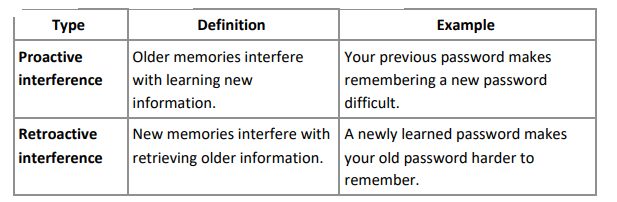
What is the difference between proactive and retroactive interference?
Proactive interference: Old information interferes with learning new information (e.g., your first language interferes with learning a second language).
Retroactive interference: New information interferes with remembering old information (e.g., a new phone number makes it harder to recall your old one).
Proactive = old affects new.
Retroactive = new affects old.
What is the Retrieval stage?
Accessing information: The process of bringing previously stored information back to mind.
• Information may be stored but temporarily inaccessible because effective retrieval cues are missing.
What is the difference between available and accessible information in retrieval?
Available: Information that is stored in memory.
Accessible: Information that can actually be retrieved at a particular moment.
Example: You cannot remember someone's name until you hear a familiar clue.
What’s the difference between recall and recognition for retrieving information?
Recall: Producing information from memory without being shown the answer (e.g., short-answer questions).
Recognition: Identifying previously learned information when presented with options (e.g., multiple-choice questions).
How does meaningful processing improve encoding?
By focusing on understanding the meaning of new information and connecting it to existing knowledge, creating stronger associations that improve later retrieval.
How does Elaboration / associations improve encoding?
By connecting new information to existing knowledge or experiences, creating meaningful associations that strengthen memory and provide retrieval cues for easier recall.
How does mental imagery improve encoding?
Create vivid pictures representing what you want to remember.
How does distinctiveness improve encoding?
By making information unusual or different from other experiences, allowing it to stand out and become more memorable.
How does Recoding improve encoding?
By converting information into a more meaningful or memorable form, making it easier to store and retrieve later.
Example: Using the acronym ROY G BIV to remember the colours of the rainbow.
How does using mnemonic devices improve encoding?
Using specific memory techniques to create memorable associations and retrieval cues.
• Recoding is useful but can accidentally introduce false details.
Difference between encoding and using mnemonic devices
Recoding focuses on changing how information is represented, while mnemonic devices focus on using organized memory aids to improve encoding and retrieval.
What is the DRM effect (Deese–Roediger–McDermott effect)? and how is it related to false memories?
Participants study a list of related words, such as door, glass, pane, and curtain.
• They may falsely recall the word window, even though it was never presented.
• Demonstrates that associations created during encoding can produce false memories.
What are pragmatic inferences, and how can they lead to memory errors?
Pragmatic inferences occur when people assume an implied meaning and later remember that assumption as if it were explicitly stated.
Example: You hear, “The student studied all night for the exam,” but later remember being told, “The student was exhausted.”
What is a retrieval cue?
A retrieval cue is a hint or stimulus that helps access stored information.
successful retrieval depends on having effective retrieval cues
What is the encoding specificity principle, and how does it improve retrieval?
Retrieval is more effective when cues or environmental conditions match those present during encoding, helping trigger the original memory.
Example: Hearing a familiar song reminds you of a party where you first heard it.
What is the cue overload principle, and how does it affect retrieval?
A retrieval cue becomes less effective when associated with too many memories, causing competition during recall.
Distinctive cues improve retrieval by pointing to fewer memories.
Example: Remembering the only picture among 99 words is easy, but becomes harder when many pictures are included because the cue is less distinctive.
What is the retrieval practice (testing) effect, and how does it improve memory?
Actively recalling previously learned information strengthens memory and makes it easier to retrieve again.
Example: Using practice quizzes or flashcards instead of only rereading notes.
What is retrieval-induced forgetting?
Retrieving one memory can make related, unpractised information harder to recall because competing memories may become inhibited.
Example: Repeatedly recalling one vocabulary word may make it harder to remember other related words.
How do organized mnemonic cues improve memory, and what is the peg word technique?
Mnemonic cues improve encoding and retrieval by associating new information with familiar, memorable cues.
Peg word technique: Uses memorized rhyming words (e.g., "one is gun," "two is shoe") linked to vivid mental images to help recall information in a specific order.
What is the method of loci (memory palace) and how does it work?
A mnemonic technique that involves mentally placing information in familiar physical locations and mentally travelling through those locations to retrieve it.
Choose a familiar location (e.g., your home).
Establish a mental route through specific locations.
Associate each item with a vivid or unusual image at one location.
Mentally follow the route to retrieve the information in order.
Why is the method of loci effective for encoding information?
Distinctiveness: Vivid, unusual images make information stand out.
Strong associations: New information is linked to familiar locations, making it more memorable.
Why is the method of loci effective for retrieving information?
Familiar locations: Provide reliable retrieval cues.
Encoding specificity: The same locations used during encoding trigger retrieval.
Reduced cue overload: Distinct locations provide separate cues, reducing competition between memories.
Organized retrieval: A familiar route allows information to be recalled systematically and in order.
What is eyewitness testimony, and why can it be unreliable?
Eyewitness testimony occurs when someone witnesses a crime, accident, or other legally significant event and later recalls its details in court. It can be unreliable because memories may change or become distorted over time.
What is the misinformation effect in eyewitness testimony?
When incorrect information received after an event alters a witness's memory of what happened.
How do leading questions affect eyewitness memory?
Questions that suggest specific details can influence or distort what a witness remembers.
Example: Asking "Did you see the broken headlight?" implies that a headlight was broken.
What is co-witness contamination?
When discussing an event with other witnesses introduces incorrect details into someone's memory, potentially altering their recollection.
What is mistaken identification in eyewitness testimony?
When a witness incorrectly identifies an innocent person as the perpetrator or fails to recognize the actual perpetrator.
What are false memories?
Memories of details or entire events that never actually occurred, often influenced by suggestion or misinformation.
What are schema-based memory errors?
When existing expectations about how situations normally occur influence or distort what someone remembers.
Example: Remembering bookshelves in a room because you were told it was a library, even if no bookshelves were present.
What is the misinformation effect, and how does it affect eyewitness memory?
A memory error caused by exposure to incorrect information after an event but before recall. Misleading questions, conversations, or interviews can distort memories or introduce details that never occurred.
Example: A witness sees a stop sign but later incorrectly remembers a yield sign after being asked about one.
What is a photo spread in eyewitness identification?
A collection of photographs presented to a witness to help identify the perpetrator of a crime.
What are foils (fillers) in an eyewitness lineup?
Individuals included in a lineup who are not the police suspect. They provide alternative choices during identification.
What are mock witnesses?
Research participants who act as eyewitnesses in experimental studies to investigate memory accuracy and identification errors.
What is the difference between target-present and target-absent lineups, and what identification errors can occur?
Target-present: The actual perpetrator is included. Errors occur when a witness selects an innocent filler or fails to identify the perpetrator.
Target-absent: The actual perpetrator is not included. An error occurs when a witness incorrectly identifies an innocent person instead of selecting no one.
What factors increase the likelihood of eyewitness identification errors?
Poor lighting or viewing conditions.
High levels of stress.
Limited time to observe the perpetrator.
Long delays between witnessing and identification.
Cross-race identification (identifying someone of a different race).
How can the justice system reduce eyewitness identification errors?
Fair lineups: All individuals match the description; no one stands out.
Double-blind lineups: Neither the witness nor administrator knows the suspect.
Unbiased instructions: Avoid implying the perpetrator must be present.
Sequential lineups: Present individuals one at a time.
Education: Teach jurors about eyewitness memory limitations.
What is the tip-of-the-tongue (TOT) effect?
The temporary inability to retrieve familiar information despite knowing it is stored in memory.
Example: Recognizing someone's face but being unable to remember their name.
What are schemata, and how can they cause memory errors?
Schemata are mental templates formed through repeated experiences that help us understand familiar situations efficiently. However, they can distort memories when expectations replace actual details.
Example: Remembering bookshelves in a library even if they were not present.
What is memory contamination, and what can cause it?
Memory contamination occurs when information encountered after an event alters someone's original memory.
Causes:
Leading questions: Suggest details that may not have occurred.
Co-witness discussions: Other witnesses influence your recollection.
False feedback: Incorrect information presented as credible changes what you believe happened.
Example: Remembering details of an accident that you only heard from another witness.
Studies and their findings

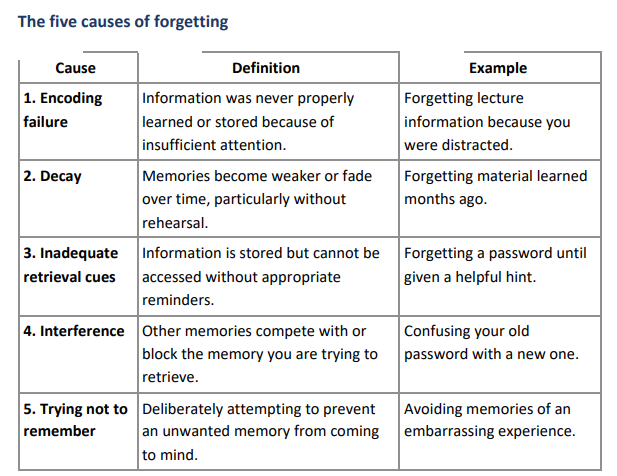
What is forgetting?
The inability to remember previously encountered information. Forgetting may occur because information was never properly learned, has faded, or cannot be retrieved.
What are the five reasons we forget?
What is encoding failure?
• Occurs when information is not successfully encoded into memory.
• Commonly results from distraction or insufficient attention.
• Information that was never encoded cannot be retrieved later.
Example: You use a keyboard every day, but when asked to draw the exact arrangement of its keys from memory, you struggle because you never paid close attention to their positions.
What is decay theory, and how does it explain forgetting?
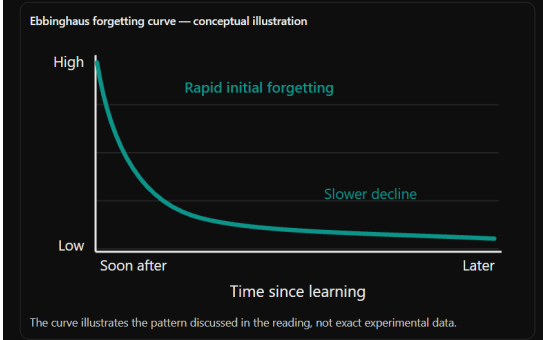
Decay theory suggests that memories weaken or fade over time, especially without rehearsal or reactivation. Forgetting is typically greatest shortly after learning and slows over time.
Example — Ebbinghaus (1885): Memorized meaningless syllables and found that forgetting occurred most rapidly soon after learning.

What is the limitation of decay theory, and how does consolidation affect memory?
Researchers cannot always determine whether a memory has truly faded or is simply temporarily inaccessible.
The process of stabilizing memory traces for long-term storage. New experiences can disrupt consolidation, causing recently learned information to be forgotten.
How do inadequate retrieval cues cause forgetting?
Information may still be stored in memory but temporarily inaccessible without appropriate retrieval cues (reminders).
ex. Participants struggled to recall former classmates' names but could recognize names and faces when given appropriate cues.
How can deliberately trying not to remember cause forgetting?
People may intentionally suppress unwanted memories or replace them with other thoughts, making those memories harder to retrieve over time.
What is adaptive forgetting, and why is it beneficial?
Adaptive forgetting is the process of forgetting irrelevant or unnecessary information, allowing memory to function more efficiently.
It helps prevent information overload and allows us to focus on important, relevant memories.
What are the four main benefits of adaptive forgetting?
Reduces information overload: Prevents unnecessary details from overwhelming memory.
Improves efficiency: Prioritizes relevant information.
Reduces competition: Prevents irrelevant memories from interfering with retrieval.
Supports decision-making: Helps us focus on current information rather than outdated experiences.
ex. Remembering where you parked today is easier when you aren't distracted by every parking spot you've used in the past.
What is the difference between declarative and procedural memory?
Declarative memory: Conscious memory for facts and events
Procedural memory: Memory for learned skills and actions
What is amnesia?
Amnesia: A profound impairment in memory that is distinct from ordinary forgetting.
Damage to the medial temporal lobes, including the hippocampus and surrounding cortex, can cause serious memory impairments.

Explain the three types of amnesia
Anterograde amnesia: Inability to form new long-term declarative memories after the onset of amnesia
Unable to remember conversations occurring after brain surgery..
Retrograde amnesia: Inability to retrieve memories formed before the onset of amnesia.
Unable to remember events from the years before brain surgery.
Temporally graded retrograde amnesia: Recent memories from before the onset are more affected, while older memories are preserved.
Remembering childhood but not events shortly before surgery.

What is memory consolidation?
Memory consolidation is the process of stabilizing newly formed memories into more durable, long-term storage.
New declarative memories initially depend on the hippocampus.
Over time, memories consolidate in the cortex, becoming less dependent on the hippocampus.
What is the difference between organic and dissociative (functional) amnesia?
Organic amnesia: Memory loss caused by identifiable brain damage or neurological disease. Can affect new and old memories and may be permanent.
Dissociative amnesia: Loss of autobiographical memories without identifiable brain damage. Often associated with trauma and less likely to be permanent.
What is dissociative fugue?
An extreme form of dissociative amnesia involving loss of autobiographical memories and personal identity, sometimes accompanied by unexpected travel or wandering.
Important: The causes and interpretation of dissociative amnesia remain scientifically controversial.