Unit 5: Roaring 20s and The Great Depression
 Call Kai
 Learn
 Practice Test
 Spaced Repetition
 Match
 Flashcards
 Knowt Play
1/47

There's no tags or description
Looks like no tags are added yet.
48 Terms
Henry Ford
1863-1947. American businessman, founder of Ford Motor Company, father of modern assembly lines, and inventor credited with 161 patents.

Mass Production
Process of making large quantities of a product quickly and cheaply

Model T
first affordable car built by Henry Ford; sturdy, reliable, inexpensive, only came in black

Assembly Line
In a factory, an arrangement where a product is moved from worker to worker, with each person performing a single task in the making of the product.

Consumer Revolution
flood of new, affordable goods in the decades after World War I

Installment Buying
A consumers buys products by promising to pay small, regular amounts over a period of time

Bull Market
A period of increased stock trading and rising stock prices

Bear Market
A steady drop in the stock market over a period of time

Buying on the Margin
the purchasing of stocks by paying only a small percentage of the price and borrowing the rest

Herbert Hoover
Republican candidate who assumed the presidency in March 1929 promising the American people prosperity and attempted to first deal with the Depression by trying to restore public faith in the community.

Teapot Dome Scandal
A government scandal involving a former United States Navy oil reserve in Wyoming that was secretly leased to a private oil company in 1921 -- corruption by a Harding cabinet member, who took bribes to allow oil drilling on public lands

Calvin Coolidge
Became president when Harding died of pneumonia. He was known for practicing a rigid economy in money and words, and acquired the name "Silent Cal" for being so soft-spoken. He was a true republican and industrialist. Believed in the government supporting big business.

Washington Naval Disarmament Conference
meeting held in 1921 and 1922 where world leaders agreed to limit construction of warships

Kellogg-Briand Pact (1928)
a multi-nation treaty, sponsored by American and French leaders, that outlawed war.

Dawes Plan
Installment payment plan for Germany, a way to help them pay reparations

Modernism
A cultural movement embracing human empowerment and rejecting traditionalism as outdated. Rationality, industry, and technology were cornerstones of progress and human achievement.

Fundamentalism
Literal interpretation and strict adherence to basic principles of a religion (or a religious branch, denomination, or sect).

Scopes Trial
1925 trial of a Tennessee schoolteacher for teaching Darwin's theory of evolution

Quota System
An arrangement placing a limit on the number of immigrants from each country

Ku Klux Klan
founded in the 1860s in the south; meant to control newly freed slaves through threats and violence; other targets: Catholics, Jews, immigrants and others thought to be un-American

Prohibition
the period from 1920 to 1933 when the sale of alcoholic beverages was prohibited in the United States by a constitutional amendment

18th Amendment (1919)
Prohibited the manufacture, sale, and distribution of alcoholic beverages

Volstead Act (1919)
The adoption of the prohibition amendment, which banned the sale of alcohol, led to this act.

Bootlegger
someone who makes or sells illegal liquor

Charlie Chaplin
popular silent film star and comedian

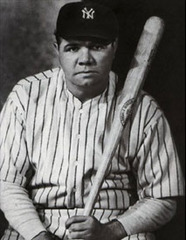
Babe Ruth
"Home Run King" in baseball, provided an idol for young people and a figurehead for America
Charles Lindbergh
United States aviator who in 1927 made the first solo nonstop flight across the Atlantic Ocean (1902-1974)

Flapper
Young women of the 1920s that behaved and dressed in a radical fashion such as bobbed hair, short dresses who smoked and drank.

Lost Generation
Group of writers in 1920s who shared the belief that they were lost in a greedy, materialistic world that lacked moral values and often choose to flee to Europe

F. Scott Fitzgerald
wrote The Great Gatsby - From Minnesota

Ernest Hemingway
Lost Generation writer, spent much of his life in France, Spain, and Cuba during WWI, notable works include A Farewell to Arms

Marcus Garvey
African American leader durin the 1920s who founded the Universal Negro Improvement Association and advocated mass migration of African Americans back to Africa. Was deported to Jamaica in 1927.

Jazz
a style of music characterized by the use of improvisation became popular in the 1920s

Louis Armstrong
Leading African American jazz musician during the Harlem Renaissance; he was a talented trumpeter whose style influenced many later musicians.

Bessie Smith
Empress of the Blues - African American blues singer who played and important role in the Harlem Renaissance.

Harlem Renaissance
A period in the 1920s when African-American achievements in art and music and literature flourished

Langston Hughes
This man was well known for making the Harlem Renaissance famous because of his poems.

Zora Neale Hurston
African American writer and folklore scholar who played a key role in the Harlem Renaissance

Speculation
the practice of making high-risk investments with borrowed money in hopes of getting a big return

Black Tuesday
October 29, 1929; date of the worst stock-market crash in American history and beginning of the Great Depression.

The Great Depression
the economic crisis beginning with the stock market crash in 1929 and continuing through the 1930s

Breadline
line of people waiting for food handouts from charities or public agencies like bread during the Great Depression

Hoovervilles
Depression shantytowns, named after the president whom many blamed for their financial distress

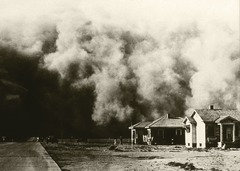
Dust Bowl
Region of the Great Plains that experienced a drought in 1930 lasting for a decade, leaving many farmers without work or substantial wages.
Okies
Displaced farm families from the Oklahoma dust bowl who migrated to California during the 1930s in search of jobs.

Trickle Down Economics
Hoover's strategy battling the Great Depression in which the money is given to the big corporations and eventually they will pay their workers more, and then the workers will spend their money and save the economy.

Hoover Dam
Dam on the Colorado River that was built during the Great Depression

Bonus Army
Group of WWI vets. that marched to D.C. in 1932 to demand the immediate payment of their government war bonuses in cash
