Diet Disease Relationships
 Call Kai
 Learn
 Practice Test
 Spaced Repetition
 Match
 Flashcards
 Knowt Play
1/45

There's no tags or description
Looks like no tags are added yet.
46 Terms
What is noise when it comes to nutrition research?
vibration or fluctuation in the data that interferes with our ability to perceive the signal

What is signal when it comes to nutrition research?
relationship between a dietary exposure and a health outcome
What are three assessment methods for dietary data?
food records
24 hr recalls
food frequency questionnaires
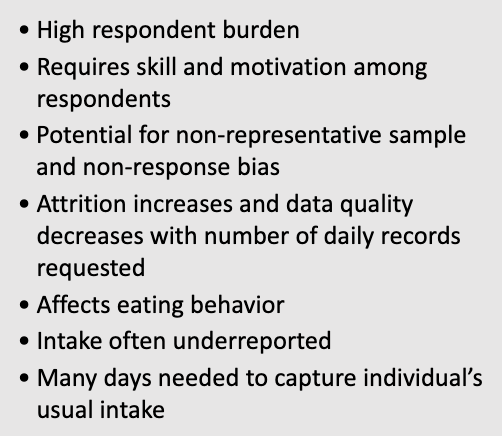
What are some characteristics associated with food records.

What are some advantages of food records (6)?

What are some disadvantages of food records (7)?
What are some characteristics of 24-hr dietary recalls?

What are some advantages of 24-hr recalls? (6)

What are some disadvantages of 24-hr recalls? (3)

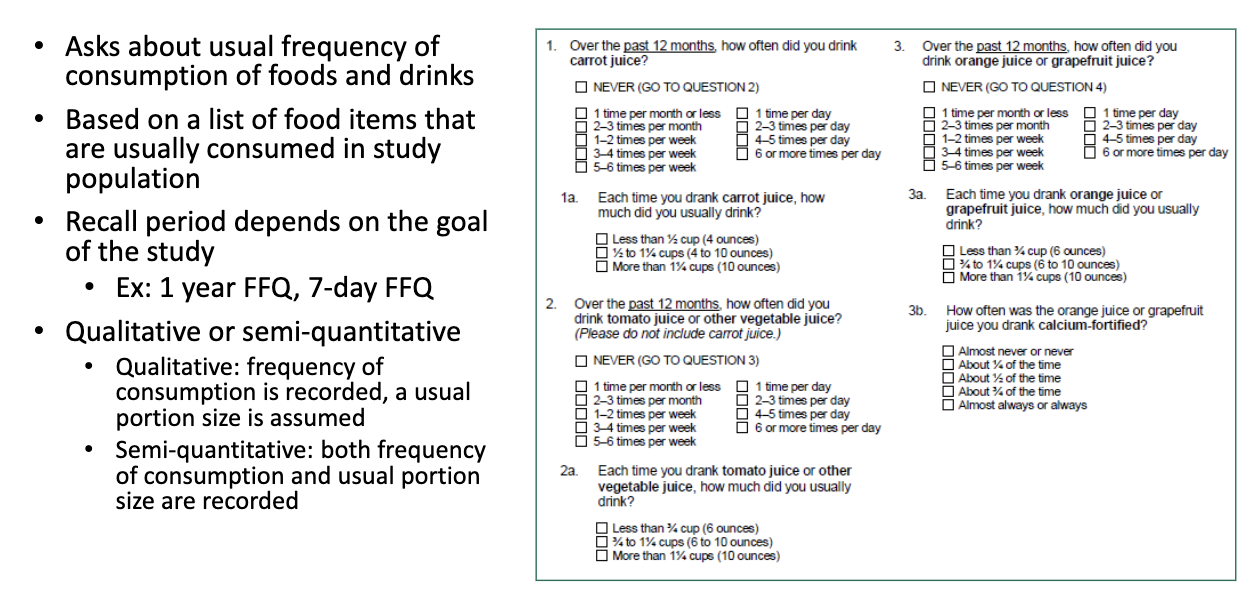
Characteristics associated with food frequency questionnaires (FFQ).
Advantages of FFQs (7)
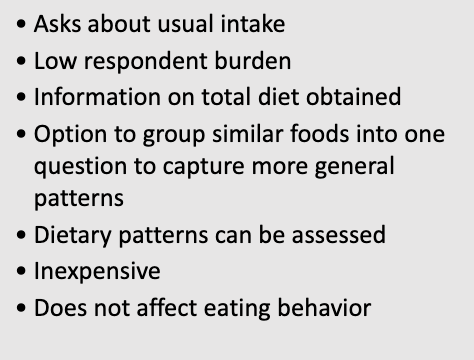
Disadvantages of FFQs. (5)

What are the trade-offs in terms of the different dietary assessment methods?

24 hr more common bc they are the in-between
What are new technologies in terms of dietary assessment?
food record apps
automated cameras
incorporation of AI (could help predict food ID and portion size from image, but requires population specific training datasets)
What are three different types of measurement errors that can occur in dietary data assessment?
omission (leaving something out)
estimation of quantities
bias
In what cases can we see omission in dietary data?
missed foods or details in food records
forgotten foods in 24 hr or FFQ
addition of habitual or desirable foods also possible
In what cases can we see estimation of quantities errors in dietary data?
portion sizes in 24 hr or FFQ
frequencies in FFQ
In what cases can we see measurement bias in dietary data?
altered eating patterns in food records
misreporting in 24 hr or FFQ
What types of noise is present within diet data (3)?
systemic error/bias
random error
correlations among aspects of diet or between diet and lifestyle
What is systemic error?
consistent under or over estimation of intakes

What are three different types of biases in dietary assessment?
social desirability bias
recall bias
flat-slope syndrome
What occurs as a result of social desirability bias?
overestimate of “good foods” and underestimate of “bad foods”
What occurs as a result of recall bias?
cases in a case/control study recall their food intake differently than controls bc of the knowledge of their disease status
related but different from recall error (errors of omission or addition due to misremembering)
What occurs as a result of flat slop syndrome?
overestimate foods consumed rarely, underestimate foods consumed frequently
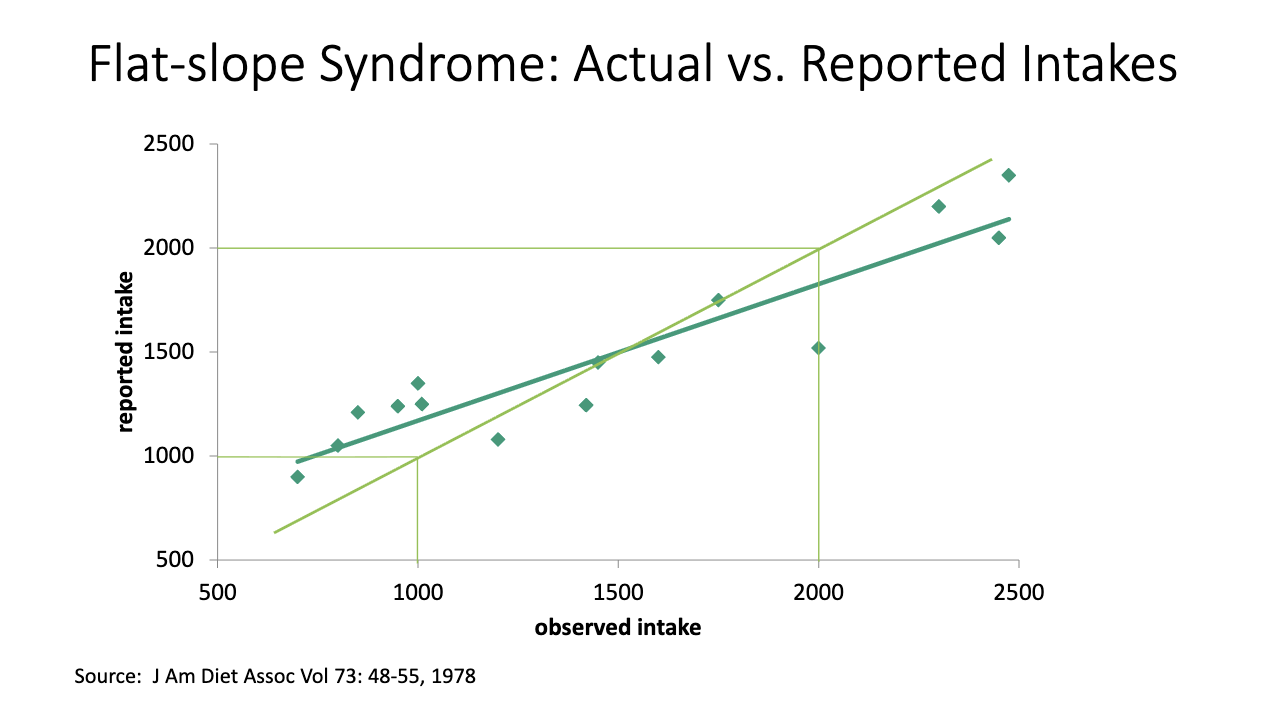
lighter green = truth
darker green = what was reported
Do dietary assessments on average under or overestimate intake?
dietary assessments on average tend to underestimate intakes
results of biomarker validation studies show that 0 to > 30% underestimate energy intake
vias varies by study population , respondent characteristics
Describe the relationship of RCTs with bias. (2)

Describe the relationship of observational studies with bias. (2)

What is the difference between systemic and random error?

scattered around the mean/truth, doesn’t move the mean.
random error is a mis-estimation of intakes scattered evenly above and below true values
measurement error, variation in nutrient contents of foods, day-to-day variability in diet can contribute to random error
In dietary assessments, why is there variation in nutrient content of foods?

How does day-to-day variability in a diet contribute to random error?

can have different average consumptions amongst people but on day to day there can be overlap amongst the individuals depending on the day
What are other noisy issues?

diet data is noisy, we need to strengthen the signal
What are the three components that go into intake variance?
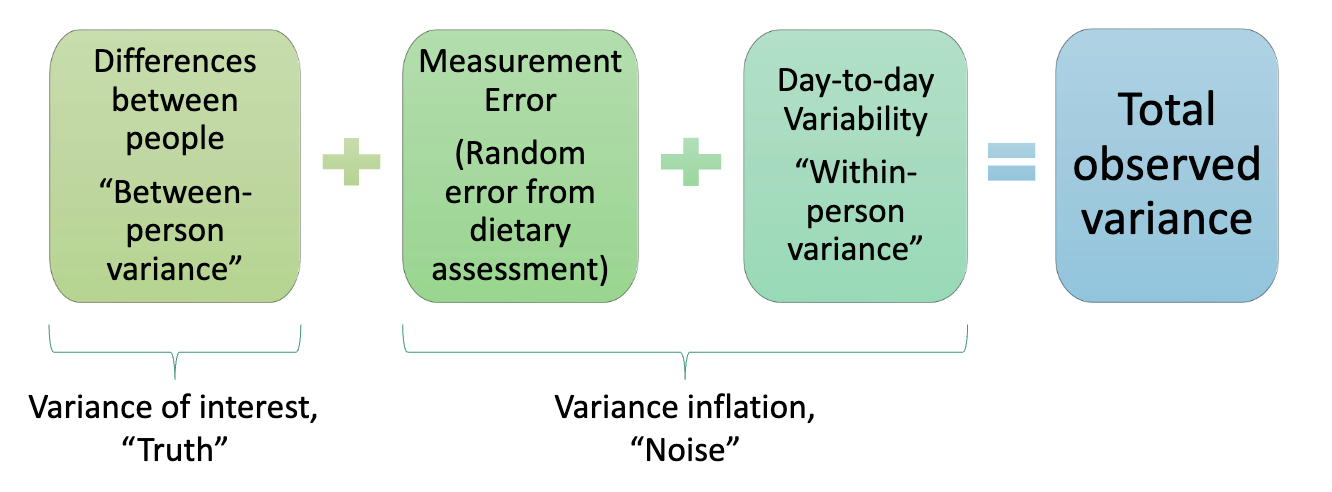

What is the problem with random error if the mean is still the same? (3)
the larger variance leads to wider confidence intervals and less statistical power to detect a difference between groups

odds ratio and RR estimates will often be biased towards the null
regression coefficients will often be biased towards the null (will be stretched and lead to less association as the conclusion)
overall biased towards the null


What happens to OR when we have systemic misclassification?
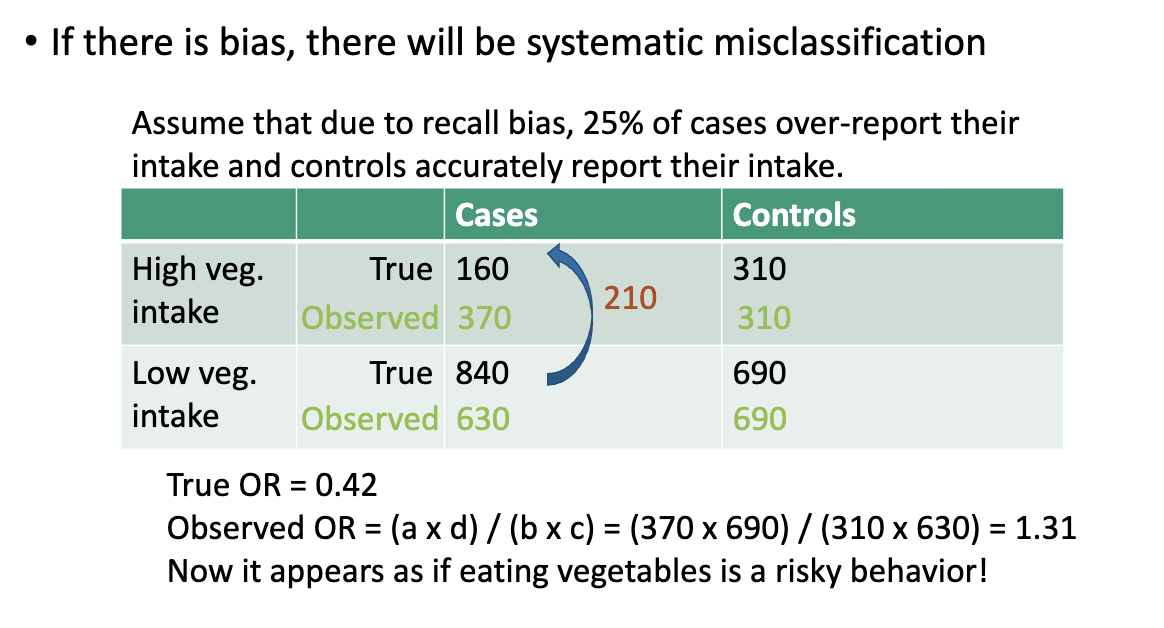
What happens to OR when you have both systemic bias and random error?

synergistic effect
estimate is even farther from the truth
What are two things you need to ask in order to evaluate dietary assessment tools?

What are three ways to validate nutrient intake estimates?

there are still sources of error that can reside in these measures
What are two examples of nutrient intake biomarkers ?
skin carotenoids via “veggie meter” as a measure of fruit and vegetable intake
doubly labeled water estimate of energy expenditure
What are some sources of error that could occur in biomarker measurements?
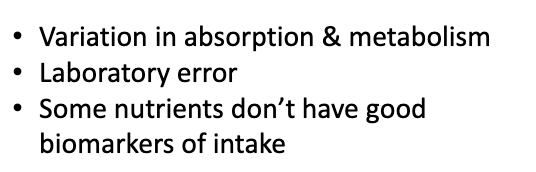
What are some sources of error that could occur in FFQs?

What are some sources of error that could occur in repeated weighed food records?

What are some reasons as to why nutrient biomarkers do not correlated strongly with dietary data?

How do you reduce random error in 24 hr recalls?
repeat 24 hr recalls over multiple days
in general repeat measures to estimate each indvidual’s usual intake
When looking at group level intake, how do we improve precision in dietary data?

When looking at individual level intake, how do we improve precision in dietary data?


What are two ways to strengthen the signal?
statistical modeling methods that account for day today variability using repeat assessments among sub-sample
study design and analyses that account for covariation